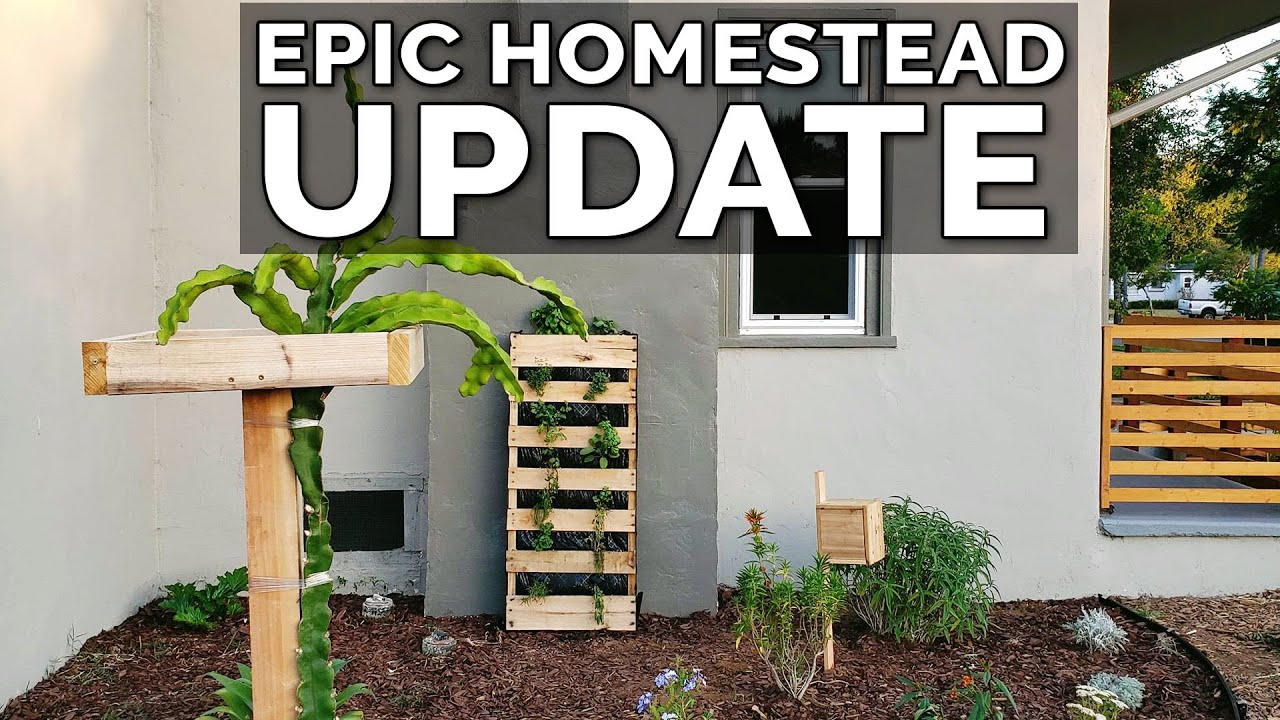
Epic Urban Homestead Tour 1 Month Update
video description
Date: 2022-07-18
Related videos


Comments and reviews: 15
Katie
Very cool. It all makes me really look forward to when I can finally own a house instead of rent: )
If you're wary of building a shed because of lack of experience, sheds are actually a really great first project for someone with a little DIY experience but not a whole lot - which from all the things you've done I think you should have the confidence if you do want to do it yourself. Now if it's simply a time thing and you have the money to spend on someone else doing it, then that's a different story: ) Given that the major issue in California is earthquakes, you might want a framed base instead of a concrete one. It looks like SoCal sheds does mostly framed bases, which have more movement which will make them better for the shifting of an earthquake (even a little one) therefore less likely to crack and be easier to repair if damage is done. I think it's also significantly less expensive. If you are going to go the concrete route you could also consider a concrete/plaster structure which will actually help keep the insides cooler. So many choices: ) But mostly I wanted to put a you can do it comment out there if you were just needing that extra boost of confidence on the shedfront
You mentioned a well, which would be awesome if you can manage it, although I understand it can be time consuming and difficult to establish one and in SoCal you might have to dig deep. I think your local planning office (dept of public works) might have more information on what is and isn't required as well as watershed information which will tell you if it's worthwhile for you to try for a well. It might be something because of fault lines that has to be done by a contractor. Then you should get the water tested and possibly put in filtration depending on its contents, because even if it's not for drinking it can have harmful levels of minerals/heavy metals.
For irrigation since it looks like you have solid concrete/plaster walls what you might want to do is see if you can tap into the main water line or main line in the house and run a pipe to a central location where you could dig a reservoir (you don't have to dig the reservoir but it's an option. Then you can run subsequent lines and have as many taps as you need from that reservoir - it can also collect rain water as need be - or pipe. That way you won't have as much alteration needed to the house, which it looks like you have plaster outside so that's not as easy to add taps to, and you'll have better flow at your outlying irrigation positions.
reply
Very cool. It all makes me really look forward to when I can finally own a house instead of rent: )
If you're wary of building a shed because of lack of experience, sheds are actually a really great first project for someone with a little DIY experience but not a whole lot - which from all the things you've done I think you should have the confidence if you do want to do it yourself. Now if it's simply a time thing and you have the money to spend on someone else doing it, then that's a different story: ) Given that the major issue in California is earthquakes, you might want a framed base instead of a concrete one. It looks like SoCal sheds does mostly framed bases, which have more movement which will make them better for the shifting of an earthquake (even a little one) therefore less likely to crack and be easier to repair if damage is done. I think it's also significantly less expensive. If you are going to go the concrete route you could also consider a concrete/plaster structure which will actually help keep the insides cooler. So many choices: ) But mostly I wanted to put a you can do it comment out there if you were just needing that extra boost of confidence on the shedfront
You mentioned a well, which would be awesome if you can manage it, although I understand it can be time consuming and difficult to establish one and in SoCal you might have to dig deep. I think your local planning office (dept of public works) might have more information on what is and isn't required as well as watershed information which will tell you if it's worthwhile for you to try for a well. It might be something because of fault lines that has to be done by a contractor. Then you should get the water tested and possibly put in filtration depending on its contents, because even if it's not for drinking it can have harmful levels of minerals/heavy metals.
For irrigation since it looks like you have solid concrete/plaster walls what you might want to do is see if you can tap into the main water line or main line in the house and run a pipe to a central location where you could dig a reservoir (you don't have to dig the reservoir but it's an option. Then you can run subsequent lines and have as many taps as you need from that reservoir - it can also collect rain water as need be - or pipe. That way you won't have as much alteration needed to the house, which it looks like you have plaster outside so that's not as easy to add taps to, and you'll have better flow at your outlying irrigation positions.
reply
Lindsey
I like seeing how your ideas evolve on the new homestead. Have you considered permaculture? I just read Gaia's Garden by Toby Hemenway and he offers some ideas that I think you would find interesting. You can probably find his book at your local library. Something else you may not be aware of: there are businesses that will drop off truckloads of mulch (sometimes compost) at your house. My mother used to get a truckload of mulch dumped in our driveway every spring/summer. She would then wheelbarrow it to where it was needed in the yard over the course of several weeks as she had time. You may find a truckload of mulch is a more economical option for you than plastic bags. Another thought: you can often search around for businesses who are getting rid of things you can use and take their waste for use in your garden. Coffee grounds from coffee shops is one that many gardeners know about. I happen to work in a chemistry laboratory and we toss mountains of cardboard and shredded paper every week. Our production facility often has heat treated wood pallets and pharmaceutical grade steel drums in the back alley to be tossed. Ask around for what you need and you'll be surprised what people are throwing away!
reply
I like seeing how your ideas evolve on the new homestead. Have you considered permaculture? I just read Gaia's Garden by Toby Hemenway and he offers some ideas that I think you would find interesting. You can probably find his book at your local library. Something else you may not be aware of: there are businesses that will drop off truckloads of mulch (sometimes compost) at your house. My mother used to get a truckload of mulch dumped in our driveway every spring/summer. She would then wheelbarrow it to where it was needed in the yard over the course of several weeks as she had time. You may find a truckload of mulch is a more economical option for you than plastic bags. Another thought: you can often search around for businesses who are getting rid of things you can use and take their waste for use in your garden. Coffee grounds from coffee shops is one that many gardeners know about. I happen to work in a chemistry laboratory and we toss mountains of cardboard and shredded paper every week. Our production facility often has heat treated wood pallets and pharmaceutical grade steel drums in the back alley to be tossed. Ask around for what you need and you'll be surprised what people are throwing away!
reply
Edemamee
I wanted to turn my boulevard into pollinator garden. The soil was hard as rock. It was exhausting to try & remove the grass. Search online for alternative way to remove it & came across the 'lasagna method'. best thing ever! So I got huge size recycle cardboard from local bike shop, BAGS of free coffee grounds from Starbucks, grass clippings, hay, leaves, any organic material I can find to layered over grass. Soaked it really well. I kept it moist so the material can break down in hot July weather. Then in Fall, since the soil has broken down a bit. I planted some spring bulbs. In Spring, got to enjoyed spring flowers popping up. Once it warmed up. I add few pollinator plants & threw random bee & butterfly seed packets. It's been 4 yrs & the soil is so rich. I don't do anything beside cleaning the area in spring time. It full of native & pollinating plants. I love it!
I thought I'd shared what I did. the lasagna method does take time. Not recommended if you want an instant garden. It more for preping soil in the following year or maybe sooner if you live in warm state. But you can always give it a try. It sooooooo easy!
reply
I wanted to turn my boulevard into pollinator garden. The soil was hard as rock. It was exhausting to try & remove the grass. Search online for alternative way to remove it & came across the 'lasagna method'. best thing ever! So I got huge size recycle cardboard from local bike shop, BAGS of free coffee grounds from Starbucks, grass clippings, hay, leaves, any organic material I can find to layered over grass. Soaked it really well. I kept it moist so the material can break down in hot July weather. Then in Fall, since the soil has broken down a bit. I planted some spring bulbs. In Spring, got to enjoyed spring flowers popping up. Once it warmed up. I add few pollinator plants & threw random bee & butterfly seed packets. It's been 4 yrs & the soil is so rich. I don't do anything beside cleaning the area in spring time. It full of native & pollinating plants. I love it!
I thought I'd shared what I did. the lasagna method does take time. Not recommended if you want an instant garden. It more for preping soil in the following year or maybe sooner if you live in warm state. But you can always give it a try. It sooooooo easy!
reply
bigweirdchick
I can tell you from experience that when you start smothering the weeds with cardboard that it needs to be layered down thick! I'm talking 3 layers of cardboard and 5 inches of mulch thick or your just gonna find yourself doing it all over again in less than a year. With as much ground as you have to cover that would be a huge pain to do all over again. Just make sure that the cardboard is 1 to 2 feet away from any plants or the roots will suffocate. Grocery stores are the best place to get tones of free boxes. I can also tell you that worms love it! I can dig anywhere I have mulched using cardboard and there are loads of them!
reply
I can tell you from experience that when you start smothering the weeds with cardboard that it needs to be layered down thick! I'm talking 3 layers of cardboard and 5 inches of mulch thick or your just gonna find yourself doing it all over again in less than a year. With as much ground as you have to cover that would be a huge pain to do all over again. Just make sure that the cardboard is 1 to 2 feet away from any plants or the roots will suffocate. Grocery stores are the best place to get tones of free boxes. I can also tell you that worms love it! I can dig anywhere I have mulched using cardboard and there are loads of them!
reply
Anne
Regarding your hard soil and possible use of cover crops: I am in a similar situation and am only doing no-dig/till. It's amazing how scientific research has led to the discovery of certain crops loosening up the soil and suppressing weeds within one growing season. For example Rodale Institute has an online article CHOOSING THE BEST COVER CROPS FOR YOUR ORGANIC NO-TILL VEGETABLE SYSTEM published in 2008. Also, The Maine Potato Lady has cover crop info. For example, check out the crop Deep Till Radish on that site. You can let the crop do the work for you until you are ready for that area!
reply
Regarding your hard soil and possible use of cover crops: I am in a similar situation and am only doing no-dig/till. It's amazing how scientific research has led to the discovery of certain crops loosening up the soil and suppressing weeds within one growing season. For example Rodale Institute has an online article CHOOSING THE BEST COVER CROPS FOR YOUR ORGANIC NO-TILL VEGETABLE SYSTEM published in 2008. Also, The Maine Potato Lady has cover crop info. For example, check out the crop Deep Till Radish on that site. You can let the crop do the work for you until you are ready for that area!
reply
Janine
Hi Kevin, Regarding your skunk problem. Go to the dollar tree store, in the pet section they have balls that are similar to tennis balls. Get a total of 6 balls and also pick up a jug or two of ammonia. Put the balls in a bucket. pour in the ammonia, then place something on top to keep the balls submerged. Let them soak for about ten hours. Remove the balls and secure a long piece of twine around each one. Hang this balls at different lengths in the garden. Skunks do not like the smell of ammonia. Best of luck. Take care.
reply
Hi Kevin, Regarding your skunk problem. Go to the dollar tree store, in the pet section they have balls that are similar to tennis balls. Get a total of 6 balls and also pick up a jug or two of ammonia. Put the balls in a bucket. pour in the ammonia, then place something on top to keep the balls submerged. Let them soak for about ten hours. Remove the balls and secure a long piece of twine around each one. Hang this balls at different lengths in the garden. Skunks do not like the smell of ammonia. Best of luck. Take care.
reply
Diana
Having a well saved my mom's plants back when she still had a yard (she moved into an apartment a few years ago. For us, most of the issue was that city water use for lawns was put on an every other day schedule during drought season. With how hot it got, that would have meant very dead gardens. Because of the layout of her sections, she was able to have a sprinkler system installed that ran off of the well, and then programmed the timer to reflect each zone of her garden and how much water each needed.
reply
Having a well saved my mom's plants back when she still had a yard (she moved into an apartment a few years ago. For us, most of the issue was that city water use for lawns was put on an every other day schedule during drought season. With how hot it got, that would have meant very dead gardens. Because of the layout of her sections, she was able to have a sprinkler system installed that ran off of the well, and then programmed the timer to reflect each zone of her garden and how much water each needed.
reply
Chickadee
Temporarily you can go to Home Depot or another Big Box store and get a hose bib with 4 spigots that you simply screw onto the one that is there. Then perhaps put manual timers on each of them. That well you spoke of could cost you $12, 000+ to dig. You'd be better off harvesting from the roof into rain barrels and also keeping an empty pitcher to catch the sink faucet water. If you let it sit overnight, the chlorine will dissipate and you can water your plants with it.
reply
Temporarily you can go to Home Depot or another Big Box store and get a hose bib with 4 spigots that you simply screw onto the one that is there. Then perhaps put manual timers on each of them. That well you spoke of could cost you $12, 000+ to dig. You'd be better off harvesting from the roof into rain barrels and also keeping an empty pitcher to catch the sink faucet water. If you let it sit overnight, the chlorine will dissipate and you can water your plants with it.
reply
Ardith
Boy, the gophers would take over this lovely bed and start eating the roots of these plants in nothing flat! I always use a hefty wire mesh on the bottom of my raised beds that those gophers cant eat thru. - then add my soil!
I did not have gophers for the fiRst 9 yeasts in my garden, and then they moved in, and were eating EVERYTHING I tried to grow!
Even if you dont have gophers now, planning ahead saves a LOT of effort to rectify a problem
reply
Boy, the gophers would take over this lovely bed and start eating the roots of these plants in nothing flat! I always use a hefty wire mesh on the bottom of my raised beds that those gophers cant eat thru. - then add my soil!
I did not have gophers for the fiRst 9 yeasts in my garden, and then they moved in, and were eating EVERYTHING I tried to grow!
Even if you dont have gophers now, planning ahead saves a LOT of effort to rectify a problem
reply
Chris
For the Luffa, put it in the ground, and use 16x4 cattle panels to trellis it. It grows insanely well in California, especially in the hotter and drier areas. It's in and of itself a huge attractant to pollinators, with copious large yellow flowers. It's not going to perform well in a tiny pot, I guarantee you, but in the ground, it'll easily vine just as much as a morning glory if not more, and will produce dozens of softball bat sized gourds.
reply
For the Luffa, put it in the ground, and use 16x4 cattle panels to trellis it. It grows insanely well in California, especially in the hotter and drier areas. It's in and of itself a huge attractant to pollinators, with copious large yellow flowers. It's not going to perform well in a tiny pot, I guarantee you, but in the ground, it'll easily vine just as much as a morning glory if not more, and will produce dozens of softball bat sized gourds.
reply
Vestalia
Plant your fruit trees before your start working too much on your vegetable garden because most fruit trees take years before they start fruiting plus you can vegetable garden in between your planted fruit trees in the mean time. I have 2. 5 acre mini farm and although my trees are finally fruiting I wish I had focused on that sooner and first before worrying about sheds and garden beds.
reply
Plant your fruit trees before your start working too much on your vegetable garden because most fruit trees take years before they start fruiting plus you can vegetable garden in between your planted fruit trees in the mean time. I have 2. 5 acre mini farm and although my trees are finally fruiting I wish I had focused on that sooner and first before worrying about sheds and garden beds.
reply
Caroline
Have you thought about registering as a host through WWOOF for your construction needs (the shed, etc? They have filters for all types of categories so you can be a host who doesn't offer lodging and looks for experienced ppl to help vs what you sometimes see of established farms looking for unexperienced farm hands. It can help save you some money and build some community!
reply
Have you thought about registering as a host through WWOOF for your construction needs (the shed, etc? They have filters for all types of categories so you can be a host who doesn't offer lodging and looks for experienced ppl to help vs what you sometimes see of established farms looking for unexperienced farm hands. It can help save you some money and build some community!
reply
Tartaglia
have you ever grown poppy flowers? There are tons of different variations. My favs are the 3 natives here: red-orange, orange, white with pink hints. (The last one was introduced by farmers. The flowers attract lots of pollinators and the seeds are delicious in many ways (bread, crackers, granola bars, cakes, desserts, etc)
reply
have you ever grown poppy flowers? There are tons of different variations. My favs are the 3 natives here: red-orange, orange, white with pink hints. (The last one was introduced by farmers. The flowers attract lots of pollinators and the seeds are delicious in many ways (bread, crackers, granola bars, cakes, desserts, etc)
reply
Barbara
I don't know how much rain is falling over there, but here in Hungary, Europe it's raining a lot at a time so much, that I can't use up my 260 liters (68 gal) water from the barrel I placed this year although it's the middle of the summer. So I'd recommend investing in some rain barrels for cheaper irrigation! ;)
reply
I don't know how much rain is falling over there, but here in Hungary, Europe it's raining a lot at a time so much, that I can't use up my 260 liters (68 gal) water from the barrel I placed this year although it's the middle of the summer. So I'd recommend investing in some rain barrels for cheaper irrigation! ;)
reply
TheCrouchRanch
I would be willing to assist with the shed build. I'm in your area, have all of the tools and skills and would benefit from the collaboration: ) This way you don't buy a kit, we design what you want and build it from raw materials. You get some good building knowledge out of it as well!
reply
I would be willing to assist with the shed build. I'm in your area, have all of the tools and skills and would benefit from the collaboration: ) This way you don't buy a kit, we design what you want and build it from raw materials. You get some good building knowledge out of it as well!
reply
Add a review, comment
Other channel videos