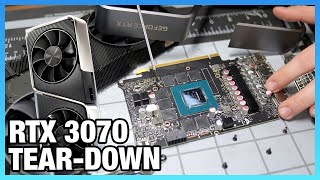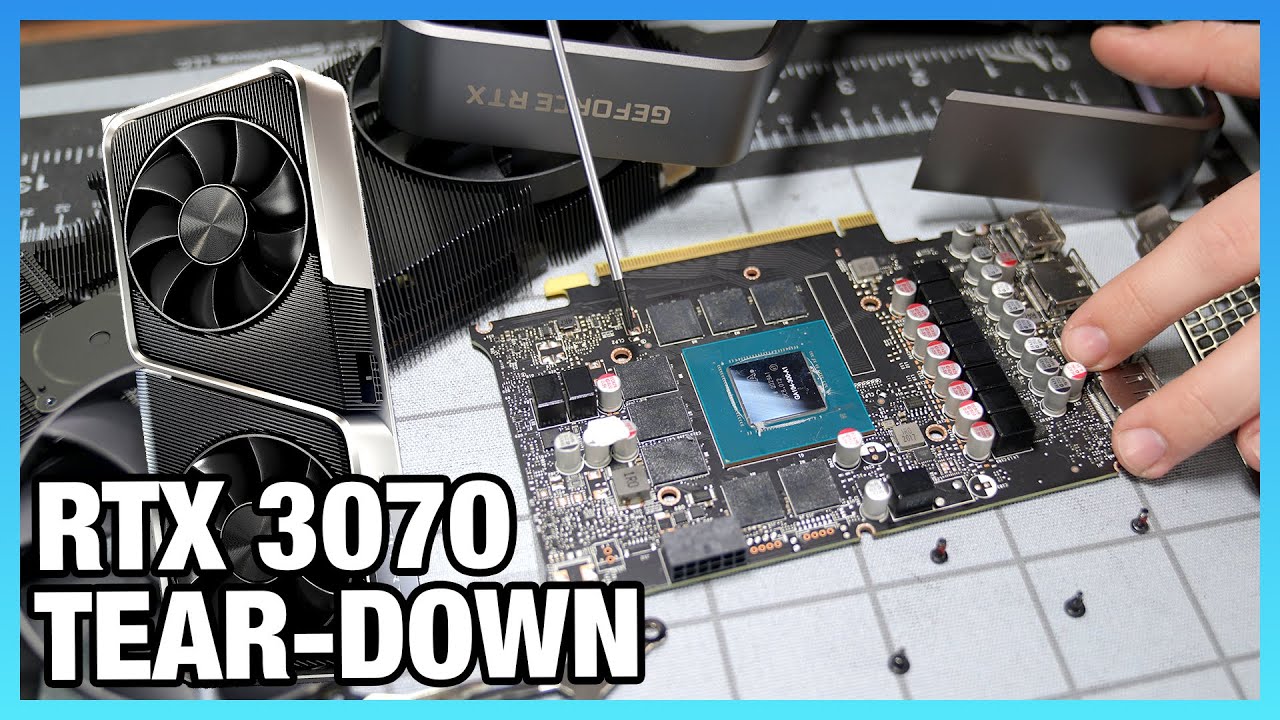
Tear-Down: NVIDIA RTX 3070 Founders Edition Disassembly
video description
Date: 2020-10-28
Related videos


Comments and reviews: 10
itech
I know it's still apples to oranges, but couldn't you compare a non-OC reference-based dual fan third party card to measure the heat profiles of a standard board to Nvidia's shrunken board? The most apples to apples comparison would be to use the same cooler on the card, say a water cooling mod for easier comparison between the two. Make a makeshift shroud, for heat trapping, then measure the temperature differences between each shroud.
It's a really dumb and overly complicated testing methodology, but it might be the only way to really compare full sized boards to stubby boards. In theory, and probably in practice, for identical components, the smaller board should get hotter due to the same amount of heat dissipation in a smaller footprint, both planar and volumetric.
As for measuring heat trapping of the cooler design, I really have no idea how you would go about that without finding a way to do a hybrid cooler mod, but everything in these coolers are connected to the GPU directly. Maybe go back to the idea of a makeshift shroud, with the water cooler on the GPU, except this time mimic the original, just without the heat pipes, but keep the fans in their places, then measure heat trapping and how that heat escapes; essentially just have disconnected metal fins under some fans within the outer shroud, it's not a perfect comparison as the fins themselves would have to connect to the shroud, but it's the closest thing. Again, really dumb and overcomplicated, but if it's something that should be measured for science, what other options are there?
I also know you don't have time to go down the rabbit hole of frankensteining GPUs in this way for science. This would probably become more of a community project if it ever were to happen, as someone needs to design and manufacture these testing concepts before they're ever tested. But I also assume Nvidia did their homework and actually tested the design in software and went through the typical product evolution stages before coming to this cooler design; it may not end up being the perfect, or really even best, design, but it also shouldn't be a failure point for the cards.
reply
I know it's still apples to oranges, but couldn't you compare a non-OC reference-based dual fan third party card to measure the heat profiles of a standard board to Nvidia's shrunken board? The most apples to apples comparison would be to use the same cooler on the card, say a water cooling mod for easier comparison between the two. Make a makeshift shroud, for heat trapping, then measure the temperature differences between each shroud.
It's a really dumb and overly complicated testing methodology, but it might be the only way to really compare full sized boards to stubby boards. In theory, and probably in practice, for identical components, the smaller board should get hotter due to the same amount of heat dissipation in a smaller footprint, both planar and volumetric.
As for measuring heat trapping of the cooler design, I really have no idea how you would go about that without finding a way to do a hybrid cooler mod, but everything in these coolers are connected to the GPU directly. Maybe go back to the idea of a makeshift shroud, with the water cooler on the GPU, except this time mimic the original, just without the heat pipes, but keep the fans in their places, then measure heat trapping and how that heat escapes; essentially just have disconnected metal fins under some fans within the outer shroud, it's not a perfect comparison as the fins themselves would have to connect to the shroud, but it's the closest thing. Again, really dumb and overcomplicated, but if it's something that should be measured for science, what other options are there?
I also know you don't have time to go down the rabbit hole of frankensteining GPUs in this way for science. This would probably become more of a community project if it ever were to happen, as someone needs to design and manufacture these testing concepts before they're ever tested. But I also assume Nvidia did their homework and actually tested the design in software and went through the typical product evolution stages before coming to this cooler design; it may not end up being the perfect, or really even best, design, but it also shouldn't be a failure point for the cards.
reply
sexinagymama
Why is the PCB analysis for EVGA 3080 FTW3 is not uploaded yet Steve??? Buildzoid have told us 2-3days ago that he already finished the video and had sent it to you! Since you are in a good relation with the evga team it is quite fishy. You did the review for the FTW3 last amongst the 3080 cards like you were waiting for a permission. Is it the same Steve? You are waiting for evga to give you permission so you can say the truth about their PCB design? This time evga have cheaped out on materials.. Let's just check their v1 FTW3 with 0 MLCC and 6x220u SPcaps... I do not want to be disappointed that your videos are too very biased and not independent...
reply
Why is the PCB analysis for EVGA 3080 FTW3 is not uploaded yet Steve??? Buildzoid have told us 2-3days ago that he already finished the video and had sent it to you! Since you are in a good relation with the evga team it is quite fishy. You did the review for the FTW3 last amongst the 3080 cards like you were waiting for a permission. Is it the same Steve? You are waiting for evga to give you permission so you can say the truth about their PCB design? This time evga have cheaped out on materials.. Let's just check their v1 FTW3 with 0 MLCC and 6x220u SPcaps... I do not want to be disappointed that your videos are too very biased and not independent...
reply
Giovanni
Is it theoretically viable to have a motherboard CPU - GPU water block sandwich - using a ribbon to the PCIe 4 slot? That would minimise the space used- if cooling could be provided to the Motherboard sub components as well. If this could be done, you could have a seriously small PC. Mini ITX is 17 x 17 cm; Dual thin radiators 200mm top and bottom or some other frame with built in Radiators would look cool...
reply
Is it theoretically viable to have a motherboard CPU - GPU water block sandwich - using a ribbon to the PCIe 4 slot? That would minimise the space used- if cooling could be provided to the Motherboard sub components as well. If this could be done, you could have a seriously small PC. Mini ITX is 17 x 17 cm; Dual thin radiators 200mm top and bottom or some other frame with built in Radiators would look cool...
reply
smashallpots
The 3070 is my favorite design style wise. I wish they made them all look kinda like a mix of the 3080 and the 3070. Make the card a bit bigger and make the fins go right to left all the way not just that small part next to the fan, another cange id make it flip the shroud so the S is the other way the the long part with the geforce bit it on the i/o side on the card.
reply
The 3070 is my favorite design style wise. I wish they made them all look kinda like a mix of the 3080 and the 3070. Make the card a bit bigger and make the fins go right to left all the way not just that small part next to the fan, another cange id make it flip the shroud so the S is the other way the the long part with the geforce bit it on the i/o side on the card.
reply
Snozz
Replying to the ad spot rather than the video subject, I wonder how much of the current trend of performance-oriented, mesh-fronted cases is thanks to you at Gamers Nexus. It's very nice to see. Going to be upgrading from my now 5 year old Corsair Carbide SPEC-02 to a Lian Li LANCOOL II Mesh Performance per your reviews. Much appreciated!
reply
Replying to the ad spot rather than the video subject, I wonder how much of the current trend of performance-oriented, mesh-fronted cases is thanks to you at Gamers Nexus. It's very nice to see. Going to be upgrading from my now 5 year old Corsair Carbide SPEC-02 to a Lian Li LANCOOL II Mesh Performance per your reviews. Much appreciated!
reply
zashbot
Hey fun fact about phillips screws: The design was bought by henry ford for use in his factories by people with non torque limited screw guns. The bit is actually designed to cam out of the screw when the proper torque is reached, so people with limited skill can use the gun to assemble components without stripping the holes.
reply
Hey fun fact about phillips screws: The design was bought by henry ford for use in his factories by people with non torque limited screw guns. The bit is actually designed to cam out of the screw when the proper torque is reached, so people with limited skill can use the gun to assemble components without stripping the holes.
reply
Rik
What I don't understand is that after all these years, GPU manufacturers are still putting the power connectors on the top of the card, instead of on the bottom. Imagine just having to poke the cable through a grommet in the chassis to connect it, and not having to route a bunch of cables around the card to the visible side.
reply
What I don't understand is that after all these years, GPU manufacturers are still putting the power connectors on the top of the card, instead of on the bottom. Imagine just having to poke the cable through a grommet in the chassis to connect it, and not having to route a bunch of cables around the card to the visible side.
reply
Siegbert
Im a bit disappointed by the VRM design. Only 8 gpu phases. Its obvious, Nvidia skimped on the 3070 at every corner. I would skip that card and go with a 3080. The improvements you get with the 3080 (faster and more VRAM, better cooling design, better VRM design, 30% more gpu power) are just easily worth 200 , imo.
reply
Im a bit disappointed by the VRM design. Only 8 gpu phases. Its obvious, Nvidia skimped on the 3070 at every corner. I would skip that card and go with a 3080. The improvements you get with the 3080 (faster and more VRAM, better cooling design, better VRM design, 30% more gpu power) are just easily worth 200 , imo.
reply
qlum
Looking at the thermal pad on the back, to me it looks like it's mostly there for rigidity.
It's in the middle of the open area of the backplate, by adding a thermal pad there the backplate will probably bend in less.
My guess is that's also why they did not bother removing the plastic underneath.
reply
Looking at the thermal pad on the back, to me it looks like it's mostly there for rigidity.
It's in the middle of the open area of the backplate, by adding a thermal pad there the backplate will probably bend in less.
My guess is that's also why they did not bother removing the plastic underneath.
reply
Ginpo
Nice looking card and looks to be very easy to take down. I can see this card in many SFF custom loop builds. Maybe even in my own Dan Case :). Request to GN, can you please start measuring the size of the PCB for those that want to have measurements for SFF custom loop builds? Thanks!
reply
Nice looking card and looks to be very easy to take down. I can see this card in many SFF custom loop builds. Maybe even in my own Dan Case :). Request to GN, can you please start measuring the size of the PCB for those that want to have measurements for SFF custom loop builds? Thanks!
reply
Add a review, comment
Other channel videos