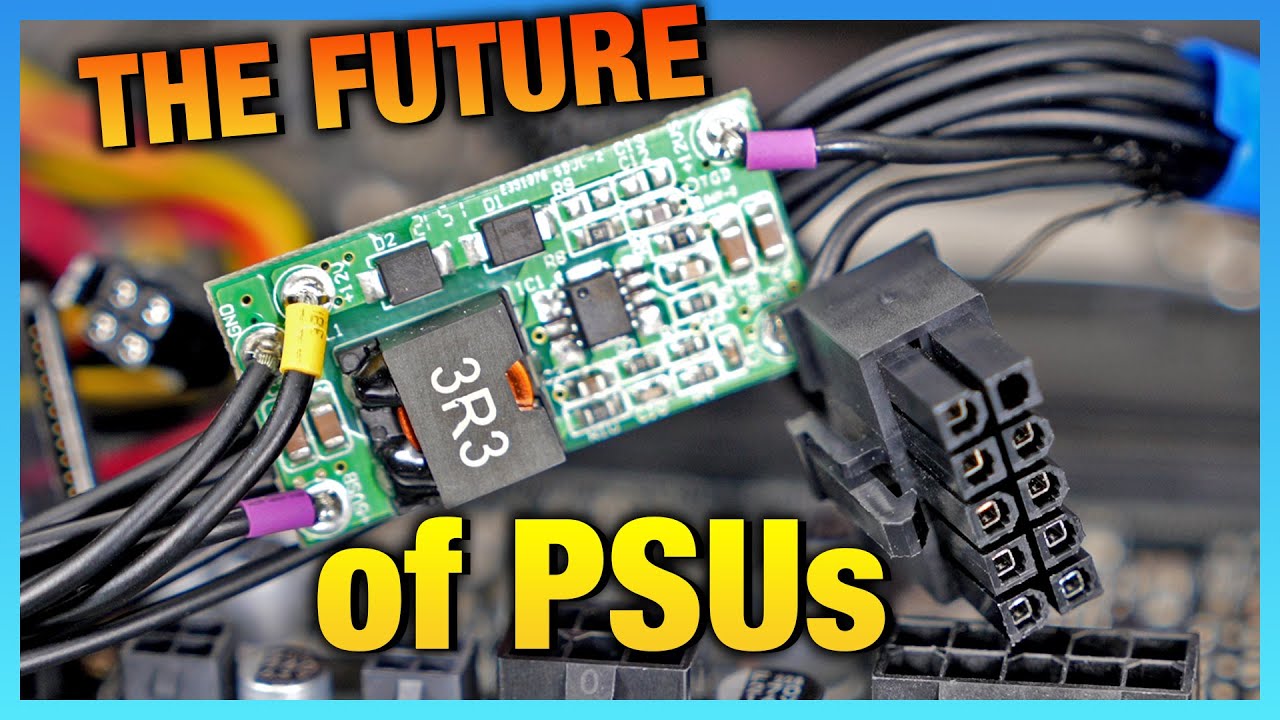
The Future of Power Supplies - Maybe (Motherboard Cost, Cables, & ATX12VO)
video description
Date: 2023-03-30
Related videos




Comments and reviews: 14
Aaron
I think that the future of PSUs is not this. The PSU will go into a modular VRM board which will have it's own cooling, and there won't be any VRMs on the motherboard. I saw that in an interesting server product. The PSU will provide better protection for clean voltage all 12V, you will buy a number of VRMs/voltage converters that will slot in behind the motherboard and will be close to what you're powering. The power plugs into the back/bottom of the motherboard with standardized power connectors that separate the VRMs from the motherboard for cooling, but also keep the distance from the powered device and the VRM at a minimum. The connections will not be cables, as the alignments will be standardized between the VRM board and the motherboard. You can buy specialized VRM components if you want to under or overvolt your components, some might be programmable, but some might just be a different spec if that's cheaper and you know your system will work with it.
There will not be ANY VRMs on the motherboard. Even the 75W PCI-e standard with come from the VRM modular board.
The components of the VRM board will be cooled on the bottom, the power connectors will be on the other side of the components. The power comes through the bottom of the motherboard and the components on the motherboard are on the top, so that they can be cooled on the top. Getting rid of the VRMs on the motherboard allows components to be placed really close to one another, reducing latency between the cpu, memory, the gpu, the fpgas, the asics, the fpaas, and all the other components that you're using.
Keep in mind... if there aren't any VRMs on the motherboard, there also aren't any VRMs on the GPU board either. So a GPU comes in two parts. The VRM board and the processor board. The CPU board has PCIe 16x slots on it's edge and the GPU board slides right in next to the CPU board - close - Grace Hopper inspired close.
My friend once said that building a computer was now more like Legos. I love the idea of power delivers being much more modular than it its. Separate the VRMs and their cooling from the devices and their cooling and give enough space so that this all can happen.
The PSU makers are responsible for one thing - supplying clean 12V.
The VRM designers are responsible for their thing - supplying the correct voltage to the device when the device needs it, keeping things from spiking on sudden changes in needed voltage, and all the other amazing things that good designed VRMs do. And designing good heat transfer as there's no perfectly efficient buck converters.
The device designers stop trying to integrate and perfect how to put the VRMs on their boards - leave that to the VRM designers. The bottom of the board gets the power and the top of the board has the device and all of the cooling hardware for the device only.
I'm sure this is all a bad idea, since it hasn't been done yet, but I love the idea of hey my gpu stopped working - unplug the VRM from the bottom of the board and plug in a new one - perhaps with better design features because the gpu is 4 years old - and fixing the whole thing without taking apart anything! Cheers.
reply
I think that the future of PSUs is not this. The PSU will go into a modular VRM board which will have it's own cooling, and there won't be any VRMs on the motherboard. I saw that in an interesting server product. The PSU will provide better protection for clean voltage all 12V, you will buy a number of VRMs/voltage converters that will slot in behind the motherboard and will be close to what you're powering. The power plugs into the back/bottom of the motherboard with standardized power connectors that separate the VRMs from the motherboard for cooling, but also keep the distance from the powered device and the VRM at a minimum. The connections will not be cables, as the alignments will be standardized between the VRM board and the motherboard. You can buy specialized VRM components if you want to under or overvolt your components, some might be programmable, but some might just be a different spec if that's cheaper and you know your system will work with it.
There will not be ANY VRMs on the motherboard. Even the 75W PCI-e standard with come from the VRM modular board.
The components of the VRM board will be cooled on the bottom, the power connectors will be on the other side of the components. The power comes through the bottom of the motherboard and the components on the motherboard are on the top, so that they can be cooled on the top. Getting rid of the VRMs on the motherboard allows components to be placed really close to one another, reducing latency between the cpu, memory, the gpu, the fpgas, the asics, the fpaas, and all the other components that you're using.
Keep in mind... if there aren't any VRMs on the motherboard, there also aren't any VRMs on the GPU board either. So a GPU comes in two parts. The VRM board and the processor board. The CPU board has PCIe 16x slots on it's edge and the GPU board slides right in next to the CPU board - close - Grace Hopper inspired close.
My friend once said that building a computer was now more like Legos. I love the idea of power delivers being much more modular than it its. Separate the VRMs and their cooling from the devices and their cooling and give enough space so that this all can happen.
The PSU makers are responsible for one thing - supplying clean 12V.
The VRM designers are responsible for their thing - supplying the correct voltage to the device when the device needs it, keeping things from spiking on sudden changes in needed voltage, and all the other amazing things that good designed VRMs do. And designing good heat transfer as there's no perfectly efficient buck converters.
The device designers stop trying to integrate and perfect how to put the VRMs on their boards - leave that to the VRM designers. The bottom of the board gets the power and the top of the board has the device and all of the cooling hardware for the device only.
I'm sure this is all a bad idea, since it hasn't been done yet, but I love the idea of hey my gpu stopped working - unplug the VRM from the bottom of the board and plug in a new one - perhaps with better design features because the gpu is 4 years old - and fixing the whole thing without taking apart anything! Cheers.
reply
grizzlee
I know Steve is always right in his assumptions/predictions. So pardon my language but the PC parts manufacturers can eff off. AM5 mobos are already bloody expensive, (I am glad I chose to max out my AM4 platform and will probably skip AM5 and/or go back to Intel), and if this tech catches on, and mobos get more expensive, it better be reasonable, and if features removed from PSU's, they better adjust pricing. GPU pricing has already ruined the PC market in my opinion, (had just gotten several friends to switch to PC from console but they are probably going back now). Otherwise I will use my high end AM4 platform until is no longer viable, then switch to gaming laptop or console. Sad to give up one of my fave hobbies, but this is getting ridiculous. I lucked out and got a GPU upgrade at MSRP right at the GPU's lowest point this past summer, and got a great deal on my high end AM4 CPU / MoBo combo last winter, and the rest of my parts were transferable. I was hoping to ride out the bumps but it clearly does look like they are trying to make PC gaming elite again, just after it had become attainable for most people pre-pandemic. What a shame. Guess my other hobbies will get all my attention once my current PC is no longer good enough. (Mountain biking, painting, hiking, wood working, camping, etc.). After slowly working my way up from entry level, to mid tier, to high end, I have no desire to go back to entry level PC builds, when they will cost as much as some of my past mid tier or even high end builds. I can afford it, but I refuse to pay inflated prices. Is your costs go up 15% then charge that, your margins are already high enough. Charging us 30% for a 15% increase is greedy.
reply
I know Steve is always right in his assumptions/predictions. So pardon my language but the PC parts manufacturers can eff off. AM5 mobos are already bloody expensive, (I am glad I chose to max out my AM4 platform and will probably skip AM5 and/or go back to Intel), and if this tech catches on, and mobos get more expensive, it better be reasonable, and if features removed from PSU's, they better adjust pricing. GPU pricing has already ruined the PC market in my opinion, (had just gotten several friends to switch to PC from console but they are probably going back now). Otherwise I will use my high end AM4 platform until is no longer viable, then switch to gaming laptop or console. Sad to give up one of my fave hobbies, but this is getting ridiculous. I lucked out and got a GPU upgrade at MSRP right at the GPU's lowest point this past summer, and got a great deal on my high end AM4 CPU / MoBo combo last winter, and the rest of my parts were transferable. I was hoping to ride out the bumps but it clearly does look like they are trying to make PC gaming elite again, just after it had become attainable for most people pre-pandemic. What a shame. Guess my other hobbies will get all my attention once my current PC is no longer good enough. (Mountain biking, painting, hiking, wood working, camping, etc.). After slowly working my way up from entry level, to mid tier, to high end, I have no desire to go back to entry level PC builds, when they will cost as much as some of my past mid tier or even high end builds. I can afford it, but I refuse to pay inflated prices. Is your costs go up 15% then charge that, your margins are already high enough. Charging us 30% for a 15% increase is greedy.
reply
Scott
It's certainly time to move away from PSU's that provide five different outputs. But it's also time to move away from 12 volts as the standard for the highest power supply voltage. With the new breeds of power-hungry CPU's and GPU's, 48 volts would be much more suitable. Motherboards and GPU's already have VRM's on board that convert 12 volts down to much lower voltages suitable for the silicon that does all the heavy lifting. But when you're talking about 700 - 1,500 watts total power draw at times, the current needed at 12 volts becomes unmanageable. That's why we saw (as I predicted) the new GPU power connectors melting. By adopting a single-rail standard of 48 volts, and then letting the motherboards and GPU's do all the necessary downconversion from that voltage, the cables from the PSU can be thinner, with fewer wires, and the connectors become far less critical in terms of keeping resistance low.
For those unfamiliar with Ohm's law, here's what I mean: A PSU delivering 1,000 watts through the 12V lines must deliver over 83 amps of current to do the job. That much current requires heavy and numerous wires and large, solid connectors to prevent overheating and possible catastrophic failure. But at 48 volts, the current requirement drops to less than 21 amps, making the job of delivering that 1,000 watts to the motherboard and GPU much easier and safer.
Computer enthusiasts are used to having to change motherboards every so often to accommodate new CPU designs. And we also have to update our PSU's as well. It's not too big of an ask to have us make the change to a better power delivery system. But it should not be 12V, it should be 48V.
reply
It's certainly time to move away from PSU's that provide five different outputs. But it's also time to move away from 12 volts as the standard for the highest power supply voltage. With the new breeds of power-hungry CPU's and GPU's, 48 volts would be much more suitable. Motherboards and GPU's already have VRM's on board that convert 12 volts down to much lower voltages suitable for the silicon that does all the heavy lifting. But when you're talking about 700 - 1,500 watts total power draw at times, the current needed at 12 volts becomes unmanageable. That's why we saw (as I predicted) the new GPU power connectors melting. By adopting a single-rail standard of 48 volts, and then letting the motherboards and GPU's do all the necessary downconversion from that voltage, the cables from the PSU can be thinner, with fewer wires, and the connectors become far less critical in terms of keeping resistance low.
For those unfamiliar with Ohm's law, here's what I mean: A PSU delivering 1,000 watts through the 12V lines must deliver over 83 amps of current to do the job. That much current requires heavy and numerous wires and large, solid connectors to prevent overheating and possible catastrophic failure. But at 48 volts, the current requirement drops to less than 21 amps, making the job of delivering that 1,000 watts to the motherboard and GPU much easier and safer.
Computer enthusiasts are used to having to change motherboards every so often to accommodate new CPU designs. And we also have to update our PSU's as well. It's not too big of an ask to have us make the change to a better power delivery system. But it should not be 12V, it should be 48V.
reply
marine6680
I get that there can be tangible benefits to the 12VO standard, but I do not think it a good idea in the DYI PC space.
It shifts the work load, complexity, and associated cost of voltage conversion in the wrong direction.
For OEM builds, especially in consumer grade PCs, it can work fine though. Upgradability isn t really a concern for these PCs, as it s not common for non-enthusiast users to delve into anything more involved than a hard drive or RAM swap.
The one component that can follow you around between builds, without any issues, is the power supply. So long as it outputs enough power for your needs in the new build.
You purchase a quality PS once, and it can last through a decade of builds easily. MBs gaining complexity just means more to break or go wrong on this expensive component.
The 12VO standard just makes the MB more complicated and expensive, and that is a component that may require replacing at least once during the lifespan of a typical high quality PS.
So MBs would definitely be more expensive, and the PS manufacturers are not likely to pass the savings to consumers. But for their OEM partners, the PSs would be cheaper, basically making it a zero sum change, with real benefits and no downside for them to switch to this standard.
Heck, companies like Dell already use their own proprietary PSs and MBs anyway. At least if they switched to 12VO, replacing a faulty PS or other component may be easier for consumers Probably why they haven t adopted it, can t have consumers fixing a broken computer rather than buying a new one.
reply
I get that there can be tangible benefits to the 12VO standard, but I do not think it a good idea in the DYI PC space.
It shifts the work load, complexity, and associated cost of voltage conversion in the wrong direction.
For OEM builds, especially in consumer grade PCs, it can work fine though. Upgradability isn t really a concern for these PCs, as it s not common for non-enthusiast users to delve into anything more involved than a hard drive or RAM swap.
The one component that can follow you around between builds, without any issues, is the power supply. So long as it outputs enough power for your needs in the new build.
You purchase a quality PS once, and it can last through a decade of builds easily. MBs gaining complexity just means more to break or go wrong on this expensive component.
The 12VO standard just makes the MB more complicated and expensive, and that is a component that may require replacing at least once during the lifespan of a typical high quality PS.
So MBs would definitely be more expensive, and the PS manufacturers are not likely to pass the savings to consumers. But for their OEM partners, the PSs would be cheaper, basically making it a zero sum change, with real benefits and no downside for them to switch to this standard.
Heck, companies like Dell already use their own proprietary PSs and MBs anyway. At least if they switched to 12VO, replacing a faulty PS or other component may be easier for consumers Probably why they haven t adopted it, can t have consumers fixing a broken computer rather than buying a new one.
reply
Dennis
48V is the best FUTURE solution. Its used in data/telecom and has been for decades. The higher you go the smaller the conductor of the wiring and fewer pins on the connector. Local POL (Point of Loads) DC to DC converters are not expensive. When you look at the legacy power solution it is based upon the needs of older technology. There was a time when a majority of the logic was 5V. This gave way to ASICs that had lower voltage cores ( 2.5 to 0.8V) and retained the 5V on the IO Pins to interface to older bits or busses. Equally drives had 12 and 5 for floppy and HDs. SSD's only 5V but could be moved to anything as their current draw is so low. Power complexity has dominated the design requirements for decades. It adds pin count, PCBA layer count, routing, signal integrity and EMI problems. Really you need to justify WHY you have a unique voltage and to the extent everything is in the box talking to itself - it should be beaten into the lowest cost solution. And your point is valid that if you move it from X to Y (PS to MOBO or MOB to card) its sort of a wash in concept but not at all in practice. Anything that reduces complexity reduces cost and increases reliability. Note the ONLY thing the 5VSB does is provide the sense voltage for pushbutton power on/WOL and BIOS update microcontrollers. Very very low current. But as it is always on its a necessary rail needing a small conductor.
reply
48V is the best FUTURE solution. Its used in data/telecom and has been for decades. The higher you go the smaller the conductor of the wiring and fewer pins on the connector. Local POL (Point of Loads) DC to DC converters are not expensive. When you look at the legacy power solution it is based upon the needs of older technology. There was a time when a majority of the logic was 5V. This gave way to ASICs that had lower voltage cores ( 2.5 to 0.8V) and retained the 5V on the IO Pins to interface to older bits or busses. Equally drives had 12 and 5 for floppy and HDs. SSD's only 5V but could be moved to anything as their current draw is so low. Power complexity has dominated the design requirements for decades. It adds pin count, PCBA layer count, routing, signal integrity and EMI problems. Really you need to justify WHY you have a unique voltage and to the extent everything is in the box talking to itself - it should be beaten into the lowest cost solution. And your point is valid that if you move it from X to Y (PS to MOBO or MOB to card) its sort of a wash in concept but not at all in practice. Anything that reduces complexity reduces cost and increases reliability. Note the ONLY thing the 5VSB does is provide the sense voltage for pushbutton power on/WOL and BIOS update microcontrollers. Very very low current. But as it is always on its a necessary rail needing a small conductor.
reply
Smarter
How are the motherboards going to dissipate the additional heat that comes from running 2 to 4 times more power through the layers of the pcb on high end cpu's, gpu's and the motherboards? Then there is the issue of maintaining signal quality for the cpu lanes, memory, gpu, etc given the much higher power and potential for power bleed issues with that much more power running through the pcb's. Also since the psu will not need anything but 12vo circuits/components you would think the psu could shrink in size, but, one example you showed, kept the same size or form factor? Why, to avoid retooling costs?
I will predict the cost of psu's will not drop significantly for 12vo units, but, motherboard cost will skyrocket... the current 200 to 500 motherboards will just become another 150 to 250 more expensive... as a customer, it will be hold on to your wallet, bend over and hope you like it rough!!! Not to mention the area on the pcb that's currently used for M.2, debug leds, etc will be crowded out by required power conversion components for 12vo to 5v and under components... It's hard to figure out how this is going to benefit the average home pc consumer. This looks like a move to benefit large commercial or server farm uses by pushing server style components into the home/small business markets.
reply
How are the motherboards going to dissipate the additional heat that comes from running 2 to 4 times more power through the layers of the pcb on high end cpu's, gpu's and the motherboards? Then there is the issue of maintaining signal quality for the cpu lanes, memory, gpu, etc given the much higher power and potential for power bleed issues with that much more power running through the pcb's. Also since the psu will not need anything but 12vo circuits/components you would think the psu could shrink in size, but, one example you showed, kept the same size or form factor? Why, to avoid retooling costs?
I will predict the cost of psu's will not drop significantly for 12vo units, but, motherboard cost will skyrocket... the current 200 to 500 motherboards will just become another 150 to 250 more expensive... as a customer, it will be hold on to your wallet, bend over and hope you like it rough!!! Not to mention the area on the pcb that's currently used for M.2, debug leds, etc will be crowded out by required power conversion components for 12vo to 5v and under components... It's hard to figure out how this is going to benefit the average home pc consumer. This looks like a move to benefit large commercial or server farm uses by pushing server style components into the home/small business markets.
reply
1kreature
12VO sucks for powerhungry boards. It is time to step it up to at least 24v. Mosfets are still easily available in small sizes to handle that and the losses in the cables drop by a factor 4!
48V to POL (Point Of Load) has been a ting since well before 2016 and is something they should look to for this. Regardless of what we do, the total ratio is still something that will need conversion. 300-400v rectified grid voltage (NON 110v ac countrys) will need to get down to core voltages of 0.8-1.2v range. It can be done in multiple smaller steps or almost directly.
Safety-wise this should NEVER go directly as a single fault would then explode the boards valuable chips. Crowbar circuits on output of stages should be mandatory and going to something like 24-48v first seems logical. You want as high as possible voltage to pass through the long runs of wire, then you can step it down as the distances to be traversed gets smaller. A rough 48v to 5v or 12v could be an option at the GPU-boards power input, and then the normal regs can do the last step. The efficiency needs to be pushed high though or the diminishing returns start to add up fast. As-is we loose almost as much in the cables for a RTX4090 as we do in the supply converting from linevoltage to 12v.
reply
12VO sucks for powerhungry boards. It is time to step it up to at least 24v. Mosfets are still easily available in small sizes to handle that and the losses in the cables drop by a factor 4!
48V to POL (Point Of Load) has been a ting since well before 2016 and is something they should look to for this. Regardless of what we do, the total ratio is still something that will need conversion. 300-400v rectified grid voltage (NON 110v ac countrys) will need to get down to core voltages of 0.8-1.2v range. It can be done in multiple smaller steps or almost directly.
Safety-wise this should NEVER go directly as a single fault would then explode the boards valuable chips. Crowbar circuits on output of stages should be mandatory and going to something like 24-48v first seems logical. You want as high as possible voltage to pass through the long runs of wire, then you can step it down as the distances to be traversed gets smaller. A rough 48v to 5v or 12v could be an option at the GPU-boards power input, and then the normal regs can do the last step. The efficiency needs to be pushed high though or the diminishing returns start to add up fast. As-is we loose almost as much in the cables for a RTX4090 as we do in the supply converting from linevoltage to 12v.
reply
Razor2048
Still seems better to keep the major power rails in the power supply. A quality power supply can easily last 10+ years, thus long term, it is cheaper since the expense of those rails is not paid repeatedly for each new upgrade/build. It will also be less of an issue for handling multiple devices that use the other rails, e.g., no worrying about if your motherboard has enough 5V amperage to handle every hard drive you want to connect, as well as every additional drive connected to your HBA. There is less worry about having enough power connectors for a larger number of accessories without having to stack multiple splitters because the motherboard maker decided to treat having enough power connectors the same way they treat having a debug 7 segment display.
One risk with that mentality will be board makers trying to do a 200 price target, will end up with 10 amps for the 5V and 3.3V rails (effectively matching the super cheap power supplies) .
reply
Still seems better to keep the major power rails in the power supply. A quality power supply can easily last 10+ years, thus long term, it is cheaper since the expense of those rails is not paid repeatedly for each new upgrade/build. It will also be less of an issue for handling multiple devices that use the other rails, e.g., no worrying about if your motherboard has enough 5V amperage to handle every hard drive you want to connect, as well as every additional drive connected to your HBA. There is less worry about having enough power connectors for a larger number of accessories without having to stack multiple splitters because the motherboard maker decided to treat having enough power connectors the same way they treat having a debug 7 segment display.
One risk with that mentality will be board makers trying to do a 200 price target, will end up with 10 amps for the 5V and 3.3V rails (effectively matching the super cheap power supplies) .
reply
Jame
Just using 12 volt is fine and dandy, BUT why route it all thrrough the damn motherboard? Just have devices step down the voltage themselves. We are not talking hundreds of volts and ampere here. Well okay inside the cpu only but still.
This adds a bunch of BS and complexity to motherboards that are already very complex and are pricy enough as is, plus we are not saving a cable because it still comes from the motherboard. And then we need shielding and measures to keep more powerlines on a pcb that soon will pack or sometimes is already packing on retimers for signal integrity for pcie 5.0.
Get your 12VO power supply, name it 12VO only powersupply, and have it use 12VO sata 2.0 power connectors, new harddrives come with the new connector, maybe make it backward compatible if possible, same connector but only 12 volt and have the drive detect newer or older. Certainly there must be options.
reply
Just using 12 volt is fine and dandy, BUT why route it all thrrough the damn motherboard? Just have devices step down the voltage themselves. We are not talking hundreds of volts and ampere here. Well okay inside the cpu only but still.
This adds a bunch of BS and complexity to motherboards that are already very complex and are pricy enough as is, plus we are not saving a cable because it still comes from the motherboard. And then we need shielding and measures to keep more powerlines on a pcb that soon will pack or sometimes is already packing on retimers for signal integrity for pcie 5.0.
Get your 12VO power supply, name it 12VO only powersupply, and have it use 12VO sata 2.0 power connectors, new harddrives come with the new connector, maybe make it backward compatible if possible, same connector but only 12 volt and have the drive detect newer or older. Certainly there must be options.
reply
Stoney
Many people worried about power conversion failures forget that the industry has enormous experience with an entire class of PCs running with single voltage inputs - we call them laptops . There was a previous attempt to popularize a laptop-like power standard in the shape of the Thin Mini-ITX standard, which mandated a 12V power input on the board and usually a barrel jack on a half-height compatible backplate (hence the thin part of the spec name) but it was a niche-in-a-niche, didn't have the volume to gain any momentum, and died quietly in a corner. I have an Asrock board built to that standard, it's from-the-wall power draw is exceptionally low when the system is powered on and idle, mostly due to the fact it runs off a 100W solid brick PSU (and partially because it's running an i5-6500T and GT1030) so it's not like there isn't precedent for engineering a power system of this nature.
reply
Many people worried about power conversion failures forget that the industry has enormous experience with an entire class of PCs running with single voltage inputs - we call them laptops . There was a previous attempt to popularize a laptop-like power standard in the shape of the Thin Mini-ITX standard, which mandated a 12V power input on the board and usually a barrel jack on a half-height compatible backplate (hence the thin part of the spec name) but it was a niche-in-a-niche, didn't have the volume to gain any momentum, and died quietly in a corner. I have an Asrock board built to that standard, it's from-the-wall power draw is exceptionally low when the system is powered on and idle, mostly due to the fact it runs off a 100W solid brick PSU (and partially because it's running an i5-6500T and GT1030) so it's not like there isn't precedent for engineering a power system of this nature.
reply
Arkanrais
So, if 12VO were to take off;
Instead of having a single set of 3.3v & 5v converters in your PSU that lasts a decade, you'll be paying for and tossing out a set every 2-5 years.
You'll be severely limited in the amount of devices that use 3.3 & 5v rails, especially on the reasonably priced motherboards. Say goodbye to boards that have more than 4 SATA ports unless you're spending over 600, and you'll likely say goodbye to more than 2 SATA ports on boards that cost less than 300.
Also you can guarantee the small BOM increase will be pushed through to the consumer starting at a 1000% markup. The 2 worth of power conversion will put an extra 20 on the board price at the lower end, and the 15 BOM increase on a top end motherboard will cost you another 300 in the store. Look forward to the 'midrange' motherboards costing as much as the 'midrange' graphics cards.
reply
So, if 12VO were to take off;
Instead of having a single set of 3.3v & 5v converters in your PSU that lasts a decade, you'll be paying for and tossing out a set every 2-5 years.
You'll be severely limited in the amount of devices that use 3.3 & 5v rails, especially on the reasonably priced motherboards. Say goodbye to boards that have more than 4 SATA ports unless you're spending over 600, and you'll likely say goodbye to more than 2 SATA ports on boards that cost less than 300.
Also you can guarantee the small BOM increase will be pushed through to the consumer starting at a 1000% markup. The 2 worth of power conversion will put an extra 20 on the board price at the lower end, and the 15 BOM increase on a top end motherboard will cost you another 300 in the store. Look forward to the 'midrange' motherboards costing as much as the 'midrange' graphics cards.
reply
Vitor
18:58 One interesting thing about that Motherboard is that it has the mounting holes for the VRM heatsinks. This means that they planed to put heatsinks on that board or they intended to release a higher price variation with heatsinks.
The fact that it has the mounting holes also makes adding custom heatsinks much easier. Its rarely done by moders but the adding of heatsinks to cheap Motherboards that doesn't have it can increase its values by something between 20 80 .
The biggest difference between low end and mid end motherboards many times boils down to the addition of the VRM heatsinks.
The mod is relatively easy to do. A hand saw, a drill, old scrap heatsink, some thermal pads, some small springs and screws with nuts is all you need.
reply
18:58 One interesting thing about that Motherboard is that it has the mounting holes for the VRM heatsinks. This means that they planed to put heatsinks on that board or they intended to release a higher price variation with heatsinks.
The fact that it has the mounting holes also makes adding custom heatsinks much easier. Its rarely done by moders but the adding of heatsinks to cheap Motherboards that doesn't have it can increase its values by something between 20 80 .
The biggest difference between low end and mid end motherboards many times boils down to the addition of the VRM heatsinks.
The mod is relatively easy to do. A hand saw, a drill, old scrap heatsink, some thermal pads, some small springs and screws with nuts is all you need.
reply
C0Nd3Mnd
Yeah, not a fan. My power supply served three motherboards already, and within its 12-year warranty is will surely serve two or three more. Doesn't really make sense to purchase these 3.3V/5V components with each new motherboard again. You have to swap motherboards a lot more often if you always want the latest and greatest while a high quality power supply can serve you for a decade or longer.
Mid- to high-end motherboards are already struggling for space, especially in the mATX or ITX form factor, where additional M.2 slots or other connectors are moved to add-on cards that you plug into the board.
Better power efficiency or not, this just feels like change for changes sake. I hope it doesn't take over the DIY market.
reply
Yeah, not a fan. My power supply served three motherboards already, and within its 12-year warranty is will surely serve two or three more. Doesn't really make sense to purchase these 3.3V/5V components with each new motherboard again. You have to swap motherboards a lot more often if you always want the latest and greatest while a high quality power supply can serve you for a decade or longer.
Mid- to high-end motherboards are already struggling for space, especially in the mATX or ITX form factor, where additional M.2 slots or other connectors are moved to add-on cards that you plug into the board.
Better power efficiency or not, this just feels like change for changes sake. I hope it doesn't take over the DIY market.
reply
Aidan
How would 12vo work with things like watercooling pumps, assuming the motherboard is now responsible for powering secondary items (sata) but these things are being shut down by standby, could we face situations where the pumps turn off during standby as a 'power saving' effect and then watercooling systems break. I don't see any gain to having the hardware on the motherboard, it makes it convenient for switching it from a business point of view (prebuilts) but not for consumers, as now a power supply failure could occur in two different locations and make already expensive ( 500+) motherboards have more points of failure. This spec seems pro business (lower energy costs) but anti consumer, frankly.
reply
How would 12vo work with things like watercooling pumps, assuming the motherboard is now responsible for powering secondary items (sata) but these things are being shut down by standby, could we face situations where the pumps turn off during standby as a 'power saving' effect and then watercooling systems break. I don't see any gain to having the hardware on the motherboard, it makes it convenient for switching it from a business point of view (prebuilts) but not for consumers, as now a power supply failure could occur in two different locations and make already expensive ( 500+) motherboards have more points of failure. This spec seems pro business (lower energy costs) but anti consumer, frankly.
reply
Add a review, comment
Other channel videos