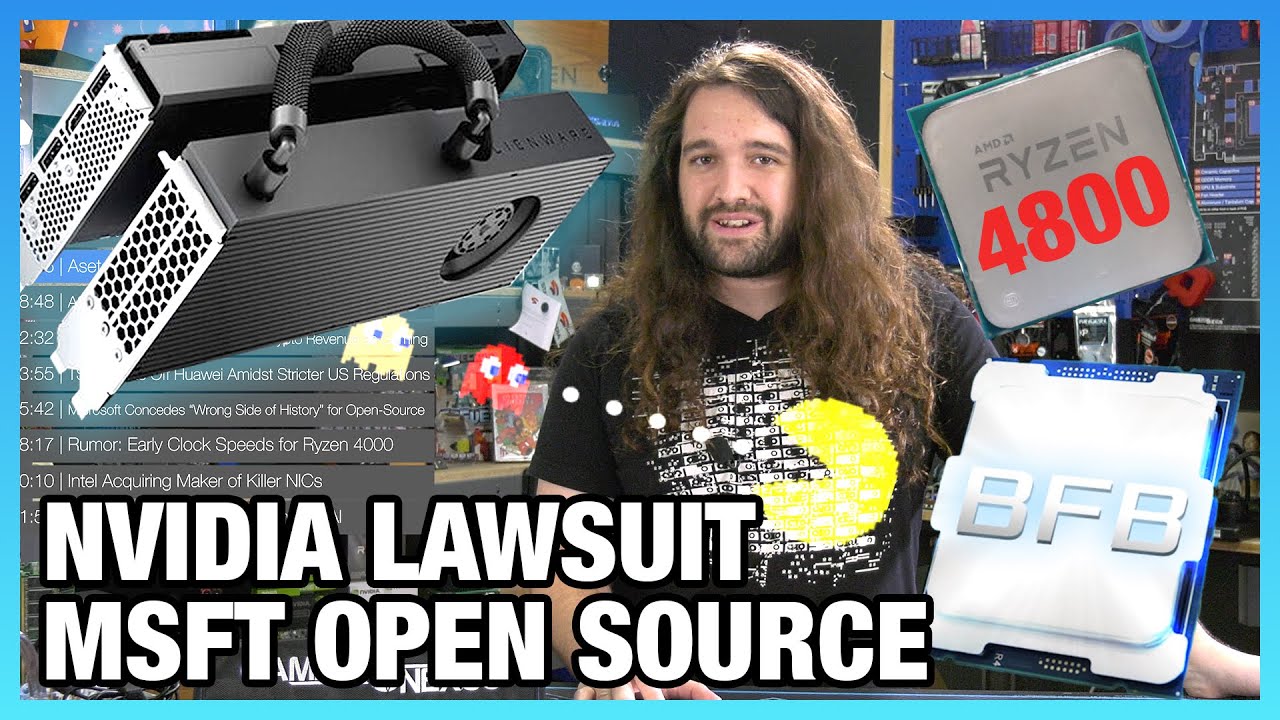
HW News - New NVIDIA Lawsuit, Microsoft Open Source Changes, Intel CPU Availability
video description
Date: 2020-05-26
Related videos


Comments and reviews: 10
Today
To a large degree, Microsoft's old comment about open source remains the same, it were just revised a little. One usually comments about the loudest person in a crowd, that in the open source world being GNU with its GPL license. GPL is a very anti commercial and generally infectious license that isn't even compatible with other similar licenses unless there is an explicit exception for it in the other license. (GPL itself makes no exceptions, since GPL is free as in freedom ... Though, GPL and GNU as a whole is a product of its time.) Though, Microsoft changed their stance on Open source, not GPL. Since GPL is far from the only open source license, and this is rather evident since Microsoft now publishes stuff under the MIT open source license. There is also the BSD license, Apache license, among others that are open source, but don't restrict what the end user can do with the supplied code. (The only real restrictions is that one can't claim ownership of the original project. Though, some BSD license versions are as infectious as GPL... It's the whole Share alike without any exceptions, that gets the infectious ball rolling.) Would be nice if one could just use a piece of code as a tool and simply just have to credit the original, and be free to have whatever end license one wants for the program said tool is a part of. If improvements of the tool itself is made, that is a totally different discussion, and here it would be logical for those improvements to fall into the tool's original project. Ie, if you make for an example an image editing program with tons of features, but want a simple bitmap to PNG converter, then go and pick such a library. Then it would be nice if said library's license didn't require that the whole image editing program you make to use the same license. After all, its only a very small part, and you likely don't make any modifications to it. And if you were to improve it and be required to contribute said improvements to the bitmap to PNG converter project, then it would be a mutually beneficial exchange that isn't overreaching into either side. This would solve the whole infectious nature of copy left and share alike licenses. (Though, GNU and the FSF fear that it can lead to companies locking down code and various open source initiatives.)
reply
To a large degree, Microsoft's old comment about open source remains the same, it were just revised a little. One usually comments about the loudest person in a crowd, that in the open source world being GNU with its GPL license. GPL is a very anti commercial and generally infectious license that isn't even compatible with other similar licenses unless there is an explicit exception for it in the other license. (GPL itself makes no exceptions, since GPL is free as in freedom ... Though, GPL and GNU as a whole is a product of its time.) Though, Microsoft changed their stance on Open source, not GPL. Since GPL is far from the only open source license, and this is rather evident since Microsoft now publishes stuff under the MIT open source license. There is also the BSD license, Apache license, among others that are open source, but don't restrict what the end user can do with the supplied code. (The only real restrictions is that one can't claim ownership of the original project. Though, some BSD license versions are as infectious as GPL... It's the whole Share alike without any exceptions, that gets the infectious ball rolling.) Would be nice if one could just use a piece of code as a tool and simply just have to credit the original, and be free to have whatever end license one wants for the program said tool is a part of. If improvements of the tool itself is made, that is a totally different discussion, and here it would be logical for those improvements to fall into the tool's original project. Ie, if you make for an example an image editing program with tons of features, but want a simple bitmap to PNG converter, then go and pick such a library. Then it would be nice if said library's license didn't require that the whole image editing program you make to use the same license. After all, its only a very small part, and you likely don't make any modifications to it. And if you were to improve it and be required to contribute said improvements to the bitmap to PNG converter project, then it would be a mutually beneficial exchange that isn't overreaching into either side. This would solve the whole infectious nature of copy left and share alike licenses. (Though, GNU and the FSF fear that it can lead to companies locking down code and various open source initiatives.)
reply
VoltaixLux
i understand that you guys are particularly looking for atx case suggestions, but i would love to see a full on case test and review of the full tower phanteks enthoo 719 (originally luxe 2), considered an eeb case. it is made for multiple radiator open loop cooling, so you're standard atx case test system will look tiny in such a large enclosure. many tech reviewers, like hardware canucks, have a lot of info on popular phanteks cases, great content by the way, so people shouldn't have a hard time finding reviews. however i would like to see a more in-depth review with proper testing methodology. a review taken from a more critical standpoint would be great. furthermore, comparisons between similar full towers (e.g. o11 xl) would be just as good. more high end case content might be able to cover a larger audience and would give this audience advice for which case to buy. a phanteks enthoo 719/luxe 2 review would benefit many people looking for a good full tower. last thing, proceed with caution when building in it, the build quality on some of the metal is, well, suboptimal.
reply
i understand that you guys are particularly looking for atx case suggestions, but i would love to see a full on case test and review of the full tower phanteks enthoo 719 (originally luxe 2), considered an eeb case. it is made for multiple radiator open loop cooling, so you're standard atx case test system will look tiny in such a large enclosure. many tech reviewers, like hardware canucks, have a lot of info on popular phanteks cases, great content by the way, so people shouldn't have a hard time finding reviews. however i would like to see a more in-depth review with proper testing methodology. a review taken from a more critical standpoint would be great. furthermore, comparisons between similar full towers (e.g. o11 xl) would be just as good. more high end case content might be able to cover a larger audience and would give this audience advice for which case to buy. a phanteks enthoo 719/luxe 2 review would benefit many people looking for a good full tower. last thing, proceed with caution when building in it, the build quality on some of the metal is, well, suboptimal.
reply
John
That Nvidia lawsuit is so dumb. The investors who lost money have no one to blame but themselves for not seeing how the trends in the market were changing. And it s not like Nvidia can tell what percentage of its gaming cards sold to miners. It would be an estimate at best. So best to leave it all marked as gaming. A smart investor would have done the research to know how exposed Nvidia was, seen how Nvidia was trying to reduce exposure by not trying to compete with ASICs for mining, and predicted that much of the stocks price gains were due to crypto mining hype. Late 2018 into 2019 was a pretty poor year for Nvidia s stock, thanks mostly to the crypto crash and a lack of upgrade incentive with Turing. Any butthurt investor from this lawsuit should get over it and look into this year s expectations for Ampere. Stock is already up over 50% since December.
reply
That Nvidia lawsuit is so dumb. The investors who lost money have no one to blame but themselves for not seeing how the trends in the market were changing. And it s not like Nvidia can tell what percentage of its gaming cards sold to miners. It would be an estimate at best. So best to leave it all marked as gaming. A smart investor would have done the research to know how exposed Nvidia was, seen how Nvidia was trying to reduce exposure by not trying to compete with ASICs for mining, and predicted that much of the stocks price gains were due to crypto mining hype. Late 2018 into 2019 was a pretty poor year for Nvidia s stock, thanks mostly to the crypto crash and a lack of upgrade incentive with Turing. Any butthurt investor from this lawsuit should get over it and look into this year s expectations for Ampere. Stock is already up over 50% since December.
reply
Ξανδρος
Rad card looks interesting, but I have very low hopes for its performance. It's a 5 slot solution for card and cooler, and it looks like it's using a blower on the radiator itself. That means the airflow is taking a very deep path through the rad. Is the ideal radiator not a thin Z depth with a large XY footprint? What they're doing is a thick Z depth with a small XY footprint; which is essentially stacking smaller radiators, which also isn't ideal. Unless I'm wrong, but the Alienware PC has absolutely no airflow unless there's a blower fan with a dumb radiator design in that card. Design seems dumb anyways, 4 to 5 slots gives you more than enough room for an absolutely massive air cooler, which would probably give you better performance than this anyways.
reply
Rad card looks interesting, but I have very low hopes for its performance. It's a 5 slot solution for card and cooler, and it looks like it's using a blower on the radiator itself. That means the airflow is taking a very deep path through the rad. Is the ideal radiator not a thin Z depth with a large XY footprint? What they're doing is a thick Z depth with a small XY footprint; which is essentially stacking smaller radiators, which also isn't ideal. Unless I'm wrong, but the Alienware PC has absolutely no airflow unless there's a blower fan with a dumb radiator design in that card. Design seems dumb anyways, 4 to 5 slots gives you more than enough room for an absolutely massive air cooler, which would probably give you better performance than this anyways.
reply
Blazs120gl
IMHO both and NV and AMD should be sued for denying crypto income. They had no problems lying about single digit percentage (a la Lisa Su) and none of them saw any contradiction between the single digit percent GPU mining and worldwide shortage of GPUs for both manufacturers. They are both liable for keeping GPU prices high. I also can't feel sorry for these investors either as they were also fine pocketing the shares during the mining boom and act like if they just don't realize where money is coming from. GPU prices will not auto-correct as the parties above aren't interested in it. The only thing they'll understand from, is when Mr. Wallet isn't paying 150..200 USD for low bin reject (=2017 perf for 2017 price) nor 400+ for midrange.
reply
IMHO both and NV and AMD should be sued for denying crypto income. They had no problems lying about single digit percentage (a la Lisa Su) and none of them saw any contradiction between the single digit percent GPU mining and worldwide shortage of GPUs for both manufacturers. They are both liable for keeping GPU prices high. I also can't feel sorry for these investors either as they were also fine pocketing the shares during the mining boom and act like if they just don't realize where money is coming from. GPU prices will not auto-correct as the parties above aren't interested in it. The only thing they'll understand from, is when Mr. Wallet isn't paying 150..200 USD for low bin reject (=2017 perf for 2017 price) nor 400+ for midrange.
reply
GGigabiteM
killer has seen wide adoption by OEMs - At the cost of the customer. Seriously, their network products are shit. I've had to pull servers with killer NICs and swap motherboards to one that didn't have it, or install a PCIe NIC because the Killer NIC would spontaneously die and no amount of driver troubleshooting or OS reinstallation would fix. Their drivers are horrible, and the only way to get them to somewhat work is to install the very hard to find Atheros variant of the driver, before they stacked their shitty software suite on top. So great, now we have mostly reliable and reputable Intel network gear getting infected with Killer Network cancer. Looks like the only decent players left are HP and Realtek.
reply
killer has seen wide adoption by OEMs - At the cost of the customer. Seriously, their network products are shit. I've had to pull servers with killer NICs and swap motherboards to one that didn't have it, or install a PCIe NIC because the Killer NIC would spontaneously die and no amount of driver troubleshooting or OS reinstallation would fix. Their drivers are horrible, and the only way to get them to somewhat work is to install the very hard to find Atheros variant of the driver, before they stacked their shitty software suite on top. So great, now we have mostly reliable and reputable Intel network gear getting infected with Killer Network cancer. Looks like the only decent players left are HP and Realtek.
reply
Kitkat5335
12:32 Knew this would be coming eventually. Nvidia really took advantage of that entire period. Price hikes to match resellers that only lined their pockets further. I mean come on, cards saw as much as a 30 40% increase in price due to cryptomining creating significantly aggressive market to get hands on one. I wanted a 1080 TI back when they came out and was expecting to spend about what I did for the 780 TI when it was new, which was roughly 800. Instead it was going for 1300 1400USD yet it was marketed for the 800 900 range. Made me put off getting a new card for nearly a year later when the 2000 series came out.
reply
12:32 Knew this would be coming eventually. Nvidia really took advantage of that entire period. Price hikes to match resellers that only lined their pockets further. I mean come on, cards saw as much as a 30 40% increase in price due to cryptomining creating significantly aggressive market to get hands on one. I wanted a 1080 TI back when they came out and was expecting to spend about what I did for the 780 TI when it was new, which was roughly 800. Instead it was going for 1300 1400USD yet it was marketed for the 800 900 range. Made me put off getting a new card for nearly a year later when the 2000 series came out.
reply
PeteSinHouston
TSMC will build a dedicated Huawei fab. The commerce department knows this and is trying to claim all semiconductor manufacturing equipment sold from anywhere in the world is based on American IP. This will be the death of the American semiconductor industry as no country will agree to that and will scrupulously shun American manufacturers (KLA, LAM, Applied Materials...) MSFT are vicious little beasts and will do their best to monetize everything you do on Linux. Both of these are rear-guard actions trying to stymie the inevitable shift in the IT center of gravity towards China. Both will fail.
reply
TSMC will build a dedicated Huawei fab. The commerce department knows this and is trying to claim all semiconductor manufacturing equipment sold from anywhere in the world is based on American IP. This will be the death of the American semiconductor industry as no country will agree to that and will scrupulously shun American manufacturers (KLA, LAM, Applied Materials...) MSFT are vicious little beasts and will do their best to monetize everything you do on Linux. Both of these are rear-guard actions trying to stymie the inevitable shift in the IT center of gravity towards China. Both will fail.
reply
Austausch
It's a common misconception, that X's are more expensive, because of difficulty of manufacturing. It's not because of that. It's because the licensing fees a manufacturer has to pay to the Alphabet Consortium are much higher for the letters 'X' and 'K'. Do you think Intel's just going to swallow the increased cost of that? Think again. AMD doesn't do that, because they buy 'X' licences in bulk, so the 'X' factor is far less for them, and so, to the end consumer as well. As if you needed more proof of AMD's more customer-focused attitude.
reply
It's a common misconception, that X's are more expensive, because of difficulty of manufacturing. It's not because of that. It's because the licensing fees a manufacturer has to pay to the Alphabet Consortium are much higher for the letters 'X' and 'K'. Do you think Intel's just going to swallow the increased cost of that? Think again. AMD doesn't do that, because they buy 'X' licences in bulk, so the 'X' factor is far less for them, and so, to the end consumer as well. As if you needed more proof of AMD's more customer-focused attitude.
reply
Jonathan
What I want to know is exactly what ability the USA has to tell a Taiwanese company who they can and can't do business with. Or is this the same kind of pressure the US was able to use to push European businesses to stop doing business with Iran under the Iran nuclear deal? OIh and all this will do is lead to Chinese chip fabs acquiring (via whatever means necessary) all the advanced technology they need to keep Huawei going.
reply
What I want to know is exactly what ability the USA has to tell a Taiwanese company who they can and can't do business with. Or is this the same kind of pressure the US was able to use to push European businesses to stop doing business with Iran under the Iran nuclear deal? OIh and all this will do is lead to Chinese chip fabs acquiring (via whatever means necessary) all the advanced technology they need to keep Huawei going.
reply
Add a review, comment
Other channel videos
 21:17
21:17