Why Do Some Countries Only Have One Big City
video description
Date: 2025-11-01
Related videos





Comments and reviews: 20
gerardo-ibarra
Visited Montevideo in 2015. I watched an Anthony Bourdain episode where he went to an area in Montevideo where they have like an outdoor festival/parade thing on weekends, with drums and dancing. Bourdain said it was fun, but also mentioned it was a little sketchy and he felt a little uneasy. When I went to visit, I found that area. Looked fun, it was broad daylight, so I went. But I should have listened to Bourdain and not gone there.
As I was there, a woman came up to my then-gf and me, and told my gf that she should take the camera off her shoulder and hide it better, because it will get snatched (dumb tourist move, I know. Then, while we were trying to celebrate and dance, another woman came up to us and said: You're being followed. You gotta go. Then, I noticed these same two dudes kept appearing in front of me. Then, ANOTHER woman came up to us and said: You are about to get robbed. There are taxis over there. Get to them as soon as you can and get in one and GO! And then I had two other people tell us we were marked and we gotta go, all while noticing the same two guys in front of us as we made our way to the taxis. I don't think I ever felt more terrified in my life.
We get really close to the taxis, a half block or so away from the outdoor party. I thought we were safe and in the clear. We started walking to one of the taxis when all of a sudden, 5-6 dudes were standing between us and the taxis. I cannot describe how COMPLETELY TERRIFIED I was. As I stared at them, I instantly feel a bump from the side of me, shoulder-to-shoulder, with a hand fishing in my pocket at the same time. My first instinct was to fight back and I grabbed the arm that was fishing min my pocket, but then luckily my better senses kicked in within a second, and I stopped fighting back, lifted both arms in the air, and yelled LLEVATELA! LLEVATELA! They took my wallet and ran.
The people that were closest by and witnessed my mugging just started pointing and laughing, except for one little girl who looked frightened. The friendly cabbie drove us straight to the police, where we filed a report, which of course went nowhere. We were tourists who were leaving in a couple of days.
When something like this happens to you, you gotta remember all the kind people that were trying to help, like the people that warned us, the nice cab driver, the friendly police officer who took the report. And you gotta think about why people resort to robbing tourists in the first place. So I sincerely hope those A$$HOLES enjoyed the $300 pesos ($7) they stole from me.
reply
Visited Montevideo in 2015. I watched an Anthony Bourdain episode where he went to an area in Montevideo where they have like an outdoor festival/parade thing on weekends, with drums and dancing. Bourdain said it was fun, but also mentioned it was a little sketchy and he felt a little uneasy. When I went to visit, I found that area. Looked fun, it was broad daylight, so I went. But I should have listened to Bourdain and not gone there.
As I was there, a woman came up to my then-gf and me, and told my gf that she should take the camera off her shoulder and hide it better, because it will get snatched (dumb tourist move, I know. Then, while we were trying to celebrate and dance, another woman came up to us and said: You're being followed. You gotta go. Then, I noticed these same two dudes kept appearing in front of me. Then, ANOTHER woman came up to us and said: You are about to get robbed. There are taxis over there. Get to them as soon as you can and get in one and GO! And then I had two other people tell us we were marked and we gotta go, all while noticing the same two guys in front of us as we made our way to the taxis. I don't think I ever felt more terrified in my life.
We get really close to the taxis, a half block or so away from the outdoor party. I thought we were safe and in the clear. We started walking to one of the taxis when all of a sudden, 5-6 dudes were standing between us and the taxis. I cannot describe how COMPLETELY TERRIFIED I was. As I stared at them, I instantly feel a bump from the side of me, shoulder-to-shoulder, with a hand fishing in my pocket at the same time. My first instinct was to fight back and I grabbed the arm that was fishing min my pocket, but then luckily my better senses kicked in within a second, and I stopped fighting back, lifted both arms in the air, and yelled LLEVATELA! LLEVATELA! They took my wallet and ran.
The people that were closest by and witnessed my mugging just started pointing and laughing, except for one little girl who looked frightened. The friendly cabbie drove us straight to the police, where we filed a report, which of course went nowhere. We were tourists who were leaving in a couple of days.
When something like this happens to you, you gotta remember all the kind people that were trying to help, like the people that warned us, the nice cab driver, the friendly police officer who took the report. And you gotta think about why people resort to robbing tourists in the first place. So I sincerely hope those A$$HOLES enjoyed the $300 pesos ($7) they stole from me.
reply
LordSesshaku
I think the Argentina statistic is probably flawed. Not out of bad data, but out of context: the city of Buenos Aires is large, yes, but it's also surrounded by a lot of other cities that have joined into one mass urban conglomerate, they're different entities, from different states (Buenos Aires, the capital and autonomous City-State and all the cities joined to it that belong to Buenos Aires the Province/State/Region.
To put it into numbers the Greater Buenos Aires looks like one single entity from space, and it houses more than 16M people. That means it's the 18th largest urban conglomerate in the world, which doesn't sound too impressive, until you realize it's the only on the top 20 that comes from a country with less population than Spain. All the others on the list come from way more populated countries. Which means the greater buenos aires concentrates like 35% of the entire country in a single urban reality.
reply
I think the Argentina statistic is probably flawed. Not out of bad data, but out of context: the city of Buenos Aires is large, yes, but it's also surrounded by a lot of other cities that have joined into one mass urban conglomerate, they're different entities, from different states (Buenos Aires, the capital and autonomous City-State and all the cities joined to it that belong to Buenos Aires the Province/State/Region.
To put it into numbers the Greater Buenos Aires looks like one single entity from space, and it houses more than 16M people. That means it's the 18th largest urban conglomerate in the world, which doesn't sound too impressive, until you realize it's the only on the top 20 that comes from a country with less population than Spain. All the others on the list come from way more populated countries. Which means the greater buenos aires concentrates like 35% of the entire country in a single urban reality.
reply
swedneck
I think it's worth talking about Central Place theory in relation to this, through the lense of central place theory it's pretty obvious why some countries have primate cities and some don't: People are only willing to spend a certain amount of time travelling for things, the more common the thing they need to do the less time they're willing to travel. So if your country is small enough that the catchment area of a single city covers basically the entire country, there's simply no reason for any other city to grow very big.
This is of course then affected by things like where precisely the largest city is located, shapes of borders, etc. But looking at europe for example the only surprising country is France.
reply
I think it's worth talking about Central Place theory in relation to this, through the lense of central place theory it's pretty obvious why some countries have primate cities and some don't: People are only willing to spend a certain amount of time travelling for things, the more common the thing they need to do the less time they're willing to travel. So if your country is small enough that the catchment area of a single city covers basically the entire country, there's simply no reason for any other city to grow very big.
This is of course then affected by things like where precisely the largest city is located, shapes of borders, etc. But looking at europe for example the only surprising country is France.
reply
UYNiko
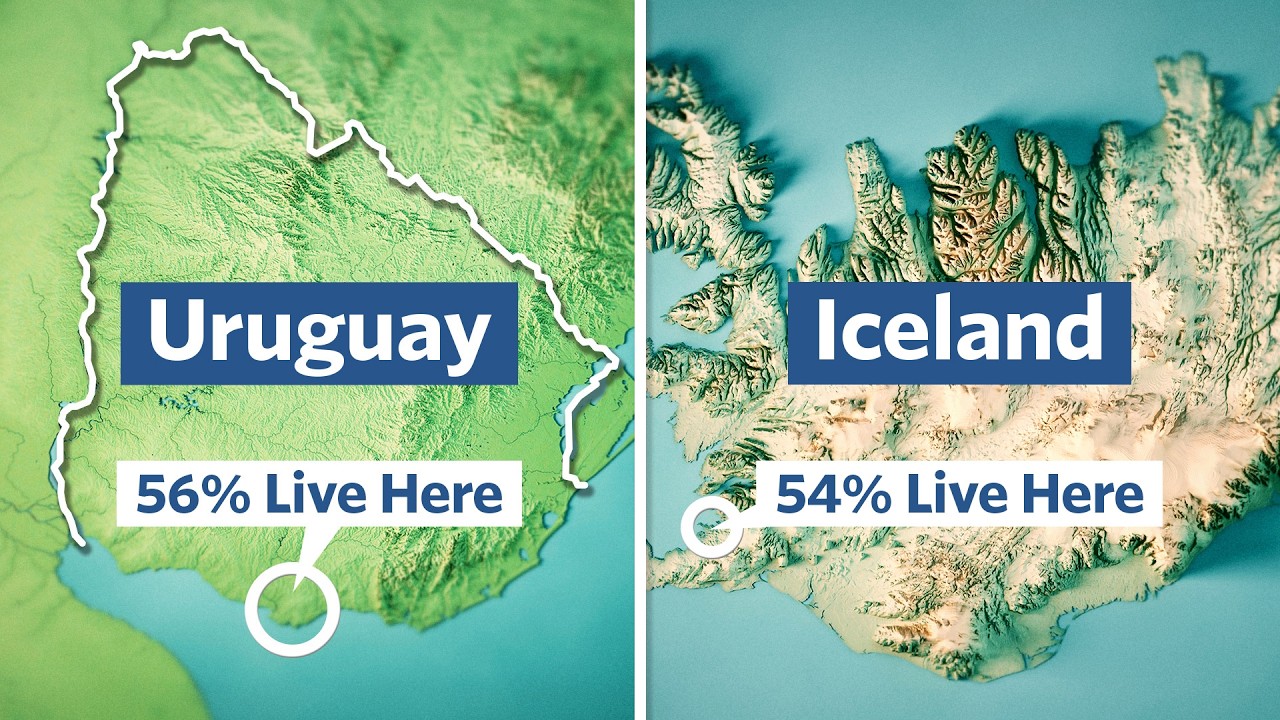
The case of Montevideo is even worse if you consider the larger area called Metroploitan Area which kinda merges with Montevideo to form a larger area where people live and work, those areas are not part of Montevideo but it's neighbor Canelones, in fact those parts of Canelones (along with Maldonado but it's not relevant here) seem to be growing rapidly while people seem to be leaving Montevideo even though they choose to travel to it for work and education which is generating traffic problems because everyone that moved there because it was cheap now needs/wants a car which generates issues for those still living in Montevideo and those that moved now need to travel at a slow pace for a long time at peak hours.
reply
The case of Montevideo is even worse if you consider the larger area called Metroploitan Area which kinda merges with Montevideo to form a larger area where people live and work, those areas are not part of Montevideo but it's neighbor Canelones, in fact those parts of Canelones (along with Maldonado but it's not relevant here) seem to be growing rapidly while people seem to be leaving Montevideo even though they choose to travel to it for work and education which is generating traffic problems because everyone that moved there because it was cheap now needs/wants a car which generates issues for those still living in Montevideo and those that moved now need to travel at a slow pace for a long time at peak hours.
reply
leonhardpauli5815
Super nice video again!
How do primary and non-primary cities change in the context of Europe with the further integrated EU Did the trends change for individual cities
I mean seeing cities in the context of countries’ boarders seems a bit arbitrary, because people are free to move within the EU and are not limited to their initial country. For example I am Austrian, currently living in Copenhagen, Denmark and before I lived in Lisbon, Portugal. Also if one considers the linguistic barriers between the countries it is still not so obvious that Austrian’s first choice would be Vienna, they could as well move to Munich, Hamburg or Berlin etc. and still have pretty much the same language.
reply
Super nice video again!
How do primary and non-primary cities change in the context of Europe with the further integrated EU Did the trends change for individual cities
I mean seeing cities in the context of countries’ boarders seems a bit arbitrary, because people are free to move within the EU and are not limited to their initial country. For example I am Austrian, currently living in Copenhagen, Denmark and before I lived in Lisbon, Portugal. Also if one considers the linguistic barriers between the countries it is still not so obvious that Austrian’s first choice would be Vienna, they could as well move to Munich, Hamburg or Berlin etc. and still have pretty much the same language.
reply
VideobyKB
You could almost say that a lot of state capitals in Australia function very similar to primate cities. Australia is huge, with very few major cities say bigger than 500, 000 population. Most of these cities are in fact state capitals. The most extreme case would certainly be Perth in Western Australia. As of the 2021 census, its population is 2 million, with Bunbury at 75, 000 being the second largest urban centre in the state. The nearest city of over 500, 000 is Adelaide, 2, 600km away. Further, WA has tried to secede from Australia a couple of times. It’s basically its own country, making Perth a primate city functionally.
reply
You could almost say that a lot of state capitals in Australia function very similar to primate cities. Australia is huge, with very few major cities say bigger than 500, 000 population. Most of these cities are in fact state capitals. The most extreme case would certainly be Perth in Western Australia. As of the 2021 census, its population is 2 million, with Bunbury at 75, 000 being the second largest urban centre in the state. The nearest city of over 500, 000 is Adelaide, 2, 600km away. Further, WA has tried to secede from Australia a couple of times. It’s basically its own country, making Perth a primate city functionally.
reply
HitonMusic
i imagine it has something to do with trade. Bigger cities are required to handle more risky, capital intensive businesses, which includes international trade. If the country relies heavily on trade it has to have a city of certain size to handle the industry. And another limitation is that at certain point increasing the city like New York is becoming more expensive and gets less return on investment, especially considering geographic limitations, so there is no point to have one 100 million city, better to have 1 city of 10 million, and spread the rest.
reply
i imagine it has something to do with trade. Bigger cities are required to handle more risky, capital intensive businesses, which includes international trade. If the country relies heavily on trade it has to have a city of certain size to handle the industry. And another limitation is that at certain point increasing the city like New York is becoming more expensive and gets less return on investment, especially considering geographic limitations, so there is no point to have one 100 million city, better to have 1 city of 10 million, and spread the rest.
reply
ElsenyoPol
Spain has always been effectively not a single nation but a forced union of nations against their will. Castilla being the nation that swallowed the rest by force, during their imperial era.
Catalonia is the largest non-Castilian nation within Spain. But there are others, such as the Galician nation or the Euskalherria nation.
If you understand that; you can clearly see that the Castilian-Spain has just one big primate city; Madrid their capital. While Catalonia has also one big primate city, Barcelona, our capital.
reply
Spain has always been effectively not a single nation but a forced union of nations against their will. Castilla being the nation that swallowed the rest by force, during their imperial era.
Catalonia is the largest non-Castilian nation within Spain. But there are others, such as the Galician nation or the Euskalherria nation.
If you understand that; you can clearly see that the Castilian-Spain has just one big primate city; Madrid their capital. While Catalonia has also one big primate city, Barcelona, our capital.
reply
sonebulae
I’ve grown up in Austria and now live in the Netherlands and the difference on how people interact with cities is insane. For my school friends there were really just 2 options: wanna stay closer to your family Graz will do. Wanna be cool and international go to Vienna. Meanwhile dutch students move literally anywhere for studies, based on on own interests and study programes, no one goes to Amsterdam because no one can afford that and if they are able to move out they also never pick the city closest to them.
reply
I’ve grown up in Austria and now live in the Netherlands and the difference on how people interact with cities is insane. For my school friends there were really just 2 options: wanna stay closer to your family Graz will do. Wanna be cool and international go to Vienna. Meanwhile dutch students move literally anywhere for studies, based on on own interests and study programes, no one goes to Amsterdam because no one can afford that and if they are able to move out they also never pick the city closest to them.
reply
Bookworm-re3ou
Using Wikipedia's page for the list of Australian capital cities, I calculated Australia's primacy as 1. 06, which is lower than any other you've mentioned. However, six of the eight states and territories in Australia have cities with over 50% of the jurisdiction's population, and four have over 75% of the jurisdiction's population. Would love to see what each state and territory's primate numbers are, but I also cbb figuring out what the second most populous city is for each of them haha
reply
Using Wikipedia's page for the list of Australian capital cities, I calculated Australia's primacy as 1. 06, which is lower than any other you've mentioned. However, six of the eight states and territories in Australia have cities with over 50% of the jurisdiction's population, and four have over 75% of the jurisdiction's population. Would love to see what each state and territory's primate numbers are, but I also cbb figuring out what the second most populous city is for each of them haha
reply
city_beautiful
The Costa Rica number seems to be incorrect. It looks like whomever made the analysis merged 3/4 province capitals into San Jose (which is the capital of the country.
Costa Rican's look at the central area of the country in a somewhat similar way, since we merge the capitals of the 4 biggest provinces and the regions in the immediate vicinity into a single region that we call Great Metropolitan Area (GAM, but the GAM is not the capital, which can me misleading for this purpose.
reply
The Costa Rica number seems to be incorrect. It looks like whomever made the analysis merged 3/4 province capitals into San Jose (which is the capital of the country.
Costa Rican's look at the central area of the country in a somewhat similar way, since we merge the capitals of the 4 biggest provinces and the regions in the immediate vicinity into a single region that we call Great Metropolitan Area (GAM, but the GAM is not the capital, which can me misleading for this purpose.
reply
pierrehenry8208
About having a lot of primates cities in Latin America it's may be linked to how spain has divided its colonial Empire, and how those colonies organize after Independance. Why not having Costa Rica and Panama together for example
Did Spain give each big city it's own independant colony status rather to group a lot of same size cities in one big colony Did each urban elites choose to be they own country after the independance rather to merge with another city in a country
reply
About having a lot of primates cities in Latin America it's may be linked to how spain has divided its colonial Empire, and how those colonies organize after Independance. Why not having Costa Rica and Panama together for example
Did Spain give each big city it's own independant colony status rather to group a lot of same size cities in one big colony Did each urban elites choose to be they own country after the independance rather to merge with another city in a country
reply
BN. ja05
7: 24 Yeah, but each administrative division (departments & districts in the case of Colombia) still has one large city that's several times larger than the next urban area on the same division, just like it works in Brazil, Venezuela, the USA and most countries. I think an interesting topic on this same field to make a video about would be urban cephalism (cephalization, which affects countries like Uruguay, Peru, Argentina, etc, much more than the countries I mentioned first.
reply
7: 24 Yeah, but each administrative division (departments & districts in the case of Colombia) still has one large city that's several times larger than the next urban area on the same division, just like it works in Brazil, Venezuela, the USA and most countries. I think an interesting topic on this same field to make a video about would be urban cephalism (cephalization, which affects countries like Uruguay, Peru, Argentina, etc, much more than the countries I mentioned first.
reply
miatx
Funny enough. Australia is a example of a rivalry.
Both 1 and 2 biggest cities Sydney and Melbourne both have almost 5, 5 and 5, 3 million people.
But there are some scientists who say no according to these measurements Melbourne is bigger some say Sydney is bigger because of density etc.
Same with Vietnam’s Hanoi and Saigon (Ho Chi Min City) both also have 6-8 million and 8-10 million respectively.
And are also the biggest city in both North and South Vietnam.
reply
Funny enough. Australia is a example of a rivalry.
Both 1 and 2 biggest cities Sydney and Melbourne both have almost 5, 5 and 5, 3 million people.
But there are some scientists who say no according to these measurements Melbourne is bigger some say Sydney is bigger because of density etc.
Same with Vietnam’s Hanoi and Saigon (Ho Chi Min City) both also have 6-8 million and 8-10 million respectively.
And are also the biggest city in both North and South Vietnam.
reply
deanstyles2567
Australia's situation is largely due to the large capital cities having developed pre-Federation.
On a national level the primate number would be small, but for each state (excluding Tasmania and maybe Queensland, the largest city is many times larger than the second largest.
Sydney is around nine or ten times the population of Newcastle, Melbourne is around 20 times the population of Geelong, Adelaide is probably 30-40 times the population of Mt Gambier, etc.
reply
Australia's situation is largely due to the large capital cities having developed pre-Federation.
On a national level the primate number would be small, but for each state (excluding Tasmania and maybe Queensland, the largest city is many times larger than the second largest.
Sydney is around nine or ten times the population of Newcastle, Melbourne is around 20 times the population of Geelong, Adelaide is probably 30-40 times the population of Mt Gambier, etc.
reply
flygonbreloom
I'm glad you bought up sub-national primate cities, because I've been practically screaming at the monitor the entire video that Australia is DEFINED by how utterly centralised on one metropolis it is on a state level. Victoria IS Melbourne, Western Australia IS Perth.
New South Wales and Queensland are the odd exemptions to this (and even then, a lot of people end up considering Newcastle and Wollongong defacto part of Sydney anyway.
reply
I'm glad you bought up sub-national primate cities, because I've been practically screaming at the monitor the entire video that Australia is DEFINED by how utterly centralised on one metropolis it is on a state level. Victoria IS Melbourne, Western Australia IS Perth.
New South Wales and Queensland are the odd exemptions to this (and even then, a lot of people end up considering Newcastle and Wollongong defacto part of Sydney anyway.
reply
swapnilemu9518
DHAKA, Bangladesh is definitely a primate City. but it's primacy number is only 4. explain that in my own explanation, i think this is because bangladesh is one of the densest country in the world, so there's people everywhere. there aren't any big cities other than dhaka, but there are lots of people all over bangladesh and not even living in cities, so that's why it might be low on primacy number or that's straight up a wrong number.
reply
DHAKA, Bangladesh is definitely a primate City. but it's primacy number is only 4. explain that in my own explanation, i think this is because bangladesh is one of the densest country in the world, so there's people everywhere. there aren't any big cities other than dhaka, but there are lots of people all over bangladesh and not even living in cities, so that's why it might be low on primacy number or that's straight up a wrong number.
reply
Evemeister12
India has multiple cities because it's comprised of multiple historical provinces which were once kingdoms in their own right. They had their own populations with their own smaller scale cities at the time. India's terrain is for the most part fertile and its climate suitable for human settlement. It's not dominated by desert like Australia or mountains like chile.
Plus, you cant put 2 billion people into one primate city
reply
India has multiple cities because it's comprised of multiple historical provinces which were once kingdoms in their own right. They had their own populations with their own smaller scale cities at the time. India's terrain is for the most part fertile and its climate suitable for human settlement. It's not dominated by desert like Australia or mountains like chile.
Plus, you cant put 2 billion people into one primate city
reply
penguinva5696
The US is vastly more decentralized than almost all other major countries. That was deliberate. DC is not in or near the largest cities. Most state capitals are not in primate state cities. Industry centers are spread out like Hollywood vs Wall Street vs Silicon Valley. None of the top 5 universities are in New York or Chicago. Most great schools are far from city centers. This has been a big part of US success historically.
reply
The US is vastly more decentralized than almost all other major countries. That was deliberate. DC is not in or near the largest cities. Most state capitals are not in primate state cities. Industry centers are spread out like Hollywood vs Wall Street vs Silicon Valley. None of the top 5 universities are in New York or Chicago. Most great schools are far from city centers. This has been a big part of US success historically.
reply
ayviondenar3461
Is it really a bad thing if a nation has a high primate city number I can probably think of three obvious downsides:
1. Over-centralization of governance, economics, and culture in one city.
2. Over-reliance on that one city; if something catastrophic were to happen to it, the whole country will feel it.
3. The city itself being strained because of having a higher population in relation to other cities.
reply
Is it really a bad thing if a nation has a high primate city number I can probably think of three obvious downsides:
1. Over-centralization of governance, economics, and culture in one city.
2. Over-reliance on that one city; if something catastrophic were to happen to it, the whole country will feel it.
3. The city itself being strained because of having a higher population in relation to other cities.
reply
Add a review, comment
Other channel videos