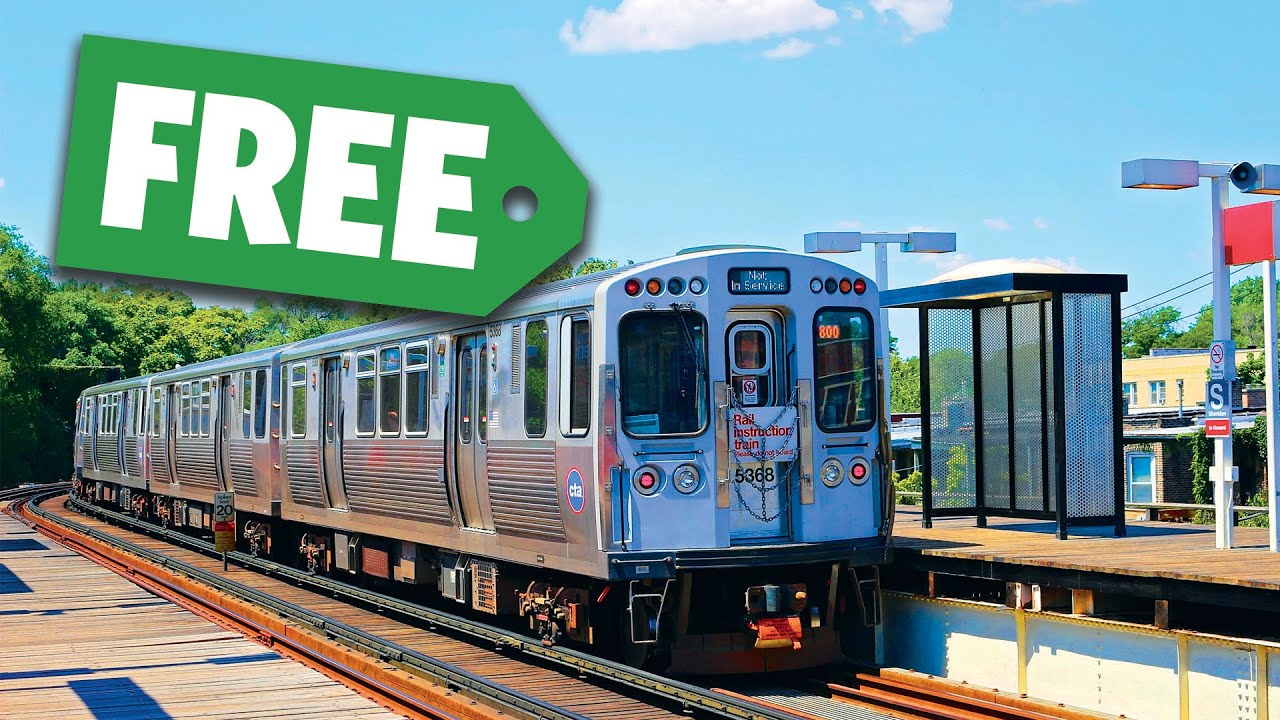
Let's Make Mass Transit Free
video description
Date: 2019-09-12
Related videos




Comments and reviews: 10
DFDalton1962
But roads aren't really free to use, are they? Aside from the obvious tollways and toll bridges, construction and maintenance of roads is supported by gas taxes averaging just under 0. 50 per gallon (combined state and federal tax and much higher for commercial-use diesel. Furthermore, vehicles are licensed for a fee, subjected to sales tax at each transaction and, in many states, assessed yearly title tax based on vehicle value. If all this money isn't directly earmarked for road maintenance it can at least be seen as a return on investment against the cost of building the roads. Seems to me this is a fair system that places the primary burden of cost on road users. (Although, I would agree that users of electric vehicles are getting a relatively free ride and some method must be found to make them pay their way) Since obviously nothing of value can ever really be free, you are suggesting that the burden of building and maintaining public transit systems should be paid primarily by people who don't use it, which is inherently unfair. It would also result in greater waste and corruption because users of poorly-managed systems would never have to face higher fares so the waste can more easily be buried and ignored. Free use would encourage overuse and frivolous use of the systems, meaning more money would have to be spent on expanding capacity and maintenance. I'm amused at how young urban hipster socialists are always eager to have everyone else pay for the things they want (public transit, college tuition, renewable energy, etc, and abolish the things they view as deplorable (suburbs, personal cars, guns, plastic straws, etc.
reply
But roads aren't really free to use, are they? Aside from the obvious tollways and toll bridges, construction and maintenance of roads is supported by gas taxes averaging just under 0. 50 per gallon (combined state and federal tax and much higher for commercial-use diesel. Furthermore, vehicles are licensed for a fee, subjected to sales tax at each transaction and, in many states, assessed yearly title tax based on vehicle value. If all this money isn't directly earmarked for road maintenance it can at least be seen as a return on investment against the cost of building the roads. Seems to me this is a fair system that places the primary burden of cost on road users. (Although, I would agree that users of electric vehicles are getting a relatively free ride and some method must be found to make them pay their way) Since obviously nothing of value can ever really be free, you are suggesting that the burden of building and maintaining public transit systems should be paid primarily by people who don't use it, which is inherently unfair. It would also result in greater waste and corruption because users of poorly-managed systems would never have to face higher fares so the waste can more easily be buried and ignored. Free use would encourage overuse and frivolous use of the systems, meaning more money would have to be spent on expanding capacity and maintenance. I'm amused at how young urban hipster socialists are always eager to have everyone else pay for the things they want (public transit, college tuition, renewable energy, etc, and abolish the things they view as deplorable (suburbs, personal cars, guns, plastic straws, etc.
reply
EpiDemic117
Free Means you are simply moving the Bill Elsewhere (the taxpayers) Also, To some of the commentors below. You are WRONG about the interstate system especially when pretending that it somehow was a huge cost burden on tax payers with no return. Interstate Infrastructure has payed it's self off 10 fold, The only reason why some of it is deteriorating in some states is due to their criminal behavior diverting all of the gas taxes towards unrelated pet projects. Hence why California's Roads are shot to shit and why Most of Nevadas roads despite having a significantly lower tax rates and having virtually no state income tax has squeaky clean and mostly well kept road infra. Oh and there is another last thing I might ad and mention that people seem to forget when favoring public transit over roads. FREIGHT FREIGHT FREIGHT Roads are highly flexible not only used for passenger travel but also bringing you mostly all of the goods/product/services you consume. Let us not forget the truck drivers that keep this country rolling. A better solution for public transportation overall though is to have private companies competing like how it used to be. the result is lower cost tickets, cleaner trains, and better customer service. That's one thing I still don't get with people. Why the hell does the government have to run and maintain public transportation vehicles? They always end up being mismanaged and broke down in the end. Do we expect the government to own and operate airlines? NO Get rid of Amtrak and privatize passenger rail once again.
reply
Free Means you are simply moving the Bill Elsewhere (the taxpayers) Also, To some of the commentors below. You are WRONG about the interstate system especially when pretending that it somehow was a huge cost burden on tax payers with no return. Interstate Infrastructure has payed it's self off 10 fold, The only reason why some of it is deteriorating in some states is due to their criminal behavior diverting all of the gas taxes towards unrelated pet projects. Hence why California's Roads are shot to shit and why Most of Nevadas roads despite having a significantly lower tax rates and having virtually no state income tax has squeaky clean and mostly well kept road infra. Oh and there is another last thing I might ad and mention that people seem to forget when favoring public transit over roads. FREIGHT FREIGHT FREIGHT Roads are highly flexible not only used for passenger travel but also bringing you mostly all of the goods/product/services you consume. Let us not forget the truck drivers that keep this country rolling. A better solution for public transportation overall though is to have private companies competing like how it used to be. the result is lower cost tickets, cleaner trains, and better customer service. That's one thing I still don't get with people. Why the hell does the government have to run and maintain public transportation vehicles? They always end up being mismanaged and broke down in the end. Do we expect the government to own and operate airlines? NO Get rid of Amtrak and privatize passenger rail once again.
reply
KILLKING110
Here's the thing how are you going to pay for free transit the only way to pay for it is to jack up taxes on residents to the point they are essentially broke no joke you can't get something from nothing in other words there has to be a equivalent exchange and public transit needs constant maintenance unlike a highway which only needs occasional maintenance unlike a bus which needs constant maintenance like engine repair, seat repair, graffiti removal, etc. Those may seem like tiny bills let me put it like this an electrical test of a vehicle typically costs 100 then if you were like me had to get new battery that's another 200 or so dollars and the chemicals that can remove permanent markers and spray paint can cost 10 a can so all the so called small costs really build up. It would actually fall under taxation without representation since a majority who actually pay road taxes would have another useless tax to bear. It could be brought into question in the federal government and with the amount of taxes you pay just in things like sugar tax, gas tax, etc which can easily reach to over a 100 small taxes you pay more for those small taxes then what you pay when you file your taxes every year. So until you've seen just how broke a city can get on small things for public transit you don't want to see just how much free public transit would cost and FYI our cops locally are finally new cop cars to replace the 200K mile crown vics and that was a 4 year battle with the city council just to give them the budget to buy the new cars.
reply
Here's the thing how are you going to pay for free transit the only way to pay for it is to jack up taxes on residents to the point they are essentially broke no joke you can't get something from nothing in other words there has to be a equivalent exchange and public transit needs constant maintenance unlike a highway which only needs occasional maintenance unlike a bus which needs constant maintenance like engine repair, seat repair, graffiti removal, etc. Those may seem like tiny bills let me put it like this an electrical test of a vehicle typically costs 100 then if you were like me had to get new battery that's another 200 or so dollars and the chemicals that can remove permanent markers and spray paint can cost 10 a can so all the so called small costs really build up. It would actually fall under taxation without representation since a majority who actually pay road taxes would have another useless tax to bear. It could be brought into question in the federal government and with the amount of taxes you pay just in things like sugar tax, gas tax, etc which can easily reach to over a 100 small taxes you pay more for those small taxes then what you pay when you file your taxes every year. So until you've seen just how broke a city can get on small things for public transit you don't want to see just how much free public transit would cost and FYI our cops locally are finally new cop cars to replace the 200K mile crown vics and that was a 4 year battle with the city council just to give them the budget to buy the new cars.
reply
Vitaly Tomachevski
What I was thinking was to have new technology with access to free personal public transportation. Mix a free public version of Uber payed by taxes with automated self driving cars in vacuum tunnels for long distance and small driver-less lanes for local travel. As time goes by we can fully adopt driver-less cars to a network grid with full safety. The usability is easy. Use an app to access a ride or scheduled or instant. Pick the vehicle type you need, car truck, etc. The computer uses your account you sign up with to keep track of the car you used and history of trips (useful for lost and found things) An automated car arrives to pick you up. You get inside, the car does a security check to make sure its clear to go. For short distance it drives to your destination. For long distance, it takes the express tunnels with checkpoints and safety measure to make sure animals don, t enter. Then it can move and high speeds. At specific times the vehicles will drive back to a checkpoint for a safety and maintenance check. The tunnels will also have an automated safety check after a specific time. It can operate using clean energyAdvantages are: 1. No traffic lights needed = no traffic2. Fewer accidents3. No drunk driving or road rages4. Faster travel5. No need to purchase cars for many6. Cheaper transportation of goods and supplies7. Less polution8. FULL TRANSPORTATION ACCESS FOR ALL (Including non-driving people)
reply
What I was thinking was to have new technology with access to free personal public transportation. Mix a free public version of Uber payed by taxes with automated self driving cars in vacuum tunnels for long distance and small driver-less lanes for local travel. As time goes by we can fully adopt driver-less cars to a network grid with full safety. The usability is easy. Use an app to access a ride or scheduled or instant. Pick the vehicle type you need, car truck, etc. The computer uses your account you sign up with to keep track of the car you used and history of trips (useful for lost and found things) An automated car arrives to pick you up. You get inside, the car does a security check to make sure its clear to go. For short distance it drives to your destination. For long distance, it takes the express tunnels with checkpoints and safety measure to make sure animals don, t enter. Then it can move and high speeds. At specific times the vehicles will drive back to a checkpoint for a safety and maintenance check. The tunnels will also have an automated safety check after a specific time. It can operate using clean energyAdvantages are: 1. No traffic lights needed = no traffic2. Fewer accidents3. No drunk driving or road rages4. Faster travel5. No need to purchase cars for many6. Cheaper transportation of goods and supplies7. Less polution8. FULL TRANSPORTATION ACCESS FOR ALL (Including non-driving people)
reply
evman1396
Look. I love mass transit as much as the next guy but making transit free by adding additional taxes leaves no room for private enterprise. Take Amtrak for example. The federal government is providing money to Amtrak to keep them alive. And more and more everyday Amtrak is approaching true independence by becoming solvent and making a profit. Once that day comes say goodbye to federal funding. The ultimate goal is to transform these public transit systems into privately owned transit systems. Now I would be in favor of handing over transit systems to private enterprise and adding a tax to the local area that transit system serves and giving a 10-20 year deadline to make that transit system solvent. That would be a great idea. But this socialistic approach to mass transit just doesnt chive with me. Roads on the other hand are as essential as police and fire departments and have a greater struggle of being maintained by private enterprise unless its an independent expressway where they can accurately take tolls. Take Japan for example. Japan is the golden standard of how private enterprise has created the best transit system in the world. But roads in local cities are tax funded. Japan is what America should look to for guidance in transforming its local and intercity mass transit systems.
reply
Look. I love mass transit as much as the next guy but making transit free by adding additional taxes leaves no room for private enterprise. Take Amtrak for example. The federal government is providing money to Amtrak to keep them alive. And more and more everyday Amtrak is approaching true independence by becoming solvent and making a profit. Once that day comes say goodbye to federal funding. The ultimate goal is to transform these public transit systems into privately owned transit systems. Now I would be in favor of handing over transit systems to private enterprise and adding a tax to the local area that transit system serves and giving a 10-20 year deadline to make that transit system solvent. That would be a great idea. But this socialistic approach to mass transit just doesnt chive with me. Roads on the other hand are as essential as police and fire departments and have a greater struggle of being maintained by private enterprise unless its an independent expressway where they can accurately take tolls. Take Japan for example. Japan is the golden standard of how private enterprise has created the best transit system in the world. But roads in local cities are tax funded. Japan is what America should look to for guidance in transforming its local and intercity mass transit systems.
reply
BaskingInObscurity
I don't buy the conclusion about inner cities seeing increased vagrancynot in established cities, anyhow, though perhaps in recently-large cities where increased transit as shelter is only just really catching on. The first thing for which a homeless person in a city saves spare change is a monthly transit pass, especially in areas with 24 hour service. Transit provides shelter and mobility. Problem people are problems wherever they go, so the police force should be monitoring uniformly, no pun intended. Misidentifying transit as the culprit for bad behavior is absurd, and it's not up to the general populace to cater to the snootypants that can't rub elbows with the down and out. Nobody wants to rub elbows with an A-hole whether they're homeless or a well-off snob. And your comment that it's a statement about our poor safety net in the US is spot on. My experiences in European countries was that nearly everyone used transit both free and fare (see what I did there) and there is no association with transit access and sociopathic behavior. As usual, we Americans spend too much energy on me-me-me and symptoms-as-causes rather than finding fair solutions to underlying problems.
reply
I don't buy the conclusion about inner cities seeing increased vagrancynot in established cities, anyhow, though perhaps in recently-large cities where increased transit as shelter is only just really catching on. The first thing for which a homeless person in a city saves spare change is a monthly transit pass, especially in areas with 24 hour service. Transit provides shelter and mobility. Problem people are problems wherever they go, so the police force should be monitoring uniformly, no pun intended. Misidentifying transit as the culprit for bad behavior is absurd, and it's not up to the general populace to cater to the snootypants that can't rub elbows with the down and out. Nobody wants to rub elbows with an A-hole whether they're homeless or a well-off snob. And your comment that it's a statement about our poor safety net in the US is spot on. My experiences in European countries was that nearly everyone used transit both free and fare (see what I did there) and there is no association with transit access and sociopathic behavior. As usual, we Americans spend too much energy on me-me-me and symptoms-as-causes rather than finding fair solutions to underlying problems.
reply
Morgan Ahoff
It's a complicated, interrelated issue. What we need is to set it up so that individuals can choose the transportation method that makes the most sense for the trip they're taking. Because car insurance is now a fixed cost, overhead if you will, once a person buys a car they are lost to the public transit system. We need to shift to a system where the more you drive, the more it costs to operate your vehicle. Along with free transit, as you suggest, this would give car owners the option of leaving the car at home when it doesn't make sense to take it, without feeling like they're paying insurance on a car that's parked in their driveway. A good topic for a future video would be that commuting by car often gives people access to higher salaries, in excess of the cost of owning a car. Jobs that are challenging, and offer the opportunity for seniority AND can be accessed by public transit are few and far between (especially in the US. These social and financial pressures have a greater impact on peoples' transportation choices that what they say: I can drive wherever I want, whenever I want. and I don't like crowded busses, full of smelly people.
reply
It's a complicated, interrelated issue. What we need is to set it up so that individuals can choose the transportation method that makes the most sense for the trip they're taking. Because car insurance is now a fixed cost, overhead if you will, once a person buys a car they are lost to the public transit system. We need to shift to a system where the more you drive, the more it costs to operate your vehicle. Along with free transit, as you suggest, this would give car owners the option of leaving the car at home when it doesn't make sense to take it, without feeling like they're paying insurance on a car that's parked in their driveway. A good topic for a future video would be that commuting by car often gives people access to higher salaries, in excess of the cost of owning a car. Jobs that are challenging, and offer the opportunity for seniority AND can be accessed by public transit are few and far between (especially in the US. These social and financial pressures have a greater impact on peoples' transportation choices that what they say: I can drive wherever I want, whenever I want. and I don't like crowded busses, full of smelly people.
reply
Nyanko Sensei
While I think that public transport should be cheap and easily affordable on any budget, Free transport is big nahhh. When people get something for free they perceive it as granted. When they perceive it as granted, they often start to abuse it. And when people starts to abuse it - quality of service falls down. It's like the problem with free parking in reverse: give them free parking and some people will never be able to park a car just for 15 minutes, because all lots will be full of cars of those who live or work nearby for 9 - 12 hours. Same thing here with free transport: it will become overcrowded by people who could just walk to their destination in reasonable time but now have no reason to, and there will be ones who use transport for long distance travel and they will suffer the most from crowded carts. There might be a compromise though. It's mixed free and paid transport. One bus (lets say white) is free, while second one (orange) is paid. 50/50. Balance prices so paid will have available seats. Tax everyone for free buses but then give tax returns to people who where using paid buses. Everyone is happy
reply
While I think that public transport should be cheap and easily affordable on any budget, Free transport is big nahhh. When people get something for free they perceive it as granted. When they perceive it as granted, they often start to abuse it. And when people starts to abuse it - quality of service falls down. It's like the problem with free parking in reverse: give them free parking and some people will never be able to park a car just for 15 minutes, because all lots will be full of cars of those who live or work nearby for 9 - 12 hours. Same thing here with free transport: it will become overcrowded by people who could just walk to their destination in reasonable time but now have no reason to, and there will be ones who use transport for long distance travel and they will suffer the most from crowded carts. There might be a compromise though. It's mixed free and paid transport. One bus (lets say white) is free, while second one (orange) is paid. 50/50. Balance prices so paid will have available seats. Tax everyone for free buses but then give tax returns to people who where using paid buses. Everyone is happy
reply
Shauday Smith
I don't know if free is the right answer, but encouraging riders is definitely important. Free isn't enough incentive for most if the service isn't convenient or comfortable. Many people will still choose to drive their vehicle for the privacy of their own space and the freedom it ultimately allots. If the timetables are the same, but the level of comfort and privacy drop, that's a big deal for most folks who have the option of their own vehicle. My coworker lives in my same hometown and stopped taking the train because of the reasons i listed. lack of privacy with other passengers, time spent commuting was the same, and her mobility was limited to train availability. She would rather pay more and aggravate the deterioration of her car than ride the train (which was free to us through our company partnerships. This mindset needs to change for folks to embrace mass transit. But how does one go about changing hearts and minds on mass transit? Maybe free is one tactic that would be part of a greater campaign to get cars off the road.
reply
I don't know if free is the right answer, but encouraging riders is definitely important. Free isn't enough incentive for most if the service isn't convenient or comfortable. Many people will still choose to drive their vehicle for the privacy of their own space and the freedom it ultimately allots. If the timetables are the same, but the level of comfort and privacy drop, that's a big deal for most folks who have the option of their own vehicle. My coworker lives in my same hometown and stopped taking the train because of the reasons i listed. lack of privacy with other passengers, time spent commuting was the same, and her mobility was limited to train availability. She would rather pay more and aggravate the deterioration of her car than ride the train (which was free to us through our company partnerships. This mindset needs to change for folks to embrace mass transit. But how does one go about changing hearts and minds on mass transit? Maybe free is one tactic that would be part of a greater campaign to get cars off the road.
reply
devonjamesj
Transit is one of the best ways to combat poverty. It allows the working poor to move to affordable neighborhoods or to look for work outside of their limited area. In addition the homeless can now access services they need to move themselves out of poverty. The argument that poor people using is a bad thing is false. A reduction in poverty leads to a reduction in what I call desperate crime. Crimes by people who are desperate. Will these changes take time and will there be some short term pain? Absolutely. But that just stems from most people's short sighted personal agendas. As for financing, it doesn't need to be an immediate transition. In Canada we have this thing called the CPPIB, the Canadian pension plan investment board. It invests excess revenue collected from our social security to ensure future benefits for all retired Canadians. Why not use a similar model to transition to funding the operation of transit not only on a local or regional scale, but a national or even international scale?
reply
Transit is one of the best ways to combat poverty. It allows the working poor to move to affordable neighborhoods or to look for work outside of their limited area. In addition the homeless can now access services they need to move themselves out of poverty. The argument that poor people using is a bad thing is false. A reduction in poverty leads to a reduction in what I call desperate crime. Crimes by people who are desperate. Will these changes take time and will there be some short term pain? Absolutely. But that just stems from most people's short sighted personal agendas. As for financing, it doesn't need to be an immediate transition. In Canada we have this thing called the CPPIB, the Canadian pension plan investment board. It invests excess revenue collected from our social security to ensure future benefits for all retired Canadians. Why not use a similar model to transition to funding the operation of transit not only on a local or regional scale, but a national or even international scale?
reply
Add a review, comment
Other channel videos