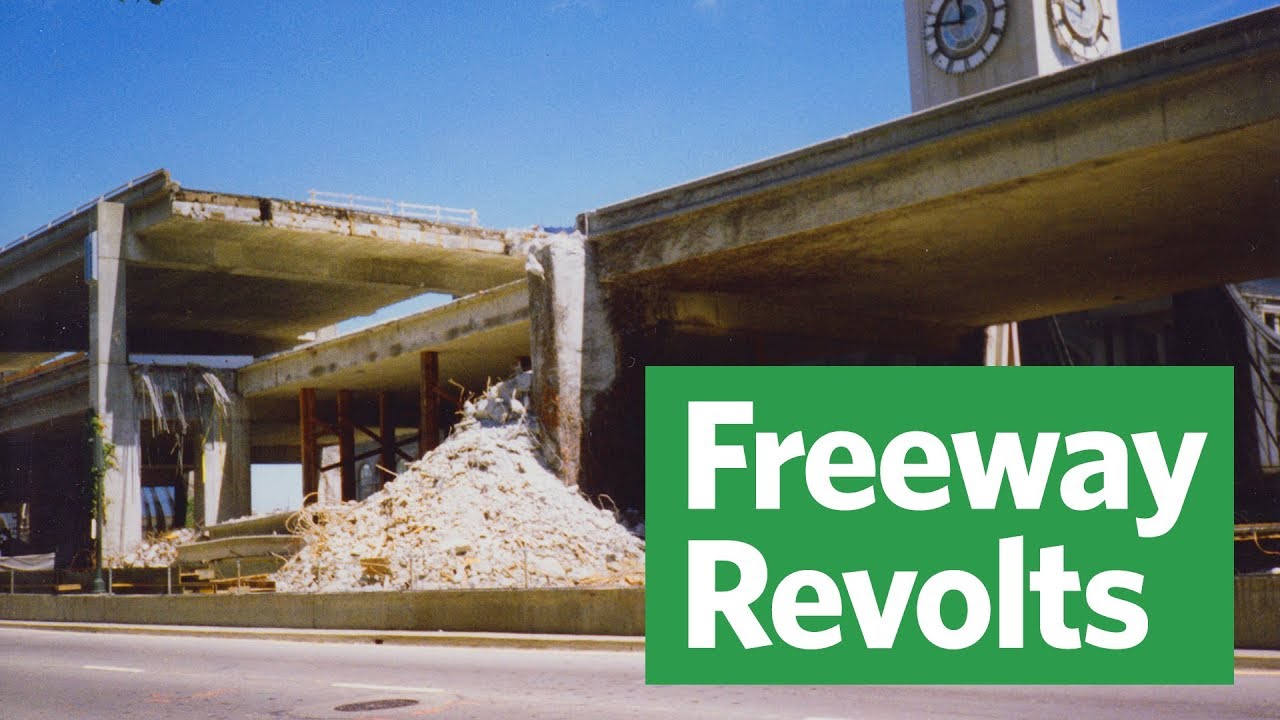
Freeways almost ruined San Francisco
video description
Date: 2019-09-12
Related videos




Comments and reviews: 10
wayne p
an interesting thing my mother told me. that about 3 months prior to the watts riot in the 60s. the plans for the 105 freeway were released. after the riot many of the damaged properties were sold. but my mother who was in real estate said the names on the those properties ownership were bogus. years later mid 70s i overheard my mother talking to governor brown about the issue that the freeways are a bad idea and the tax base is going to move out of the inner city and it will destroy the farms supplying the united states with fresh food. shortly after that phone call governor brown canceled the freeway expansion. i had been writing letters and emails to cal trans about a lane shift on a local interchange that would fix traffic for miles. i happened to include the MTA in one batch of emails. a few months later i got a phone call from mta demanding to know who had told me about the project i had written about. i told him that i wrote the letter/email many times over the past 20+ years. seems the study by caltrans hit every point i mentioned in the letter. but at that time there were no funds to do it. i ask for a project number so i could write an email to president obama to get rapid approval for it. i don't think he believed me. my emails to president obama got new ferry boats funded for washington state and extra fire staff for baker ca on highway 15. some of washington states ferries were over 70 years old and had been previously been in Golden state bridge ferry service.
reply
an interesting thing my mother told me. that about 3 months prior to the watts riot in the 60s. the plans for the 105 freeway were released. after the riot many of the damaged properties were sold. but my mother who was in real estate said the names on the those properties ownership were bogus. years later mid 70s i overheard my mother talking to governor brown about the issue that the freeways are a bad idea and the tax base is going to move out of the inner city and it will destroy the farms supplying the united states with fresh food. shortly after that phone call governor brown canceled the freeway expansion. i had been writing letters and emails to cal trans about a lane shift on a local interchange that would fix traffic for miles. i happened to include the MTA in one batch of emails. a few months later i got a phone call from mta demanding to know who had told me about the project i had written about. i told him that i wrote the letter/email many times over the past 20+ years. seems the study by caltrans hit every point i mentioned in the letter. but at that time there were no funds to do it. i ask for a project number so i could write an email to president obama to get rapid approval for it. i don't think he believed me. my emails to president obama got new ferry boats funded for washington state and extra fire staff for baker ca on highway 15. some of washington states ferries were over 70 years old and had been previously been in Golden state bridge ferry service.
reply
Sly88Frye
San Francisco instead got ruined by being impossibly expensive to live in, being impossible to park your car in, having impossibly expensive parking garages, pedestrians who think they own the road and we'll cross when they aren't supposed to there for nearly causing accidents, having building the pond buildings upon buildings stacked on each other all over the place causing almost every area of the sea to look exactly the same, and not being the only city in the Bay Area at all where you can work in the tech industry there for making sure there is literally no point of ever moving to San Francisco Sadly, people still move there even though all they're going to end up doing it after being homeless or have to leave. I live only an hour North of San Francisco and I honestly hate San Francisco. And this is coming from somebody who definitely leans left politically so don't think that progressives can't hate San Francisco either as I am a Bernie Sanders supporter. Now San Jose on the other hand is far superior. Despite it being a much larger city with a much larger population, it's a lot easier know where you're going there and it's actually more affordable to park somewhere by a lot. It's also more beautiful looking City. San Francisco just has the view, but San Jose has a much nicer City with much better buildings and it's easier to tell where you're going to spite it being larger because they don't make almost the entire sea look exactly the same like San Francisco does.
reply
San Francisco instead got ruined by being impossibly expensive to live in, being impossible to park your car in, having impossibly expensive parking garages, pedestrians who think they own the road and we'll cross when they aren't supposed to there for nearly causing accidents, having building the pond buildings upon buildings stacked on each other all over the place causing almost every area of the sea to look exactly the same, and not being the only city in the Bay Area at all where you can work in the tech industry there for making sure there is literally no point of ever moving to San Francisco Sadly, people still move there even though all they're going to end up doing it after being homeless or have to leave. I live only an hour North of San Francisco and I honestly hate San Francisco. And this is coming from somebody who definitely leans left politically so don't think that progressives can't hate San Francisco either as I am a Bernie Sanders supporter. Now San Jose on the other hand is far superior. Despite it being a much larger city with a much larger population, it's a lot easier know where you're going there and it's actually more affordable to park somewhere by a lot. It's also more beautiful looking City. San Francisco just has the view, but San Jose has a much nicer City with much better buildings and it's easier to tell where you're going to spite it being larger because they don't make almost the entire sea look exactly the same like San Francisco does.
reply
Zeyev
You may have left out a key factor in a particular feature of California law. Unless I'm mistaken. While the State has the power to build a freeway nearly anywhere, only a city (or a City and County as in the case of San Francisco) can block a road or street. All of the plans called for blocking streets so only the local jurisdiction could approve the routes. In other parts of the country, similar local opposition may not have succeeded without the legal authority to tell the State to go blow. I wish the City had not approved what I still call the Alemany Freeway. Although it's a convenient ending to the Junipero Serra Freeway, it - in my opinion - unnecessarily divides neighborhoods on the southern edge of town. Yes, poorer neighborhoods. Its elevated extension served to destroy neighborhoods on the - again - poorer eastern edge of the city. In Washington, D. C, the Federal Government with the backing of the Washington Post was planning to obliterate the remnants of the C&O Canal until Justice Douglas led some of the members of the editorial board on a hike. He changed the position of the Post and they worked to change the opinion of the Government. Clout instead of law. The canal is now a national historical park.
reply
You may have left out a key factor in a particular feature of California law. Unless I'm mistaken. While the State has the power to build a freeway nearly anywhere, only a city (or a City and County as in the case of San Francisco) can block a road or street. All of the plans called for blocking streets so only the local jurisdiction could approve the routes. In other parts of the country, similar local opposition may not have succeeded without the legal authority to tell the State to go blow. I wish the City had not approved what I still call the Alemany Freeway. Although it's a convenient ending to the Junipero Serra Freeway, it - in my opinion - unnecessarily divides neighborhoods on the southern edge of town. Yes, poorer neighborhoods. Its elevated extension served to destroy neighborhoods on the - again - poorer eastern edge of the city. In Washington, D. C, the Federal Government with the backing of the Washington Post was planning to obliterate the remnants of the C&O Canal until Justice Douglas led some of the members of the editorial board on a hike. He changed the position of the Post and they worked to change the opinion of the Government. Clout instead of law. The canal is now a national historical park.
reply
Steven Torrey
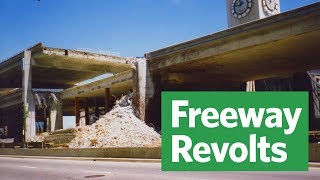
Look at the transit lines now in San Francisco. Instead of Freeways, what are essentially secondary roads now guide cars through the city. Route 1 on 19th Street through Golden Gate Park, where Route 1 is barely noticeable when people walk beneath it, onto Funston Ave to Golden Gate Bridge. Route 101 through Van Ness Avenue to Lombard Street to Golden Gate Bridge. Routes 280 and 80 funneling traffic through Embarcadero. While the aesthetic mess of elevated highways are avoided, the use of secondary roads oftentime means pedestrians crossing those roads take life in hand. Collapse of the Embarcadero Freeway was an urban planning godsend opening a city area that had been an urban dead zone opened to city revitalization of the 6 mile water-front including a stadium for the San Francisco Giants baseball team attracting tourist dollars to the improvement of the city economy. In conclusion, denying the construction of Freeways in the city, preserved the character and personality and soul of the city.
reply
Look at the transit lines now in San Francisco. Instead of Freeways, what are essentially secondary roads now guide cars through the city. Route 1 on 19th Street through Golden Gate Park, where Route 1 is barely noticeable when people walk beneath it, onto Funston Ave to Golden Gate Bridge. Route 101 through Van Ness Avenue to Lombard Street to Golden Gate Bridge. Routes 280 and 80 funneling traffic through Embarcadero. While the aesthetic mess of elevated highways are avoided, the use of secondary roads oftentime means pedestrians crossing those roads take life in hand. Collapse of the Embarcadero Freeway was an urban planning godsend opening a city area that had been an urban dead zone opened to city revitalization of the 6 mile water-front including a stadium for the San Francisco Giants baseball team attracting tourist dollars to the improvement of the city economy. In conclusion, denying the construction of Freeways in the city, preserved the character and personality and soul of the city.
reply
Jake James
Fortunately for where I live, it's not a huge metropolis like San Francisco but still a good sized small city, when interstate 94 was built through it, the city had not yet built that far, so the freeway didnt require any demolition of existing houses. After the freeway was built, that spurred growth around the freeway and made my city what it is today. Then in the 70s, the city decided that a freeway route going to the south of the city was needed, and it was built without destroying a bunch of houses and leaving the river banks alone. Fast forward to today and the city is looking at options to get traffic from the freeway to the north side of town while also not destroying any current housing. I think freeways can be a good option as long as people's lives aren't being messed with. Inner city freeways are a terrible idea unless they existed before the city built around it.
reply
Fortunately for where I live, it's not a huge metropolis like San Francisco but still a good sized small city, when interstate 94 was built through it, the city had not yet built that far, so the freeway didnt require any demolition of existing houses. After the freeway was built, that spurred growth around the freeway and made my city what it is today. Then in the 70s, the city decided that a freeway route going to the south of the city was needed, and it was built without destroying a bunch of houses and leaving the river banks alone. Fast forward to today and the city is looking at options to get traffic from the freeway to the north side of town while also not destroying any current housing. I think freeways can be a good option as long as people's lives aren't being messed with. Inner city freeways are a terrible idea unless they existed before the city built around it.
reply
Peter Albert
You did an impressive job with such a complicated history Even after the 1989 earthquake had damaged the Embarcadero and Central Freeways, there was so residual opposition to removing them. Theyre gone, and youre correct in connecting the expansion of Muni and BART in SF as the direction the city is going. The first two subways in downtown (BART and Muni Metro) were opened in the 1970s and 1980s, a good decade after the Embarcadero freeway was halted. The new Muni Central Subway, roughly tracing one of the abandoned N-S freeway routes, opens in 2019, and Caltrain electrifies and intensifies its old diesel commuter line to Silicon Valley by 2022. In the final nail to the freeway coffin, BART and Caltrain are now planning another tube to run through Downtown and to connect the Peninsula to the East Bay for both rail systems.
reply
You did an impressive job with such a complicated history Even after the 1989 earthquake had damaged the Embarcadero and Central Freeways, there was so residual opposition to removing them. Theyre gone, and youre correct in connecting the expansion of Muni and BART in SF as the direction the city is going. The first two subways in downtown (BART and Muni Metro) were opened in the 1970s and 1980s, a good decade after the Embarcadero freeway was halted. The new Muni Central Subway, roughly tracing one of the abandoned N-S freeway routes, opens in 2019, and Caltrain electrifies and intensifies its old diesel commuter line to Silicon Valley by 2022. In the final nail to the freeway coffin, BART and Caltrain are now planning another tube to run through Downtown and to connect the Peninsula to the East Bay for both rail systems.
reply
craigtorso
I know covering everything is impossible, but some thoughts: - As important as key City Supervisors were, they acted because of public opinion. Many of the key citizen organizers were women (Sue Bierman, Jean Kortum) - The last blows in the freeway battle involved 280 through the city-owned Crystal Springs watershed; theres a GREAT story here involving the city basically trying to go over the states head direct to the White House (if memory serves) - Also, would love to here more about CA freeway revolts prior to SFin particular, Jean Kortums father-in-law helped organize Petaluma chicken ranchers in a successful fight against 101 (which was first delayed and then re-routed as a result) way back in 1948) or so (again, if Im recalling correctly)Not trying to be nit picky. I enjoyed the video and its a topic Im interested in.
reply
I know covering everything is impossible, but some thoughts: - As important as key City Supervisors were, they acted because of public opinion. Many of the key citizen organizers were women (Sue Bierman, Jean Kortum) - The last blows in the freeway battle involved 280 through the city-owned Crystal Springs watershed; theres a GREAT story here involving the city basically trying to go over the states head direct to the White House (if memory serves) - Also, would love to here more about CA freeway revolts prior to SFin particular, Jean Kortums father-in-law helped organize Petaluma chicken ranchers in a successful fight against 101 (which was first delayed and then re-routed as a result) way back in 1948) or so (again, if Im recalling correctly)Not trying to be nit picky. I enjoyed the video and its a topic Im interested in.
reply
GH1618
Heres how I see the criticism: Everybody wants their own route through the city to the places they want to go to be quick and easy. But the catch is that, for others, it will be an obstruction, or will destroy their neighborhood, while doing nothing for their transportation needs. Congestion is inherent in a large city. Adding traffic lanes never reduces congestion generally. When you have a growing population, any traffic lane you build quickly fills up until the congestion is the same as everywhere else. That is because of the atomic nature of individual vehicles. Cars are like molecules in a liquid they flow to fill the available space. A good example is the road which bypasses Portland on the west, connecting US 26 to I-5 south of Portland. I have used that shortcut many times. Often, traffic comes to a dead stop.
reply
Heres how I see the criticism: Everybody wants their own route through the city to the places they want to go to be quick and easy. But the catch is that, for others, it will be an obstruction, or will destroy their neighborhood, while doing nothing for their transportation needs. Congestion is inherent in a large city. Adding traffic lanes never reduces congestion generally. When you have a growing population, any traffic lane you build quickly fills up until the congestion is the same as everywhere else. That is because of the atomic nature of individual vehicles. Cars are like molecules in a liquid they flow to fill the available space. A good example is the road which bypasses Portland on the west, connecting US 26 to I-5 south of Portland. I have used that shortcut many times. Often, traffic comes to a dead stop.
reply
Freek Buttz
Highways through historic cities are just a bad idea. Thats why in Europe, we generally dont have them. However, whats far worse, is that America requires a certain amount of parking spaces per structure, greatly inhibiting the development of closely knit, compact cities in favor of a massive amount of land occupied for 10% by buildings, and 90% by concrete and asphalt. The most beautiful American cities (imo, such as San Francisco, New York and Boston (among many others of course, can no longer be imitated or recreated, as new urban development has to comply to the view of spreading everything out in favor of excessive parking space, leaving people isolated. This might sound logical to an American, but as a European who loves your country dearly, its outrageous and quite sad actually.
reply
Highways through historic cities are just a bad idea. Thats why in Europe, we generally dont have them. However, whats far worse, is that America requires a certain amount of parking spaces per structure, greatly inhibiting the development of closely knit, compact cities in favor of a massive amount of land occupied for 10% by buildings, and 90% by concrete and asphalt. The most beautiful American cities (imo, such as San Francisco, New York and Boston (among many others of course, can no longer be imitated or recreated, as new urban development has to comply to the view of spreading everything out in favor of excessive parking space, leaving people isolated. This might sound logical to an American, but as a European who loves your country dearly, its outrageous and quite sad actually.
reply
ygg drasil
Great video. What happened in San Francisco is an inspiration. Meanwhile Sydney is in an underground tollway building frenzy. Adopting a failed transport mode from 70 years ago. You couldn't make this stuff up. It's not the car companies that own Sydney because Australia doesn't make cars any more, it's the tollroad operators that own the city and prevent much needed new public transport rail lines from being built. Melbourne meanwhile has more sense. They cancelled the Eastwest motorway when the previous government got voted out over the issue and now have a plan to build a huge ring railway system to interconnect all radial suburban rail lines.
reply
Great video. What happened in San Francisco is an inspiration. Meanwhile Sydney is in an underground tollway building frenzy. Adopting a failed transport mode from 70 years ago. You couldn't make this stuff up. It's not the car companies that own Sydney because Australia doesn't make cars any more, it's the tollroad operators that own the city and prevent much needed new public transport rail lines from being built. Melbourne meanwhile has more sense. They cancelled the Eastwest motorway when the previous government got voted out over the issue and now have a plan to build a huge ring railway system to interconnect all radial suburban rail lines.
reply
Add a review, comment
Other channel videos