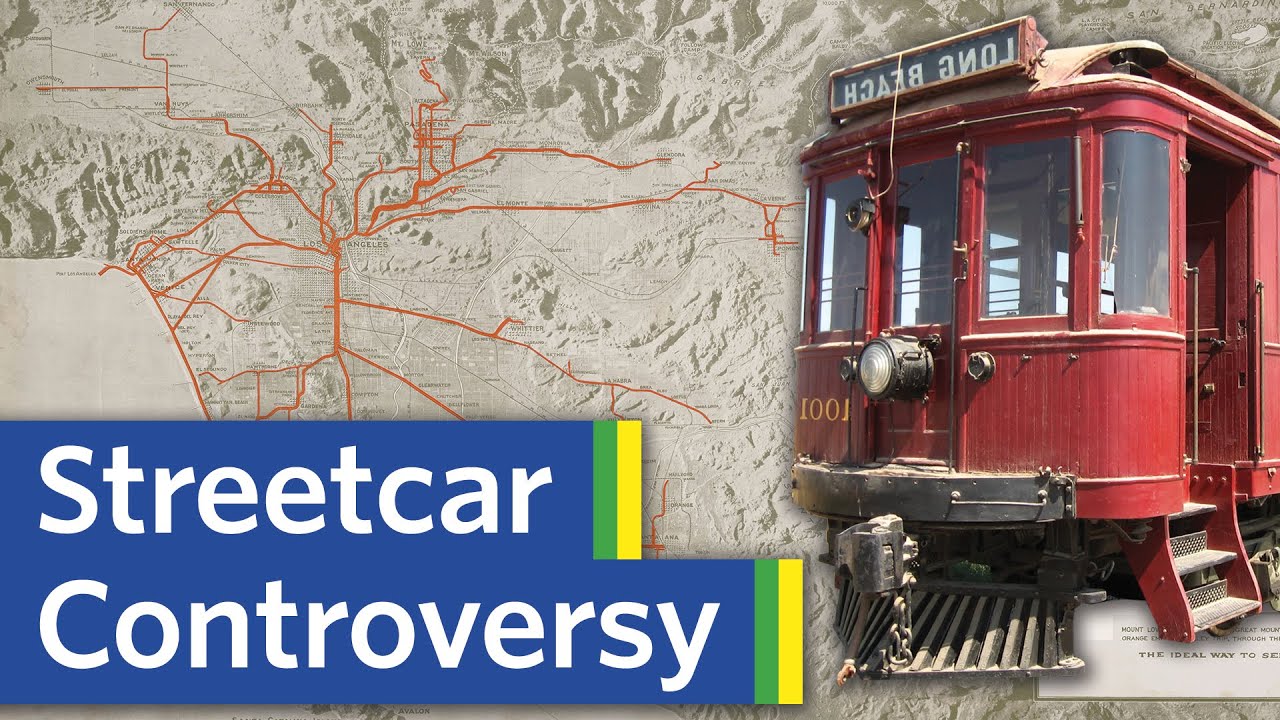
Did GM really kill the streetcar in Los Angeles?
video description
Date: 2019-09-12
Related videos


Comments and reviews: 10
Supadubya
City Beautiful, sometimes your analysis of complex issues is good- but your analysis completely missed the elephant in the room. The reason the streetcars were struggling financially, as you point out (3: 30) is NOT because the transit mode was inherently more expensive than the car (in fact, streetcars were much, much cheaper to operate than personal automobile/road networks) but because they were competing against the SUBSIDIZED roadways automobiles drove on. Consider this: the owner of an automobile didn't have to pay for the roadways (or the cost of road-improvements to make existing roads more driveable and higher-capacity, nor did he have to pay for automobile parking. The roadways were paid for by the local government, which raised the money from property taxes. This meant that, especially in the early days where automobiles still had low market-share in Los Angeles, the government was essentially TAKING money from people who rode the streetcar every day, and GIVING it to the drivers of automobiles- who both drove the demand for, and were the main beneficiaries of, publicly-funded road improvements. This was essentially Theft (as taxation for purposes in neither an individual's interest nor the public good always is, and helped neither the streetcar commuters (who then both had less money to spend on higher streetcar fares to keep the rails and trains in better condition) nor the community as a whole (as subsidizing automobiles by improving roads at public expense massively increased automobile usage, and pollution in the process, despite the streetcar system being cheaper and more cost-effective overall, and drove economic inefficiency. Parking, as I mentioned, also constituted a FURTHER subsidy on automobiles. By instituting zoning laws REQUIRING businesses to add a certain amount of parking, the government created a MASSIVE Unfunded Subsidy on automobiles (only owners of cars benefitted from having this parking- the requirements for which forced far more to be constructed than economic forces of Supply, Demand, and Pricing ever would have caused to have been built- causing most of thos parking to be offered free. Many of these laws were first added in the 1920's and 30's, and the government further compounded the problem by adding often FREE streetside-parking (usually constructed at public expense) in some areas. In short, automobiles DID NOT beat out streetcars because they were a better system or had market-forces on their side. In fact, the streetcars were initially the dominant player in the market and had significant momentum behind their usage: it would have been much simpler and cheaper to have just raised streetcar fares to a point where they were sufficient to adequately maintain the system and turn a tidy profit. The automobiles won out in the end because the government picked and choose winners and losers- the government SUBSIDIZED automobiles (a non-subsidized solution, by contrast, would have placed a heavy tax on car sales and gasoline, and used those revenues to pay for any road improvements and maintenance- of course in that case, few people would have ever bought cars due to their ACTUAL, as opposed to subsidized, cost- and streetcars would have remained dominant) and the price-pressure on streetcars this created prevented their owners from being able to raise fares enough to adequately maintain the system and still turn a respectable profit.
reply
City Beautiful, sometimes your analysis of complex issues is good- but your analysis completely missed the elephant in the room. The reason the streetcars were struggling financially, as you point out (3: 30) is NOT because the transit mode was inherently more expensive than the car (in fact, streetcars were much, much cheaper to operate than personal automobile/road networks) but because they were competing against the SUBSIDIZED roadways automobiles drove on. Consider this: the owner of an automobile didn't have to pay for the roadways (or the cost of road-improvements to make existing roads more driveable and higher-capacity, nor did he have to pay for automobile parking. The roadways were paid for by the local government, which raised the money from property taxes. This meant that, especially in the early days where automobiles still had low market-share in Los Angeles, the government was essentially TAKING money from people who rode the streetcar every day, and GIVING it to the drivers of automobiles- who both drove the demand for, and were the main beneficiaries of, publicly-funded road improvements. This was essentially Theft (as taxation for purposes in neither an individual's interest nor the public good always is, and helped neither the streetcar commuters (who then both had less money to spend on higher streetcar fares to keep the rails and trains in better condition) nor the community as a whole (as subsidizing automobiles by improving roads at public expense massively increased automobile usage, and pollution in the process, despite the streetcar system being cheaper and more cost-effective overall, and drove economic inefficiency. Parking, as I mentioned, also constituted a FURTHER subsidy on automobiles. By instituting zoning laws REQUIRING businesses to add a certain amount of parking, the government created a MASSIVE Unfunded Subsidy on automobiles (only owners of cars benefitted from having this parking- the requirements for which forced far more to be constructed than economic forces of Supply, Demand, and Pricing ever would have caused to have been built- causing most of thos parking to be offered free. Many of these laws were first added in the 1920's and 30's, and the government further compounded the problem by adding often FREE streetside-parking (usually constructed at public expense) in some areas. In short, automobiles DID NOT beat out streetcars because they were a better system or had market-forces on their side. In fact, the streetcars were initially the dominant player in the market and had significant momentum behind their usage: it would have been much simpler and cheaper to have just raised streetcar fares to a point where they were sufficient to adequately maintain the system and turn a tidy profit. The automobiles won out in the end because the government picked and choose winners and losers- the government SUBSIDIZED automobiles (a non-subsidized solution, by contrast, would have placed a heavy tax on car sales and gasoline, and used those revenues to pay for any road improvements and maintenance- of course in that case, few people would have ever bought cars due to their ACTUAL, as opposed to subsidized, cost- and streetcars would have remained dominant) and the price-pressure on streetcars this created prevented their owners from being able to raise fares enough to adequately maintain the system and still turn a respectable profit.
reply
hebneh
The city where I live had a streetcar system beginning in 1901. but it ended all streetcars in 1941. They were replaced by both regular buses and electric buses (trolley buses, which in turn ended in 1957. GM was never involved in any of this. So why did it happen? A number of reasons: 1) An electric system required, first, a separate generating plant, as well as the network of overhead wires for every route; the streetcars also required tracks to be installed and maintained. Why deal with all this expense when a fleet of diesel buses just runs on the same roads as everything else, and doesn't need any additional equipment? 2) Streetcars on tracks are absolutely fixed in place. They cannot go around an unexpected obstacle (like a fallen tree) nor can they stop quickly or swerve to avoid a collision. And when such a thing happens, all other streetcars on this route will eventually be forced to stop till the problem is cleared up. They can't be detoured to avoid it. Electric buses at least can move from the center of the street to the sidewalk to pick or drop off riders, but they too are forced to stay attached to the overhead wires. If that connection is lost, they're stopped dead. 3) Streetcars run in the center of the street. All passengers therefore have to cross active lanes of traffic to get to them. Originally there was no accommodation for this; in some cases people were forced to literally stand on the road among moving vehicles to wait to be picked up. And getting off was extremely dangerous in that a passing car could run a person over in a flash when they stepped into the street unexpectedly from the stopped streetcar. 4) Unlike elevated systems or subways, streetcars are subject to the same stopped traffic as everything else if they aren't in a dedicated right of way that's separated from other vehicles. And that became a major problem for streetcars in many American cities, in some cases even before there were any cars at all. In downtown Los Angeles in the 1920s, parking was banned specifically because it was interfering with the operation of the streetcars; this was immediately denounced and rejected by all the merchants who suffered a quick loss of customers who stopped coming since there was nowhere to park. So the traffic returned to being jammed. This is not to say that electric streetcars are worthless - but their demise in most American cities isn't mysterious when you consider everything I just wrote.
reply
The city where I live had a streetcar system beginning in 1901. but it ended all streetcars in 1941. They were replaced by both regular buses and electric buses (trolley buses, which in turn ended in 1957. GM was never involved in any of this. So why did it happen? A number of reasons: 1) An electric system required, first, a separate generating plant, as well as the network of overhead wires for every route; the streetcars also required tracks to be installed and maintained. Why deal with all this expense when a fleet of diesel buses just runs on the same roads as everything else, and doesn't need any additional equipment? 2) Streetcars on tracks are absolutely fixed in place. They cannot go around an unexpected obstacle (like a fallen tree) nor can they stop quickly or swerve to avoid a collision. And when such a thing happens, all other streetcars on this route will eventually be forced to stop till the problem is cleared up. They can't be detoured to avoid it. Electric buses at least can move from the center of the street to the sidewalk to pick or drop off riders, but they too are forced to stay attached to the overhead wires. If that connection is lost, they're stopped dead. 3) Streetcars run in the center of the street. All passengers therefore have to cross active lanes of traffic to get to them. Originally there was no accommodation for this; in some cases people were forced to literally stand on the road among moving vehicles to wait to be picked up. And getting off was extremely dangerous in that a passing car could run a person over in a flash when they stepped into the street unexpectedly from the stopped streetcar. 4) Unlike elevated systems or subways, streetcars are subject to the same stopped traffic as everything else if they aren't in a dedicated right of way that's separated from other vehicles. And that became a major problem for streetcars in many American cities, in some cases even before there were any cars at all. In downtown Los Angeles in the 1920s, parking was banned specifically because it was interfering with the operation of the streetcars; this was immediately denounced and rejected by all the merchants who suffered a quick loss of customers who stopped coming since there was nowhere to park. So the traffic returned to being jammed. This is not to say that electric streetcars are worthless - but their demise in most American cities isn't mysterious when you consider everything I just wrote.
reply
S Tho
The story you just told does match everything I have read, that was not written by someone with excessive rail nostalgia, or a modern only cars made sprawl writer. The sprawl all over the western world was already there before the 1920s. Streetcars and light rail created it as the horse streetcar was replaced with motorized ones. Pacific Electric and their parent company The Southern Pacific RR were a monopoly that LA residents and the Tribune called The Octopus. They pushed car lines out to worthless land they owned, making that land attractive. Similar companies did the same thing in NY, Chicago, New Orleans, Mobile, Pittsburgh. They even built amusement parks at line ends to lure out prospective home buyers. They discouraged business and residency in Central City. Following WWII most of that land had been sold by Pacific Electric or sold as military bases in WWII (especially the now worthless amusement parks. Streetcar riding in the US was seldom as nice as most imagine. My Dad said it was usually slow, erratic, overcrowded, dirty and fights would break out. In the 1950s Pacific Electric (a private company) wanted a tax from the people to revive the broken down system, but they would keep the profits from ridership. The people voted that down in favor of street widening projects and freeways. For a few years the car method relieved a lot of stress caused by the insane valley to ocean sprawl of unrelated cities. By the late 69s though, the success of Southern California again caught up with its infrastructure. The Red Car could probably not be saved as the cost of extending lines, buying new equipment, union operators AS WELL AS paving roads to these same places could not be sustained. The line had deteriorated too far, and too many people felt it was the conspiracy. Cars were how the wealthy had travelled, and so average people wanted that too. As to the joys of overpopulated streetcar riding in the olden days, take a look at the silent film It, about 15 minutes in. Ask yourself, would you ride the streetcar or bus, if a car was waiting?
reply
The story you just told does match everything I have read, that was not written by someone with excessive rail nostalgia, or a modern only cars made sprawl writer. The sprawl all over the western world was already there before the 1920s. Streetcars and light rail created it as the horse streetcar was replaced with motorized ones. Pacific Electric and their parent company The Southern Pacific RR were a monopoly that LA residents and the Tribune called The Octopus. They pushed car lines out to worthless land they owned, making that land attractive. Similar companies did the same thing in NY, Chicago, New Orleans, Mobile, Pittsburgh. They even built amusement parks at line ends to lure out prospective home buyers. They discouraged business and residency in Central City. Following WWII most of that land had been sold by Pacific Electric or sold as military bases in WWII (especially the now worthless amusement parks. Streetcar riding in the US was seldom as nice as most imagine. My Dad said it was usually slow, erratic, overcrowded, dirty and fights would break out. In the 1950s Pacific Electric (a private company) wanted a tax from the people to revive the broken down system, but they would keep the profits from ridership. The people voted that down in favor of street widening projects and freeways. For a few years the car method relieved a lot of stress caused by the insane valley to ocean sprawl of unrelated cities. By the late 69s though, the success of Southern California again caught up with its infrastructure. The Red Car could probably not be saved as the cost of extending lines, buying new equipment, union operators AS WELL AS paving roads to these same places could not be sustained. The line had deteriorated too far, and too many people felt it was the conspiracy. Cars were how the wealthy had travelled, and so average people wanted that too. As to the joys of overpopulated streetcar riding in the olden days, take a look at the silent film It, about 15 minutes in. Ask yourself, would you ride the streetcar or bus, if a car was waiting?
reply
btomimatsucunard
seems like the Los Angeles railway and the pe got a little mashed in here with some info. The two companies were created in 1911 to stop a turf war between Huntingtons interests and the interests of Southern Pacifics Harriman. Coming out of the great merger of 1911, Huntington and his estate got the LA yellow cars (Los Angeles railway) and Harriman and the SP got the big red cars. It remained like this until 46 when Huntingtons estate sold their shares in the LA railway and metropolitan coach lines moved in. The PE and their parent company the SP held on until the early 50s, with the PE having varying amounts of abandonments under their banner, the biggest being the conversions of their northern district (to Pasadena and the foothills), and the Venice Short Line out to the west side and Santa Monica. Metropolitan coach lines assumed passenger operations for the PE, and further abandoned the last of the eastern district trains, the Hollywood and Santa Monica blvd lines, the line to No Ho, and the lines to Glendale and Burbank. The tracks werent immediately torn up, and PE and later SP maintained old PE lines for freight use, many of which passed to Metro later on. Metros early predecessor took over in the late 50s and maintained the remaining streetcar lines of the yellow cars and red cars until the early 60s when they abandoned them for cost, and reportedly for a dispute between them and the SP ( the Long Beach and San Pedro lines. Additionally the reason Ive heard why many early attempts to create a rapid transit network in la between 1925 and 1947 was because each plan basically gave City money to improve the private PE, which wasnt very popular with voters. After that LA wouldnt have the desire to pass legislation like that until measure A in 1980. The history of LA transit really reads like a soap opera and is a great thing to look into if you want to see the past and possible future of how to build transit in the USA.
reply
seems like the Los Angeles railway and the pe got a little mashed in here with some info. The two companies were created in 1911 to stop a turf war between Huntingtons interests and the interests of Southern Pacifics Harriman. Coming out of the great merger of 1911, Huntington and his estate got the LA yellow cars (Los Angeles railway) and Harriman and the SP got the big red cars. It remained like this until 46 when Huntingtons estate sold their shares in the LA railway and metropolitan coach lines moved in. The PE and their parent company the SP held on until the early 50s, with the PE having varying amounts of abandonments under their banner, the biggest being the conversions of their northern district (to Pasadena and the foothills), and the Venice Short Line out to the west side and Santa Monica. Metropolitan coach lines assumed passenger operations for the PE, and further abandoned the last of the eastern district trains, the Hollywood and Santa Monica blvd lines, the line to No Ho, and the lines to Glendale and Burbank. The tracks werent immediately torn up, and PE and later SP maintained old PE lines for freight use, many of which passed to Metro later on. Metros early predecessor took over in the late 50s and maintained the remaining streetcar lines of the yellow cars and red cars until the early 60s when they abandoned them for cost, and reportedly for a dispute between them and the SP ( the Long Beach and San Pedro lines. Additionally the reason Ive heard why many early attempts to create a rapid transit network in la between 1925 and 1947 was because each plan basically gave City money to improve the private PE, which wasnt very popular with voters. After that LA wouldnt have the desire to pass legislation like that until measure A in 1980. The history of LA transit really reads like a soap opera and is a great thing to look into if you want to see the past and possible future of how to build transit in the USA.
reply
l wilton
I believe that you have the red cars (PE) and the normal streetcars confused in several ways. HH created the PE, and eventually sold it to the Southern Pacific Railroad. It was a standard gage line (4' 8. 5, and was an inter-urban, not an urban line. After he sold the PE, he used the money to buy a number of normal urban streetcar lines, which were 3' narrow gage, and only ran in LA and very nearby cities. It was this line that was eventually sold in the way you describe. Both the PE and the streetcar lines were used to open new lands to development, and both suffered as you described. The PE had additional problems. It actually made most of its revenue carrying freight, not passengers. But it was now owned by one of its direct competitors, the SP Railroad. As you might expect, the SP was not happy with the competition, and treated the PE as a poor stepchild. As you note, maintenance suffered, and the ancient cars became less desirable to ride. The closed off divisions as quickly as they could. The Northern divisions were finished when the 10 Freeway was built just south of Union Station, cutting the PE line from the Northern division to the PE building on 6th Street. The Southern divisions lasted a few years longer, but not much. The PE attempted to replace routes with busses with minimal success. The green car streetcar line had better luck with first trolley buses and then regular busses. Eventually these lines all became the MTA, which still runs a few bus lines, but for decades tried their best not to. In a practical sense the cars and trucks doomed all of these street-running rail lines simply by creating so much congestion on the streets that the rail-based assets simply had no room to move. That had come as a problem fairly early for the PE, resulting in the mile-long subway from 6th street to the northwest, getting a significant number of cars off 6th street.
reply
I believe that you have the red cars (PE) and the normal streetcars confused in several ways. HH created the PE, and eventually sold it to the Southern Pacific Railroad. It was a standard gage line (4' 8. 5, and was an inter-urban, not an urban line. After he sold the PE, he used the money to buy a number of normal urban streetcar lines, which were 3' narrow gage, and only ran in LA and very nearby cities. It was this line that was eventually sold in the way you describe. Both the PE and the streetcar lines were used to open new lands to development, and both suffered as you described. The PE had additional problems. It actually made most of its revenue carrying freight, not passengers. But it was now owned by one of its direct competitors, the SP Railroad. As you might expect, the SP was not happy with the competition, and treated the PE as a poor stepchild. As you note, maintenance suffered, and the ancient cars became less desirable to ride. The closed off divisions as quickly as they could. The Northern divisions were finished when the 10 Freeway was built just south of Union Station, cutting the PE line from the Northern division to the PE building on 6th Street. The Southern divisions lasted a few years longer, but not much. The PE attempted to replace routes with busses with minimal success. The green car streetcar line had better luck with first trolley buses and then regular busses. Eventually these lines all became the MTA, which still runs a few bus lines, but for decades tried their best not to. In a practical sense the cars and trucks doomed all of these street-running rail lines simply by creating so much congestion on the streets that the rail-based assets simply had no room to move. That had come as a problem fairly early for the PE, resulting in the mile-long subway from 6th street to the northwest, getting a significant number of cars off 6th street.
reply
Mikey
Why would transit lines raise the property value if no one cared to use them? The fact that people moved there specifically because of the the transit lines should speak volumes of proof to their value. The fact that one of the largest C a r M a n u f a c t u r e r s happened to buy the street cars and cared so little about maintain them that people stopped wanting to use them says less about the street car and more about the interest of the company which purchased them. The most expensive part about street cars was L a y ing the tracks so it doesn't make much sense why GM would make such a short sighted decision to just _ stop_ maintaining the carts if keeping a nice little streetcar business was what really interested them. It's not so much I think Gm had bad intentions when they purchased the biggest obstacle to people buying their cars(alternative transport) -then left them to rot, but it would seem odd that after quietly removing them from operation; even though any reasonable company might try to sell anything of value to recoup some of their losses, GM didn't quite try that. Here the largest auto manufacturer of the time, after innocently coming to own all the now somehow defunct street cars, had a question on their hands of what to do with the little carts that people in the cities liked so much better than buying expensive, congestive automobiles. What did they do. And it wasn't just L. A. Its a conspiracy, but one of that unfortunate kind that happen to be true. I'm sure we will come to remember just how incredibly important public transport is to the health and well-being of not just the city but the people in them, but until then I think we should at least do our best not buy into lies GM and other auto manufacturers told ages ago that brought us to a hyper-congestive, hyper- polluted state.
reply
Why would transit lines raise the property value if no one cared to use them? The fact that people moved there specifically because of the the transit lines should speak volumes of proof to their value. The fact that one of the largest C a r M a n u f a c t u r e r s happened to buy the street cars and cared so little about maintain them that people stopped wanting to use them says less about the street car and more about the interest of the company which purchased them. The most expensive part about street cars was L a y ing the tracks so it doesn't make much sense why GM would make such a short sighted decision to just _ stop_ maintaining the carts if keeping a nice little streetcar business was what really interested them. It's not so much I think Gm had bad intentions when they purchased the biggest obstacle to people buying their cars(alternative transport) -then left them to rot, but it would seem odd that after quietly removing them from operation; even though any reasonable company might try to sell anything of value to recoup some of their losses, GM didn't quite try that. Here the largest auto manufacturer of the time, after innocently coming to own all the now somehow defunct street cars, had a question on their hands of what to do with the little carts that people in the cities liked so much better than buying expensive, congestive automobiles. What did they do. And it wasn't just L. A. Its a conspiracy, but one of that unfortunate kind that happen to be true. I'm sure we will come to remember just how incredibly important public transport is to the health and well-being of not just the city but the people in them, but until then I think we should at least do our best not buy into lies GM and other auto manufacturers told ages ago that brought us to a hyper-congestive, hyper- polluted state.
reply
Call Me Swivel Hips
I'm reading a book right now that goes into depth on this topic. It's called Crabgrass Frontier: The Suburbanization of the United States. It starts at the beginning of the 19th century and works it's way forward. IT'S FASCINATING. I especially love how the author, Kenneth T Jackson, compares development in Europe to that in America in order to illustrate the cause and effect of why we have urban sprawl and Europe doesn't. In short, the United States is a new country, and a big one. We have lots of empty land, something Europe doesn't have. The fact their cities are so old means many of them were originally built as walking cities, and so are very dense. This means mass transit development happened under very different circumstances there than here, especially when considering the effect of the World Wars, which happened right in the middle of newer mass transit technology developments. There was definitely concerted effort to convert streetcar lines to buslines, and to build our road infrastructure, for the express purpose of profit. But it's also a fact that in the 19th century, this country was almost completely undeveloped. It shouldn't be surprising, as a result, that there was such a drive to develop. Which, of course, can potentially lead to sloppy results. My point here is that our infrastructure and urban design both have so much untapped potential. Whats the term. retrofitting?
reply
I'm reading a book right now that goes into depth on this topic. It's called Crabgrass Frontier: The Suburbanization of the United States. It starts at the beginning of the 19th century and works it's way forward. IT'S FASCINATING. I especially love how the author, Kenneth T Jackson, compares development in Europe to that in America in order to illustrate the cause and effect of why we have urban sprawl and Europe doesn't. In short, the United States is a new country, and a big one. We have lots of empty land, something Europe doesn't have. The fact their cities are so old means many of them were originally built as walking cities, and so are very dense. This means mass transit development happened under very different circumstances there than here, especially when considering the effect of the World Wars, which happened right in the middle of newer mass transit technology developments. There was definitely concerted effort to convert streetcar lines to buslines, and to build our road infrastructure, for the express purpose of profit. But it's also a fact that in the 19th century, this country was almost completely undeveloped. It shouldn't be surprising, as a result, that there was such a drive to develop. Which, of course, can potentially lead to sloppy results. My point here is that our infrastructure and urban design both have so much untapped potential. Whats the term. retrofitting?
reply
Supadubya
3: 50 it emerged from the fact that buses only required one operatorBULL#/T. Look below the bus What is the freakin' pollution-spewing monstrosity driving on? A ROAD. BUILT AND MAINTAINED AT PUBLIC EXPENSE You focus your attention on the bus itself, and you miss the fact that how what's beneath its wheels is paid for is the single most important factor in this equationTHAT is why buses were more affordable (at sticker-price, but not in truth) than streetcars. No other reason is needed. The vast, vast majority of the costs of owning and operating a bus were not, and are not, paid for by the bus owner or its passengers. They are paid by the local community. By contrast, a streetcar company had to pay to build and maintain its own tracks. And even if they did not, the tracks a streetcar operates on actually represent proportionally LESS of the operating costs of the system as a whole than do the cost of roads for a bus or car system. Cars and buses were heavily subsidized. By public roads. By public parking, and Mandatory Parking Minimums. By not having to pay for the damage caused by the exhaust coming out their tailpipe. And by wars and expensive diplomatic distortions (for instance befriending oil-rich dictatorships like Saudi Arabia that otherwise oppose our interests) that are not paid for by motorists at the pump, by a high Gas Tax or high tariffs on foreign oil.
reply
3: 50 it emerged from the fact that buses only required one operatorBULL#/T. Look below the bus What is the freakin' pollution-spewing monstrosity driving on? A ROAD. BUILT AND MAINTAINED AT PUBLIC EXPENSE You focus your attention on the bus itself, and you miss the fact that how what's beneath its wheels is paid for is the single most important factor in this equationTHAT is why buses were more affordable (at sticker-price, but not in truth) than streetcars. No other reason is needed. The vast, vast majority of the costs of owning and operating a bus were not, and are not, paid for by the bus owner or its passengers. They are paid by the local community. By contrast, a streetcar company had to pay to build and maintain its own tracks. And even if they did not, the tracks a streetcar operates on actually represent proportionally LESS of the operating costs of the system as a whole than do the cost of roads for a bus or car system. Cars and buses were heavily subsidized. By public roads. By public parking, and Mandatory Parking Minimums. By not having to pay for the damage caused by the exhaust coming out their tailpipe. And by wars and expensive diplomatic distortions (for instance befriending oil-rich dictatorships like Saudi Arabia that otherwise oppose our interests) that are not paid for by motorists at the pump, by a high Gas Tax or high tariffs on foreign oil.
reply
Apatheism
This is one of the reasons why I love my city so much. Ranked the worlds largest Tram network in the world, no wonder why Melbourne has also consistently ranked among the top, if not THE most livable city in the world for year after year without fail. So proud of Melbourne. Sure its not perfect. Its become extremely expensive. Its recently fallen into a crime wave and resembling more like Gotham city. But still. great place. Every other city in Australia is either rebuilding or extending their tram networks after they all shut down in the 70s. Everywhere thats rebuilding their tram network is exactly the same; at first the entire community complains about the cost, the loss of income and interruption of trade during lengthy construction. But they ALL praise their new light rail systems once theyre up and running. It transforms the community. F highways. Build light rail and bike lanes everywhere. With exception to delivery trucks, couriers, ride sharing and public transports systems I believe all cars should be banned from all cities. Its so easy to get around Melbourne with light rail. It would be much faster and smoother if it werent slowed down by cars everyday.
reply
This is one of the reasons why I love my city so much. Ranked the worlds largest Tram network in the world, no wonder why Melbourne has also consistently ranked among the top, if not THE most livable city in the world for year after year without fail. So proud of Melbourne. Sure its not perfect. Its become extremely expensive. Its recently fallen into a crime wave and resembling more like Gotham city. But still. great place. Every other city in Australia is either rebuilding or extending their tram networks after they all shut down in the 70s. Everywhere thats rebuilding their tram network is exactly the same; at first the entire community complains about the cost, the loss of income and interruption of trade during lengthy construction. But they ALL praise their new light rail systems once theyre up and running. It transforms the community. F highways. Build light rail and bike lanes everywhere. With exception to delivery trucks, couriers, ride sharing and public transports systems I believe all cars should be banned from all cities. Its so easy to get around Melbourne with light rail. It would be much faster and smoother if it werent slowed down by cars everyday.
reply
R Nanjappa
This is an interesting presentation. We are experiencing this now in India: the invasion of private cars/automobiles at the cost of public transport. Our cities and towns are so congested, there is not even space to park the vehicles, but the craze for the car goes on, as it is a status-symbol for the emerging rich or higher middle class. Before that, the bus companies bribed their way to curb other means of mass transit, like the tram or the water canal in Madras. Now, there is a craze for building elevated metro light trains, at huge cost. But, for our bulging population, mindless expansion of urban conurbations and idiotic housing patterns housing thousands in high rise buildings in small space demolishing the old sprawling buildings with garden space around, nothing will work; any so called modern solution will only worsen the situation, and add to the tax burden, while benefiting private contractors, politicians, corrupt bureaucrats, etc. Thousands of fully grown trees are senselessly cut to make way for the modern metro monster, while school children are routinely told about the value of trees This video made for interesting viewing. Thank you.
reply
This is an interesting presentation. We are experiencing this now in India: the invasion of private cars/automobiles at the cost of public transport. Our cities and towns are so congested, there is not even space to park the vehicles, but the craze for the car goes on, as it is a status-symbol for the emerging rich or higher middle class. Before that, the bus companies bribed their way to curb other means of mass transit, like the tram or the water canal in Madras. Now, there is a craze for building elevated metro light trains, at huge cost. But, for our bulging population, mindless expansion of urban conurbations and idiotic housing patterns housing thousands in high rise buildings in small space demolishing the old sprawling buildings with garden space around, nothing will work; any so called modern solution will only worsen the situation, and add to the tax burden, while benefiting private contractors, politicians, corrupt bureaucrats, etc. Thousands of fully grown trees are senselessly cut to make way for the modern metro monster, while school children are routinely told about the value of trees This video made for interesting viewing. Thank you.
reply
Add a review, comment
Other channel videos