
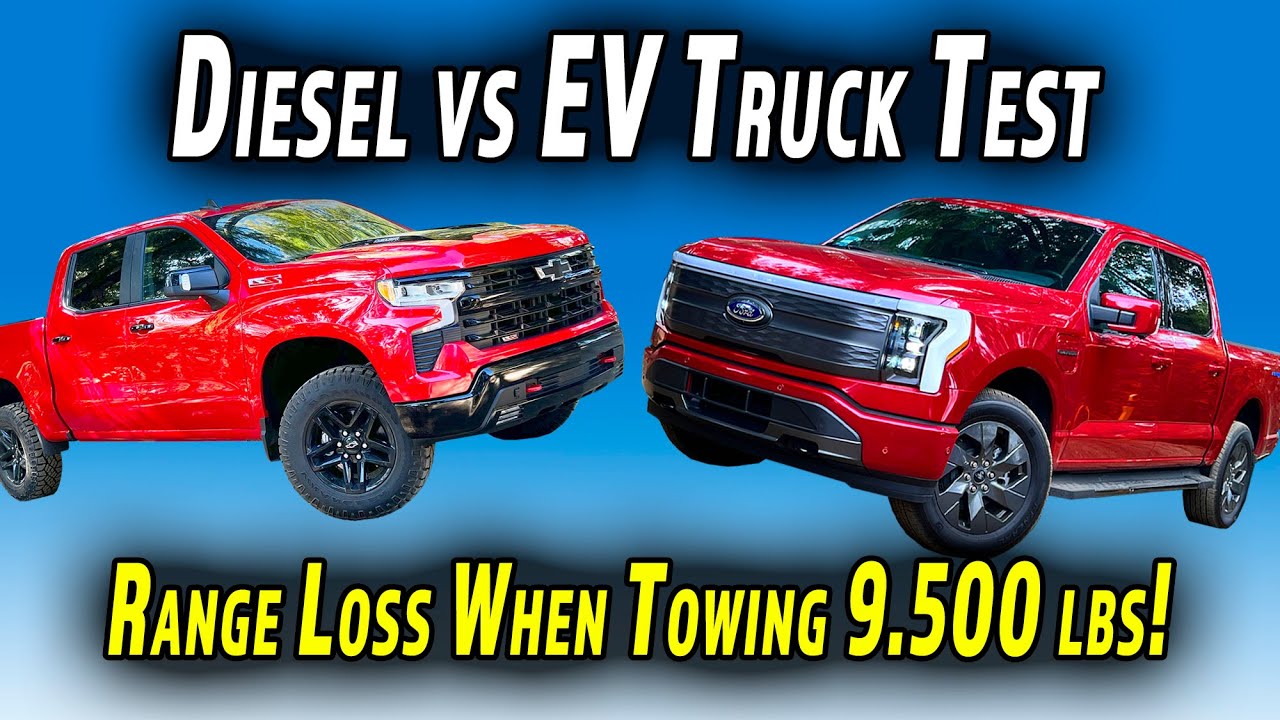
Do Electric Trucks Really Lose More Range Than Regular Trucks? How About vs Diesel Trucks?
video description
I do think, however, that there could be an explanation why EVs may see a (scientifically and objectively) slightly larger drop in efficiency when towing or while laden than ICE vehicles: the drivetrain of ICE vehicles (esp. when equipped with technologies such as dual port + direct injection, variable valve timing etc) tends to operate at a higher thermal efficiency under high load, but low rpm - it's one of the reasons why modern cars shift up at lower rpm. In other words, as long as the heavily laden vehicle can cruise at a given speed (say, 62 mph) in the same gear as it would do in an unladen condition, the rpm will be similar but engine load will be higher, and therefore at a higher % thermal efficiency.
Date: 2022-11-24
Related videos


Comments and reviews: 14
Korvics
Thank you for this valuable data Alex. While it's good to acknowledge that relative range loss when making apples to apples comparison is similar; I do get a sense that some complaints come from considering the absolute performance. 157 miles of range in a perfect California weather is great, but it is almost half of Silverado's towing range. Throw in cold temperatures and I would guess the range drops further, all while charging times get slower in cold weather as well. I would love and appreciate a video from you that shows how temperatures affect range and charge times of your EVs, although I realize it's tough for you, given where you live.
I can see how someone who doesn't live in a perfect climate, and has to tow something that's 150 miles away on a regular basis would not be happy with a Lightning.
reply
Thank you for this valuable data Alex. While it's good to acknowledge that relative range loss when making apples to apples comparison is similar; I do get a sense that some complaints come from considering the absolute performance. 157 miles of range in a perfect California weather is great, but it is almost half of Silverado's towing range. Throw in cold temperatures and I would guess the range drops further, all while charging times get slower in cold weather as well. I would love and appreciate a video from you that shows how temperatures affect range and charge times of your EVs, although I realize it's tough for you, given where you live.
I can see how someone who doesn't live in a perfect climate, and has to tow something that's 150 miles away on a regular basis would not be happy with a Lightning.
reply
Jason
Awesome video Alex, I really appreciate the effort you put into these. So batteries vs fuel - way, way more energy in a gas or diesel tank than a battery pack. The Lightning might be the perfect truck for someone. So could the diesel or gas. What about another option? The F150 and Tundra hybrid make a compelling case for a broad use case. I remember you saying (agreeing with Toyota I believe) that more hybrids on the road have a greater effect than fewer EVs for a plethora of reasons. Keep up the good work, and hope your back heals up!
reply
Awesome video Alex, I really appreciate the effort you put into these. So batteries vs fuel - way, way more energy in a gas or diesel tank than a battery pack. The Lightning might be the perfect truck for someone. So could the diesel or gas. What about another option? The F150 and Tundra hybrid make a compelling case for a broad use case. I remember you saying (agreeing with Toyota I believe) that more hybrids on the road have a greater effect than fewer EVs for a plethora of reasons. Keep up the good work, and hope your back heals up!
reply
My
Lol, this is pure comedy. Stop every 2. 5 hours for two hours to cover 150 miles. At that rate, it shouldn't take more than a few months to drive from NY to CA. Bravo Ford. Well done. And when we factor in the cost difference between these two trucks, there is only one logical conclusion left: Ford's truck division is run by idiots and GM's by total and complete idiots. Why did Ford score higher? Because at the very least they managed to retain the diesel engine in their truck lineup whereas GM is going 100% electric.
reply
Lol, this is pure comedy. Stop every 2. 5 hours for two hours to cover 150 miles. At that rate, it shouldn't take more than a few months to drive from NY to CA. Bravo Ford. Well done. And when we factor in the cost difference between these two trucks, there is only one logical conclusion left: Ford's truck division is run by idiots and GM's by total and complete idiots. Why did Ford score higher? Because at the very least they managed to retain the diesel engine in their truck lineup whereas GM is going 100% electric.
reply
Beartank
the issue for towing is really that refuel/ recharge time at least in a commercial setting. If I am personally going to the hardware store and grabbing a pallet of concrete no problem really. If I am a contractor grabbing supplies from the hardware store multiple times in a day and taking them to a job site or multiple sites that might be located at greater distances from the hardware store or lumber yard etc that i am purchasing from I cannot depend on having the down time to recharge multiple times a day
reply
the issue for towing is really that refuel/ recharge time at least in a commercial setting. If I am personally going to the hardware store and grabbing a pallet of concrete no problem really. If I am a contractor grabbing supplies from the hardware store multiple times in a day and taking them to a job site or multiple sites that might be located at greater distances from the hardware store or lumber yard etc that i am purchasing from I cannot depend on having the down time to recharge multiple times a day
reply
Jeff
Alex I'm a bit confused about the statement that range loss due to climbing and descending a hill being similar to ICE vs. Electric. While the electric truck will not recover all of the energy while descending it recovers 70% of it, the ICE truck recovers 0%. I would expect if you compared going up and down a hill vs. Driving on a flat surface for the same distance the EV would lose significantly less range than the ICE truck.
reply
Alex I'm a bit confused about the statement that range loss due to climbing and descending a hill being similar to ICE vs. Electric. While the electric truck will not recover all of the energy while descending it recovers 70% of it, the ICE truck recovers 0%. I would expect if you compared going up and down a hill vs. Driving on a flat surface for the same distance the EV would lose significantly less range than the ICE truck.
reply
Phil
This video is about % loss comparison. It addressed what I haven't seen done before. Much closer result than some make you believe. Very good information. I would think the same thing applies with cold weather vs normal weather. ICE vehicles also get reduced fuel economy in the cold. I wonder if the % loss would be equivalent as electric vehicles. It would be a tough test to do though.
reply
This video is about % loss comparison. It addressed what I haven't seen done before. Much closer result than some make you believe. Very good information. I would think the same thing applies with cold weather vs normal weather. ICE vehicles also get reduced fuel economy in the cold. I wonder if the % loss would be equivalent as electric vehicles. It would be a tough test to do though.
reply
Alexander
I had a sustained 40. 4 in my Ram Eco-Diesel for almost 2 hours on the way to visit my mother in Fayetteville. I just stayed behind a semi with the closest following distance on the adaptive cruise and had the air suspension in it's aero mode. That Chevy you pics is a lifted off-roady thing. I am curious what you could get if you had a model similar to how my ram was.
reply
I had a sustained 40. 4 in my Ram Eco-Diesel for almost 2 hours on the way to visit my mother in Fayetteville. I just stayed behind a semi with the closest following distance on the adaptive cruise and had the air suspension in it's aero mode. That Chevy you pics is a lifted off-roady thing. I am curious what you could get if you had a model similar to how my ram was.
reply
John
Your discussion on towing loss is technically correct, but kind of missing the point. The point is that electric trucks can't tow on the freeway, without extremely frequent and lengthy stops. They have 0 range compared to a diesel. That is the heart of the matter. A diesel with a large tank can go for hours, then take < 5 minutes to refill (without unhooking I might add.
reply
Your discussion on towing loss is technically correct, but kind of missing the point. The point is that electric trucks can't tow on the freeway, without extremely frequent and lengthy stops. They have 0 range compared to a diesel. That is the heart of the matter. A diesel with a large tank can go for hours, then take < 5 minutes to refill (without unhooking I might add.
reply
Tom
This is not a fair comparison this has the Trail Boss package, its not the most efficient version of the diesel Silverado because its lifted and has bigger tires. Normal trim levels EPA ratings For Diesel 2WD are at 24 MPG city / 29 MPG highway / 26 MPG combined and the 4WD gets 24 MPG combined / 22 MPG city / 27 MPG highway. C'mon Alex, you know better than that.
reply
This is not a fair comparison this has the Trail Boss package, its not the most efficient version of the diesel Silverado because its lifted and has bigger tires. Normal trim levels EPA ratings For Diesel 2WD are at 24 MPG city / 29 MPG highway / 26 MPG combined and the 4WD gets 24 MPG combined / 22 MPG city / 27 MPG highway. C'mon Alex, you know better than that.
reply
Philip
How the hell did you only get 23mpg in the duramax. I have the duramax with Max tow so my fuel economy is lower than trucks without it. Doing 75 I'll average around 30 mpg.
Doing 62 if easily hit mid to high 30s. And tfl truck did similar wieght towing with the lightning. And got well under 100 miles range.
reply
How the hell did you only get 23mpg in the duramax. I have the duramax with Max tow so my fuel economy is lower than trucks without it. Doing 75 I'll average around 30 mpg.
Doing 62 if easily hit mid to high 30s. And tfl truck did similar wieght towing with the lightning. And got well under 100 miles range.
reply
Jeff
I tow with my Model 3 and it tows like nothing is back there. I especially like to take off from stop lights and see the reaction people have. I get around 230 miles normally on the highway. Drops to 100 miles towing. My observation is it's mostly due to aero and not necessarily weight when you are doing 70mph.
reply
I tow with my Model 3 and it tows like nothing is back there. I especially like to take off from stop lights and see the reaction people have. I get around 230 miles normally on the highway. Drops to 100 miles towing. My observation is it's mostly due to aero and not necessarily weight when you are doing 70mph.
reply
john
Usual dumb towing video. Where do I start? No bed cover. Towing a Mule with a roof and turbulator window.
P. S. All vehicles do better in the city if they don't have to stop. ICE vehicle flunk when the have to stop, EV's don't.
Regenerative braking is worth 70% and that is not nothing.
reply
Usual dumb towing video. Where do I start? No bed cover. Towing a Mule with a roof and turbulator window.
P. S. All vehicles do better in the city if they don't have to stop. ICE vehicle flunk when the have to stop, EV's don't.
Regenerative braking is worth 70% and that is not nothing.
reply
Wesley
Interesting that the unloaded Lightning averaged 2. 6 mi/kWh. TFL just did their EV cannonball in an Ioniq 5 and averaged 2. 7 mi/kWh in a much smaller, more aerodynamic package, albeit at higher speeds. Could it be that aerodynamics are less important than driving style?
reply
Interesting that the unloaded Lightning averaged 2. 6 mi/kWh. TFL just did their EV cannonball in an Ioniq 5 and averaged 2. 7 mi/kWh in a much smaller, more aerodynamic package, albeit at higher speeds. Could it be that aerodynamics are less important than driving style?
reply
Frugal
I ve always been able to beat EPA HWY ratings for every vehicle I ve owned in my own combined driving. I can get 31 mpg w/ my Boxster; 24 mpg in my Sienna; 17 mpg in my 100 series; 50 mpg in my 08 Prius w/ a weak hybrid battery. But I live at 6500.
reply
I ve always been able to beat EPA HWY ratings for every vehicle I ve owned in my own combined driving. I can get 31 mpg w/ my Boxster; 24 mpg in my Sienna; 17 mpg in my 100 series; 50 mpg in my 08 Prius w/ a weak hybrid battery. But I live at 6500.
reply
Add a review, comment
Other channel videos


