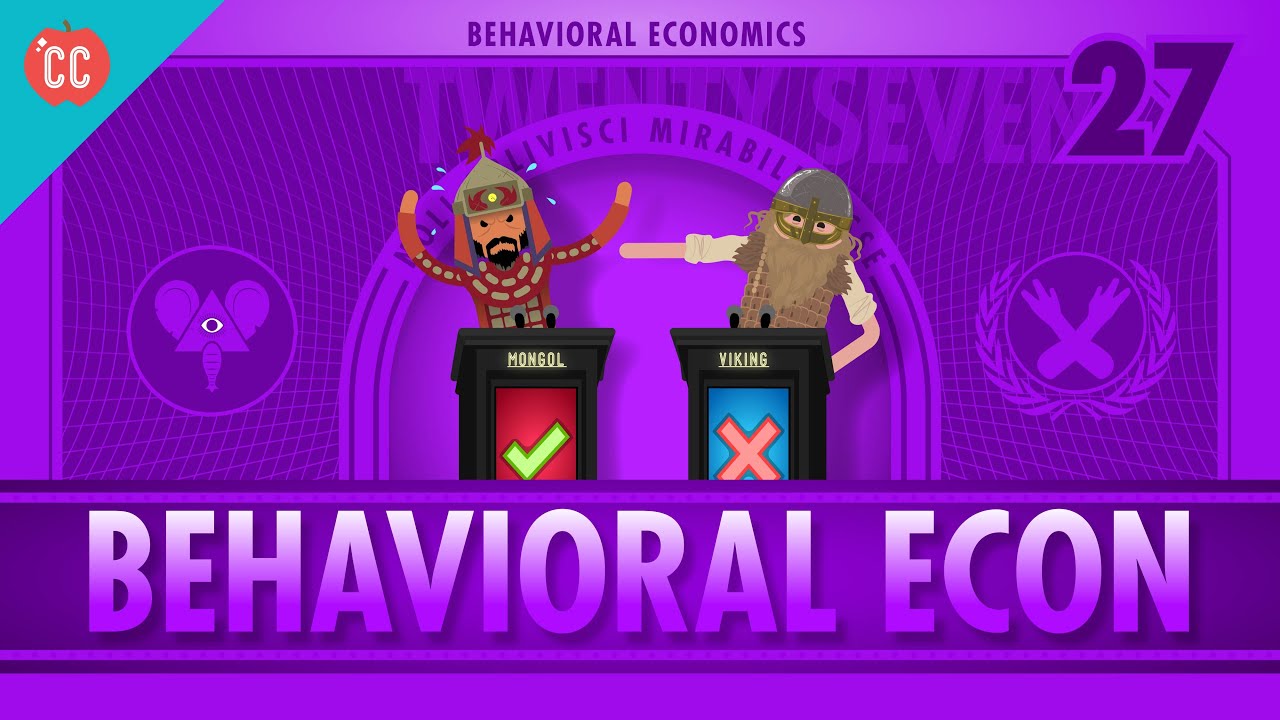
Behavioral Economics: Crash Course Economics #27
video description
Date: 2022-04-04
Related videos

• TED-Ed



Comments and reviews: 10
Subhrajit
Summary:
-Behavioral Economics-
Behavioral economics speaks about the psychological, social and emotional factors that influence decision making and so it adds a layer of complexity to Classical Economics, which generally assume people are rational and predictable, but in most cases they are not.
-Lack of information-
Prices Send Signals and they can change perception. For example, given 2 ice creams tubs and the only information provided about them is their price. People tend to prefer the one with a higher price.
-Manipulate non intrinsic attributes of price-
Contrary to basic assumptions of economics, marketing actions can successfully affect pleasantness by manipulating the non-intrinsic attributes of goods
For example given a a decent wine, increasing the price of the wine may actually create a demand, because people perceive wines with higher tags to be good wine.
The idea that perception and passions influence our decisions also applies in finance, which explains the Dutch Tulip Mania in the 17th Century or the 2008 Financial Crisis in the US.
-Framing effect-
If People were entirely rational they'd make the same decisions given identical option but sometimes their preferences are dependent on how the options are presented. Psychologists call this Cognitive bias or the Framing Effect.
For example people would prefer to eat beef which is 75%, fat free rather than beef having 25% fat. Also you'd buy a lottery ticket that say's 1 out of 1000 is a winner or 999 out of 1000 are looser.
Classical Economics argues that framing has little impact on decision making because most people are intelligent and rational but in the real world people can be very irrational.
A gym might break it's membership and call it 1$ a year. This may make it look a lot more affordable than paying 365$ a year. This is reason a TV worth 499. 99 $ looks like a good deal rather than 500$. This is called psychological and it make people feel they're getting a good deal.
However some high end retailers mark their prices in whole dollars, basically signalling their goods are of a higher quality.
Nudge theory:
Nudge theory suggests that nudges actually makes people behave in a certain way without changing the choices available to them. For example to tackle the problem of child obesity, instead of changing the food choices available in a school cafeteria, rearranging the food choices in a cafeteria by putting fruits and veggies in the eye level shelf and desserts on the top level shelf actually lead to healthier eats patterns in a school.
So Nudge theory works and it's changing how public policies can be implemented.
Risk(neutral & averse)
Suppose is a choice of two sealed envelopes. One has a hundred dollars, and one has no dollars.
You can choose an envelope, or you can take $50 cash right now.
So do you take the fifty bucks? Or what about $49? Now, this is unlikely to happen to you in real life, but the exercise is about your attitude towards risk. Since there-s a 50/50 chance of getting $100 or nothing, the expected return, or the average of the possible outcomes is $50.
Risk Neutral:
If you-re willing to accept $50 cash to abandon the envelopes, then you-re risk neutral.
Risk Averse:
But If you accept less than $50, just to avoid walking away with nothing, then you-re risk-averse.
Studies by Behavioral Economists about risk and loss aversion suggests that people strongly want to avoid losing. The Study suggests to people losses are more painful, than gains are pleasurable. So people might choose the safe course of action even if it's not the most logical choice.
For example loss aversion can help incentivise employees. Researchers subdivided a group of workers in 3 groups. The first group was control group and were not given any bonus. The second group was promised bonus at the end of the year based on performance. The third group was given the bonus at the start of the year and they were told they have to pay it back if they didn-t meet specific goals. The workers in the first and second groups performed about the same. But the ones in the third group performed significantly better.
So people hate loosing. And account for emotion gives us a realistic view of how people actually behave.
reply
Summary:
-Behavioral Economics-
Behavioral economics speaks about the psychological, social and emotional factors that influence decision making and so it adds a layer of complexity to Classical Economics, which generally assume people are rational and predictable, but in most cases they are not.
-Lack of information-
Prices Send Signals and they can change perception. For example, given 2 ice creams tubs and the only information provided about them is their price. People tend to prefer the one with a higher price.
-Manipulate non intrinsic attributes of price-
Contrary to basic assumptions of economics, marketing actions can successfully affect pleasantness by manipulating the non-intrinsic attributes of goods
For example given a a decent wine, increasing the price of the wine may actually create a demand, because people perceive wines with higher tags to be good wine.
The idea that perception and passions influence our decisions also applies in finance, which explains the Dutch Tulip Mania in the 17th Century or the 2008 Financial Crisis in the US.
-Framing effect-
If People were entirely rational they'd make the same decisions given identical option but sometimes their preferences are dependent on how the options are presented. Psychologists call this Cognitive bias or the Framing Effect.
For example people would prefer to eat beef which is 75%, fat free rather than beef having 25% fat. Also you'd buy a lottery ticket that say's 1 out of 1000 is a winner or 999 out of 1000 are looser.
Classical Economics argues that framing has little impact on decision making because most people are intelligent and rational but in the real world people can be very irrational.
A gym might break it's membership and call it 1$ a year. This may make it look a lot more affordable than paying 365$ a year. This is reason a TV worth 499. 99 $ looks like a good deal rather than 500$. This is called psychological and it make people feel they're getting a good deal.
However some high end retailers mark their prices in whole dollars, basically signalling their goods are of a higher quality.
Nudge theory:
Nudge theory suggests that nudges actually makes people behave in a certain way without changing the choices available to them. For example to tackle the problem of child obesity, instead of changing the food choices available in a school cafeteria, rearranging the food choices in a cafeteria by putting fruits and veggies in the eye level shelf and desserts on the top level shelf actually lead to healthier eats patterns in a school.
So Nudge theory works and it's changing how public policies can be implemented.
Risk(neutral & averse)
Suppose is a choice of two sealed envelopes. One has a hundred dollars, and one has no dollars.
You can choose an envelope, or you can take $50 cash right now.
So do you take the fifty bucks? Or what about $49? Now, this is unlikely to happen to you in real life, but the exercise is about your attitude towards risk. Since there-s a 50/50 chance of getting $100 or nothing, the expected return, or the average of the possible outcomes is $50.
Risk Neutral:
If you-re willing to accept $50 cash to abandon the envelopes, then you-re risk neutral.
Risk Averse:
But If you accept less than $50, just to avoid walking away with nothing, then you-re risk-averse.
Studies by Behavioral Economists about risk and loss aversion suggests that people strongly want to avoid losing. The Study suggests to people losses are more painful, than gains are pleasurable. So people might choose the safe course of action even if it's not the most logical choice.
For example loss aversion can help incentivise employees. Researchers subdivided a group of workers in 3 groups. The first group was control group and were not given any bonus. The second group was promised bonus at the end of the year based on performance. The third group was given the bonus at the start of the year and they were told they have to pay it back if they didn-t meet specific goals. The workers in the first and second groups performed about the same. But the ones in the third group performed significantly better.
So people hate loosing. And account for emotion gives us a realistic view of how people actually behave.
reply
Dave
The problem is that classical economics really does not explain the behavior of the economy or individual economic behavior. Behavioral Economics was developed firstly precisely to show that. Nothing on classical economics really holds up if you think precisely of the big picture. Keynes's work shows it in its entirety on the macroeconomic level. There is a whole field of economics outside of the New Neoclassical Synthesis that shows that. Neo-Ricardian/Sraffian, Post-Keynesian, Neo-Chartalist. And the Creative destruction/Innovation led Neo-Schumpeterian models on the Microeconomic Level. You can't simply talk about Social Science like you talk about Physics or Biology. We economists are not dealing with static rigid systems. We are dealing with everchanging societies and behavior. Everything is often unpredictable. The classical models assume rational expectations, perfect competition, symmetrical information, isotropic space, atomistic markets, etc. None of these assumptions holds in the real world. They could even generate well-predicting models. But they have been a disaster wherever they were applied. Look at the US. Unregulated markets leading to far from the optimal condition. People impoverished all around, due to the lack of work protection and health protection. Struggling public education and massive debt from market-led university price setting, millions on food stamps. Look at the southern European countries where increased labour flexibilization has led to market segmentation and precarious employment. Of course, you can put all the externalities and market failures you want. But if you consider them all together, you see that the models simply don't hold up.
reply
The problem is that classical economics really does not explain the behavior of the economy or individual economic behavior. Behavioral Economics was developed firstly precisely to show that. Nothing on classical economics really holds up if you think precisely of the big picture. Keynes's work shows it in its entirety on the macroeconomic level. There is a whole field of economics outside of the New Neoclassical Synthesis that shows that. Neo-Ricardian/Sraffian, Post-Keynesian, Neo-Chartalist. And the Creative destruction/Innovation led Neo-Schumpeterian models on the Microeconomic Level. You can't simply talk about Social Science like you talk about Physics or Biology. We economists are not dealing with static rigid systems. We are dealing with everchanging societies and behavior. Everything is often unpredictable. The classical models assume rational expectations, perfect competition, symmetrical information, isotropic space, atomistic markets, etc. None of these assumptions holds in the real world. They could even generate well-predicting models. But they have been a disaster wherever they were applied. Look at the US. Unregulated markets leading to far from the optimal condition. People impoverished all around, due to the lack of work protection and health protection. Struggling public education and massive debt from market-led university price setting, millions on food stamps. Look at the southern European countries where increased labour flexibilization has led to market segmentation and precarious employment. Of course, you can put all the externalities and market failures you want. But if you consider them all together, you see that the models simply don't hold up.
reply
160p2GHz
Oh. oh boy. Ok your gravity example is wrong. Sorry, physicist here, I have to correct:
Newtonian gravity wasn't problematic because it couldn't explain the behavior of electrons. Electrons are controlled by the electromagnetic force. Tiny things have much stronger forces that dominate over gravity. What was lacking in Newton's gravitational theory was the behavior of bodies in orbit. It gets most things approximately right but is a little off (notably for Mercury's orbit in our own Solar System. This was corrected by Einstein's interpretation of gravity which utilized the idea of -spacetime- fabric. Thinking of gravity/mass as something that curves spacetime fixed a lot of those issues. Now, people are trying to improve even further than Einstein's version to help explain how gravity works in black holes, where it seems even Einstein's interpretation breaks down. So far they've shown that the spacetime fabric interpretation does hold up at least to the -surface- of a black hole, but they want a better description of what happens inside.
reply
Oh. oh boy. Ok your gravity example is wrong. Sorry, physicist here, I have to correct:
Newtonian gravity wasn't problematic because it couldn't explain the behavior of electrons. Electrons are controlled by the electromagnetic force. Tiny things have much stronger forces that dominate over gravity. What was lacking in Newton's gravitational theory was the behavior of bodies in orbit. It gets most things approximately right but is a little off (notably for Mercury's orbit in our own Solar System. This was corrected by Einstein's interpretation of gravity which utilized the idea of -spacetime- fabric. Thinking of gravity/mass as something that curves spacetime fixed a lot of those issues. Now, people are trying to improve even further than Einstein's version to help explain how gravity works in black holes, where it seems even Einstein's interpretation breaks down. So far they've shown that the spacetime fabric interpretation does hold up at least to the -surface- of a black hole, but they want a better description of what happens inside.
reply
Anil
Economists just decided that self-interest is rational, everything else is irrational. Uh, no. Evolutionary and affective psychology provides ample evidence for why in many cases acting based on your emotions with blind faith is often good in the long run. Emotion is an evolved mechanism for making decisions when there is a lack of information.
reply
Economists just decided that self-interest is rational, everything else is irrational. Uh, no. Evolutionary and affective psychology provides ample evidence for why in many cases acting based on your emotions with blind faith is often good in the long run. Emotion is an evolved mechanism for making decisions when there is a lack of information.
reply
Talin
Why would they leave out one of the most important aspects of a economic model. Economics has been flawed for years And there are so many little caveats to behavior. Also, lol what I would not compare the laws of physics to laws of economics. But overall good video! Thanks
reply
Why would they leave out one of the most important aspects of a economic model. Economics has been flawed for years And there are so many little caveats to behavior. Also, lol what I would not compare the laws of physics to laws of economics. But overall good video! Thanks
reply
Jonathan
You mean to suggest that I don't always know what's -best-! How rude.
But in all seriousness, this is interesting to think about in contrast to the invisible hand [of self-interest] being generally good for society as free-marketers like to hold as scientific truth.
reply
You mean to suggest that I don't always know what's -best-! How rude.
But in all seriousness, this is interesting to think about in contrast to the invisible hand [of self-interest] being generally good for society as free-marketers like to hold as scientific truth.
reply
Aakanksha
How did Jacob Clifford's belt change from red to white? It's the same ACDC belt he was wearing at the beginning of the video. Ask the other clothes are same too expect the belt
reply
How did Jacob Clifford's belt change from red to white? It's the same ACDC belt he was wearing at the beginning of the video. Ask the other clothes are same too expect the belt
reply
Sharon
I took this video very seriously but on the more light side of things - am I the only one who thinks this guy really reminds of Marshall from How I Met Your Mother?
reply
I took this video very seriously but on the more light side of things - am I the only one who thinks this guy really reminds of Marshall from How I Met Your Mother?
reply
james
If you-re into this stuff, check out the paper -Prospect Theory: An Analysis of Decision Under Risk- by Daniel Kahneman, Amos Tversky. It was a game changer!
reply
If you-re into this stuff, check out the paper -Prospect Theory: An Analysis of Decision Under Risk- by Daniel Kahneman, Amos Tversky. It was a game changer!
reply
nGAhGENVH0Ul
Knowing that we are loss averse is good, but how is that going to help us since it's biologically encoded and not much we can do to change it?
reply
Knowing that we are loss averse is good, but how is that going to help us since it's biologically encoded and not much we can do to change it?
reply
Add a review, comment
Other channel videos