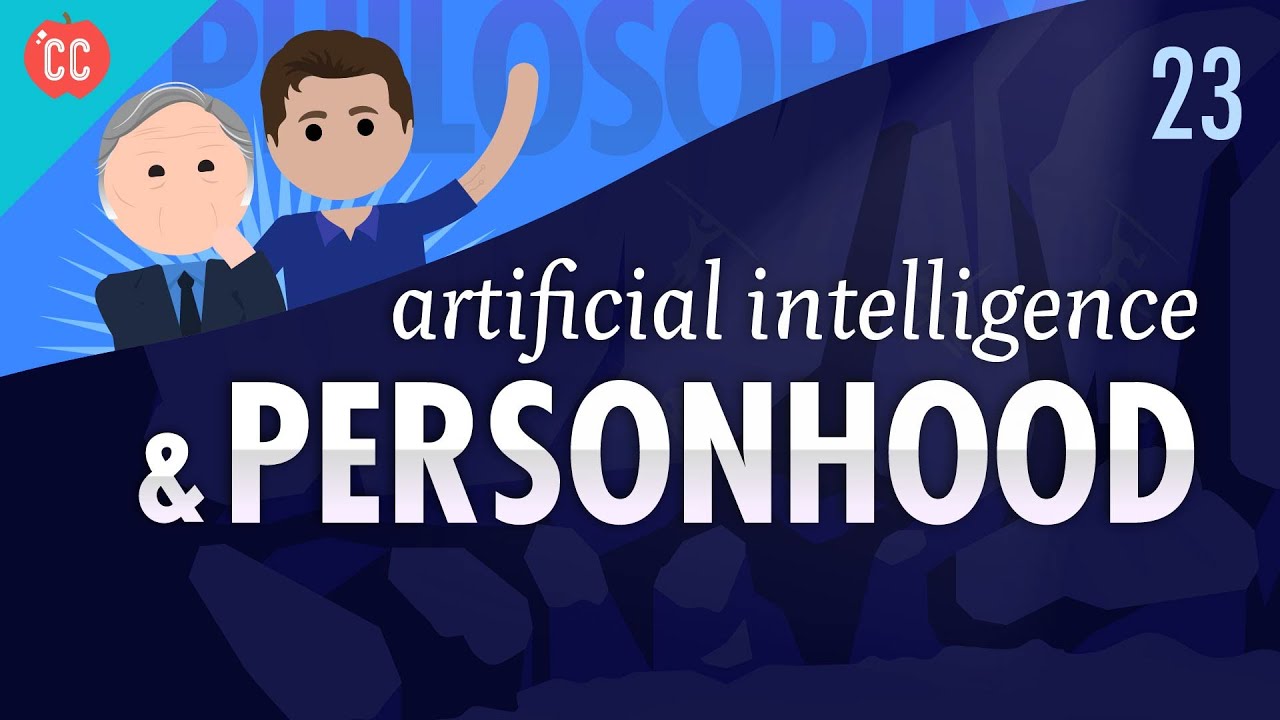
Artificial Intelligence & Personhood: Crash Course Philosophy #23
video description
Date: 2022-04-04
Related videos




Comments and reviews: 10
Jesse
I thought Captain Louvre of the Starfleet JAG office settled the robots are people thing back in the 1980s? -It sits there looking at me; and I don't know what it is. This case has dealt with metaphysics; with questions best left to saints and philosophers. I am neither competent nor qualified to answer those. But I've got to make a ruling, to try to speak to the future. Is Data a machine? Yes. Is he the property of Starfleet? No. We have all been dancing around the basic issue: does Data have a soul? I don't know that he has. I don't know that I have. But I have got to give him the freedom to explore that question himself. It is the ruling of this court that Lieutenant Commander Data has the freedom to choose. -
reply
I thought Captain Louvre of the Starfleet JAG office settled the robots are people thing back in the 1980s? -It sits there looking at me; and I don't know what it is. This case has dealt with metaphysics; with questions best left to saints and philosophers. I am neither competent nor qualified to answer those. But I've got to make a ruling, to try to speak to the future. Is Data a machine? Yes. Is he the property of Starfleet? No. We have all been dancing around the basic issue: does Data have a soul? I don't know that he has. I don't know that I have. But I have got to give him the freedom to explore that question himself. It is the ruling of this court that Lieutenant Commander Data has the freedom to choose. -
reply
Anonymous
Hanks should've at least pointed out the distinction between information processing (i. e. intelligence) and conscious experience. It seems pretty obvious to me that person vs non-personhood will go down to whether we think it has conscious experience.
Most scientists do not believe that our computers (based on the 'Von Neuman architecture') could give rise to conscious experience. No matter how generally intelligent Siri becomes, she's still as conscious as a rock. A sentient machine can only be made once we figure out what sort of complex processing of information actually gives rise to conscious experience. Then, we can build the hardware for an artificial consciousness.
reply
Hanks should've at least pointed out the distinction between information processing (i. e. intelligence) and conscious experience. It seems pretty obvious to me that person vs non-personhood will go down to whether we think it has conscious experience.
Most scientists do not believe that our computers (based on the 'Von Neuman architecture') could give rise to conscious experience. No matter how generally intelligent Siri becomes, she's still as conscious as a rock. A sentient machine can only be made once we figure out what sort of complex processing of information actually gives rise to conscious experience. Then, we can build the hardware for an artificial consciousness.
reply
mubalicious
The argument does fall apart once the motor oil comes out. No humans could survive with that fluid as our circulation system. What we consider to be a human being (therefore a person) contains all of the characteristics of being human, once one of those characteristics is not there, it cannot be classified as a human. As was mentioned, one would think another is human until the exhibit behavior that is not found in humans, bleeding motor oil would be one of those characteristics not found in humans.
reply
The argument does fall apart once the motor oil comes out. No humans could survive with that fluid as our circulation system. What we consider to be a human being (therefore a person) contains all of the characteristics of being human, once one of those characteristics is not there, it cannot be classified as a human. As was mentioned, one would think another is human until the exhibit behavior that is not found in humans, bleeding motor oil would be one of those characteristics not found in humans.
reply
Daniel
No, we were not programmed. There is a difference between evolved and designed beings and this difference has nothing to do with -personhood-. Harry would be a person in the social sense because he would fulfill the role of a person in society, but he would be a free person only if he were not an avatar for someone else and no one else had to respond for him in court. Please, there are bad ideas and arguments in philosophy and they should be forgotten as they age badly!
reply
No, we were not programmed. There is a difference between evolved and designed beings and this difference has nothing to do with -personhood-. Harry would be a person in the social sense because he would fulfill the role of a person in society, but he would be a free person only if he were not an avatar for someone else and no one else had to respond for him in court. Please, there are bad ideas and arguments in philosophy and they should be forgotten as they age badly!
reply
Souchira
Weak AI is what we understand. Strong AI is ones we don't understand. This includes us as well, yes in my opinion we are strong AI's. We are made up out of a complex biological process we don't fully understand yet and this creates us humans. When/if we get to the point that we fully understand how this entire process works we are weak AI and, probably, no longer human in the eyes of the ones before we understood the entire process.
reply
Weak AI is what we understand. Strong AI is ones we don't understand. This includes us as well, yes in my opinion we are strong AI's. We are made up out of a complex biological process we don't fully understand yet and this creates us humans. When/if we get to the point that we fully understand how this entire process works we are weak AI and, probably, no longer human in the eyes of the ones before we understood the entire process.
reply
jodders
If an AI can understand a principle and not just a rule does it have strong AI.
The rule says 'Do not kill'
How would the AI interpret the principle behind the rule?
To quote my Dad (who was probably quoting someone else):
Rules exist for those who can't, or wont, understand a principle.
reply
If an AI can understand a principle and not just a rule does it have strong AI.
The rule says 'Do not kill'
How would the AI interpret the principle behind the rule?
To quote my Dad (who was probably quoting someone else):
Rules exist for those who can't, or wont, understand a principle.
reply
Lee
There's a problem that humans live to see humans everywhere
And just add some motion and eyes to any object, and then we will start to recognize some temper
And also, we are all robots, there's no difference between organic robots and metal robots
We lust live to reproduce
reply
There's a problem that humans live to see humans everywhere
And just add some motion and eyes to any object, and then we will start to recognize some temper
And also, we are all robots, there's no difference between organic robots and metal robots
We lust live to reproduce
reply
Luna
But what about emotions?
An AI can nowadays maybe react to facial expressions and so -pretend- to feel it but can it ever really feel?
And emotions that are not a direct reaction to an action or facial expressions and so on. for example love?
reply
But what about emotions?
An AI can nowadays maybe react to facial expressions and so -pretend- to feel it but can it ever really feel?
And emotions that are not a direct reaction to an action or facial expressions and so on. for example love?
reply
Darth
I think strong AI is tied to an ability to homogenize all forms of input to a universal base symbol system, or language. We humans do that, reassemble data from organ sources into something we(the whole human) can process with extant machinery.
reply
I think strong AI is tied to an ability to homogenize all forms of input to a universal base symbol system, or language. We humans do that, reassemble data from organ sources into something we(the whole human) can process with extant machinery.
reply
CyborgCurryBunny
I read a book about this -The Fourth Age- it was actually SUPER interesting of a read and I highly recommend it. Weak AI was referred to as -Artificial Narrow Intelligence- and Super AI was called -Artificial General Intelligence-
reply
I read a book about this -The Fourth Age- it was actually SUPER interesting of a read and I highly recommend it. Weak AI was referred to as -Artificial Narrow Intelligence- and Super AI was called -Artificial General Intelligence-
reply
Add a review, comment
Other channel videos