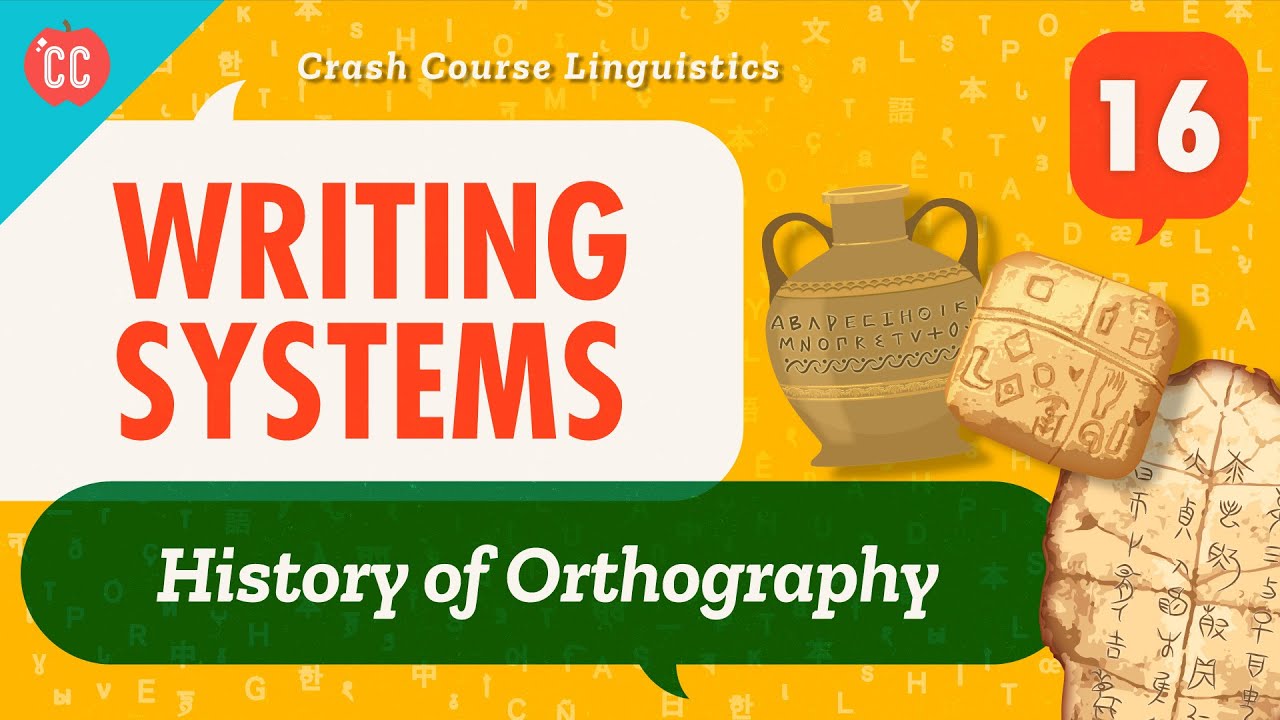
Writing Systems: Crash Course Linguistics #16
video description
Date: 2022-04-04
Related videos


Comments and reviews: 9
Brian
It is now broadly accepted (following Edward Catich) that Roman letters were first written with a brush on the stone before being carved into stone. The same thing happened with Chinese characters, which were carved in stone just like they were written with a brush. The more pronounced rationalization of the Roman letterforms came much later starting in the Age of Enlightenment typefaces such as the Romain du Roi. Something similar happened to Chinese characters in printing, with the forms becoming more and more regular with straight lines until they looked very different from the forms written with a brush. So the explanation in the video is just wrong here. Better examples would have been Runic alphabets using only vertical and diagonal strokes or many Indic scripts such as Tamil and Balinese which favoured curved strokes so as not to damage the palm leaves they were written on.
reply
It is now broadly accepted (following Edward Catich) that Roman letters were first written with a brush on the stone before being carved into stone. The same thing happened with Chinese characters, which were carved in stone just like they were written with a brush. The more pronounced rationalization of the Roman letterforms came much later starting in the Age of Enlightenment typefaces such as the Romain du Roi. Something similar happened to Chinese characters in printing, with the forms becoming more and more regular with straight lines until they looked very different from the forms written with a brush. So the explanation in the video is just wrong here. Better examples would have been Runic alphabets using only vertical and diagonal strokes or many Indic scripts such as Tamil and Balinese which favoured curved strokes so as not to damage the palm leaves they were written on.
reply
Rachel
i had so much fun listening to this series and i would love for this to have more episodes!
and yes, lingthusiam is such a delightful podcast!
when im not watching uni lectures on psycholinguitcs and sociolinguistics, im crocheting and listening to lingthusiam if there is not a crashcourse linguistics episode!
thank you so much for this series! i thoroughly enjoyed it!
reply
i had so much fun listening to this series and i would love for this to have more episodes!
and yes, lingthusiam is such a delightful podcast!
when im not watching uni lectures on psycholinguitcs and sociolinguistics, im crocheting and listening to lingthusiam if there is not a crashcourse linguistics episode!
thank you so much for this series! i thoroughly enjoyed it!
reply
Alejandro
I loved this course. It's not that I learned so many new things, since I've been following the subject for many years, but the way it was presented and explained. I found it very inspirational. I really hope that you get into linguistics again soon.
reply
I loved this course. It's not that I learned so many new things, since I've been following the subject for many years, but the way it was presented and explained. I found it very inspirational. I really hope that you get into linguistics again soon.
reply
Jim
I'm curious as to why you chose to describe many Indian writing systems and Inuktitut as -syllabaries-. I've always heard them described as -abugidas- before, which is a major type of writing system that this video didn't even mention.
reply
I'm curious as to why you chose to describe many Indian writing systems and Inuktitut as -syllabaries-. I've always heard them described as -abugidas- before, which is a major type of writing system that this video didn't even mention.
reply
Business
thank you. it is quite a sudden that the course stopped here. I thought there are still a lot more things to go through. Anyway, thank you for the contritbution. it has been a great journey learning all these cool things.
reply
thank you. it is quite a sudden that the course stopped here. I thought there are still a lot more things to go through. Anyway, thank you for the contritbution. it has been a great journey learning all these cool things.
reply
education
Hangul was/is based on hPhags-Pa, not the shapes of the mouth. That's a reverse-engineered myth, and not even a very believable one. Other than that, great video and series.
reply
Hangul was/is based on hPhags-Pa, not the shapes of the mouth. That's a reverse-engineered myth, and not even a very believable one. Other than that, great video and series.
reply
Francisco
Hey, thanks for the video; just a remark. SINGLE SOUND ARE NOT PHONEMES; PHONEMES CAN IMPLY VARIOUS DIFFERENT SOUNDS DEPENDING ON THE LANGUAGE WE ARE TALKING ABOUT: )
reply
Hey, thanks for the video; just a remark. SINGLE SOUND ARE NOT PHONEMES; PHONEMES CAN IMPLY VARIOUS DIFFERENT SOUNDS DEPENDING ON THE LANGUAGE WE ARE TALKING ABOUT: )
reply
someinteresting
Given that first hieroglyphs are somewhat older than the first cuneiform the theory for borrowing into Egyptian of the Sumerian system is rather unprecise.
reply
Given that first hieroglyphs are somewhat older than the first cuneiform the theory for borrowing into Egyptian of the Sumerian system is rather unprecise.
reply
NorkNork
Nooo last episode already? I hope you consider making a part two of this, there is so much more linguistics to cover! Thanks for the great content Taylor!
reply
Nooo last episode already? I hope you consider making a part two of this, there is so much more linguistics to cover! Thanks for the great content Taylor!
reply
Add a review, comment
Other channel videos