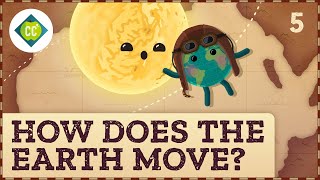
How Does the Earth Move? Crash Course Geography #5
video description
Date: 2022-04-04
Related videos






Comments and reviews: 10
George
6: 15 Earth''s orbit is elliptical -with the sun at one focus-. It took a second for me to remember that. If the sun was at the center of the ellipse (where the axes intersect, then the perihelion and aphelion would be 3 months apart but. because distance from the sun doesn't affect anything, we'd never know the difference? 9: 55 If the earth didn't rotate, i. e. spin, at all, then a day would be the same length as a year? One side would be very hot and one very cold -at any given time-, but the zone of heat and cold would move around the earth once a year? If the earth were tidally locked, so one side was always facing the sun and the other side always facing away, then it would rotate once a year? 10: 00 But, if the earth rotated but didn't revolve -- hung in space spinning but not moving around the sun -- wow, that's hard to picture. It'd be like one particular day of the calendar forever, wouldn't it? So when you said -the length of a day would remain fixed, - you meant the length of -daylight- would remain fixed for each latitude, right? The length of a -day- (one noon to the next) remains fixed anyway, or very close. Note 1: The actual circle of illumination (the line between light and dark) is called the terminator, right? Sunrise and sunset will both ve vaack. Note 2: You correctly stated that for the earth to spin once on its axis takes less than a day, but didn't explain why -- solar vs. sidereal day -- extra rotation needed for noon to catch up with the earth's travel in its orbit. I wonder if any of this is right.
reply
6: 15 Earth''s orbit is elliptical -with the sun at one focus-. It took a second for me to remember that. If the sun was at the center of the ellipse (where the axes intersect, then the perihelion and aphelion would be 3 months apart but. because distance from the sun doesn't affect anything, we'd never know the difference? 9: 55 If the earth didn't rotate, i. e. spin, at all, then a day would be the same length as a year? One side would be very hot and one very cold -at any given time-, but the zone of heat and cold would move around the earth once a year? If the earth were tidally locked, so one side was always facing the sun and the other side always facing away, then it would rotate once a year? 10: 00 But, if the earth rotated but didn't revolve -- hung in space spinning but not moving around the sun -- wow, that's hard to picture. It'd be like one particular day of the calendar forever, wouldn't it? So when you said -the length of a day would remain fixed, - you meant the length of -daylight- would remain fixed for each latitude, right? The length of a -day- (one noon to the next) remains fixed anyway, or very close. Note 1: The actual circle of illumination (the line between light and dark) is called the terminator, right? Sunrise and sunset will both ve vaack. Note 2: You correctly stated that for the earth to spin once on its axis takes less than a day, but didn't explain why -- solar vs. sidereal day -- extra rotation needed for noon to catch up with the earth's travel in its orbit. I wonder if any of this is right.
reply
ShieldAre
For those wondering: -A day- in normal usage means 24 hours. A day as an unit measurement is exactly 24 hours. A -civil day- in a sort of bureaucratic sense is 24 hours plus or minus a second or two whenever we have a leap second to match changes in Earth's rotation. The time from a noon to a noon, a solar day, is 24 hours give or take a few seconds, and for obvious practical reasons this is what we mean by day in the normal sense. The sidereal time, ie. the actual time it takes for Earth to fully spin once, is about 23 hours and 56 minutes. The difference between the two is because during each day, Earth advances on its orbit around the Sun, so the next noon will always comes slightly before Earth has actually spun around a full rotation. There's also something called a stellar day, but this is almost exactly the same as the sidereal day.
Sounds complicated, but important difference here is between a day, 24 hours, and a full rotation of the Earth, which is 23 hours, 56 minutes and about 4 seconds.
reply
For those wondering: -A day- in normal usage means 24 hours. A day as an unit measurement is exactly 24 hours. A -civil day- in a sort of bureaucratic sense is 24 hours plus or minus a second or two whenever we have a leap second to match changes in Earth's rotation. The time from a noon to a noon, a solar day, is 24 hours give or take a few seconds, and for obvious practical reasons this is what we mean by day in the normal sense. The sidereal time, ie. the actual time it takes for Earth to fully spin once, is about 23 hours and 56 minutes. The difference between the two is because during each day, Earth advances on its orbit around the Sun, so the next noon will always comes slightly before Earth has actually spun around a full rotation. There's also something called a stellar day, but this is almost exactly the same as the sidereal day.
Sounds complicated, but important difference here is between a day, 24 hours, and a full rotation of the Earth, which is 23 hours, 56 minutes and about 4 seconds.
reply
Jim
Sorry, but 9: 05 -[March 21] is the first official day of fall in the southern hemisphere- no it isn't. Here in Australia the first official day of autumn is 1 March. We don't use equinoxes and solstices (which, as you said about 30 seconds earlier, are the -peak- of their respective seasons) as the _start_ date for the season. That doesn't even make sense.
reply
Sorry, but 9: 05 -[March 21] is the first official day of fall in the southern hemisphere- no it isn't. Here in Australia the first official day of autumn is 1 March. We don't use equinoxes and solstices (which, as you said about 30 seconds earlier, are the -peak- of their respective seasons) as the _start_ date for the season. That doesn't even make sense.
reply
Konpal
I accidentally got enrolled in Geography for Undergraduation due to a messed up system of cut offs in India's central university and just hated it. but now am realising how misplaced my anger was and that its such a lovely subject and i couldn't have had this epiphany at a better time since now i get to follow this series like a TV show in real time!
reply
I accidentally got enrolled in Geography for Undergraduation due to a messed up system of cut offs in India's central university and just hated it. but now am realising how misplaced my anger was and that its such a lovely subject and i couldn't have had this epiphany at a better time since now i get to follow this series like a TV show in real time!
reply
Vaughn
And wrong about the cheetah being slower. (I-m not considering how you used the cheetah as a reference point. Don-t get mad at me) technically the cheetah running the same way as the spin of the earth at the equator is going even faster than the earth. But only technically
reply
And wrong about the cheetah being slower. (I-m not considering how you used the cheetah as a reference point. Don-t get mad at me) technically the cheetah running the same way as the spin of the earth at the equator is going even faster than the earth. But only technically
reply
Scott
-First official day of Fall in the southern hemisphere-. The australian Bureau of Meteorology would disagree.
The Australian government says the seasons are.
Summer 1 Dec - 28/9 Feb
Autumn 1 March - May 30
Winter 1 June - Aug 31.
Spring 1 Sept - 30 Nov.
reply
-First official day of Fall in the southern hemisphere-. The australian Bureau of Meteorology would disagree.
The Australian government says the seasons are.
Summer 1 Dec - 28/9 Feb
Autumn 1 March - May 30
Winter 1 June - Aug 31.
Spring 1 Sept - 30 Nov.
reply
Fuad
The Earth moved out of its orbit and was soared and vanished by The Sun. Only living people are the ones living on The Mars now. We are 35. 000 people here from all around the world. Believe me I am sending this comment from 4759 Mars Years.
reply
The Earth moved out of its orbit and was soared and vanished by The Sun. Only living people are the ones living on The Mars now. We are 35. 000 people here from all around the world. Believe me I am sending this comment from 4759 Mars Years.
reply
Sabine
Calling incoming solar radiation insolation, when insUlation is also a word that exists and means something completely different, seems like a recipe for disaster. Or, you know, at the very least a crossword enthusiast's nightmare.
reply
Calling incoming solar radiation insolation, when insUlation is also a word that exists and means something completely different, seems like a recipe for disaster. Or, you know, at the very least a crossword enthusiast's nightmare.
reply
Jakub
God I love this. I always hated geography at school, with having to memorize lists of capitals and all that. This I love! Putting everything in context so it makes sense, and all that. Brilliant, thank you!
reply
God I love this. I always hated geography at school, with having to memorize lists of capitals and all that. This I love! Putting everything in context so it makes sense, and all that. Brilliant, thank you!
reply
Timothy
So the earth is like a spinning Quarter and wobbles as it slows down. /jk just ripping on Flatties as if they would EVER step foot on this page. however they should probably be here the most.
reply
So the earth is like a spinning Quarter and wobbles as it slows down. /jk just ripping on Flatties as if they would EVER step foot on this page. however they should probably be here the most.
reply
Add a review, comment
Other channel videos