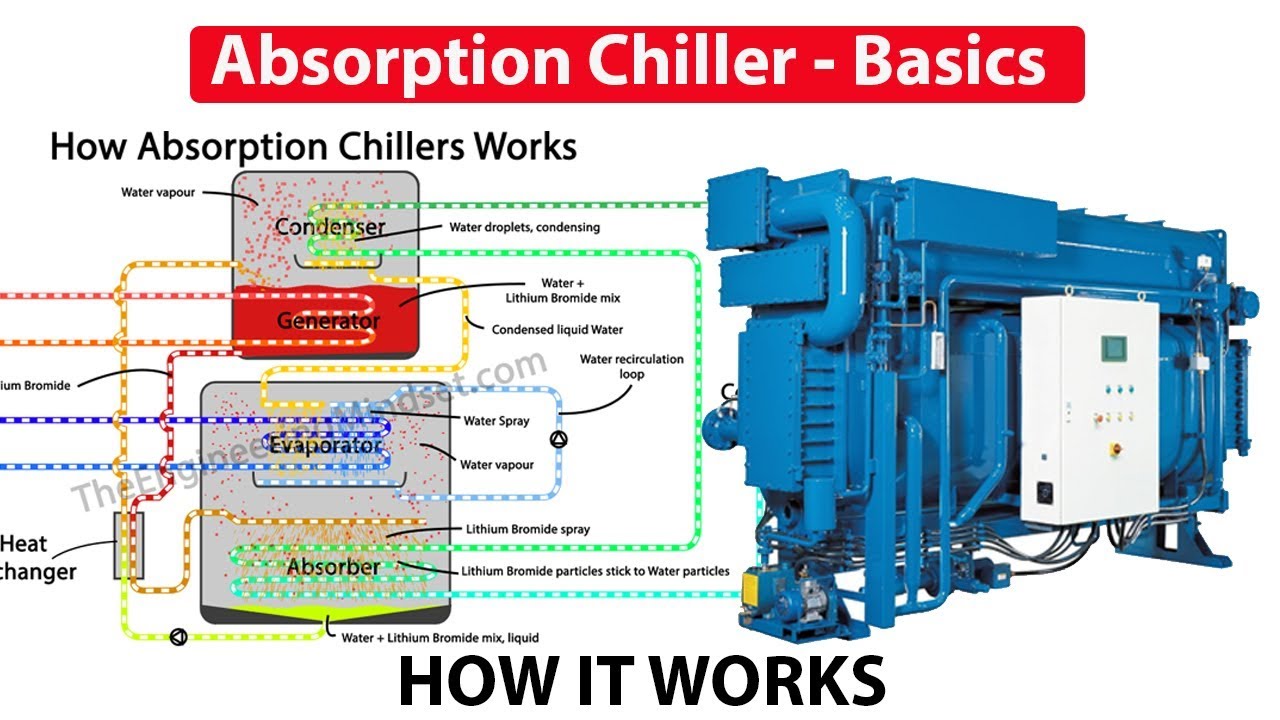
Absorption Chiller, How it works - working principle hvac
video description
Date: 2023-11-17
Related videos




Comments and reviews: 30
Daniel
Hi, I think it is pretty well explained. one issue. you say the condenser water in the evaporator water takes the heat given off by condensation away. i think that could be explain better; because by saying so i believe you are violating the principle that heat always travel from high to low temperature. it is, i know in a sense taking the heat of condensation away, as this heat because of the vacuum is very low temperature. and the condenser water is cooling down. but the condenser water is actually giving its heat up to the evaporator. it is the only way to say it correctly. Has nothing to do with the the condensation of the refrigeration water. The water vapor is condensing because of the affinity, as you say magnetic pull, of the salt for water. steam condensing cause additional vacuum. steam takes up a lot more space the water, so when steam condenses it creates pressure drop, and even lower temperature by definition i would say. the condenser water is being cooled down and this isadding efficiency to the whole system. it is really just another heat exchanger. let me know what you think. thanks for the video. its great
reply
Hi, I think it is pretty well explained. one issue. you say the condenser water in the evaporator water takes the heat given off by condensation away. i think that could be explain better; because by saying so i believe you are violating the principle that heat always travel from high to low temperature. it is, i know in a sense taking the heat of condensation away, as this heat because of the vacuum is very low temperature. and the condenser water is cooling down. but the condenser water is actually giving its heat up to the evaporator. it is the only way to say it correctly. Has nothing to do with the the condensation of the refrigeration water. The water vapor is condensing because of the affinity, as you say magnetic pull, of the salt for water. steam condensing cause additional vacuum. steam takes up a lot more space the water, so when steam condenses it creates pressure drop, and even lower temperature by definition i would say. the condenser water is being cooled down and this isadding efficiency to the whole system. it is really just another heat exchanger. let me know what you think. thanks for the video. its great
reply
Siggy
I've been toying with the idea of a solar powered air conditioning unit and came across the ammonia/water based systems and the thought of working with concentrated ammonia is kind of scary. This seems to be a far safer chemistry to do this with.
Overall this was a great intro to the way it works. Though there are a couple questions that spring to mind. How is the vacuum pulled? Is a separate vacuum pump used? Does the pump feeding the generator manage to do so? Or, as someone in the comments below stated, the cooled concentrated lithium bromide solution is so hygrophilic that is will create the low pressure by pulling water vapor into the solution. Which, if true, would simplify things immensely.
Also, I'm assuming the water collection tray in the evaporator will need some sort of purge mechanism to occasionally dump the contents as otherwise over time it would inevitably start to accumulate the salt.
reply
I've been toying with the idea of a solar powered air conditioning unit and came across the ammonia/water based systems and the thought of working with concentrated ammonia is kind of scary. This seems to be a far safer chemistry to do this with.
Overall this was a great intro to the way it works. Though there are a couple questions that spring to mind. How is the vacuum pulled? Is a separate vacuum pump used? Does the pump feeding the generator manage to do so? Or, as someone in the comments below stated, the cooled concentrated lithium bromide solution is so hygrophilic that is will create the low pressure by pulling water vapor into the solution. Which, if true, would simplify things immensely.
Also, I'm assuming the water collection tray in the evaporator will need some sort of purge mechanism to occasionally dump the contents as otherwise over time it would inevitably start to accumulate the salt.
reply
Simon
Hi thanks for the presentation. How does the efficiency of an Absorption chiller compare with the energy needed to run a geothermal heat pump.
I live in an off grid situation in Fiji and would like to set up a cool room for chilling vegetables to around 4c. I would need to generate electricity to run a heat pump or I could use solar heated hot water or a boiler to run a absorption chiller. If I build some thermal mass into the cool room the cooling system wouldn't need to run for 24 hours.
Thanks Simon
reply
Hi thanks for the presentation. How does the efficiency of an Absorption chiller compare with the energy needed to run a geothermal heat pump.
I live in an off grid situation in Fiji and would like to set up a cool room for chilling vegetables to around 4c. I would need to generate electricity to run a heat pump or I could use solar heated hot water or a boiler to run a absorption chiller. If I build some thermal mass into the cool room the cooling system wouldn't need to run for 24 hours.
Thanks Simon
reply
Michal
Great video thanks!
I'm desperately trying to find an answer to my question;
How can possibly a double-effect absorption heat pump reach coefficients of performance (COP) higher than 1?
I don't understand how a heat input (let's say waste heat) can result in a greater amount of heat removed (numerator of COP) than the said input (denominator of COP. Someone to help here? Thanks in advance!
reply
Great video thanks!
I'm desperately trying to find an answer to my question;
How can possibly a double-effect absorption heat pump reach coefficients of performance (COP) higher than 1?
I don't understand how a heat input (let's say waste heat) can result in a greater amount of heat removed (numerator of COP) than the said input (denominator of COP. Someone to help here? Thanks in advance!
reply
Quadrible
So I was tracking the process backwards from the flashing of liquid water to a water vapour mixture in low pressure that takes heat from the chilled water and I thought why not just create steam in a furnace, flash it and forget all this chemical messy stuff. then I realised that all that steam would be wasted so an absorption thingy like lithium bromide seems useful
reply
So I was tracking the process backwards from the flashing of liquid water to a water vapour mixture in low pressure that takes heat from the chilled water and I thought why not just create steam in a furnace, flash it and forget all this chemical messy stuff. then I realised that all that steam would be wasted so an absorption thingy like lithium bromide seems useful
reply
Dylan
Thanks for the excellent video! This particular one could definitely have benefited from the narrator pointing at what he was talking about with a cursor or something, especially towards the end when he's putting it all together, it got hard to follow. But still it's way better than the black and white pictures in my text books!
reply
Thanks for the excellent video! This particular one could definitely have benefited from the narrator pointing at what he was talking about with a cursor or something, especially towards the end when he's putting it all together, it got hard to follow. But still it's way better than the black and white pictures in my text books!
reply
CiaoCarbon
Great explanation, a real human voice and no distracting muzak in the background.
There is no compressor, but compared to a classic vapor-compression A/C, how much energy does the pumps and control system use? This assuming the heat source is free, just the system itself. Thank you.
reply
Great explanation, a real human voice and no distracting muzak in the background.
There is no compressor, but compared to a classic vapor-compression A/C, how much energy does the pumps and control system use? This assuming the heat source is free, just the system itself. Thank you.
reply
Henpon
hey, the chilled water flow direction icon seems reversed. and I think it will be easier to understand if you put Operating Pressure and Temperature (or T & P for each flow) so we know whether the heat transfers are feasible. Thank you anyway for making such a great educational video.
reply
hey, the chilled water flow direction icon seems reversed. and I think it will be easier to understand if you put Operating Pressure and Temperature (or T & P for each flow) so we know whether the heat transfers are feasible. Thank you anyway for making such a great educational video.
reply
Vin
The secret lies with partial pressure. As the Li-Br absorbs H2O molecules, it decreases the partial pressure of water inside the evaporator which causes the partial vacuum and hence the cooling effect. This is almost similar to the expansion valves of a vapor-compression systems.
reply
The secret lies with partial pressure. As the Li-Br absorbs H2O molecules, it decreases the partial pressure of water inside the evaporator which causes the partial vacuum and hence the cooling effect. This is almost similar to the expansion valves of a vapor-compression systems.
reply
Arief
Thank u sir for the best explanation. Does this type of chiller only come with rectangular-shaped heat exchanger for the evaporator-absorber as well as the condenser-generator? What are the considerations of why are so many Absorption chillers use rectangular-shaped vessels?
reply
Thank u sir for the best explanation. Does this type of chiller only come with rectangular-shaped heat exchanger for the evaporator-absorber as well as the condenser-generator? What are the considerations of why are so many Absorption chillers use rectangular-shaped vessels?
reply
Technically
not a magnetic attraction to lithium bromide but when water vapor produced in the evaporator area so there is more pressure than the absorber by pressure difference water vapor traveled to absorber hence lithium bromide absorb the water vapor. BTW nice teaching thanks
reply
not a magnetic attraction to lithium bromide but when water vapor produced in the evaporator area so there is more pressure than the absorber by pressure difference water vapor traveled to absorber hence lithium bromide absorb the water vapor. BTW nice teaching thanks
reply
Benjamin
At what point in the absorption chiller is it used to cool a building? Is the chilled water pipe whats used for cooling a building? I understand how the system works in a closed loop, but am trying to understand how its implemented in a cooling system
reply
At what point in the absorption chiller is it used to cool a building? Is the chilled water pipe whats used for cooling a building? I understand how the system works in a closed loop, but am trying to understand how its implemented in a cooling system
reply
Sadegh
this mov one of the best movies about absorbtion chiller I have ever seen.
Dear, can you record and teach a mov about multi effect absorbtion chiller and cristalization effect in chiller?
with best regards
reply
this mov one of the best movies about absorbtion chiller I have ever seen.
Dear, can you record and teach a mov about multi effect absorbtion chiller and cristalization effect in chiller?
with best regards
reply
PJ
I think the key point here is not low pressure low boiling point. Key point is Li Br has low boiling point, it take energy away from water when evaporated. That's why Li Be solution is used, instead of pure water.
reply
I think the key point here is not low pressure low boiling point. Key point is Li Br has low boiling point, it take energy away from water when evaporated. That's why Li Be solution is used, instead of pure water.
reply
Imtiaz
Even this is 4 years old video, I found it very informative. I want to make a small homemade Low pressure ammonia absorption chiller. I need some more information to design one. May I ask you few questions?
reply
Even this is 4 years old video, I found it very informative. I want to make a small homemade Low pressure ammonia absorption chiller. I need some more information to design one. May I ask you few questions?
reply
krutikzim
Sir, what if I assume there is no heat passing through the either condenser or evaporator. instead we only allow the water passing through it. Then what can happen. Will there be any possible cooling
reply
Sir, what if I assume there is no heat passing through the either condenser or evaporator. instead we only allow the water passing through it. Then what can happen. Will there be any possible cooling
reply
peckdec
Really good video. However, not to be that guy, but pure lithium bromide is not a liquid at least in the typical absorption pump temperature range. Its the solution of water and LiBr thats liquid.
reply
Really good video. However, not to be that guy, but pure lithium bromide is not a liquid at least in the typical absorption pump temperature range. Its the solution of water and LiBr thats liquid.
reply
berges104
Rough numbers would certainly help conceptualize. Exact numbers would vary but Temperature trends should be consistent. 100 in leaves at 75 out ect ect
But looks pretty straight forward
reply
Rough numbers would certainly help conceptualize. Exact numbers would vary but Temperature trends should be consistent. 100 in leaves at 75 out ect ect
But looks pretty straight forward
reply
Tim
Great video! But I suggest you change the third pic of water boiling at vacuum from an open beaker in the lab set up to some kind of closed vessel. Just to emphasize the vacuum in this case.
reply
Great video! But I suggest you change the third pic of water boiling at vacuum from an open beaker in the lab set up to some kind of closed vessel. Just to emphasize the vacuum in this case.
reply
j0j0pat00
Dear The-Engineering-Mindset, why don't they use absorption chiller in car with internal combustion engine where heat is generated all the time? Thank you in advance for your answer.
reply
Dear The-Engineering-Mindset, why don't they use absorption chiller in car with internal combustion engine where heat is generated all the time? Thank you in advance for your answer.
reply
maysam
very very nice video and explain. i imagined that vacuum pumps create vacuum in absorption chiller but yo said that attraction between LTr and water steam make this vacuum
reply
very very nice video and explain. i imagined that vacuum pumps create vacuum in absorption chiller but yo said that attraction between LTr and water steam make this vacuum
reply
education
When is this system best used? Why is it better than another system when used? What is the comparison efficiency for this system compared to other systems?
reply
When is this system best used? Why is it better than another system when used? What is the comparison efficiency for this system compared to other systems?
reply
Ancurio
The cooling tower is confusing me. why do you need to chill a chiller? Couldn't you just feed the cold water of the cooling tower directly to the output?
reply
The cooling tower is confusing me. why do you need to chill a chiller? Couldn't you just feed the cold water of the cooling tower directly to the output?
reply
France
why is that in evaporator dropping temperature happen instead of hammering or increasing temperature (boiled) if the issue is sudden change pressure?
reply
why is that in evaporator dropping temperature happen instead of hammering or increasing temperature (boiled) if the issue is sudden change pressure?
reply
enigma
theory is good.
question: who is manufacture such absorption type air conditioner in USA?
how much cost?
and unit that use amonia?
reply
theory is good.
question: who is manufacture such absorption type air conditioner in USA?
how much cost?
and unit that use amonia?
reply
education
Hi can anyone please help. Does the condensing loop always have to go throughout cooling tower to reject the heat or is their another way.
reply
Hi can anyone please help. Does the condensing loop always have to go throughout cooling tower to reject the heat or is their another way.
reply
Peter
So the heat from the thermal input plus the heat extracted from the chilled water output all ends up being dissipated in the cooling tower?
reply
So the heat from the thermal input plus the heat extracted from the chilled water output all ends up being dissipated in the cooling tower?
reply
nirav
Thanks for the video,
but Ive question
What is the absorption form and refrigerant form in VAHP? Please Ans if anybody knows.
reply
Thanks for the video,
but Ive question
What is the absorption form and refrigerant form in VAHP? Please Ans if anybody knows.
reply
Blackjesus
If the water is responsible for producing the refrigeration effect, then what is the use of lithium bromide? Please Explain!
reply
If the water is responsible for producing the refrigeration effect, then what is the use of lithium bromide? Please Explain!
reply
Frank
Now how to scale down this concept for use in vehicle engines that not only cool the engine but also generates electricity.
reply
Now how to scale down this concept for use in vehicle engines that not only cool the engine but also generates electricity.
reply
Add a review, comment
Other channel videos