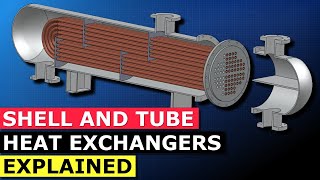
Shell and Tube Heat Exchanger basics explained
video description
Date: 2023-11-17
Related videos





Comments and reviews: 14
purple
Is this the sistem that is used in regular combo (2 in 1) washer-dryer machines (not the ones with heat pumps) for condensation of the moisture drawn by the hot air from the clothes?
If so, does anyone know how exactly it uses the cooling water? Does the machine draw cold water continuously? Does it empty and refill the shell after every set amount of time? Or does it have a temperature sensor inside the shell that governs either the refilling of the shell or the debit of cooling water running through the shell?
reply
Is this the sistem that is used in regular combo (2 in 1) washer-dryer machines (not the ones with heat pumps) for condensation of the moisture drawn by the hot air from the clothes?
If so, does anyone know how exactly it uses the cooling water? Does the machine draw cold water continuously? Does it empty and refill the shell after every set amount of time? Or does it have a temperature sensor inside the shell that governs either the refilling of the shell or the debit of cooling water running through the shell?
reply
thepianoman
Used to design the piping to these pieces of equipment as well as all equipment found on oil (etc) refineries / chemical plants etc. did so for decades. You bring back memories. When installed, there is a fixed end and floating end for these exchangers. the floating end is the opposite end to the header and slides on its supports as it expands.
The piping needs to be designed with this and all stresses borne in mind.
reply
Used to design the piping to these pieces of equipment as well as all equipment found on oil (etc) refineries / chemical plants etc. did so for decades. You bring back memories. When installed, there is a fixed end and floating end for these exchangers. the floating end is the opposite end to the header and slides on its supports as it expands.
The piping needs to be designed with this and all stresses borne in mind.
reply
Brandon
Might be good for cheaper desalination as well. Pump filtered sea water into the header, heated to evaporation in the tubes, and back to the header with one outlet for heavier brine and one outlet for water vapor to be condensed and pumped out to the water supply. Seems way less expensive than reverse osmosis. Especially with 8 degree C temp difference between boiling points.
reply
Might be good for cheaper desalination as well. Pump filtered sea water into the header, heated to evaporation in the tubes, and back to the header with one outlet for heavier brine and one outlet for water vapor to be condensed and pumped out to the water supply. Seems way less expensive than reverse osmosis. Especially with 8 degree C temp difference between boiling points.
reply
Aaron
I did water treatment on cooling towers 20+ years ago. I wouldve progressed into chillers & boilers more if I wouldve stayed with the on but my trainer was just to big an A-hole, I grew to despise him, & I feared becoming him. He made a lot of money but it doesnt make up for being as big a tool as this guy was.
reply
I did water treatment on cooling towers 20+ years ago. I wouldve progressed into chillers & boilers more if I wouldve stayed with the on but my trainer was just to big an A-hole, I grew to despise him, & I feared becoming him. He made a lot of money but it doesnt make up for being as big a tool as this guy was.
reply
waleed
At 4: 00, the animation shows the milk being warmed starting from the outlet side and not the inlet side. Is there any reason for this, since warming it from the inlet side would be more efficient thermally? Love your videos BTW.
reply
At 4: 00, the animation shows the milk being warmed starting from the outlet side and not the inlet side. Is there any reason for this, since warming it from the inlet side would be more efficient thermally? Love your videos BTW.
reply
Matt
What is the boiler design that uses a spray of water to create instant, high pressure steam? I can't remember what it's called and my googling has not been productive!
reply
What is the boiler design that uses a spray of water to create instant, high pressure steam? I can't remember what it's called and my googling has not been productive!
reply
Zhu
You showed but did not explain, in addition to the U-Tube type shell-in-tube heat exchanger, the floating tube sheet type. You may want to also explain that type.
reply
You showed but did not explain, in addition to the U-Tube type shell-in-tube heat exchanger, the floating tube sheet type. You may want to also explain that type.
reply
ilgar
Thank you for perfect explanation.
Very helpful
Could you please in your video talk about PID controller as well
proportional integral derivative
reply
Thank you for perfect explanation.
Very helpful
Could you please in your video talk about PID controller as well
proportional integral derivative
reply
education
The 6. 9L and 7. 3L IDI international Harvester Diesel engines used in Ford pickup trucks from 1983 to 1994 used these heat exchangers as oil coolers.
reply
The 6. 9L and 7. 3L IDI international Harvester Diesel engines used in Ford pickup trucks from 1983 to 1994 used these heat exchangers as oil coolers.
reply
Ivan
As a marine diesel mechanic, I'm very familiar with heat exchangers, since you can't place a radiator inside an engine room. Thank you for this lesson.
reply
As a marine diesel mechanic, I'm very familiar with heat exchangers, since you can't place a radiator inside an engine room. Thank you for this lesson.
reply
Juan
I work in a coal power plant and this its also use after the vapor does the work in te turbine it goes to 5 of those to heat the feeding water
reply
I work in a coal power plant and this its also use after the vapor does the work in te turbine it goes to 5 of those to heat the feeding water
reply
Vladimir
Steam locomotives use similar to Shell and Tube Heat Exchangers. It would be nice to make a video on steam locomotives: )
reply
Steam locomotives use similar to Shell and Tube Heat Exchangers. It would be nice to make a video on steam locomotives: )
reply
bad74maverick1
Here in the US the Double Pipe or Tube in Tube heat exchanger is also called a Plate and Frame heat exchanger.
reply
Here in the US the Double Pipe or Tube in Tube heat exchanger is also called a Plate and Frame heat exchanger.
reply
ArtemLUL
This is very helpful and right on time, because I work with these heat exchangers right now! Many thanks.
reply
This is very helpful and right on time, because I work with these heat exchangers right now! Many thanks.
reply
Add a review, comment
Other channel videos