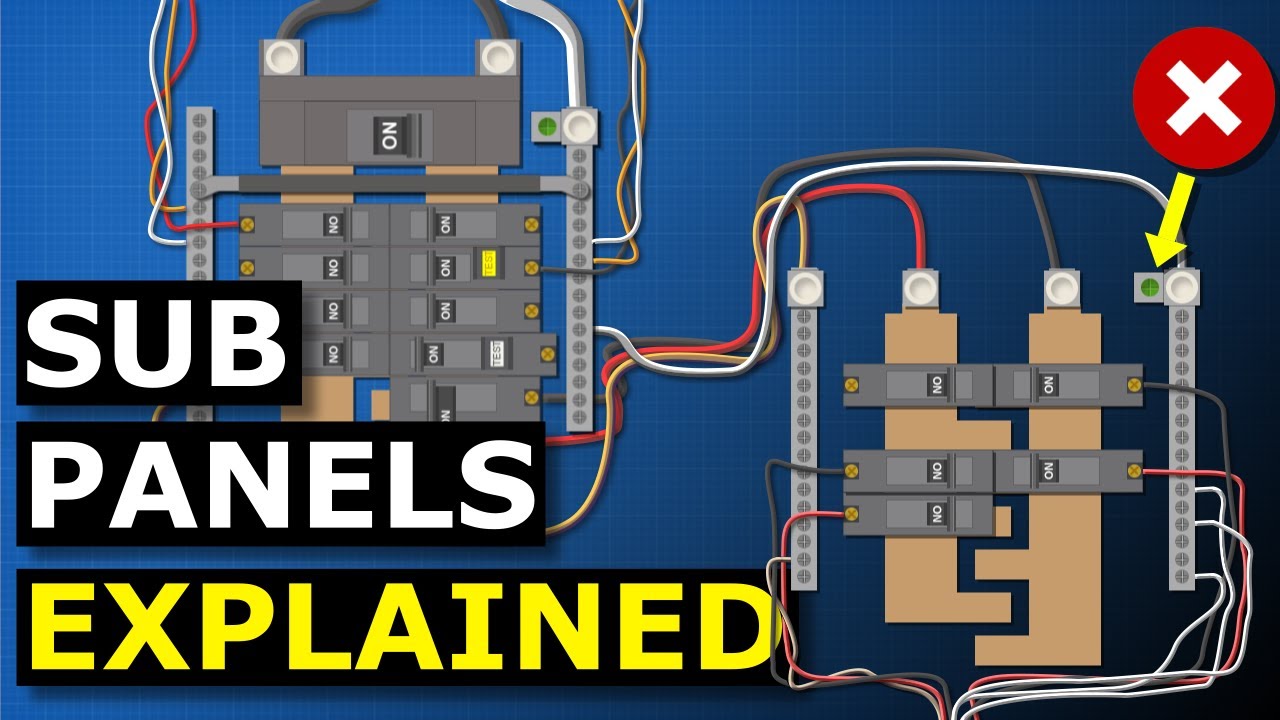
Sub Panels Explained - Why are neutral and ground separated?
video description
The neutral to the home is derived from a transformer secondary center tap, with this center tap also earthed at the pole. So coming to the home is center tapped 240 VAC with the neutral earthed at the pole.
In the US the main panel is often called a load center. Load Center is a generic term because load centers are configurable for either having a main breaker (main panel application) or having only lugs (remote (sub) panel application.
Per the NEC in the US there must be a main disconnect at the main panel (at a minimum a meter with a main breaker) external to the dwelling. This is to allow the fire department to de-energize the home in case of a fire. So if the installation calls for one main panel it is accessible from the exterior of the home, and if no sub-panels are used will also house all of the branch circuit breakers, which usually makes for a very confined installation. Because, ideally you would want to distribute all of the branch circuits of a home from what could be called the branch circuits minimum length center. So, you would find a sub-panel centrally located (in relation to the loads) with in the home, in addition to the meter + main breaker panel on the exterior at the service entrance.
The quality of panel is directly tied to the materials used for the main bus bars. The highest quality (and most expensive) is tin plated electrolytic copper. The lower cost panel has bus bars made from aluminum.
The real distinguishing factor in branch circuit protection and conductor sizing with the NEC is in describing the branch circuit load as either continuous duty (on for 3 hours or more) or non-continuous (on for less than 3 hours) duty. This has largely been ignored in residential because the loads traditionally are non-continuous. However, with Electric Vehicle charging continuous operation beyond 3 hours is not uncommon. So, as a result there is consideration for derating the continuous load, which also relates directly to panel sizing and conductor selection.
Date: 2023-11-17
Related videos




Comments and reviews: 29
Clyde
The main panel will need to be rated suitable for the use of a sub panel since all sub panels need to be 100 amps the minimum amps the main panel should be is at least 200 amp main, the main panel needs to be grounded and bonded, and a continuous #4 awg ground wire from 2 ground rods minimum 6ft apart and to main panel or disconnect but ran through the main panel to the sub panel or sub panels, the bonding is for the main panel or main disconnect and not the sub panels, the grounding which is done incorrectly in video because the #4 awg ground wire in video is broken and made up under ground bar in main panel is cut and #4 awg ground wire to sub panel comes from ground bar, not continuous run, but the sub panel needs the #4 awg ground from main ground rods through main panel as well as ground rods for sub panels
reply
The main panel will need to be rated suitable for the use of a sub panel since all sub panels need to be 100 amps the minimum amps the main panel should be is at least 200 amp main, the main panel needs to be grounded and bonded, and a continuous #4 awg ground wire from 2 ground rods minimum 6ft apart and to main panel or disconnect but ran through the main panel to the sub panel or sub panels, the bonding is for the main panel or main disconnect and not the sub panels, the grounding which is done incorrectly in video because the #4 awg ground wire in video is broken and made up under ground bar in main panel is cut and #4 awg ground wire to sub panel comes from ground bar, not continuous run, but the sub panel needs the #4 awg ground from main ground rods through main panel as well as ground rods for sub panels
reply
CityguyUSA
Can someone explain why ROMEX and an extension cord of the same amperage rating and length aren't interchangeable?
I have a garage 80' from the nearest outlet in my home also 80' from the main panel. If I want to run a welder in my garage an extension cord won't work but ROMEX will? I get that stranded wire is more flexible and ROMEX less. I'm willing to agree that stranded disappates electrons a tiny bit faster which I guess could resolved with better insulation but the copper is equivalant. I also understand that electrons run on the outside of the wires not in the core. Extension cords would therefore seem to dissapate heat better and push more electrons because of the increased surfaces of stranded wire. Wouldn't more electron movement be better in the long run? Pun intended.
What am I missing?
reply
Can someone explain why ROMEX and an extension cord of the same amperage rating and length aren't interchangeable?
I have a garage 80' from the nearest outlet in my home also 80' from the main panel. If I want to run a welder in my garage an extension cord won't work but ROMEX will? I get that stranded wire is more flexible and ROMEX less. I'm willing to agree that stranded disappates electrons a tiny bit faster which I guess could resolved with better insulation but the copper is equivalant. I also understand that electrons run on the outside of the wires not in the core. Extension cords would therefore seem to dissapate heat better and push more electrons because of the increased surfaces of stranded wire. Wouldn't more electron movement be better in the long run? Pun intended.
What am I missing?
reply
Heroes
If you lose the service neutral, the voltage supplied to all lights and appliances will float between 120 - 240 volts, potentially burning up everything you have.
Light bulbs will produce less / more light and will burn up within a short time, repeatedly.
If you see this happening, do not turn on small appliances until you have it checked out by a qualified person.
I have seen the connections come loose at the pole, at the mast head, and at the panel.
Service connections swaying in the wind for a long time come loose more than the utility company wants to admit and they do not want to replace what was destroyed.
I have seen qualified installers not tighten a lug in a meter base and burn up the lug and wire.
reply
If you lose the service neutral, the voltage supplied to all lights and appliances will float between 120 - 240 volts, potentially burning up everything you have.
Light bulbs will produce less / more light and will burn up within a short time, repeatedly.
If you see this happening, do not turn on small appliances until you have it checked out by a qualified person.
I have seen the connections come loose at the pole, at the mast head, and at the panel.
Service connections swaying in the wind for a long time come loose more than the utility company wants to admit and they do not want to replace what was destroyed.
I have seen qualified installers not tighten a lug in a meter base and burn up the lug and wire.
reply
LeeTom
Thanks for sharing. I saw that manufacturers of panel box recommand to attach a jumper (small metal) from the netrual bar to the metal box to satisfy a bar from netrual bar to ground bar. Is that safe enough? So is it true that besides installing the ground rod to the main panel, a metal bar needed to connect from neutral to ground? Thanks for any advice.
At the same time, at my house, i have a disconnect right above the elctrical meter base. It is not a switch but a pull-out disconnect mechanism. Inside the house, the main panel also has another disconnect switch. But never see a ground wire. How to ground it?
reply
Thanks for sharing. I saw that manufacturers of panel box recommand to attach a jumper (small metal) from the netrual bar to the metal box to satisfy a bar from netrual bar to ground bar. Is that safe enough? So is it true that besides installing the ground rod to the main panel, a metal bar needed to connect from neutral to ground? Thanks for any advice.
At the same time, at my house, i have a disconnect right above the elctrical meter base. It is not a switch but a pull-out disconnect mechanism. Inside the house, the main panel also has another disconnect switch. But never see a ground wire. How to ground it?
reply
Perry
Great explanation of perhaps a common possibility. BUT, in my house both the man panel and adjacent sub panel only have a common ground neutral bar; not 2 separate ones (that adjacent sub panel was only added about a decade ago - and it only came with a single common neutral/ground bar.
Now perhaps in my favor the adjacent sub panel common neutral/ground bar is both connected to the main beaker ground/neutral bar and also to the grounding electrode (water pipes entering the house. It appears that the sub panel has the same protection as the main breaker panel.
Comments anyone
reply
Great explanation of perhaps a common possibility. BUT, in my house both the man panel and adjacent sub panel only have a common ground neutral bar; not 2 separate ones (that adjacent sub panel was only added about a decade ago - and it only came with a single common neutral/ground bar.
Now perhaps in my favor the adjacent sub panel common neutral/ground bar is both connected to the main beaker ground/neutral bar and also to the grounding electrode (water pipes entering the house. It appears that the sub panel has the same protection as the main breaker panel.
Comments anyone
reply
xmfclick
It's amusing to hear an English voice explaining the American electrical system. It's also interesting to see how different the US system is from the UK system, which is variously different again from the systems in most European countries. Of course, the general principles are the same but the details are fairly different.
reply
It's amusing to hear an English voice explaining the American electrical system. It's also interesting to see how different the US system is from the UK system, which is variously different again from the systems in most European countries. Of course, the general principles are the same but the details are fairly different.
reply
BowhunterBrothers
Just a reminder to hire a professional if you have even the slightest confusion here. My good family friend was a WELL known professional electrician for over 30 years, and even he managed to accidentally electrocute himself at work one day. A few dollars is not worth your life.
reply
Just a reminder to hire a professional if you have even the slightest confusion here. My good family friend was a WELL known professional electrician for over 30 years, and even he managed to accidentally electrocute himself at work one day. A few dollars is not worth your life.
reply
Torbjrn
In Norway, all new houses have 3 phase 400V and 230 volt for consume takes from one face and neutral. 120 Volt demands 2 times the amount of copper also. In additional, all houses can use 3 phase motors. (we don't have miles, inches, pounds or gallons over here. That's stone age)
reply
In Norway, all new houses have 3 phase 400V and 230 volt for consume takes from one face and neutral. 120 Volt demands 2 times the amount of copper also. In additional, all houses can use 3 phase motors. (we don't have miles, inches, pounds or gallons over here. That's stone age)
reply
Helen
I have a 200amp panel. I know you are supposed to try to have equal distribution along each bus bar. I have an electric on demand water heater which requires 3 - 40A breakers, it uses 100A max when turned on. Should I have one breaker on one bus bar and two breakers on the other?
reply
I have a 200amp panel. I know you are supposed to try to have equal distribution along each bus bar. I have an electric on demand water heater which requires 3 - 40A breakers, it uses 100A max when turned on. Should I have one breaker on one bus bar and two breakers on the other?
reply
David
There are a lot of great electrical basics videos on YT, but by far, you've explained these concepts so well, and along with the fantastic graphics, made these concepts very well articulated. Thank you for producing these amazing videos and keep up the good work!
reply
There are a lot of great electrical basics videos on YT, but by far, you've explained these concepts so well, and along with the fantastic graphics, made these concepts very well articulated. Thank you for producing these amazing videos and keep up the good work!
reply
Quag
Excellent explanation, I, wired a sub panel for a solar system to run some of the circuits like, well, sewer lift station, refrigerators and a few outlets for back up and had a hard time finding the answer to my questions, this video did it with ease.
reply
Excellent explanation, I, wired a sub panel for a solar system to run some of the circuits like, well, sewer lift station, refrigerators and a few outlets for back up and had a hard time finding the answer to my questions, this video did it with ease.
reply
Jvls
I always believe that the current takes the path to least resistance which would be the first grounding electrode thats connected to the sub if the load was in the sub. Why would it go to the main pnl electrode?
Can you explain that to me?
reply
I always believe that the current takes the path to least resistance which would be the first grounding electrode thats connected to the sub if the load was in the sub. Why would it go to the main pnl electrode?
Can you explain that to me?
reply
Nofer
You definitely explained it. However a wiring schematic would be much easier to understand. The pictures can be used to layout the components but when it comes to the scenarios, use a wiring schematic which makes things crystal clear.
reply
You definitely explained it. However a wiring schematic would be much easier to understand. The pictures can be used to layout the components but when it comes to the scenarios, use a wiring schematic which makes things crystal clear.
reply
Tempo
So lets say somone pulls two legs and a neutral out to the garage.
Disconnect at the meter.
Can you set a ground rod outside the garage and call it good or must a ground conductor be pulled from the garage to the disconnect?
reply
So lets say somone pulls two legs and a neutral out to the garage.
Disconnect at the meter.
Can you set a ground rod outside the garage and call it good or must a ground conductor be pulled from the garage to the disconnect?
reply
Chad
Can you explain why a portable generator with a GFCI protected 240V 30A pops the GFCI when connected to a bonded neutral breaker box (for storm backup power? It's like it's seeing a ground fault because of the bonded neutral.
reply
Can you explain why a portable generator with a GFCI protected 240V 30A pops the GFCI when connected to a bonded neutral breaker box (for storm backup power? It's like it's seeing a ground fault because of the bonded neutral.
reply
hippo
Main panel with sub panel attached, if running romex through the main panel into the sub panel at what point do you strip the romex outer jacket, as it enters the main panel or as it enters the sub panel? Thanks
reply
Main panel with sub panel attached, if running romex through the main panel into the sub panel at what point do you strip the romex outer jacket, as it enters the main panel or as it enters the sub panel? Thanks
reply
David
Great video a sharp novice could understand it on the 1st run through the video, it would probably take a few pauses or rewinds for someone who has no concept to get how it all works. Well done!
reply
Great video a sharp novice could understand it on the 1st run through the video, it would probably take a few pauses or rewinds for someone who has no concept to get how it all works. Well done!
reply
muskaman2k
At 10: 23 you said same property. Did you mean to say same structure? Im asking cause im about to add a sub panel in a detached garage on my propertylol see my confusion? Great vid btw
reply
At 10: 23 you said same property. Did you mean to say same structure? Im asking cause im about to add a sub panel in a detached garage on my propertylol see my confusion? Great vid btw
reply
Denis
What is the function of the ground rod connection circuit? Tests have proven that it won't allow enough current to trip a breaker due to the high contact resistance between rod and dirt.
reply
What is the function of the ground rod connection circuit? Tests have proven that it won't allow enough current to trip a breaker due to the high contact resistance between rod and dirt.
reply
Carlos
How can I identify the conductors ungrounded color at a M-box?
Im sure they are black, red and blue. They are all black now.
I would appreciate your help
Thank you
reply
How can I identify the conductors ungrounded color at a M-box?
Im sure they are black, red and blue. They are all black now.
I would appreciate your help
Thank you
reply
Jay
Many older subpanels are neutral ground bonded and have no issues. it really came down to profits and industry having to purchase more materials for extra panel bars
reply
Many older subpanels are neutral ground bonded and have no issues. it really came down to profits and industry having to purchase more materials for extra panel bars
reply
education
Well I will rather ask you, why would you connect neutral and ground, that defeat the whole purpose and that will sabotage the flow of circuit
reply
Well I will rather ask you, why would you connect neutral and ground, that defeat the whole purpose and that will sabotage the flow of circuit
reply
cherriagana
Always interesting to see how massively dfferent this from here in europe.
Weird to not see a differential breaker as a mandatory thing.
reply
Always interesting to see how massively dfferent this from here in europe.
Weird to not see a differential breaker as a mandatory thing.
reply
Bee4PC
What if no equipment Ground was wire run to the sub panel would you bond the neutral to the ground bar. to server as a path back to main ground
reply
What if no equipment Ground was wire run to the sub panel would you bond the neutral to the ground bar. to server as a path back to main ground
reply
Larry
So if I just take off the 100 amp writing on the breaker and wright 250amps in its place then the breaker wont trip. Perfect. Got it. Ty.
reply
So if I just take off the 100 amp writing on the breaker and wright 250amps in its place then the breaker wont trip. Perfect. Got it. Ty.
reply
Corey
Love the video, but also discuss objectional current on the metal parts under normal operation when sub panels are bonded accidentally
reply
Love the video, but also discuss objectional current on the metal parts under normal operation when sub panels are bonded accidentally
reply
Don
Paul, you are English but the vid is about US Electrics. Can you do a Vid on UK electrical systems. But thanks for the brilliant vids.
reply
Paul, you are English but the vid is about US Electrics. Can you do a Vid on UK electrical systems. But thanks for the brilliant vids.
reply
Joanna
Great video, thank you. Section 254. 24 (time stamp 10: 51) is not in my 2005 copy of the NEC. When was this section issued?
reply
Great video, thank you. Section 254. 24 (time stamp 10: 51) is not in my 2005 copy of the NEC. When was this section issued?
reply
verminer7
I was wondering whether its possible to make a video about electrical in ship and yachts and how grounding works there?
reply
I was wondering whether its possible to make a video about electrical in ship and yachts and how grounding works there?
reply
Add a review, comment
Other channel videos