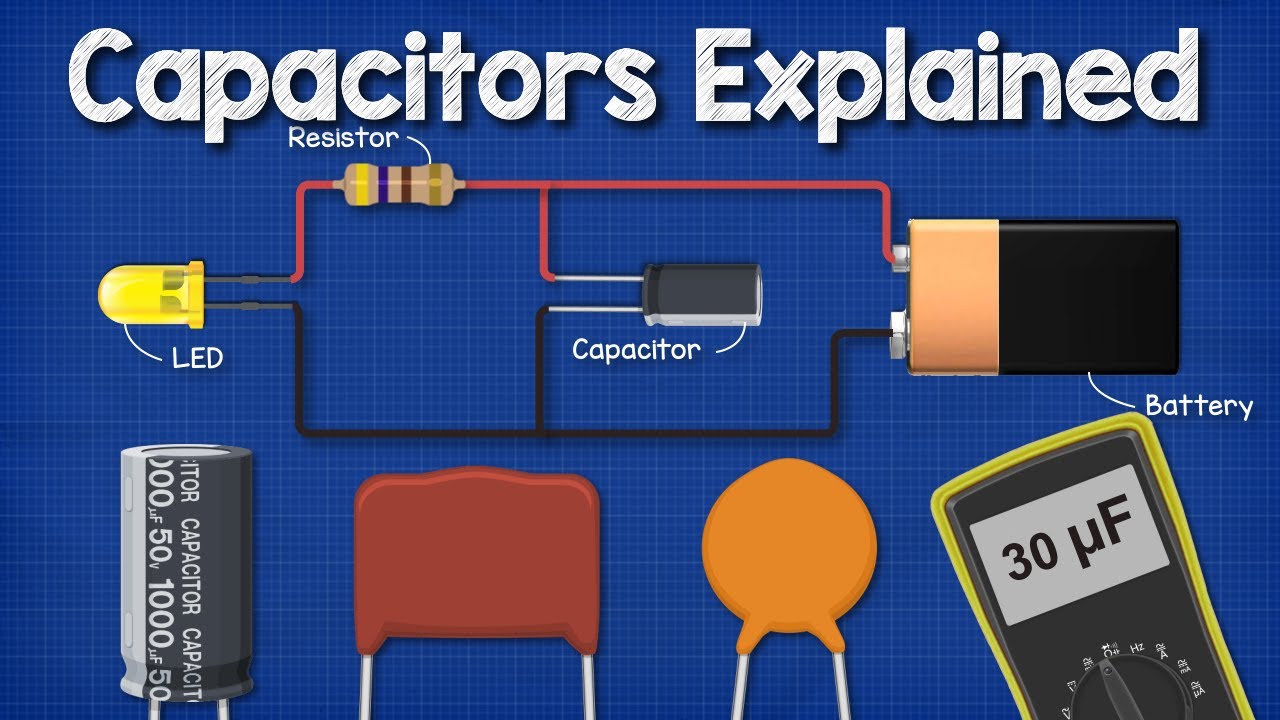
Capacitors Explained - The basics how capacitors work working principle
video description
Date: 2023-11-17
Related videos


Comments and reviews: 30
Ken
1. A capacitor is simply two conductors separated by an insulator (dielectric)
2. Capacitance is that property of an electric that tends to oppose a change in the voltage
3. The charge is not stored on one plate or the other; the charge is stored in the dielectric
- these are simple but accurate descriptions
Your water tank analogy is more applicable to an inductor or inductance. If you want to use a water analogy for a capacitor I would suggest using a hose, where once you shut the nozzle off, the hose expands to a point depending upon the water pressure applied (analogous to voltage. When you open the nozzle again you get a blast of water until the hose regains its original size. The elasticity of the hoses is analogous to the dielectric in the capacitor.
A capacitor is simply a device that concentrates the juxtaposition of the two conductors and the dielectric so you get a large r capacitance than you would with just two (insulated) wires running side-by-side
reply
1. A capacitor is simply two conductors separated by an insulator (dielectric)
2. Capacitance is that property of an electric that tends to oppose a change in the voltage
3. The charge is not stored on one plate or the other; the charge is stored in the dielectric
- these are simple but accurate descriptions
Your water tank analogy is more applicable to an inductor or inductance. If you want to use a water analogy for a capacitor I would suggest using a hose, where once you shut the nozzle off, the hose expands to a point depending upon the water pressure applied (analogous to voltage. When you open the nozzle again you get a blast of water until the hose regains its original size. The elasticity of the hoses is analogous to the dielectric in the capacitor.
A capacitor is simply a device that concentrates the juxtaposition of the two conductors and the dielectric so you get a large r capacitance than you would with just two (insulated) wires running side-by-side
reply
Glyxis
How long capacitors can actually store the energy? I've been disassembling some electronics/motherboards and stuff in recycling center and one thing we did there was that we cleaned circuit boards as much as we could, so we also pulled all capacitators out, usually just with pliers or side cutters. Does this mean we have always been in a danger of a shock? Wow, didn't even know that, I've probably yanked hundreds of them out, lol.
Well, most electronics there was probably been years out of use, so capacitators probably were out of charge, but there was also pretty new stuff time to time. Also, there was pretty large capacitators like microwaves and radios have, those were such chunky boys!
reply
How long capacitors can actually store the energy? I've been disassembling some electronics/motherboards and stuff in recycling center and one thing we did there was that we cleaned circuit boards as much as we could, so we also pulled all capacitators out, usually just with pliers or side cutters. Does this mean we have always been in a danger of a shock? Wow, didn't even know that, I've probably yanked hundreds of them out, lol.
Well, most electronics there was probably been years out of use, so capacitators probably were out of charge, but there was also pretty new stuff time to time. Also, there was pretty large capacitators like microwaves and radios have, those were such chunky boys!
reply
Himalaya
I use to be afraid of these because I never really understood the mechanism and principles behind these things (capacitors, resistors, diodes, transmitters etc. These things were included in our physics syllabus. Everything I studied just went above my head. All the teachers were just very bad at teaching topics like these. Now looking back in the time, I wish those teachers would've taught these concepts like you did. Now I am not afraid of those concepts and it's all because of you. Thank you so much for clearing my mind on these concepts. You are a true sensai.
reply
I use to be afraid of these because I never really understood the mechanism and principles behind these things (capacitors, resistors, diodes, transmitters etc. These things were included in our physics syllabus. Everything I studied just went above my head. All the teachers were just very bad at teaching topics like these. Now looking back in the time, I wish those teachers would've taught these concepts like you did. Now I am not afraid of those concepts and it's all because of you. Thank you so much for clearing my mind on these concepts. You are a true sensai.
reply
ChadAF
I went to college for Chem e, and I am extremely concerned at 35 years old I went into the wrong field. I just started electronics as a hobby, and after finding your videos I believe I missed my calling. Im currently building a handheld tool that can detect water behind polyurethane, as I built my Tesla coil and am happy with it now! Please keep up the videos!
reply
I went to college for Chem e, and I am extremely concerned at 35 years old I went into the wrong field. I just started electronics as a hobby, and after finding your videos I believe I missed my calling. Im currently building a handheld tool that can detect water behind polyurethane, as I built my Tesla coil and am happy with it now! Please keep up the videos!
reply
Wayne
In my high school auto-shop class, one quickly learned that, even if it's sitting harmlessly on a workbench, never pick up a condenser (an old name for a capacitor. It's a 2 long metal can with a wire attached. It will hold a 12V charge until it's picked up, completing the circuit between the wire and can.
It's a s\hocking experience.
reply
In my high school auto-shop class, one quickly learned that, even if it's sitting harmlessly on a workbench, never pick up a condenser (an old name for a capacitor. It's a 2 long metal can with a wire attached. It will hold a 12V charge until it's picked up, completing the circuit between the wire and can.
It's a s\hocking experience.
reply
Neil
Hi, could you please explain something thats confusing me right now? In this video the electrons are flowing from the negative to the positive of the battery but in the transistor video the electrons are flowing from the positive to the negative. Which is correct or are they both correct and it depends on the type of circuit?
reply
Hi, could you please explain something thats confusing me right now? In this video the electrons are flowing from the negative to the positive of the battery but in the transistor video the electrons are flowing from the positive to the negative. Which is correct or are they both correct and it depends on the type of circuit?
reply
Manuel
Sir it is a very helpfull information that inspire me to love my work as a RADIO/TELEVISION SERVICE MAN TECHNICIAN
EVEN IN ELECTRICITY AS I AM AN ELECTRICIAN AS WELL
Your explanation is well understood you are more than a professor in a prestigious School YOU HAVE JUST COMLETED MY TECHNICAL KNOW HOW thanks Sir.
reply
Sir it is a very helpfull information that inspire me to love my work as a RADIO/TELEVISION SERVICE MAN TECHNICIAN
EVEN IN ELECTRICITY AS I AM AN ELECTRICIAN AS WELL
Your explanation is well understood you are more than a professor in a prestigious School YOU HAVE JUST COMLETED MY TECHNICAL KNOW HOW thanks Sir.
reply
Ben
Hi Sir, I have a question. For touch screen switch and some smart light bulb, when you turn off the switch, the light bulb only dim and not completely turn off. but when a capacitor is added between the live and neutral cable, the light bulb is completely turn off. Able to illustrate what is the reason behind that?
reply
Hi Sir, I have a question. For touch screen switch and some smart light bulb, when you turn off the switch, the light bulb only dim and not completely turn off. but when a capacitor is added between the live and neutral cable, the light bulb is completely turn off. Able to illustrate what is the reason behind that?
reply
Cloud
Fun fact: on a strictly technical level, capacitors do not store charge, they store just the energy - the net sum of charges in a capacitor is zero. It's a fun fact to remember, but for almost all intents and purposes that simplification is understood and only the ummm ackshually people may try to correct you
reply
Fun fact: on a strictly technical level, capacitors do not store charge, they store just the energy - the net sum of charges in a capacitor is zero. It's a fun fact to remember, but for almost all intents and purposes that simplification is understood and only the ummm ackshually people may try to correct you
reply
Dave
July 2023 - Thank you for this amazing video. I know it took a lot of work to put together, but you covered everything and left nothing to the imagination. As was said before, you put other instructional videos to shame! Thanks again!
reply
July 2023 - Thank you for this amazing video. I know it took a lot of work to put together, but you covered everything and left nothing to the imagination. As was said before, you put other instructional videos to shame! Thanks again!
reply
classic
I have electronic devices from the early 90s in storage, turning them on for 1 hour (60 minutes) Is it good or bad to prevent all electrolytic capacitor failures due to disuse? what interval time tuning on all electronic devices?
reply
I have electronic devices from the early 90s in storage, turning them on for 1 hour (60 minutes) Is it good or bad to prevent all electrolytic capacitor failures due to disuse? what interval time tuning on all electronic devices?
reply
Ted
I took a dc circuits course years ago. Plenty of stuff hadn't heard of before in class. There was a guy from our area named An Wang who used capacitors to make the first computer logic circuits to make a 5v 1 bit or a 0v 0 bit
reply
I took a dc circuits course years ago. Plenty of stuff hadn't heard of before in class. There was a guy from our area named An Wang who used capacitors to make the first computer logic circuits to make a 5v 1 bit or a 0v 0 bit
reply
TheYTPguy
I just built my first circuit on a breadboard 2 days ago. Even for an absolute beginner, this was so easy to understand! Ive watched other videos but this was by far the best! Keep up the great work!
reply
I just built my first circuit on a breadboard 2 days ago. Even for an absolute beginner, this was so easy to understand! Ive watched other videos but this was by far the best! Keep up the great work!
reply
tony
2023 electrical engineering professionals: K this is good subject matter.
1997 Kid with 2500W parallel amps and 2000 Farad caps and twin alternators with 6 marine batteries in the trunk: K Brah.
reply
2023 electrical engineering professionals: K this is good subject matter.
1997 Kid with 2500W parallel amps and 2000 Farad caps and twin alternators with 6 marine batteries in the trunk: K Brah.
reply
rama18ification
Its been 20 yrs i have completed my electrical engineering. Now im developing intrest to understand and dig deeper seeing these videos. I never understood all these when in college
reply
Its been 20 yrs i have completed my electrical engineering. Now im developing intrest to understand and dig deeper seeing these videos. I never understood all these when in college
reply
BC
WOW! Wish we had this video on the Internet in 1990 when I was getting my BSEE degree. The electronic circuits classes and labs would have been a whole lot easier to understand!
reply
WOW! Wish we had this video on the Internet in 1990 when I was getting my BSEE degree. The electronic circuits classes and labs would have been a whole lot easier to understand!
reply
sprigatitooooo
Thank you for the video! my teacher only explained and tested the equations, without the concept of capacitor itself. This immensely helped me, thanks again!
reply
Thank you for the video! my teacher only explained and tested the equations, without the concept of capacitor itself. This immensely helped me, thanks again!
reply
Dr.
Beautiful. Loving your videos and your pedagogical approach. You offer plenty of remediation which is great for an older student like me with ADHD. Much appreciated.
reply
Beautiful. Loving your videos and your pedagogical approach. You offer plenty of remediation which is great for an older student like me with ADHD. Much appreciated.
reply
Brian
As a previous Electronics Technician, from the Vacuum-Tube era, I appreciate the way you explain with illustrations the concepts of components. Awesome Job! Thanks!
reply
As a previous Electronics Technician, from the Vacuum-Tube era, I appreciate the way you explain with illustrations the concepts of components. Awesome Job! Thanks!
reply
Jawsjawsjawsrg
I really wish this kind of stuff existed 15 years ago when I was going to school for electronics. I might have actually completed my degree for it.
reply
I really wish this kind of stuff existed 15 years ago when I was going to school for electronics. I might have actually completed my degree for it.
reply
Zebra
If a capacitor stores energy for only 2 seconds, what happens if we used 2 capacitors? Will it become 4 seconds or the voltage/current doubles or other
reply
If a capacitor stores energy for only 2 seconds, what happens if we used 2 capacitors? Will it become 4 seconds or the voltage/current doubles or other
reply
Nimajneb
Not sure if this is the proper place to ask this, but How would I discharge a capacitor? I have been just desoldering them hoping they are empty.
reply
Not sure if this is the proper place to ask this, but How would I discharge a capacitor? I have been just desoldering them hoping they are empty.
reply
Christopher
At what point does electricity become lethal? Is there a tipping point of volts or amps or something which then makes it a no no touch
reply
At what point does electricity become lethal? Is there a tipping point of volts or amps or something which then makes it a no no touch
reply
Justin
Well, this is helpful, I dont think it adequately explains the distinction between a battery and a capacitor. Both are for storing energy.
reply
Well, this is helpful, I dont think it adequately explains the distinction between a battery and a capacitor. Both are for storing energy.
reply
Mark
wow your video is amazing I blew my capacitor in my voice modulator it still worked but I couldnt understand why know I do excellent stuff
reply
wow your video is amazing I blew my capacitor in my voice modulator it still worked but I couldnt understand why know I do excellent stuff
reply
The
Thanks So Much! The explanation is so good and simple, Everything is easy to understand. You made it easy to understand. Thanks So Much!
reply
Thanks So Much! The explanation is so good and simple, Everything is easy to understand. You made it easy to understand. Thanks So Much!
reply
ChadAF
Connecting the negative lead to the longer pin on your capacitor just made me 2nd guess everything I thought I knew about electronics
reply
Connecting the negative lead to the longer pin on your capacitor just made me 2nd guess everything I thought I knew about electronics
reply
RJEEY
Im a noobie and I just wanted to ask Why is the resistor after the LED? Shouldn't the voltage be reduced before it reaches the LED?
reply
Im a noobie and I just wanted to ask Why is the resistor after the LED? Shouldn't the voltage be reduced before it reaches the LED?
reply
Aero
In a few more minutes you could have discussed the role of the capacitor in a tuned circuit. Wireless is THE thing these days.
reply
In a few more minutes you could have discussed the role of the capacitor in a tuned circuit. Wireless is THE thing these days.
reply
mrsanchaz2003
I dont think that the electrons move along the wire as shown. I remember watching another video which explained that
reply
I dont think that the electrons move along the wire as shown. I remember watching another video which explained that
reply
Add a review, comment
Other channel videos