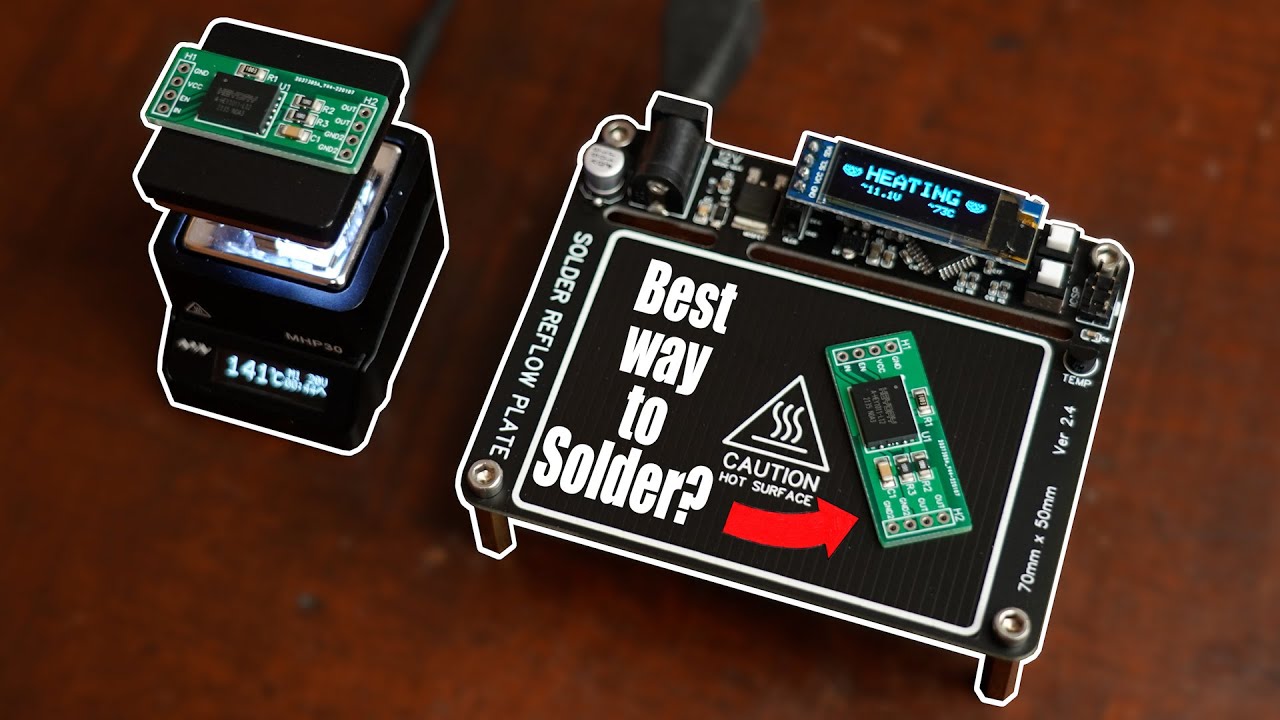
The Best way to Solder? Hot Plate to the rescue! (DIY or Buy)
video description
Date: 2022-02-27
Related videos


• TED-Ed




Comments and reviews: 10
Florian
If you don't have a hotplate yet, but you got a heat gun laying around: Just put one edge of the board in some kind of holder, like a vise or alligator clips and heat it from below. This has the same effect as a hotplate. I have soldered like this very often, no damage to the backside of any board yet and you can control the heat intuitively with your hands. Only downside is that the heating isn't as uniform as with the hotplate and large boards will warp a bit because of that. Largest one i have soldered this way was 100x70mm 2.
reply
If you don't have a hotplate yet, but you got a heat gun laying around: Just put one edge of the board in some kind of holder, like a vise or alligator clips and heat it from below. This has the same effect as a hotplate. I have soldered like this very often, no damage to the backside of any board yet and you can control the heat intuitively with your hands. Only downside is that the heating isn't as uniform as with the hotplate and large boards will warp a bit because of that. Largest one i have soldered this way was 100x70mm 2.
reply
David
Litterally ordered six different pcbs at JLC till now, my biggest one had over 110 components (took me araound 8 hours of hand soldering) and i havent used a hotplate or a hot air gun once. The reason i never did always was the pricepoint but I can definetly see why hotplates are so popular these days, since soldering with my ts100 can be quite tricky for some very small chips. So for me a cheap diy reflow plate to play arround and get familliar with this tecnique is a great option,
reply
Litterally ordered six different pcbs at JLC till now, my biggest one had over 110 components (took me araound 8 hours of hand soldering) and i havent used a hotplate or a hot air gun once. The reason i never did always was the pricepoint but I can definetly see why hotplates are so popular these days, since soldering with my ts100 can be quite tricky for some very small chips. So for me a cheap diy reflow plate to play arround and get familliar with this tecnique is a great option,
reply
ornotermes
I think it would make more sense to make the DIY version as two boards, one control board and one just as a heater. That way you only need to replace the heater board if it gets damaged over time. The heater could also be larger and it might also be possible to have a temperature sensor touching the bottom of the heater if the boards are stacked to get a more accurate temperature measurement.
reply
I think it would make more sense to make the DIY version as two boards, one control board and one just as a heater. That way you only need to replace the heater board if it gets damaged over time. The heater could also be larger and it might also be possible to have a temperature sensor touching the bottom of the heater if the boards are stacked to get a more accurate temperature measurement.
reply
K.
My sons graphics card burnt a mosfet (plus fuse and regulator. I quickly learned, even at 450c hot air reflow station is no match to get anything off the PCB. Normal PCBs bubble at such heat but graphics cards can take way more (just like your aluminum LED board. I wonder, would this be a possibility for such removing? FYI it s double sided for extra difficulty!
reply
My sons graphics card burnt a mosfet (plus fuse and regulator. I quickly learned, even at 450c hot air reflow station is no match to get anything off the PCB. Normal PCBs bubble at such heat but graphics cards can take way more (just like your aluminum LED board. I wonder, would this be a possibility for such removing? FYI it s double sided for extra difficulty!
reply
No
Sorry but there is nothing intuitive about the MHP-30's user interface. It's a nice device but the human I/O is terrible. I've used it for over a year, getting it out only once a month or less. If it were intuitive I would not have to find and puzzle through the manul every time. Both the user interface and the default manual are both absolutely abysmal.
reply
Sorry but there is nothing intuitive about the MHP-30's user interface. It's a nice device but the human I/O is terrible. I've used it for over a year, getting it out only once a month or less. If it were intuitive I would not have to find and puzzle through the manul every time. Both the user interface and the default manual are both absolutely abysmal.
reply
powertomato
It's maybe a bit bulky but I was thinking about buying one of those cheap kitchen top hotplates. There are a ton of used ones that you can get quite cheap or even free. For control I tought about bang-bang it using a solid-state-relais and an arduino.
Though I must admit that small DIY hotplate looks like a very fun and useful project
reply
It's maybe a bit bulky but I was thinking about buying one of those cheap kitchen top hotplates. There are a ton of used ones that you can get quite cheap or even free. For control I tought about bang-bang it using a solid-state-relais and an arduino.
Though I must admit that small DIY hotplate looks like a very fun and useful project
reply
Ben
A former collegae always used a electric home cooking plate (allso known as gourmet plate. The heating and cooling down Curve is almost matching one on one with a good reflow oven curve. He placed the PCB on the cold plate and covers IT with a glass oven dish. Just power it on and shut it down on the right moment.
reply
A former collegae always used a electric home cooking plate (allso known as gourmet plate. The heating and cooling down Curve is almost matching one on one with a good reflow oven curve. He placed the PCB on the cold plate and covers IT with a glass oven dish. Just power it on and shut it down on the right moment.
reply
Gaki
Hey! How about hacking the heatplate of a 3D printer. It's design to handle the heat up and cool down cycle but also feature a quite big heating area. The main problem is wethaer the heatplate can handle tempeature up to 200C or the power draw. But it's will turn out to be fun!
reply
Hey! How about hacking the heatplate of a 3D printer. It's design to handle the heat up and cool down cycle but also feature a quite big heating area. The main problem is wethaer the heatplate can handle tempeature up to 200C or the power draw. But it's will turn out to be fun!
reply
kubard
I've made my diy hotplate using an old iron and pid controller from aliexpress. It fits medium sized pcbs, does have planty of power (my iron was 2200W, and is really cheap, you can get an worn out iron for free, and the pid controller was only like 10
reply
I've made my diy hotplate using an old iron and pid controller from aliexpress. It fits medium sized pcbs, does have planty of power (my iron was 2200W, and is really cheap, you can get an worn out iron for free, and the pid controller was only like 10
reply
supertoegang
That discount would be perfect when purchasing first versions of my own microcontroller board design! Also, the subject of this video is perfect for when I get to solder the boards myself afterwards because of the tiny formfactor. Thanks
reply
That discount would be perfect when purchasing first versions of my own microcontroller board design! Also, the subject of this video is perfect for when I get to solder the boards myself afterwards because of the tiny formfactor. Thanks
reply
Add a review, comment
Other channel videos