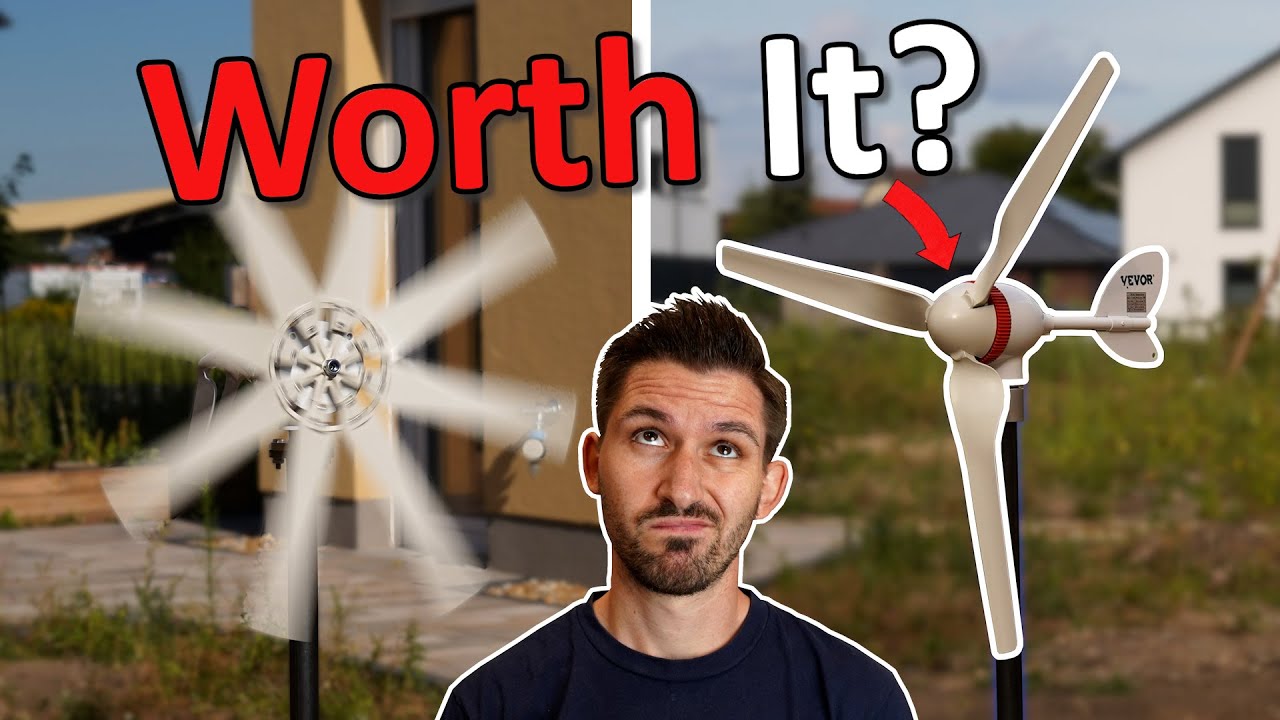
I tried to Power my Home with Wind Generators! (Worth it)
video description
Date: 2024-08-25
Related videos





Comments and reviews: 20
elvinhaak
Well, a couple of things about this.
a) well, even getting a meter higher will be doing a lot and if it is 'out of sight' but somehow the most common winddirection is tunneled towards your generator, you will gain a lot of more efficient power.
b) those fans are really, really flat and not curved right so far from optimal especially at low speeds. You probably want to aim for a speed at which the tips of the fanblades go around 100 km/h at a good strong wind (like force 5, or go slower but with deeper blade-curvature.
With that said, I had a little wind-generator just a bit bigger (longer blades, only 3) with a simple bike-dynamo as a child that could easiely generate 3 Watts with the wind you had in your back-garden. It was just a little bit higher but of course you get a far more efficient windflow, also lots safer because you don't walk into it or pets for example. Maybe just on top of the washing-rack
Actually, as long as things are 'mobile' like on top of something you ride or drive, most building-codes are pretty 'free' in most EU-countries as long as you stay under 6 meters or the maximum roof-hight.
And yes, there are also exceptions for wind-generators and such as long as they don't give disturbing shades and reflections so you might go higher than that.
My father had an experimental generator that was bigger (I think 4 meter tip-tip, 2 blades) and could easily generate 50-80 Watts but for those you really need to get some safety-things into place for storms and such. A couple of 100 Watts was theoretically also possible but we didn't get around to hooking the electronics and generator up (it was the 80s.
We were both millers (yes, the old-time famous windmills of the Netherlands) with diploma's a couple of years later and those were having no real problem with some KWatts with a small generator of course. But you need some well made regulators to controll the loading and also the different windspeeds within just a couple of minutes.
reply
Well, a couple of things about this.
a) well, even getting a meter higher will be doing a lot and if it is 'out of sight' but somehow the most common winddirection is tunneled towards your generator, you will gain a lot of more efficient power.
b) those fans are really, really flat and not curved right so far from optimal especially at low speeds. You probably want to aim for a speed at which the tips of the fanblades go around 100 km/h at a good strong wind (like force 5, or go slower but with deeper blade-curvature.
With that said, I had a little wind-generator just a bit bigger (longer blades, only 3) with a simple bike-dynamo as a child that could easiely generate 3 Watts with the wind you had in your back-garden. It was just a little bit higher but of course you get a far more efficient windflow, also lots safer because you don't walk into it or pets for example. Maybe just on top of the washing-rack
Actually, as long as things are 'mobile' like on top of something you ride or drive, most building-codes are pretty 'free' in most EU-countries as long as you stay under 6 meters or the maximum roof-hight.
And yes, there are also exceptions for wind-generators and such as long as they don't give disturbing shades and reflections so you might go higher than that.
My father had an experimental generator that was bigger (I think 4 meter tip-tip, 2 blades) and could easily generate 50-80 Watts but for those you really need to get some safety-things into place for storms and such. A couple of 100 Watts was theoretically also possible but we didn't get around to hooking the electronics and generator up (it was the 80s.
We were both millers (yes, the old-time famous windmills of the Netherlands) with diploma's a couple of years later and those were having no real problem with some KWatts with a small generator of course. But you need some well made regulators to controll the loading and also the different windspeeds within just a couple of minutes.
reply
BromideBride
Wind isn't worth it. Ignore all the fluffy hippy waffle. I live on a hill, in a 5m/s wind stream with a very very expensive not Chinese, 1kW turbine. It produced lots of power on top of the 10mtr street lamp post. But it also blew away twice, burned out the slip rings, snapped off the tail, twisted off the alternator and needed annual checks that meant climbing a 12mtr ladder to reach the thing - and I was an aerial installer for years so I've climbed more ladders than most people ever will.
Add that to the problem with lithium batteries that don't want dump charging at random voltages.
Basically, it's excessive work, excessive cost and limited output _even in a wind stream rated above design specs.
Add any eddy currents from nearby (twenty to thirty metres) buildings, trees, hedges, overweight cows etc etc that will trash the bearings or the alternator.
I've been doing off grid since the 1980s and am fully off grid for power and water.
If you want wind, go for a full scale commercial turbine.
Otherwise, build a car port, a pergola, a shed, another shed, another shed and cover them all with as much solar as possible. It's cheap, reliable, quiet (I didn't mention the continuous variable pitch whirring) and use the spare cash for another battery or 16.
reply
Wind isn't worth it. Ignore all the fluffy hippy waffle. I live on a hill, in a 5m/s wind stream with a very very expensive not Chinese, 1kW turbine. It produced lots of power on top of the 10mtr street lamp post. But it also blew away twice, burned out the slip rings, snapped off the tail, twisted off the alternator and needed annual checks that meant climbing a 12mtr ladder to reach the thing - and I was an aerial installer for years so I've climbed more ladders than most people ever will.
Add that to the problem with lithium batteries that don't want dump charging at random voltages.
Basically, it's excessive work, excessive cost and limited output _even in a wind stream rated above design specs.
Add any eddy currents from nearby (twenty to thirty metres) buildings, trees, hedges, overweight cows etc etc that will trash the bearings or the alternator.
I've been doing off grid since the 1980s and am fully off grid for power and water.
If you want wind, go for a full scale commercial turbine.
Otherwise, build a car port, a pergola, a shed, another shed, another shed and cover them all with as much solar as possible. It's cheap, reliable, quiet (I didn't mention the continuous variable pitch whirring) and use the spare cash for another battery or 16.
reply
moongooat
Interresteing video, and nice to give it a try! There are a lot of turbulence close to a house and close to the ground and without the possibillty to have the turbine high up very little energy will be produced. Only reason for small wind turbines would be if beeing offgrid, then it might be a good complement for maintainance charging of battery banks. Where I live (Sweden) you are allowed to put up a wind mill up to 20 meters in height (top of blades included in measurement) without building permit. Since my cabin is offgrid i thougth about this first, but went for solar panels instead due to cost for the pole and securing systems.
Another thought: On such low voltage 12V energy are lost in the cables, even a few meters (I guess you already calculated on cable area and voltage dropped) will be a problem. Well. maybe not if fhe power is 2W. but more power are problematic on long cables and low voltage. What about using transformers, get the voltage up to say 80V, and then down again at the regulator
reply
Interresteing video, and nice to give it a try! There are a lot of turbulence close to a house and close to the ground and without the possibillty to have the turbine high up very little energy will be produced. Only reason for small wind turbines would be if beeing offgrid, then it might be a good complement for maintainance charging of battery banks. Where I live (Sweden) you are allowed to put up a wind mill up to 20 meters in height (top of blades included in measurement) without building permit. Since my cabin is offgrid i thougth about this first, but went for solar panels instead due to cost for the pole and securing systems.
Another thought: On such low voltage 12V energy are lost in the cables, even a few meters (I guess you already calculated on cable area and voltage dropped) will be a problem. Well. maybe not if fhe power is 2W. but more power are problematic on long cables and low voltage. What about using transformers, get the voltage up to say 80V, and then down again at the regulator
reply
pa4tim
You only tried low budget Chinese stuff, I had hoped to see a compare to something a lot better. I live on a boat in a very windy harbor. I use solar panels but in winter I could use something extra. It almost always is windy here, almost always between 3 and 6 beaufort. Nobody here uses wind generators, but there are sometimes travelers who do use one on their boat and when I ask, some say it is a waste of money, others say it works very well. The first are most time low budget direct from China like yours. , the latter use much more expensive brands (over 1000 euro) but up to now all of them had no EE background and often not even know the difference between current and voltage, let alone they can measure things.
Was that a new generator, that metal ring looked rather (heavy) used.
reply
You only tried low budget Chinese stuff, I had hoped to see a compare to something a lot better. I live on a boat in a very windy harbor. I use solar panels but in winter I could use something extra. It almost always is windy here, almost always between 3 and 6 beaufort. Nobody here uses wind generators, but there are sometimes travelers who do use one on their boat and when I ask, some say it is a waste of money, others say it works very well. The first are most time low budget direct from China like yours. , the latter use much more expensive brands (over 1000 euro) but up to now all of them had no EE background and often not even know the difference between current and voltage, let alone they can measure things.
Was that a new generator, that metal ring looked rather (heavy) used.
reply
debiancool
Great video, but I am curious, why did you opt for 12V instead of 48V I think that would have yielded much better results. All that to say, yes, please rewind it: D
I am very curious whether some DIY arduino-controlled DC-DC buck/boost module could improve your results through trial and error. You basically have rotational speed data in the output voltage frequency, and there must be an ideal powerband even at low speeds when boosting it (which would be the maximum current pulled without leading to significant loss in frequency once up to speed, minus some margin of error, I think - totally could be wrong. I have thought about these things a lot, so I appreciate your video!
reply
Great video, but I am curious, why did you opt for 12V instead of 48V I think that would have yielded much better results. All that to say, yes, please rewind it: D
I am very curious whether some DIY arduino-controlled DC-DC buck/boost module could improve your results through trial and error. You basically have rotational speed data in the output voltage frequency, and there must be an ideal powerband even at low speeds when boosting it (which would be the maximum current pulled without leading to significant loss in frequency once up to speed, minus some margin of error, I think - totally could be wrong. I have thought about these things a lot, so I appreciate your video!
reply
drunk_astronomy
good video. The only time I’ve ever thought a turbine was right was for marine applications like on the back of a sailboat.
Of course those cheap generators give you cheap results and in my years of doing alternative energy for a living I have never recommended a wind turbine.
Also if you want any good output, you gotta spend some serious money to get something worthwhile then you gotta put up a tower. There’s regulatory hurdles, just a straight up pain in the butt. Solar is easier and for the trouble we can always build bigger battery packs.
that’s my two cents
reply
good video. The only time I’ve ever thought a turbine was right was for marine applications like on the back of a sailboat.
Of course those cheap generators give you cheap results and in my years of doing alternative energy for a living I have never recommended a wind turbine.
Also if you want any good output, you gotta spend some serious money to get something worthwhile then you gotta put up a tower. There’s regulatory hurdles, just a straight up pain in the butt. Solar is easier and for the trouble we can always build bigger battery packs.
that’s my two cents
reply
ErtsenPlayGames
Maybe diy roof invisible turbine like ridgeblade (but diy maybe using big used industrial fan or something), it should be possible to mount it without legal problems (but im not sure)
If you rewind the ones you have you will probably reach way more voltage than controllers can handle, it should be possible to make bridge rectifier, add some capacitors etc and connect standard solar mppt
But because there is no brake in it add simple rpm controller brake using some resistor or something to slow it down at specified rpm
reply
Maybe diy roof invisible turbine like ridgeblade (but diy maybe using big used industrial fan or something), it should be possible to mount it without legal problems (but im not sure)
If you rewind the ones you have you will probably reach way more voltage than controllers can handle, it should be possible to make bridge rectifier, add some capacitors etc and connect standard solar mppt
But because there is no brake in it add simple rpm controller brake using some resistor or something to slow it down at specified rpm
reply
peterz2027
Well, according to various sources, the power of wind is given by pi/2 rho R2 V3, where rho = 1. 225 kg/m3 is the air density, R is the blade radius (0. 6m in the case of your newer 3-blade turbine according to the AliExpress site. Now if we assume a wind speed of v = 3 m/s, then the above formula gives us roughly 18. 7 Watts -- which would be at 100% efficiency, of course, so there simply isn't all that much wind energy to harness at those wind speeds and with such small rotor blades in the first place.
reply
Well, according to various sources, the power of wind is given by pi/2 rho R2 V3, where rho = 1. 225 kg/m3 is the air density, R is the blade radius (0. 6m in the case of your newer 3-blade turbine according to the AliExpress site. Now if we assume a wind speed of v = 3 m/s, then the above formula gives us roughly 18. 7 Watts -- which would be at 100% efficiency, of course, so there simply isn't all that much wind energy to harness at those wind speeds and with such small rotor blades in the first place.
reply
techheck3358
The power in wind equation tells us that power = 1/2 air density (kg/m3) swept area (m2) (velocity (m/s)3
Small scale wind power just doesn’t make sense. You need big blades to increase the swept area, and put it as high up as possible
For your little turbine which is like, 50cm radius 2. 5m/s wind You can get a maximum of 7 watts. Except that is not possible. Betz law tells us the theoretical maximum is 59%. Your 1. 5 watts is 21%, not much of a surprise with the cheap controller & windings
reply
The power in wind equation tells us that power = 1/2 air density (kg/m3) swept area (m2) (velocity (m/s)3
Small scale wind power just doesn’t make sense. You need big blades to increase the swept area, and put it as high up as possible
For your little turbine which is like, 50cm radius 2. 5m/s wind You can get a maximum of 7 watts. Except that is not possible. Betz law tells us the theoretical maximum is 59%. Your 1. 5 watts is 21%, not much of a surprise with the cheap controller & windings
reply
user-kl2zs3kp7d
How much you want to bet we could have a highly efficient wind turbine on every household and all save money but instead they only allow the industrial ones so they can keep us dependent on them. Even getting solar youre still grid tied in the US. Ive always felt that toyota or someone could design a long lasting easily repairable efiicient low speed wind generator but it seems theres a hidden hand keeping them off the market and all we can get is cheap useless junk now for decades.
reply
How much you want to bet we could have a highly efficient wind turbine on every household and all save money but instead they only allow the industrial ones so they can keep us dependent on them. Even getting solar youre still grid tied in the US. Ive always felt that toyota or someone could design a long lasting easily repairable efiicient low speed wind generator but it seems theres a hidden hand keeping them off the market and all we can get is cheap useless junk now for decades.
reply
mxblock
Nice video as allways!
I myself build a wind generator with some hoverboard motors - with higher wind speeds they also worked great. But I also encountered the problem of either way to slow wind for high enough ouput for my controller and after resoldering the windings I managed to get a higher output Voltage, but now in stormy winds it would go so high i feared damaging the wires. Since then I halted the project.
Would love to see you coming up with a low voltage controller!
reply
Nice video as allways!
I myself build a wind generator with some hoverboard motors - with higher wind speeds they also worked great. But I also encountered the problem of either way to slow wind for high enough ouput for my controller and after resoldering the windings I managed to get a higher output Voltage, but now in stormy winds it would go so high i feared damaging the wires. Since then I halted the project.
Would love to see you coming up with a low voltage controller!
reply
I_Am_Empyrean
In order to get more energy out of it, you would need more impedance. In order to sustain a higher impedance, you would need larger propellers. In order to have larger propellers, you would need a larger base. Oh look, now you have a traditional windmill. Wind generators are terribly expensive and terribly inefficient, they are prone to mechanical failure, freezes, etcetera. It's a marvel of beaurocracy that governments fund their construction over better alternatives.
reply
In order to get more energy out of it, you would need more impedance. In order to sustain a higher impedance, you would need larger propellers. In order to have larger propellers, you would need a larger base. Oh look, now you have a traditional windmill. Wind generators are terribly expensive and terribly inefficient, they are prone to mechanical failure, freezes, etcetera. It's a marvel of beaurocracy that governments fund their construction over better alternatives.
reply
HBProductions.
This is something I've been wanting to do too. I want solar panels and wind generation to charge a power bank to power a few devices of the home. Mainly, the air conditioning, 220v clothes drier and computers as these things are the most power consumers in my home. I'd like to have these items run in a seperate power supply from the rest of the house as they aren't in use all the time, but they currently spike my electric bill.
reply
This is something I've been wanting to do too. I want solar panels and wind generation to charge a power bank to power a few devices of the home. Mainly, the air conditioning, 220v clothes drier and computers as these things are the most power consumers in my home. I'd like to have these items run in a seperate power supply from the rest of the house as they aren't in use all the time, but they currently spike my electric bill.
reply
RandomNoob
Well this went as expected lol
I don't know if you have used or looked for a previous video (can't remember) but maybe check out omnicalculator to get a rough estimate of the total power output available for a given blade size and wind speed.
In general smaller wind turbines are pretty much useless because you just don't have the power available in the wind to start off with in typical wind speeds like you and I have.
reply
Well this went as expected lol
I don't know if you have used or looked for a previous video (can't remember) but maybe check out omnicalculator to get a rough estimate of the total power output available for a given blade size and wind speed.
In general smaller wind turbines are pretty much useless because you just don't have the power available in the wind to start off with in typical wind speeds like you and I have.
reply
RubenKelevra
Your conclusion is a bit harsh, as you bought the most scammy models on the market with the most useless power output and mounted them in the worst position possible and complain that it doesn't work.
Yeah, no shit
Checkout the SuperWind 1250 for example and mount it on a 5-10m pole (after getting the permission to do that of course. They work great and have inverters which give you real power output at low speeds.
reply
Your conclusion is a bit harsh, as you bought the most scammy models on the market with the most useless power output and mounted them in the worst position possible and complain that it doesn't work.
Yeah, no shit
Checkout the SuperWind 1250 for example and mount it on a 5-10m pole (after getting the permission to do that of course. They work great and have inverters which give you real power output at low speeds.
reply
greatscott
Hi mr Scott i wanna tell u something about electrical welding
U need to move very slowly with around 1mm between welding stick and the metal that u were welding (after the stick get red) to get a perfect welding. after finishing use the back of ur hammer (the triangular part of the hammer) hit the welding to remove the oxidation layer. I wonder if it was clear for u
reply
Hi mr Scott i wanna tell u something about electrical welding
U need to move very slowly with around 1mm between welding stick and the metal that u were welding (after the stick get red) to get a perfect welding. after finishing use the back of ur hammer (the triangular part of the hammer) hit the welding to remove the oxidation layer. I wonder if it was clear for u
reply
stevenwillie2782
I lived with a wind generator like that on my boat for years. It only produced a significant number of amps in 20 knots of wind or more, so a few hours a month. On my next boat, I put all the money into solar and we never had to run the diesel generator. Now, on my house, we have 18, 500 watts of solar panels in tropical Mexico. We can run the A/C all year.
reply
I lived with a wind generator like that on my boat for years. It only produced a significant number of amps in 20 knots of wind or more, so a few hours a month. On my next boat, I put all the money into solar and we never had to run the diesel generator. Now, on my house, we have 18, 500 watts of solar panels in tropical Mexico. We can run the A/C all year.
reply
tcmtech7515
Seeing your video at around 10: 24 mark the windings appear to have two windings in parallel for each phase in a likely 3 phase Delta configuration. If so you should be able to isolate each winding set for each phase and put them in series and then reconfigure the the three phases into a Wye configuration to get a way higher output voltage from it.
reply
Seeing your video at around 10: 24 mark the windings appear to have two windings in parallel for each phase in a likely 3 phase Delta configuration. If so you should be able to isolate each winding set for each phase and put them in series and then reconfigure the the three phases into a Wye configuration to get a way higher output voltage from it.
reply
Alacritous
You made a major mistake. You need to get it off the ground. On the ground between two buildings is just about the worst place you could have put it other than simply burying it in the ground itself. the wind about 20 feet off the ground is ALWAYS higher than it is at ground level where you have that. It's like keeping a solar panel in a closet.
reply
You made a major mistake. You need to get it off the ground. On the ground between two buildings is just about the worst place you could have put it other than simply burying it in the ground itself. the wind about 20 feet off the ground is ALWAYS higher than it is at ground level where you have that. It's like keeping a solar panel in a closet.
reply
CloudaceMC
replace the neodymium magnets inside with a much stronger version, a tighter winding and more copper on the coils a small termination coil on the end of each neodymium magnet and somehow incorporate a gearbox into the spinning of the rotor blade so that the blade can spin sorter freely until it picks up enough torque to spin the generator
reply
replace the neodymium magnets inside with a much stronger version, a tighter winding and more copper on the coils a small termination coil on the end of each neodymium magnet and somehow incorporate a gearbox into the spinning of the rotor blade so that the blade can spin sorter freely until it picks up enough torque to spin the generator
reply
Add a review, comment
Other channel videos