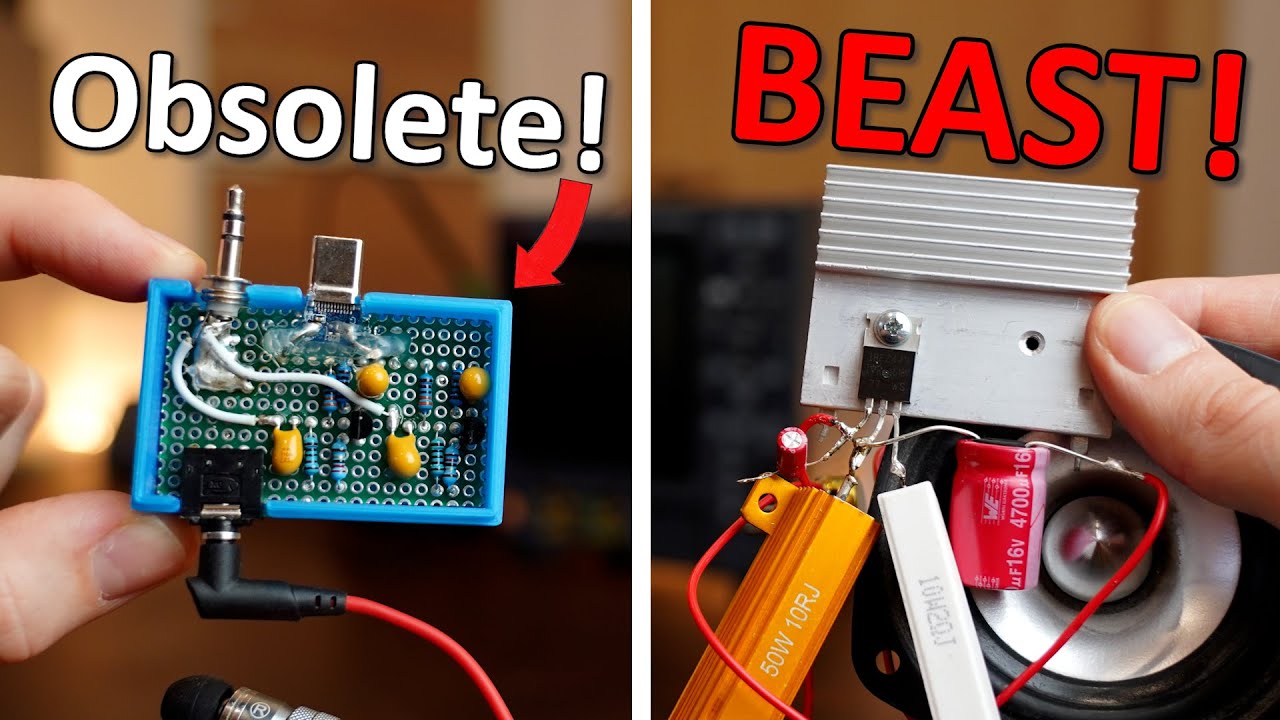
The World's Simplest Audio Amp just got BETTER! (MOSFET Amp) EB#61
video description
Date: 2024-11-25
Related videos



Comments and reviews: 20
greatscott
Yes, the problem with Class A amplifiers: efficiency of less than 50%, if you're luck. Class B will be really efficient, but sound like you are listening underwater with how badly they distort things. Class C are pretty efficient and sound alright, but are not really suitable for music level fidelity. They are fine for a telephone conversation or an intercom. A lot of cheap amplifiers are Class C.
What you are going to land on is a Class D amplifier as your perfect solution, which is a digital amplifier. It uses a high frequency pulse modulated signal to form the sinusoidal sound waves by controlling the number of pulses used per second in any given time frame. This allows any waveform below a certain frequency of the driver frequency to be recreated. This is highly power efficient, very accurate, and uses MOSFETs to drive the power side of the circuit. For small, sub 1 watt applications, you can get single chip amps that just require a heat sink or some copper/soldier on the board to dissipate some of the heat they will generate. Most surround sound systems use Class D amps, as does your phone, and your computer.
reply
Yes, the problem with Class A amplifiers: efficiency of less than 50%, if you're luck. Class B will be really efficient, but sound like you are listening underwater with how badly they distort things. Class C are pretty efficient and sound alright, but are not really suitable for music level fidelity. They are fine for a telephone conversation or an intercom. A lot of cheap amplifiers are Class C.
What you are going to land on is a Class D amplifier as your perfect solution, which is a digital amplifier. It uses a high frequency pulse modulated signal to form the sinusoidal sound waves by controlling the number of pulses used per second in any given time frame. This allows any waveform below a certain frequency of the driver frequency to be recreated. This is highly power efficient, very accurate, and uses MOSFETs to drive the power side of the circuit. For small, sub 1 watt applications, you can get single chip amps that just require a heat sink or some copper/soldier on the board to dissipate some of the heat they will generate. Most surround sound systems use Class D amps, as does your phone, and your computer.
reply
arjovenzia
I spent alot of time messing around with class A mosfet amps, they can be made to sound very good. but they are also so precarious, dont expect to be actually using your volume knob. but it was a good primer for when I started playing with tubes, which are far more forgiving, just because they have alot more voltage to play with. if you do need a small, simple power amp, you simply cant go past power opamps like the LM1875 or LM3886 (other brands are available. for how few parts required, the ease of construction and fidelity is incredible. you are going to want a very stout power supply, lots of filter caps and a big bit of iron. and significant amounts of cooling. If you want a bargain price DIY audiophile setup, a moderately good USB DAC, and adjustable active crossover, a LM1875 to run your tweeters and an LM3886 on your woofers, in an MDF speaker box will blow your socks off. all for less than the price of an 'audiophool grade' power cable.
reply
I spent alot of time messing around with class A mosfet amps, they can be made to sound very good. but they are also so precarious, dont expect to be actually using your volume knob. but it was a good primer for when I started playing with tubes, which are far more forgiving, just because they have alot more voltage to play with. if you do need a small, simple power amp, you simply cant go past power opamps like the LM1875 or LM3886 (other brands are available. for how few parts required, the ease of construction and fidelity is incredible. you are going to want a very stout power supply, lots of filter caps and a big bit of iron. and significant amounts of cooling. If you want a bargain price DIY audiophile setup, a moderately good USB DAC, and adjustable active crossover, a LM1875 to run your tweeters and an LM3886 on your woofers, in an MDF speaker box will blow your socks off. all for less than the price of an 'audiophool grade' power cable.
reply
Tarodenaro
It's not like amplifier using Mosfet is rare, is just that most people nowadays prefer monolithic chip amp, for example, if you look at any CMOS/DMOS amp (ex: ST516) there's going to be Mosfet inside, since it's exactly said so in it's name duh.
Also, you might wanted to put disclaimer since some Mosfet has transistor gate driver embedded inside and might inverse the signal output, putting smaller silicon in cascode is a pretty nifty technique and we're very likely see less BJT based amp and having every single new amp using either CMOS or DMOS as gate driver especially after Nexperia starting to use Si Mosfet in cascode with their GanFet starting from their GAN041.
Lastly, if you wanted cheap usb to audio input, just use PCM27xx series, it's not a DSD DAC but who cares about DSD anyway lol; if you need mic input, there's PCM2912A, it's a very decent interface for DIY.
reply
It's not like amplifier using Mosfet is rare, is just that most people nowadays prefer monolithic chip amp, for example, if you look at any CMOS/DMOS amp (ex: ST516) there's going to be Mosfet inside, since it's exactly said so in it's name duh.
Also, you might wanted to put disclaimer since some Mosfet has transistor gate driver embedded inside and might inverse the signal output, putting smaller silicon in cascode is a pretty nifty technique and we're very likely see less BJT based amp and having every single new amp using either CMOS or DMOS as gate driver especially after Nexperia starting to use Si Mosfet in cascode with their GanFet starting from their GAN041.
Lastly, if you wanted cheap usb to audio input, just use PCM27xx series, it's not a DSD DAC but who cares about DSD anyway lol; if you need mic input, there's PCM2912A, it's a very decent interface for DIY.
reply
jaysunx1
I've always felt like this is one of the biggest issues when designing any electronic circuit that handles higher power. Yes it can be cooled down and yes the circuit will probably work but the fact that it gets hot means it is wasting a lot of power and ultimately indicates a bad design and I personally feel like any self-respecting electronics engineer should cringe at the idea of just going with the simple yet inefficient way of designing anything. Damn I've been needing to say that for a long time.
Anyways I'm really excited about the next audio project you mentioned and I can't wait to see what solution you use to solve the inefficiency issue. Though I just realised home audio project doesn't necessarily sound like building the speaker amplifiers from the ground up but I'm still really curious about what you have cooking.
Great video as always!
reply
I've always felt like this is one of the biggest issues when designing any electronic circuit that handles higher power. Yes it can be cooled down and yes the circuit will probably work but the fact that it gets hot means it is wasting a lot of power and ultimately indicates a bad design and I personally feel like any self-respecting electronics engineer should cringe at the idea of just going with the simple yet inefficient way of designing anything. Damn I've been needing to say that for a long time.
Anyways I'm really excited about the next audio project you mentioned and I can't wait to see what solution you use to solve the inefficiency issue. Though I just realised home audio project doesn't necessarily sound like building the speaker amplifiers from the ground up but I'm still really curious about what you have cooking.
Great video as always!
reply
rene0
The previous Nordic (nRF52) was a disaster for claiming half of memory for the wireless stack, placed hardcoded at an inconvenient place somewhere half away RAM space, as Blob. Both with Arduino/C and micropython (actually running when jumping hoops) i totally gave up on this supplier. Yes, i you have a need for their specific RF functionality, and are willing to (rewrite) your app to compile with their tools, they may be your game. As a generic uC, they suck big time. Maybe their new offering (N54) is better, but for pretty much anything we rather use an ESP32 which at least tries to standardize stuff. Yes, an ESP has inferior ADC and yes, all microcontrollers have their quirks. But i wasted way too much time working with Nordic, and am not willing to try again until properly supported. Your mileage may very, but i am not that smart.
reply
The previous Nordic (nRF52) was a disaster for claiming half of memory for the wireless stack, placed hardcoded at an inconvenient place somewhere half away RAM space, as Blob. Both with Arduino/C and micropython (actually running when jumping hoops) i totally gave up on this supplier. Yes, i you have a need for their specific RF functionality, and are willing to (rewrite) your app to compile with their tools, they may be your game. As a generic uC, they suck big time. Maybe their new offering (N54) is better, but for pretty much anything we rather use an ESP32 which at least tries to standardize stuff. Yes, an ESP has inferior ADC and yes, all microcontrollers have their quirks. But i wasted way too much time working with Nordic, and am not willing to try again until properly supported. Your mileage may very, but i am not that smart.
reply
mikehartigan2703
Darlingtons do sound great but be careful. I recently repaired a Fender solid state guitar amplifier that uses that same Darlington in a push/pull complimentary pair. (TIP 142, TIP 147. On my first attempt I overlooked the fact that one of the biasing components (a diode in this case) had drifted out of spec. That is one of the big downsides to using high power Darlington devices (at least in push/pull configurations. They are very unforgiving if they aren't perfectly balanced. The amp sounded great for about 2 minutes before one of the transistors went into a thermal runaway failure. It was like watching a firecracker in slow motion. First a loud buzzing sound, followed by a bright flash of light and a pop! Once I fixed the bias issue the amp sounded great. I still use it on my workbench for testing purposes.
reply
Darlingtons do sound great but be careful. I recently repaired a Fender solid state guitar amplifier that uses that same Darlington in a push/pull complimentary pair. (TIP 142, TIP 147. On my first attempt I overlooked the fact that one of the biasing components (a diode in this case) had drifted out of spec. That is one of the big downsides to using high power Darlington devices (at least in push/pull configurations. They are very unforgiving if they aren't perfectly balanced. The amp sounded great for about 2 minutes before one of the transistors went into a thermal runaway failure. It was like watching a firecracker in slow motion. First a loud buzzing sound, followed by a bright flash of light and a pop! Once I fixed the bias issue the amp sounded great. I still use it on my workbench for testing purposes.
reply
letitrotfuckit
It is much harder to stabilize it when you have no current flowing from the base to the emitter (which has a resistor) like with a BJT. I made an audio amp with a low power pre driver using a 150 ohm resistor (collector) and a 10 ohm resistor on the emitter with a BD139 and then had it drive a pair of PNP NPN push pull type through a DC blocking capacitor which were biased so that the voltage on the emitters was half of the VDD as well as there being some quiescent current. It is a bit more complicated but it is nice and loud and runs off of 12 volts. It also does not get hot unless you make the volume high then it gets warm. I saw some people mentioning feedback. While it is cool, when it comes to audio and amplification of this sorts it can cause parasitic oscillation.
reply
It is much harder to stabilize it when you have no current flowing from the base to the emitter (which has a resistor) like with a BJT. I made an audio amp with a low power pre driver using a 150 ohm resistor (collector) and a 10 ohm resistor on the emitter with a BD139 and then had it drive a pair of PNP NPN push pull type through a DC blocking capacitor which were biased so that the voltage on the emitters was half of the VDD as well as there being some quiescent current. It is a bit more complicated but it is nice and loud and runs off of 12 volts. It also does not get hot unless you make the volume high then it gets warm. I saw some people mentioning feedback. While it is cool, when it comes to audio and amplification of this sorts it can cause parasitic oscillation.
reply
jendak7921
My new phone have not 3, 5mm jack it's big lack. Samsung have no internal DAC so not possible use USB-C->3, 5mm jack cable even cabe with DAC often not work and you cant charge phone at same time (when not split cable) and phone charging port worn out really soon when used for headphones few time in day. So I bought consecutive three portable bluetooth receiver with 3, 5mm jack for my wired headset and not satisfied. Bad sound quality, low volume, short operating time some had no volume controls. I build my own with bluetooth 5. 3 receiver board, TP4056 charging board, 18650 accu. It have 5 control buttons, red charging and blue operating LED, 3, 5mm 4pin jack (it support mic, charging port all in small plastic box and work perfect for long time.
reply
My new phone have not 3, 5mm jack it's big lack. Samsung have no internal DAC so not possible use USB-C->3, 5mm jack cable even cabe with DAC often not work and you cant charge phone at same time (when not split cable) and phone charging port worn out really soon when used for headphones few time in day. So I bought consecutive three portable bluetooth receiver with 3, 5mm jack for my wired headset and not satisfied. Bad sound quality, low volume, short operating time some had no volume controls. I build my own with bluetooth 5. 3 receiver board, TP4056 charging board, 18650 accu. It have 5 control buttons, red charging and blue operating LED, 3, 5mm 4pin jack (it support mic, charging port all in small plastic box and work perfect for long time.
reply
therealjammit
Another problem with high power MOSFETs is that they were designed as switches. In other words they try to design them to go from off to on in a narrow range. By modifying the gate design and the geometry of the source and drain the turn on voltage doesn't operate as a linear input. It's what allows a power MOSFET to quickly turn on and off at high frequencies without a long transition period.
I've used a tungsten lamp (like a car headlamp) for the collector or drain resistor. It has a non linear resistance and sort of acts like a current source, plus it was designed to get hot. You can get them for free if you check out a car repair shop. Most cars have a dual filament, so if the low beam goes bad the high filament still works.
reply
Another problem with high power MOSFETs is that they were designed as switches. In other words they try to design them to go from off to on in a narrow range. By modifying the gate design and the geometry of the source and drain the turn on voltage doesn't operate as a linear input. It's what allows a power MOSFET to quickly turn on and off at high frequencies without a long transition period.
I've used a tungsten lamp (like a car headlamp) for the collector or drain resistor. It has a non linear resistance and sort of acts like a current source, plus it was designed to get hot. You can get them for free if you check out a car repair shop. Most cars have a dual filament, so if the low beam goes bad the high filament still works.
reply
HeartOfGermany
This video is interresting. But nothing more. Class A for Power Amplification just plain sucks. The claim, that AB distorts is also false. If tuned well and with a differential preamplifier with a very responsive feedback loop, it matches or exceeds Class A in every metric. Just take a look at elliotsoundprojects. I recommend you to build one of the many amps there. The circuits are amazing! Work in real life and in LTSpice simulation aswell. (I mean, expected, right) But you can visualize the tuning easily within a simulation. Adjust your thing, simulate, get noise free measurements of crossover distortion (very visible for ultra low voltage input signals, where the crossover distortion might dominate the output. signal
reply
This video is interresting. But nothing more. Class A for Power Amplification just plain sucks. The claim, that AB distorts is also false. If tuned well and with a differential preamplifier with a very responsive feedback loop, it matches or exceeds Class A in every metric. Just take a look at elliotsoundprojects. I recommend you to build one of the many amps there. The circuits are amazing! Work in real life and in LTSpice simulation aswell. (I mean, expected, right) But you can visualize the tuning easily within a simulation. Adjust your thing, simulate, get noise free measurements of crossover distortion (very visible for ultra low voltage input signals, where the crossover distortion might dominate the output. signal
reply
Robbedoes2
Note that MOSFETs usually have a positive temperature feedback when operating in its linear region. This means with the same gate voltage, it gets a lower Rdson with a higher temperature. This means it gets into a sort of slow thermal runaway. There are MOSFETs though that feature a negative feedback if I'm right. This is one of the reasons I'll always try to avoid MOSFETs in linear applications.
That being said, I love to see you make an LDO using a MOSFET and a zener diode. If you connect the gate of a MOSFET to a stable voltage made with a zener diode, you get a crude LDO. It drops its drain at its GS threshold voltage. I want to use them for very low power applications but I've never done it.
reply
Note that MOSFETs usually have a positive temperature feedback when operating in its linear region. This means with the same gate voltage, it gets a lower Rdson with a higher temperature. This means it gets into a sort of slow thermal runaway. There are MOSFETs though that feature a negative feedback if I'm right. This is one of the reasons I'll always try to avoid MOSFETs in linear applications.
That being said, I love to see you make an LDO using a MOSFET and a zener diode. If you connect the gate of a MOSFET to a stable voltage made with a zener diode, you get a crude LDO. It drops its drain at its GS threshold voltage. I want to use them for very low power applications but I've never done it.
reply
Zebra_Paw
Hey, I remember that headphones amplifier! I love the way you revisited that.
I believe the most efficient and generally good design would be an opamp-like structure, with a feedback.
You could also build a class D amp of course, but that's quite a bit trickier and not as pure analog
That being said, I am myself looking to build an amplifier for a headset that would need a decent amount of power. It's a DT880, and it sounds pretty bad, also without bass, when plugged directly into a phone. An EQ doesn't solve it, it really feels like a lack of power.
I'm not sure what would be a good amp design that won't hiss. I thought of several NE5532 mounted in parallel.
reply
Hey, I remember that headphones amplifier! I love the way you revisited that.
I believe the most efficient and generally good design would be an opamp-like structure, with a feedback.
You could also build a class D amp of course, but that's quite a bit trickier and not as pure analog
That being said, I am myself looking to build an amplifier for a headset that would need a decent amount of power. It's a DT880, and it sounds pretty bad, also without bass, when plugged directly into a phone. An EQ doesn't solve it, it really feels like a lack of power.
I'm not sure what would be a good amp design that won't hiss. I thought of several NE5532 mounted in parallel.
reply
JackWse
Speak for yourself, I didn't know what flux was when I soldered my HD 555s together again, didn't know what coated wires were. and it took 4 hours and several attempts, around similar length. 4 hours at attempt. and they sound great! Although I heard they got disconnected again, I gave them to my buddy and he had them for about 15 years before I guess they snap finally. so I guess I could use the flux now. But why can't I solder Why am I so bad at it! Why is it so bad! You have no idea! There are so many dead boards so may burn capacitor so many PCBs burned into my brain, nothing resembling their former self their traces long since evaporated.
reply
Speak for yourself, I didn't know what flux was when I soldered my HD 555s together again, didn't know what coated wires were. and it took 4 hours and several attempts, around similar length. 4 hours at attempt. and they sound great! Although I heard they got disconnected again, I gave them to my buddy and he had them for about 15 years before I guess they snap finally. so I guess I could use the flux now. But why can't I solder Why am I so bad at it! Why is it so bad! You have no idea! There are so many dead boards so may burn capacitor so many PCBs burned into my brain, nothing resembling their former self their traces long since evaporated.
reply
SpikeKastleman
Watch yourself. Audiophiles are a fickle bunch. Saying our ears can't hear such small differences opens up a can of worms you may not want to see.
I've heard some wild theories about sound amplification. I myself am just the type that wants Hi Res Audio because up until about 96kHz, 32 bit, I can hear a difference if the file was originally mastered as high quality as the file being played. Like, if a song is mastered at 192kHz, 32 bit, I can hear the difference between 48kHz and 96kHz, and/or 16 bit, 24 bit, and 32 bit. But if it was mastered at 48kHz, 16 bit, nobody can hear a difference above that range.
reply
Watch yourself. Audiophiles are a fickle bunch. Saying our ears can't hear such small differences opens up a can of worms you may not want to see.
I've heard some wild theories about sound amplification. I myself am just the type that wants Hi Res Audio because up until about 96kHz, 32 bit, I can hear a difference if the file was originally mastered as high quality as the file being played. Like, if a song is mastered at 192kHz, 32 bit, I can hear the difference between 48kHz and 96kHz, and/or 16 bit, 24 bit, and 32 bit. But if it was mastered at 48kHz, 16 bit, nobody can hear a difference above that range.
reply
StanleyKubick1
EDIT: it looked like the THD on the mosfet was happening at around -75db to -95db (circa) which is not really an issue in a small speaker like this and can be further mitigated with a good enclosure to the point of becoming insignificant.
original comment: man, this is such a cool and practical project to draw in noobs like myself. I think I've been subbed since 2017-ish and this is the first project I'm going to attempt. I'm not sure what that says about your turnover rate, but I'm super thankful at least; )
ps. please consider doing a simple preamp some day
reply
EDIT: it looked like the THD on the mosfet was happening at around -75db to -95db (circa) which is not really an issue in a small speaker like this and can be further mitigated with a good enclosure to the point of becoming insignificant.
original comment: man, this is such a cool and practical project to draw in noobs like myself. I think I've been subbed since 2017-ish and this is the first project I'm going to attempt. I'm not sure what that says about your turnover rate, but I'm super thankful at least; )
ps. please consider doing a simple preamp some day
reply
Levibetz
The thing about the non-linearities of the mosfet means. people will probably actually like it more. Next time try building a transformer coupled amplifier with it, you can get a massive bump in efficiency with this, and it's the topology of a vacuum tube amp which can be attractive to audio nerds. Also next time at least get a piece of cardboard or something and put the speaker in it so you don't get that thin tinny sound. Having the speaker bare like that causes pressure waves from the front and back to wrap around and cancel, reducing bass and volume.
reply
The thing about the non-linearities of the mosfet means. people will probably actually like it more. Next time try building a transformer coupled amplifier with it, you can get a massive bump in efficiency with this, and it's the topology of a vacuum tube amp which can be attractive to audio nerds. Also next time at least get a piece of cardboard or something and put the speaker in it so you don't get that thin tinny sound. Having the speaker bare like that causes pressure waves from the front and back to wrap around and cancel, reducing bass and volume.
reply
paulstubbs7678
There is another catch with MOSFETS, most that you come across are designed for switching only. with higher power ones often using multiple FET in parallel internally to get the desired current, trouble is they don't all operate identically, so when biased to be linear, the load is not shared properly internally, meaning you can kill the MOSFET. In it's intended use, hard switching, they never see this linear zone, so no problems.
So if you want to use a MOSFET as shown, make sure it is designed/intended for linear/audio use.
reply
There is another catch with MOSFETS, most that you come across are designed for switching only. with higher power ones often using multiple FET in parallel internally to get the desired current, trouble is they don't all operate identically, so when biased to be linear, the load is not shared properly internally, meaning you can kill the MOSFET. In it's intended use, hard switching, they never see this linear zone, so no problems.
So if you want to use a MOSFET as shown, make sure it is designed/intended for linear/audio use.
reply
gosdeCarrer
A common way to approach it is to put first a pre-amp, e. g. your initial circuit, followed by a power amp circuit. The pre-amp just amplifies the voltage and focus on low noise and distortion. And the power amp adds the current (power) needed to drive the speakers. Also, low noise audio op-amps makes things simpler and modular. For example the ubiquitous NE5532, present in many audio devices for many years. Probably there is not a single piece of music in the world that has not gone through an NE5532 many times.
reply
A common way to approach it is to put first a pre-amp, e. g. your initial circuit, followed by a power amp circuit. The pre-amp just amplifies the voltage and focus on low noise and distortion. And the power amp adds the current (power) needed to drive the speakers. Also, low noise audio op-amps makes things simpler and modular. For example the ubiquitous NE5532, present in many audio devices for many years. Probably there is not a single piece of music in the world that has not gone through an NE5532 many times.
reply
233kosta
The thing about FETs in general and power FETs in particular is that they're designed for efficient high frequency switching. Their linear region is generally considered undesirable. As such efforts are made to minimise it as much as possible instead of making it truly linear. Smaller linear region (and faster transition through it) means quicker switching, less heat output and less power wasted by the FET pretending it's a resistor.
One would have to buy a special amplification FET for a project like this.
reply
The thing about FETs in general and power FETs in particular is that they're designed for efficient high frequency switching. Their linear region is generally considered undesirable. As such efforts are made to minimise it as much as possible instead of making it truly linear. Smaller linear region (and faster transition through it) means quicker switching, less heat output and less power wasted by the FET pretending it's a resistor.
One would have to buy a special amplification FET for a project like this.
reply
FrankHarwald
Something basic: electrolytic caps distort signals quiet a lot & in several ways at the same time. & usually unipolar ones - even if you manage to operate them only in forward direction - are even worse then the more rarer bipolar electrolytic ones. For the smaller input I'd recommend using a compact film cap, but for the output, if you're not willing to get poor from a large audio film cap, you'd really have to think outside the box to make it both safe & functional.
reply
Something basic: electrolytic caps distort signals quiet a lot & in several ways at the same time. & usually unipolar ones - even if you manage to operate them only in forward direction - are even worse then the more rarer bipolar electrolytic ones. For the smaller input I'd recommend using a compact film cap, but for the output, if you're not willing to get poor from a large audio film cap, you'd really have to think outside the box to make it both safe & functional.
reply
Add a review, comment
Other channel videos