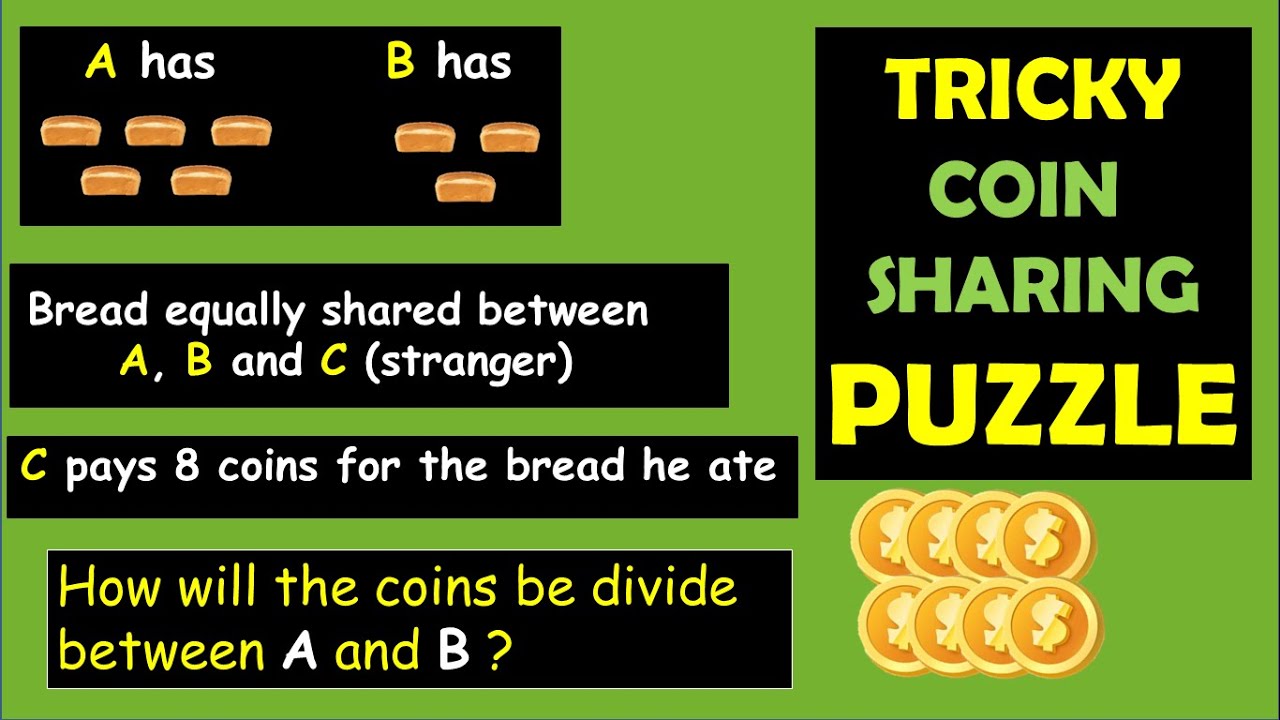
Tricky Maths Puzzle Coin Sharing Math Logic Interview Riddle (Math Puzzles and Riddles)
video description
Say 2 people are playing a game called -Game Of Pure Strategy- (aka GOPS/Goofspiel. Each player has 10 cards numbered 1-10 (bet cards, and there are 10 prize/point cards numbered 1-10. A round consists of a random point card being shown, after which the players secretly select a bet card. The bets are revealed simultaneously, and the highest bidder wins the point card (in a tie the point card is discarded. Then the bet cards are discarded.
There are 10 total rounds. The winner is the person with the highest sum of point cards (can be a draw.
The game value is 0 by symmetry.
Q: If, on the fist round, the point card is shown to be a 10, what percentage of the time would a perfect player bet a 10?
(Assumming he wants to maximize his expected wins)
Date: 2023-11-15
Related videos




Comments and reviews: 26
disguisedhell
This was quite easy if you picture the process quite clearly. Here is how I did it assume that they each took a plate of bread (which is equal to 8/3 but for simplicity take it as 1 plate. Each plate has 5/8 contribution from A and 3/8 from B. So according to the traveller, he divide 5 to A and 3 to B and go away. Then the contributions of A and B in the 2 plates of A and B are 10/8 and 6/8 their difference 1/2 is what A gave more. And 1/2/2=1/4 is what B ate from the extra A part. As the traveller value 1 coin for 1/8 part B should give A 2 coins for 1/4 part. Hence 7 1
reply
This was quite easy if you picture the process quite clearly. Here is how I did it assume that they each took a plate of bread (which is equal to 8/3 but for simplicity take it as 1 plate. Each plate has 5/8 contribution from A and 3/8 from B. So according to the traveller, he divide 5 to A and 3 to B and go away. Then the contributions of A and B in the 2 plates of A and B are 10/8 and 6/8 their difference 1/2 is what A gave more. And 1/2/2=1/4 is what B ate from the extra A part. As the traveller value 1 coin for 1/8 part B should give A 2 coins for 1/4 part. Hence 7 1
reply
Devon
1 and 7 Answer.
let's say the 8 pieces of bread worth 24 coins or 3 coins each, so Alice 5 loaves would worth 15 coins and Bob 3 loaves would worth 9 coins. Each of the three ate 8/3 loaves of bread which cost 8 coins (8/3 x3. Given that Alice loaves worth 15 coins (but she ate 8 coins worth, she would be owed 7 coins and given that Bob loaves worth 9 coins (but he also ate
8 coins worth) he would be owed 1 coin. So Alice should get 7 coins and Bob 1 coin.
reply
1 and 7 Answer.
let's say the 8 pieces of bread worth 24 coins or 3 coins each, so Alice 5 loaves would worth 15 coins and Bob 3 loaves would worth 9 coins. Each of the three ate 8/3 loaves of bread which cost 8 coins (8/3 x3. Given that Alice loaves worth 15 coins (but she ate 8 coins worth, she would be owed 7 coins and given that Bob loaves worth 9 coins (but he also ate
8 coins worth) he would be owed 1 coin. So Alice should get 7 coins and Bob 1 coin.
reply
Jeremy
This is incorrect as the coins are payment only for what was shared with the stranger, not with each other. The stranger did not pay Alice for sharing with Bob. Jointly, Alice and Bob shared 1/3 of the 8 loaves. The stranger consumed 8/3 of the loaves. He payed for 8/3 of the loaves. If the loaves were divided equally, Alice gets 5 coins and Bob gets 3 coins because the man is not paying for Bob's food, only his own.
reply
This is incorrect as the coins are payment only for what was shared with the stranger, not with each other. The stranger did not pay Alice for sharing with Bob. Jointly, Alice and Bob shared 1/3 of the 8 loaves. The stranger consumed 8/3 of the loaves. He payed for 8/3 of the loaves. If the loaves were divided equally, Alice gets 5 coins and Bob gets 3 coins because the man is not paying for Bob's food, only his own.
reply
Rohit
Let's say stranger also brought some breads. For the total sum to be divisible by 3 (for equal sharing, stranger should have brought 3n+1 breads. Since stranger pays money to have food, he would have brought only one bread. Hence without making smaller pieces of bread, each of them eats 3 pieces. And total 8 coin goes to the one having 5 breads for giving his 2 breads to the stranger.
reply
Let's say stranger also brought some breads. For the total sum to be divisible by 3 (for equal sharing, stranger should have brought 3n+1 breads. Since stranger pays money to have food, he would have brought only one bread. Hence without making smaller pieces of bread, each of them eats 3 pieces. And total 8 coin goes to the one having 5 breads for giving his 2 breads to the stranger.
reply
Rajavarman
Here is how i did
8 bread shared by 3 people= 2. 67 breads per person.
8 coins divided by 2. 67 of breads = 2. 996 cost of each bread.
Bob had 3 bread - he ate 2. 67 bread=. 33 of his bread he shared with stranger.
Cost of. 33 bread is =. 33 x2. 996=. 9887 coins
Bob gets. 9887 coins
Remaining 7. 0113 coins goes to Alice.
Eeeeeeee. -
reply
Here is how i did
8 bread shared by 3 people= 2. 67 breads per person.
8 coins divided by 2. 67 of breads = 2. 996 cost of each bread.
Bob had 3 bread - he ate 2. 67 bread=. 33 of his bread he shared with stranger.
Cost of. 33 bread is =. 33 x2. 996=. 9887 coins
Bob gets. 9887 coins
Remaining 7. 0113 coins goes to Alice.
Eeeeeeee. -
reply
princy
My answer is right but the method of solving is different and a bit lengthy:
Step1: I had divided 8 bread loaves into three parts. e. i. 8/3= 2. 2/3
Step2: I considered 1 coin for 1/3 part.
Step3: Coins that bob get= 3-8/3 = 1/3.
so, the bob will get 1 coin.
Step4: Coins that alice get= 5-8/3 = 7/3
so, the alice will get 7 coins.
reply
My answer is right but the method of solving is different and a bit lengthy:
Step1: I had divided 8 bread loaves into three parts. e. i. 8/3= 2. 2/3
Step2: I considered 1 coin for 1/3 part.
Step3: Coins that bob get= 3-8/3 = 1/3.
so, the bob will get 1 coin.
Step4: Coins that alice get= 5-8/3 = 7/3
so, the alice will get 7 coins.
reply
Devon
Assume the stranger is not a stranger and they told him the 8 loaves cost 24 coins, so he had to pay 8 coins, and since Alice had 5 loaves (cost her15 coins) and Bob had 3 loaves (cost him 9 coins, then Alice 'overpaid ' by 7 coins and Bob 'overpaid' by 1 coin. Here 'overpaid' is used to mean eat less than the money originally spent.
reply
Assume the stranger is not a stranger and they told him the 8 loaves cost 24 coins, so he had to pay 8 coins, and since Alice had 5 loaves (cost her15 coins) and Bob had 3 loaves (cost him 9 coins, then Alice 'overpaid ' by 7 coins and Bob 'overpaid' by 1 coin. Here 'overpaid' is used to mean eat less than the money originally spent.
reply
Greg
Why are you giving any money back to the Stranger, what did he contribute to the meal? And why are you paying Alice and Bob equally when they contributed different amounts of the meal? This not only screws the Woman as she contributed more, but sounds like a socialist propaganda exercise in my opinion. lol
reply
Why are you giving any money back to the Stranger, what did he contribute to the meal? And why are you paying Alice and Bob equally when they contributed different amounts of the meal? This not only screws the Woman as she contributed more, but sounds like a socialist propaganda exercise in my opinion. lol
reply
Ignore
We can also do it by finding sacrifice ratio
Old ratio = 5: 3 (Alice, Bob)
New Ratio= 1: 1: 1(Alice, Bob, Stranger)
Sacrifice ratio = Old ratio - New ratio
Alice's sacrifice= (5/8)-(1/3)= 7/24
Bob's sacrifice= (3/8)-(1/3) = 1/24
Hence Sacrifice Ratio of Alice & Bob is. 7: 1
reply
We can also do it by finding sacrifice ratio
Old ratio = 5: 3 (Alice, Bob)
New Ratio= 1: 1: 1(Alice, Bob, Stranger)
Sacrifice ratio = Old ratio - New ratio
Alice's sacrifice= (5/8)-(1/3)= 7/24
Bob's sacrifice= (3/8)-(1/3) = 1/24
Hence Sacrifice Ratio of Alice & Bob is. 7: 1
reply
Vinod
A bike of capacity 10 litre fuel gives a mileage of. 50 km/L (with rider +bike+full tank weight) and if the bikes travels 1km more if it weight decrease by 1kg and travels 1km more if 1kg increase. what is the total distance travelled by it from 10 l to nil tank by it. if 1l fuel = 1kg
reply
A bike of capacity 10 litre fuel gives a mileage of. 50 km/L (with rider +bike+full tank weight) and if the bikes travels 1km more if it weight decrease by 1kg and travels 1km more if 1kg increase. what is the total distance travelled by it from 10 l to nil tank by it. if 1l fuel = 1kg
reply
Sad
I'd say Alice 7 and Bob 1 because everyone got 2 and 2/3 of loaf so Bob gave 1/3 of a loaf to stranger and alice 2 and 1/3 so alice gave seven times as much bread to stranger than bob therefore she should get seven times more money so x1=7x2 and x1+x2=8 and we geet one and seven
reply
I'd say Alice 7 and Bob 1 because everyone got 2 and 2/3 of loaf so Bob gave 1/3 of a loaf to stranger and alice 2 and 1/3 so alice gave seven times as much bread to stranger than bob therefore she should get seven times more money so x1=7x2 and x1+x2=8 and we geet one and seven
reply
Haval
I solved it in mathamtical way since there is 8 leaves in total each share for 3 is - 2. 67, hence Alice had given 87. 59% of his leaves and Bob 12. 4%, for 8 coins the 87. 59% is 7. 0., and remaining is 1 so alice gets 7 and bob gets 1 coin.
reply
I solved it in mathamtical way since there is 8 leaves in total each share for 3 is - 2. 67, hence Alice had given 87. 59% of his leaves and Bob 12. 4%, for 8 coins the 87. 59% is 7. 0., and remaining is 1 so alice gets 7 and bob gets 1 coin.
reply
chaman, charlie
7 coins and 1 coin. This one was quite simple. Could do mentally in half a minute.
Each of then has 8/3 loaves.
Loaves paid extra by both are
5 - 8/3 = 7/3 and 3 - 8/3 = 1/3
So coins should be shared in 7: 1
reply
7 coins and 1 coin. This one was quite simple. Could do mentally in half a minute.
Each of then has 8/3 loaves.
Loaves paid extra by both are
5 - 8/3 = 7/3 and 3 - 8/3 = 1/3
So coins should be shared in 7: 1
reply
TigruArdavi
the real question is, how pathologically obese must be alice and bob that are used to eat almost three whole loaves of bread just for lunch. guess the had a ton of saturated fatty-spready to go with it, too -
reply
the real question is, how pathologically obese must be alice and bob that are used to eat almost three whole loaves of bread just for lunch. guess the had a ton of saturated fatty-spready to go with it, too -
reply
Nurulhasan
Ammar. this is not just a puzzle. this is a real incident happend 1400 years ago. Maula Ali a. s. solved this.
And this puzzle is also asked in interviews too.
reply
Ammar. this is not just a puzzle. this is a real incident happend 1400 years ago. Maula Ali a. s. solved this.
And this puzzle is also asked in interviews too.
reply
Nihar
Idid this question correctly. I think this question can be solve easily by commerce background student it's same as we do the treatment of Goodwill in partnership.
reply
Idid this question correctly. I think this question can be solve easily by commerce background student it's same as we do the treatment of Goodwill in partnership.
reply
Aaryan
I was right but I approached differently I just got each will get 8/3 bread and then subtract the remaining and I got 7/3 and 1/3 so I got ans 7 and 1 coins
reply
I was right but I approached differently I just got each will get 8/3 bread and then subtract the remaining and I got 7/3 and 1/3 so I got ans 7 and 1 coins
reply
Vikas
People: nice puzzle--
Mathematician: lol, it is pure mathematics not puzzle
Me: the puzzle is that it's not a puzzle---
Like if u agree
reply
People: nice puzzle--
Mathematician: lol, it is pure mathematics not puzzle
Me: the puzzle is that it's not a puzzle---
Like if u agree
reply
Dougal
Ahh but.
Alice is richer than Bob, since Alice has more loaves.
Bob needs more coins than Alice, so give Bob 7 and Alice 1.
reply
Ahh but.
Alice is richer than Bob, since Alice has more loaves.
Bob needs more coins than Alice, so give Bob 7 and Alice 1.
reply
Tamir
A very nice display of the problem, and, as always - the clearest and most graphical explanation possible.
Well done Ammar!
reply
A very nice display of the problem, and, as always - the clearest and most graphical explanation possible.
Well done Ammar!
reply
prateek
Nice puzzle and tricky one also. But the way u explain ur puzzle is always amazing. U can make tough puzzle into simple one.
reply
Nice puzzle and tricky one also. But the way u explain ur puzzle is always amazing. U can make tough puzzle into simple one.
reply
hssc
I answered right just help of calculator. But approach was right. Summary - the money distributed in sacrifice ratio.
reply
I answered right just help of calculator. But approach was right. Summary - the money distributed in sacrifice ratio.
reply
Priyanshu
It is also possible that they eat only 6 breads because it is not mentioned in puzzle that they eat all bread
reply
It is also possible that they eat only 6 breads because it is not mentioned in puzzle that they eat all bread
reply
Nanda
4th comment.
Your hardwork is reflected in the trickiness of the question.
Thank you logically yours.
reply
4th comment.
Your hardwork is reflected in the trickiness of the question.
Thank you logically yours.
reply
Bill
In Singapore, this question may be for 4th graders. It is easy to solve with their -Bar Drawing- method.
reply
In Singapore, this question may be for 4th graders. It is easy to solve with their -Bar Drawing- method.
reply
Alex
Multiplying each by 3 makes a lot of sense. Had the same answer but much harder to work with fractions
reply
Multiplying each by 3 makes a lot of sense. Had the same answer but much harder to work with fractions
reply
Add a review, comment
Other channel videos