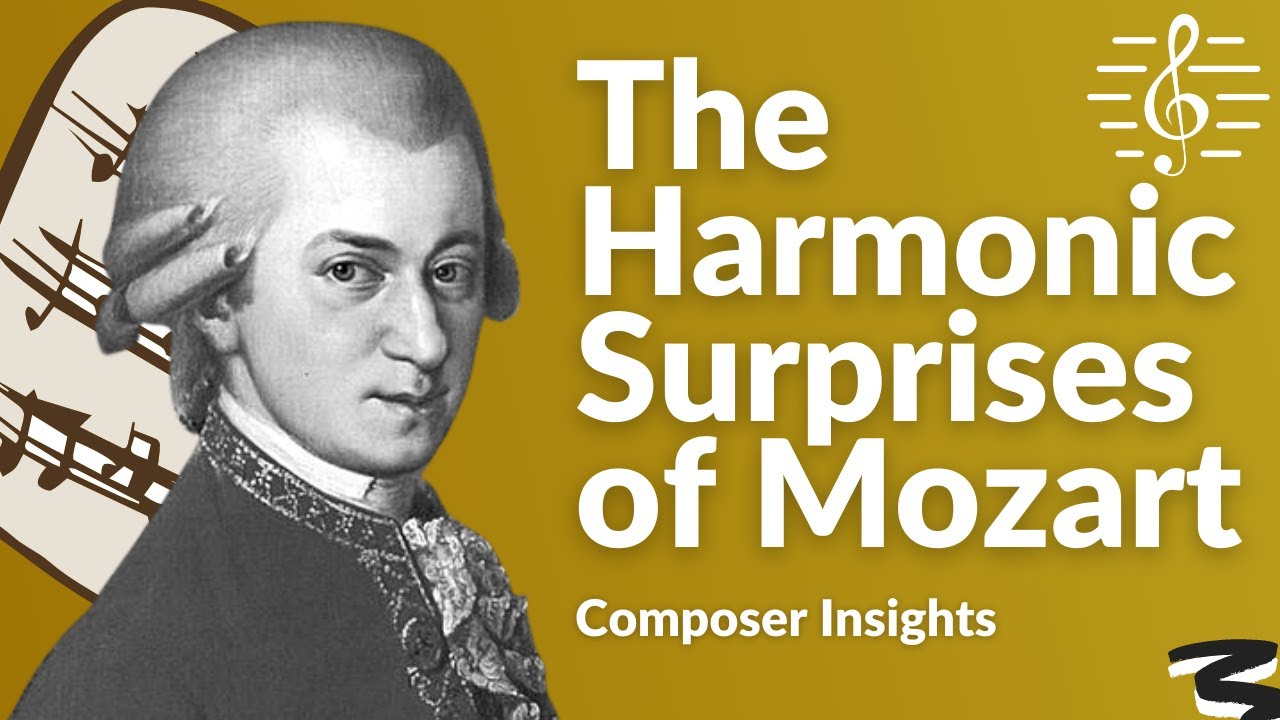
The Harmonic Surprises of Mozart - Composer Insights
video description
Date: 2022-03-28
Related videos





Comments and reviews: 10
Roger
The second chord is actually II chromatic dim 7, V of V . This is an incomplete minor 9th commonly used in the classical period.
It is built like this. In C Major the II chord is D Minor, II chromatic is D Major, II chromatic 7th is D7. II chromatic minor 9th is D7 flat 9 the notes of this chord are 1,3,5, flat 7. flat 9 or D, F sharp, A, C, E flat. To create II chromatic dim 7 we take this dominant flat 9 chord and remove the root. Thus F sharp, A, C, E flat. The same chord II chromatic dim 7 in B minor is thus E sharp, G sharp, B, D remember create a dominant flat 9 chord from the root (C sharp) and then remove the root. The next dim 7 chord is V dim 7. Built the same way as the last example. V flat 9 with root removed (F Sharp), A sharp, C sharp, E, G. These chords function as dominants therefore the normal voice leading applies 3rd raises to tonic A sharp - B, 7th falls to 3rd E - D, Minor 9th falls to 5th G - F sharp.
reply
The second chord is actually II chromatic dim 7, V of V . This is an incomplete minor 9th commonly used in the classical period.
It is built like this. In C Major the II chord is D Minor, II chromatic is D Major, II chromatic 7th is D7. II chromatic minor 9th is D7 flat 9 the notes of this chord are 1,3,5, flat 7. flat 9 or D, F sharp, A, C, E flat. To create II chromatic dim 7 we take this dominant flat 9 chord and remove the root. Thus F sharp, A, C, E flat. The same chord II chromatic dim 7 in B minor is thus E sharp, G sharp, B, D remember create a dominant flat 9 chord from the root (C sharp) and then remove the root. The next dim 7 chord is V dim 7. Built the same way as the last example. V flat 9 with root removed (F Sharp), A sharp, C sharp, E, G. These chords function as dominants therefore the normal voice leading applies 3rd raises to tonic A sharp - B, 7th falls to 3rd E - D, Minor 9th falls to 5th G - F sharp.
reply
tony
Interesting stuff, especially for a bod like me who (courtesy of jazz guitar lessons) has only recently been able to get his head around theory and thus understand what you are talking about. Which brings me to my question:
I've always assumed Beethoven, Mozart, Schumann etc would start by getting a few ideas by improvising, noting what they were doing, then writing it down and 'editing' it in the process to achieve what they wanted to achieve. Would this, broadly, be true?
reply
Interesting stuff, especially for a bod like me who (courtesy of jazz guitar lessons) has only recently been able to get his head around theory and thus understand what you are talking about. Which brings me to my question:
I've always assumed Beethoven, Mozart, Schumann etc would start by getting a few ideas by improvising, noting what they were doing, then writing it down and 'editing' it in the process to achieve what they wanted to achieve. Would this, broadly, be true?
reply
Randolph
Fascinating! I'd never heard the idea that you find the -correct- diminished 7th name by stacking it into true minor thirds (according to the spelling) and seeing what the root is. Of course, this would only work if the composer is careful about spelling his notes and thereby signaling harmonic function. I'm afraid I'm very careless about diminished 7th spellings, as it has no effect on the sound. But I'll try to think about this in the future! Another great video!
reply
Fascinating! I'd never heard the idea that you find the -correct- diminished 7th name by stacking it into true minor thirds (according to the spelling) and seeing what the root is. Of course, this would only work if the composer is careful about spelling his notes and thereby signaling harmonic function. I'm afraid I'm very careless about diminished 7th spellings, as it has no effect on the sound. But I'll try to think about this in the future! Another great video!
reply
NidusFormicarum
This peice toegether with the a minor rondo is Mozart's two best solo peices for piano by far. The adagio is truely perfect and the rondo is even more expressive and personal and contains some rather complicated harmonic modulations that I would love to have a look at one day. It s of the same high expressive and technical (formal) quality as Beethoven's famous rondo in his sonata phatique.
reply
This peice toegether with the a minor rondo is Mozart's two best solo peices for piano by far. The adagio is truely perfect and the rondo is even more expressive and personal and contains some rather complicated harmonic modulations that I would love to have a look at one day. It s of the same high expressive and technical (formal) quality as Beethoven's famous rondo in his sonata phatique.
reply
Julia
Diminished 7th chords [there are only three of them] being symmetrical chords do not have inversions in the conventional sense. They are also easily resolvable in any of four keys, rather than 'existing within a key'.
As here, they are frequently used in Baroque and Classical music as tension building devices, often resolving towards the prevailing tonality of the piece or section.
reply
Diminished 7th chords [there are only three of them] being symmetrical chords do not have inversions in the conventional sense. They are also easily resolvable in any of four keys, rather than 'existing within a key'.
As here, they are frequently used in Baroque and Classical music as tension building devices, often resolving towards the prevailing tonality of the piece or section.
reply
Soundhealer
Thanks so much for this! As a guitarist, (mostly Rock and Bluesy stuff, dabbling in Classical and Spanish styles), I really enjoyed adapting this lesson to the fretboard to expand my knowledge. I noticed immediately that a number of Pop Rock tunes were heavily inspired by this piece, (and probably many other pieces which were inspired by this piece).
reply
Thanks so much for this! As a guitarist, (mostly Rock and Bluesy stuff, dabbling in Classical and Spanish styles), I really enjoyed adapting this lesson to the fretboard to expand my knowledge. I noticed immediately that a number of Pop Rock tunes were heavily inspired by this piece, (and probably many other pieces which were inspired by this piece).
reply
Doug
Of course with training in jazz harmony , put a root on a diminished chord and you have a dominant chord with a flat 9, so: B min , C#7(b9) - Bm 6/4 , A# dim with F# in bass = F#7(b9) back to the tonic
Xyz
Walter Piston admits of flat nines in dominant chords in a later chapter of his harmony book , although their resolution is I don-t what :-)
reply
Of course with training in jazz harmony , put a root on a diminished chord and you have a dominant chord with a flat 9, so: B min , C#7(b9) - Bm 6/4 , A# dim with F# in bass = F#7(b9) back to the tonic
Xyz
Walter Piston admits of flat nines in dominant chords in a later chapter of his harmony book , although their resolution is I don-t what :-)
reply
Tom
Nice to get these detailed insights from the masters. I think this would make a good series waking through a score focusing on a different compositional element for each composer (development/continuity Beethoven, harmony Bach, economy or form Mozart, Chromaticism Wagner etc). I liked your -inside the mind of Bach- video on the subject too. Thank you.
reply
Nice to get these detailed insights from the masters. I think this would make a good series waking through a score focusing on a different compositional element for each composer (development/continuity Beethoven, harmony Bach, economy or form Mozart, Chromaticism Wagner etc). I liked your -inside the mind of Bach- video on the subject too. Thank you.
reply
Biggles
Really nice presentation. I think if people learn partimento and the rule of the octave would help elucidate analysis of this music. Speaking the language that they spoke allows analysis of this music without many problems. Would be interesting to note that form bar 3 Mozart is implementing a modulating prinner.
reply
Really nice presentation. I think if people learn partimento and the rule of the octave would help elucidate analysis of this music. Speaking the language that they spoke allows analysis of this music without many problems. Would be interesting to note that form bar 3 Mozart is implementing a modulating prinner.
reply
Pirschk-nig
if you deal intensively with Mozart, you will very quickly find that the intrinsic value of his compositions is at least on a par with Beethoven's works and is often even superior to them.The only question that remains is how the intrinsic value is defined?
reply
if you deal intensively with Mozart, you will very quickly find that the intrinsic value of his compositions is at least on a par with Beethoven's works and is often even superior to them.The only question that remains is how the intrinsic value is defined?
reply
Add a review, comment
Other channel videos