
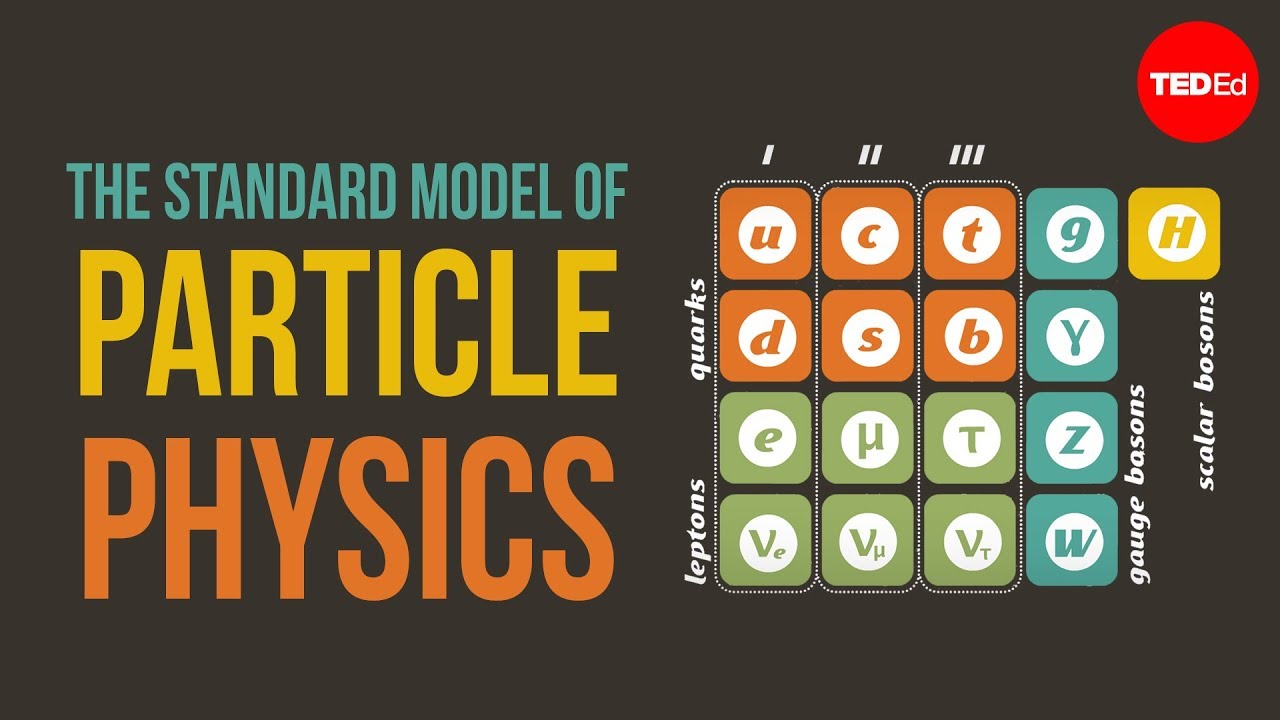
Whats the smallest thing in the universe? - Jonathan Butterworth
video description
Date: 2020-08-22
Related videos




Comments and reviews: 10
Tom
QUARKS DO NOT MAKE SENSE - or the 3rd quark is REALLY weird.
Proton = 2 up, 1 down quarks. Neutron = 2 down, 1 up quarks.
So the difference between the two is the 3rd quark.
Both the proton and neutron, have one up and one down quark.
That leaves the difference between the proton and neutron as the 3rd quark.
So difference between a proton and neutron is due to whether the 3rd quark is up as in a proton, or down as in a neutron.
So, if that's true then:
The third quark determines these things:
If it has an up quark - proton, then the particle is immortal.
If it has a down quark - neutron, then the particle decays in 10 minutes. EXPLAIN
If it has an up quark - a proton, then the particle has less mass then the neutron.
If it has a down quark - a neutron, then the particle has. 1% more mass than the proton.
So the down quark weighs. 1% more than the up quark. EXPLAIN
Quarks have no measurable physical extension, and seem to exist at points. Yet that single point does all this and more. EXPLAIN
The proton has an up quark, and that magic third quark also determines half of the electromagnetic force in the universe. And it in no way is like the electron, the other half, except in being an opposite charge. EXPLAIN
The electron is one full charge, the magic third quark is 2/3+ charge, but somehow it determines all positive charge (and the 1/3- charge of the neutron's third quark determines all zero charge particles) EXPLAIN.
When three quarks team up only a small part of the proton's mass comes from the masses of the quarks. Most is binding energy. So that third quark has virtually no mass but can do all these magic things. EXPLAIN.
Quarks interact strongly and link in twos or threes to make particles such as pions, protons, and neutrons. Yet the other half of the charge world, electrons, does none of these things. EXPLAIN
Physics is a science of pairs. For every particle there is an anti-particle. Virtual particles come in pairs. Spin, waves - destructive and constructive interference, etc. In these cases the pairs are virtually identical and or mirror images of each other. So why would electromagnetic charge have electrons and protons so different from each other, and in no way seem built on exact opposites, or mirror image opposites. EXPLAIN!
Particle wave duality includes atoms, electrons, protons, neutrons, quarks and gluons.
Now imagine a nucleus of deuterium, that has no particles only waves
that include in the nucleus of the atom, a proton wave, neutron wave,
6 quark waves, plus gluon waves. EXPLAIN.
reply
QUARKS DO NOT MAKE SENSE - or the 3rd quark is REALLY weird.
Proton = 2 up, 1 down quarks. Neutron = 2 down, 1 up quarks.
So the difference between the two is the 3rd quark.
Both the proton and neutron, have one up and one down quark.
That leaves the difference between the proton and neutron as the 3rd quark.
So difference between a proton and neutron is due to whether the 3rd quark is up as in a proton, or down as in a neutron.
So, if that's true then:
The third quark determines these things:
If it has an up quark - proton, then the particle is immortal.
If it has a down quark - neutron, then the particle decays in 10 minutes. EXPLAIN
If it has an up quark - a proton, then the particle has less mass then the neutron.
If it has a down quark - a neutron, then the particle has. 1% more mass than the proton.
So the down quark weighs. 1% more than the up quark. EXPLAIN
Quarks have no measurable physical extension, and seem to exist at points. Yet that single point does all this and more. EXPLAIN
The proton has an up quark, and that magic third quark also determines half of the electromagnetic force in the universe. And it in no way is like the electron, the other half, except in being an opposite charge. EXPLAIN
The electron is one full charge, the magic third quark is 2/3+ charge, but somehow it determines all positive charge (and the 1/3- charge of the neutron's third quark determines all zero charge particles) EXPLAIN.
When three quarks team up only a small part of the proton's mass comes from the masses of the quarks. Most is binding energy. So that third quark has virtually no mass but can do all these magic things. EXPLAIN.
Quarks interact strongly and link in twos or threes to make particles such as pions, protons, and neutrons. Yet the other half of the charge world, electrons, does none of these things. EXPLAIN
Physics is a science of pairs. For every particle there is an anti-particle. Virtual particles come in pairs. Spin, waves - destructive and constructive interference, etc. In these cases the pairs are virtually identical and or mirror images of each other. So why would electromagnetic charge have electrons and protons so different from each other, and in no way seem built on exact opposites, or mirror image opposites. EXPLAIN!
Particle wave duality includes atoms, electrons, protons, neutrons, quarks and gluons.
Now imagine a nucleus of deuterium, that has no particles only waves
that include in the nucleus of the atom, a proton wave, neutron wave,
6 quark waves, plus gluon waves. EXPLAIN.
reply
Daniel
Well since electrons Interact with the core via photons, photons also interact with gravity there is small connection so in a big stream it's a wave interacting with gravity, separately its particle
reply
Well since electrons Interact with the core via photons, photons also interact with gravity there is small connection so in a big stream it's a wave interacting with gravity, separately its particle
reply
Antnio
Well, quarks can be composed of Preons, since just by looking at this particles table you see similarities to the atomic table.
I could talk about 1D strings but that's another story
reply
Well, quarks can be composed of Preons, since just by looking at this particles table you see similarities to the atomic table.
I could talk about 1D strings but that's another story
reply
Spyer
Should we be happy we were born before future theories have been created and put into textbooks? What have we been taught by our schools today that will be called silly tomorrow.
reply
Should we be happy we were born before future theories have been created and put into textbooks? What have we been taught by our schools today that will be called silly tomorrow.
reply
Leo
My physics and chemistry teachers should be ashamed of themselves and should have ended their life at their first of their job is what it feels like after watching this video.
reply
My physics and chemistry teachers should be ashamed of themselves and should have ended their life at their first of their job is what it feels like after watching this video.
reply
Andy
Great video! However at the start you said that these are infinitely small. which theyre very much not. They have size and matter, while very small, it is still non zero
reply
Great video! However at the start you said that these are infinitely small. which theyre very much not. They have size and matter, while very small, it is still non zero
reply
Guru
This may be an unpopular opinion but is there is a way to know if each and every partical's size and empty space in it is expanding or shrinking all over the universe
reply
This may be an unpopular opinion but is there is a way to know if each and every partical's size and empty space in it is expanding or shrinking all over the universe
reply
Rupkatha
Thank you so much for helping. I was trying to understand the standard model for 3. 5 months, but after seeing this video I understood it.
reply
Thank you so much for helping. I was trying to understand the standard model for 3. 5 months, but after seeing this video I understood it.
reply
upsilan
I did not get what is the smallest thing then. I just learned more about quantom particles (not sure if i wrote correctly)
reply
I did not get what is the smallest thing then. I just learned more about quantom particles (not sure if i wrote correctly)
reply
The
1: 39 how so u say electrons attract each other? They repel each other right? Anyone here watching this video on lockdown?
reply
1: 39 how so u say electrons attract each other? They repel each other right? Anyone here watching this video on lockdown?
reply
Add a review, comment
Other channel videos


