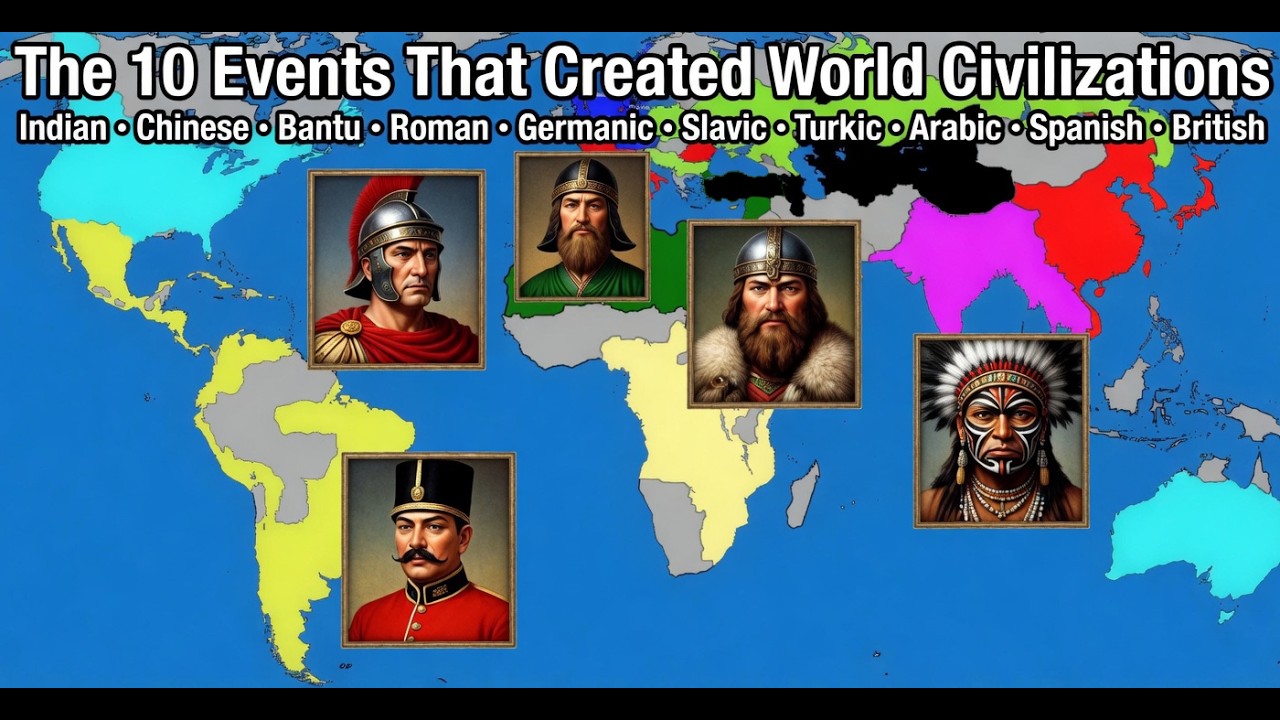
The Ten Great Macro-Cultures
video description
Date: 2026-07-10
Related videos


Comments and reviews: 20
Owlr4ider
A point on the Indian 'civilization', it's not really a civilization like all the other examples because it has always been fragmented. Not even de-centralized but different kingdoms entirely. You used the term 'Hinduism' to reference the ideas of the ancient Indian civilization, which was an error on your part. Hinduism is a modern concept that arose after the British Empire begun colonizing/conquering the Indian subcontinent. As an attempt of the local Indian kingdoms and peoples to define who they were: culturally, historically, religiously, linguistically, etc, in the face of these new British ideas that were being forced upon them. Before the British Raj it's simply incorrect to talk about India as a singular civilization as it simply wasn't. Even during earlier (Turkic) conquests, the latest of which being the Mughals who conquered most(but not all) the subcontinent, India wasn't unified. The only reason Hinduism hasn't started back then was because these foreign conquerors, much like the Mongols and unlike the British, blended into the local population rather than trying to enforce their own will upon it.
The same is true for China, though with a caveat. China too is an amalgamation of different peoples, cultures, languages, etc. However unlike India China was unified for large parts of its history. As you correctly said in this video China has been going through cycles of unification and collapses throughout its entire history. The thing you got wrong, just as with India, is using the terms 'Han' and 'Mandarin'. Don't get me wrong, the Han dynasty absolutely did exist, along with many other dynasties in China. However the Han identity as a singular Chinese identity is a modern concept, just as the Mandarin language, something India never did, though they did have Sanskrit as a shared language, though it was limited to religious/spiritual purposes only(or perhaps I should say mostly. The reason the current Chinese identity is named after the Han dynasty rather than the Tang, Song, etc, is a very arbitrary one. It is said that the Han was China's golden age, yet the other 2 dynasties I used as examples were also considered as golden ages. Moreover in neither dynasty(including the Han) the Chinese people were unified under a singular culture, religion, etc. That is to say that during period of Han dynasty China, the term 'Han Chinese' simply didn't exist. They were different Chinese peoples and cultures based on their geographic location within China.
Another thing about India and China specifically is their concept of religion is very different from that the western world's and the western cultures it created. Therefore you can't just compare 1 religion to another or 1 religious context to another and treat them as equals as it is far from an apples to apples comparison. In fact a larger factor behind the formation of Hinduism that I mentioned above, was precisely an attempt by the Indians to explain their own religion in a way the British would understand. If you wish to draw any parallels between east and west you can compare Hinduism to the Protestant reformation. A very different context but the end result isn't too dissimilar: trying to explain what you are and how to differentiate yourself from the 'other'.
Speaking of this gap in understanding of religion between east and west, and your lack of understanding of the eastern vision, your complete lack of understanding of the Japanese civilization. No, Japan was not a Confucian nation whatsoever. It was heavily influenced by China, but what it took from China wasn't Confucianism but rather Buddhism(the Chinese variant rather than the Indian one, thus being taken from China rather than India. Japan had its own distinct culture, mythology, etc, going back to ancient times, and that hasn't changed at all with the Chinese influences. What did change was religion, in its western interpretation rather than eastern ironically enough. That is to say that Japan adopted Buddhism as a religion but not as a philosophy, culture, way of life, etc. Buddhism did of course influence all of these other concepts, like any other religion influences these other concepts in any other civilization, but it wasn't directly tied to them like in China and India. In fact Japan's official Shinto religion, which just like with India and China, was developed much later after Europeans made contact and eventually entered a conflict with them. Shinto itself is an amalgamation of Japanese ideas, old and new alike, as Japan never abandoned its roots but simply added each new influence(from Buddhism to Christianity to modernity and everything in between) on top of what existed before rather than replacing it. So Shinto does have a lot of elements that originated in Buddhism(be it the original Chinese version: Mahayana or its Japanese offshoots like Zen Buddhism) as well as any other influence Japanese cultured incorporated over the years.
reply
A point on the Indian 'civilization', it's not really a civilization like all the other examples because it has always been fragmented. Not even de-centralized but different kingdoms entirely. You used the term 'Hinduism' to reference the ideas of the ancient Indian civilization, which was an error on your part. Hinduism is a modern concept that arose after the British Empire begun colonizing/conquering the Indian subcontinent. As an attempt of the local Indian kingdoms and peoples to define who they were: culturally, historically, religiously, linguistically, etc, in the face of these new British ideas that were being forced upon them. Before the British Raj it's simply incorrect to talk about India as a singular civilization as it simply wasn't. Even during earlier (Turkic) conquests, the latest of which being the Mughals who conquered most(but not all) the subcontinent, India wasn't unified. The only reason Hinduism hasn't started back then was because these foreign conquerors, much like the Mongols and unlike the British, blended into the local population rather than trying to enforce their own will upon it.
The same is true for China, though with a caveat. China too is an amalgamation of different peoples, cultures, languages, etc. However unlike India China was unified for large parts of its history. As you correctly said in this video China has been going through cycles of unification and collapses throughout its entire history. The thing you got wrong, just as with India, is using the terms 'Han' and 'Mandarin'. Don't get me wrong, the Han dynasty absolutely did exist, along with many other dynasties in China. However the Han identity as a singular Chinese identity is a modern concept, just as the Mandarin language, something India never did, though they did have Sanskrit as a shared language, though it was limited to religious/spiritual purposes only(or perhaps I should say mostly. The reason the current Chinese identity is named after the Han dynasty rather than the Tang, Song, etc, is a very arbitrary one. It is said that the Han was China's golden age, yet the other 2 dynasties I used as examples were also considered as golden ages. Moreover in neither dynasty(including the Han) the Chinese people were unified under a singular culture, religion, etc. That is to say that during period of Han dynasty China, the term 'Han Chinese' simply didn't exist. They were different Chinese peoples and cultures based on their geographic location within China.
Another thing about India and China specifically is their concept of religion is very different from that the western world's and the western cultures it created. Therefore you can't just compare 1 religion to another or 1 religious context to another and treat them as equals as it is far from an apples to apples comparison. In fact a larger factor behind the formation of Hinduism that I mentioned above, was precisely an attempt by the Indians to explain their own religion in a way the British would understand. If you wish to draw any parallels between east and west you can compare Hinduism to the Protestant reformation. A very different context but the end result isn't too dissimilar: trying to explain what you are and how to differentiate yourself from the 'other'.
Speaking of this gap in understanding of religion between east and west, and your lack of understanding of the eastern vision, your complete lack of understanding of the Japanese civilization. No, Japan was not a Confucian nation whatsoever. It was heavily influenced by China, but what it took from China wasn't Confucianism but rather Buddhism(the Chinese variant rather than the Indian one, thus being taken from China rather than India. Japan had its own distinct culture, mythology, etc, going back to ancient times, and that hasn't changed at all with the Chinese influences. What did change was religion, in its western interpretation rather than eastern ironically enough. That is to say that Japan adopted Buddhism as a religion but not as a philosophy, culture, way of life, etc. Buddhism did of course influence all of these other concepts, like any other religion influences these other concepts in any other civilization, but it wasn't directly tied to them like in China and India. In fact Japan's official Shinto religion, which just like with India and China, was developed much later after Europeans made contact and eventually entered a conflict with them. Shinto itself is an amalgamation of Japanese ideas, old and new alike, as Japan never abandoned its roots but simply added each new influence(from Buddhism to Christianity to modernity and everything in between) on top of what existed before rather than replacing it. So Shinto does have a lot of elements that originated in Buddhism(be it the original Chinese version: Mahayana or its Japanese offshoots like Zen Buddhism) as well as any other influence Japanese cultured incorporated over the years.
reply
TBDPortugal
20: 21
Not ALL of those things, the Romans are not the primary genetic component for any of those countries, not even for all of Italy.
Spain Portugal and France overwhelmingly descend from the Celts and Aquitanians/Basques before Roman conquest, and the Germanic invasions afterwards also had a significant impact, which in France's case is on pair to Roman genetic impact.
Romania had massive Slavic, Germanic and broader steppe-related immigration that makes it almost the perfect result of what would happen if you had a melting pot of all Europe's peoples.
You can argue that the linguistic, cultural and legal contributions of Rome outweigh in the broad scheme of what defines a people's ethnis, than the genetic contributions of the aforementioned peoples, especially since these are all these people had a phenotype that doesn't look incompatibly different from the Romans in the first place. But it's simply wrong to claim Southwestern Europe genetically descends from Romans. They were culturally Romanized, not replaced.
Also it's completely false to claim they all feel a visceral descendence from Rome. They acknowledge Rome as a fundamental part of the heritage and yes they do recognise the shared Roman heritage that binds them, but none of them sees themselves as being simply a continuation of Rome. I'm not even sure if even Italy does.
France, Spain and Portugal have had foundational myths being built all the way from the Medieval to the Romantic period that explain their origin and served as beacons of historical continuity that don't start on Rome. Yes they all recognise Rome as the most important moment that made them what they are, but they don't consider themselves an offshoot of Rome, but rather a pre-Roman people who has mutated due to several different invasions, most important of which being the Roman one, but with all of them playing their part.
The role of the Franks in France's foundational myth is paramount, and the Gauls are viewed not as an outsider their conquered but as their direct ancestors.
The role of the Visigoths was the glue that bound the Spanish together during the Reconquista. We have medieval Records of this very discussion being had where the kings and nobles would appeal to a shared Spanish-Visigothic identity to unite the distinct local identites who even though Latinised still identified with their pre-Roman Celtic identites.
Portugal's foundational myth written down in the Lusiads is very explicit that it's identity traces to the Lusitanians, not the Romans, even though they were aware they language was Latin-derived.
Romania is ironically the country who tries the hardest to tie it's origin exclusively to the Roman identity, even though it's arguably the least Roman out of them all.
reply
20: 21
Not ALL of those things, the Romans are not the primary genetic component for any of those countries, not even for all of Italy.
Spain Portugal and France overwhelmingly descend from the Celts and Aquitanians/Basques before Roman conquest, and the Germanic invasions afterwards also had a significant impact, which in France's case is on pair to Roman genetic impact.
Romania had massive Slavic, Germanic and broader steppe-related immigration that makes it almost the perfect result of what would happen if you had a melting pot of all Europe's peoples.
You can argue that the linguistic, cultural and legal contributions of Rome outweigh in the broad scheme of what defines a people's ethnis, than the genetic contributions of the aforementioned peoples, especially since these are all these people had a phenotype that doesn't look incompatibly different from the Romans in the first place. But it's simply wrong to claim Southwestern Europe genetically descends from Romans. They were culturally Romanized, not replaced.
Also it's completely false to claim they all feel a visceral descendence from Rome. They acknowledge Rome as a fundamental part of the heritage and yes they do recognise the shared Roman heritage that binds them, but none of them sees themselves as being simply a continuation of Rome. I'm not even sure if even Italy does.
France, Spain and Portugal have had foundational myths being built all the way from the Medieval to the Romantic period that explain their origin and served as beacons of historical continuity that don't start on Rome. Yes they all recognise Rome as the most important moment that made them what they are, but they don't consider themselves an offshoot of Rome, but rather a pre-Roman people who has mutated due to several different invasions, most important of which being the Roman one, but with all of them playing their part.
The role of the Franks in France's foundational myth is paramount, and the Gauls are viewed not as an outsider their conquered but as their direct ancestors.
The role of the Visigoths was the glue that bound the Spanish together during the Reconquista. We have medieval Records of this very discussion being had where the kings and nobles would appeal to a shared Spanish-Visigothic identity to unite the distinct local identites who even though Latinised still identified with their pre-Roman Celtic identites.
Portugal's foundational myth written down in the Lusiads is very explicit that it's identity traces to the Lusitanians, not the Romans, even though they were aware they language was Latin-derived.
Romania is ironically the country who tries the hardest to tie it's origin exclusively to the Roman identity, even though it's arguably the least Roman out of them all.
reply
FootballClips101
Dividing the Conquistador and Roman cultures is a mistake. The Spanish empire did not collapse as cleanly as you imagine it did. Ever heard of the war of the quadruple coalition That single datapoint should crush your entire belief structure around its collapse. Remember that during the revolutionary war Spain was able to take back Minorca and Florida from Britain. Their current failures are not a result of their own failures but of a coalition of enemies too large for anyone to handle. Unlike may diversity grievance activists, I have a recent great historical past (as recently as the mid 1700s) and a cause of their decline, which is combination of a dynastic coup that forced Spain to fight wars not in their self interest, and a coalition of enemies, (French, Dutch, Anglo, North German, Turk, Swede (and and internal Portuguese rebellion) which each at some point put their differences and worked together in wars against Spain. Latin America’s position is not solely a cause of their own culture, but largely of a loss stemming from their central geographical position and unfortunate dynastic events. A stark example is the cisplatine war. The economies or Brazil and Argentina were in an inevitable march towards Union until the British got involved to hamper their economies. A unified Brazil and Argentina would have easily been capable of rivalling the United States. Argentina itself was once one of the richest nations in the world. So why would the British stop a potential countercheck to the American empire Simple. The machinery was not British. Before the glorious revoltion, when the VOC effectively couped the United Kingdom, due to their perceived lack of safety on the European mainland, their stocks were 25% owned by Sephardic Jews which had escaped from Spain. That same trans-national alliance of germanic atheists (Protestants) and Jews has an express interest in destroying the Catholic (Essentially a proxy for Roman) s stranglehold on the world. The king they themselves replaced was Catholic. You can see the exact connections and financial interests in the epstein files. They are anti-christian and truly anti-human. And America is just the current stop in the destination. You should know this deeply. Appalachia has been ravished by the trans-national interests. You should correct the mistakes of your ancestors.
reply
Dividing the Conquistador and Roman cultures is a mistake. The Spanish empire did not collapse as cleanly as you imagine it did. Ever heard of the war of the quadruple coalition That single datapoint should crush your entire belief structure around its collapse. Remember that during the revolutionary war Spain was able to take back Minorca and Florida from Britain. Their current failures are not a result of their own failures but of a coalition of enemies too large for anyone to handle. Unlike may diversity grievance activists, I have a recent great historical past (as recently as the mid 1700s) and a cause of their decline, which is combination of a dynastic coup that forced Spain to fight wars not in their self interest, and a coalition of enemies, (French, Dutch, Anglo, North German, Turk, Swede (and and internal Portuguese rebellion) which each at some point put their differences and worked together in wars against Spain. Latin America’s position is not solely a cause of their own culture, but largely of a loss stemming from their central geographical position and unfortunate dynastic events. A stark example is the cisplatine war. The economies or Brazil and Argentina were in an inevitable march towards Union until the British got involved to hamper their economies. A unified Brazil and Argentina would have easily been capable of rivalling the United States. Argentina itself was once one of the richest nations in the world. So why would the British stop a potential countercheck to the American empire Simple. The machinery was not British. Before the glorious revoltion, when the VOC effectively couped the United Kingdom, due to their perceived lack of safety on the European mainland, their stocks were 25% owned by Sephardic Jews which had escaped from Spain. That same trans-national alliance of germanic atheists (Protestants) and Jews has an express interest in destroying the Catholic (Essentially a proxy for Roman) s stranglehold on the world. The king they themselves replaced was Catholic. You can see the exact connections and financial interests in the epstein files. They are anti-christian and truly anti-human. And America is just the current stop in the destination. You should know this deeply. Appalachia has been ravished by the trans-national interests. You should correct the mistakes of your ancestors.
reply
JOJO-of8vl
Mixes Turkic with Turkish - wrong
India never invaded outside of its current borders. - False- invasion by Raja Raja Chola of Indonesia - invasion of a northern king of the erstwhile Turkic states. (Forgetting name)
India was run as a polytheistic theocracy- False - Indian polytheistic theology always encouraged neti neti- which goes against any form of government imposition of a belief system - exception was the Ashoka period with Buddhism- but that of course was monotheism.
India did not have historic records until conquered - False- it was exactly after it was conquered did India stop having any historical records - sack of Nalanda University by Bhaktiar Khilji - the infamous fire that lasted months (hyperbole)
India never had a major universal empire unify it for centuries- partly true- there have been numerous- IVC, Pandyas, Guptas, Marathas and Mughals partly.
India is trying to make a heroic struggle to integrate their age old history into a modern society and a democratic system - - how does he define a modern society exactly- the Indians experimented with democracy before Greece did-in fact it’s a very successful democracy- economically it’s weighed down by the burden of the bureaucratic system.
He’s hopeful for India- sigh - nobody in the India middle class is hopeful for India but this guy is- cheers to him I guess- India will always remain bogged down by it’s bureaucracy and this will never change- you’ll never see a rising phoenix moment. The best that India had to offer was the IVC, a civilisation that had a level of standardisation and urbanisation that is not seen in a lot of places today, and was way way ahead of its peers in its time.
reply
Mixes Turkic with Turkish - wrong
India never invaded outside of its current borders. - False- invasion by Raja Raja Chola of Indonesia - invasion of a northern king of the erstwhile Turkic states. (Forgetting name)
India was run as a polytheistic theocracy- False - Indian polytheistic theology always encouraged neti neti- which goes against any form of government imposition of a belief system - exception was the Ashoka period with Buddhism- but that of course was monotheism.
India did not have historic records until conquered - False- it was exactly after it was conquered did India stop having any historical records - sack of Nalanda University by Bhaktiar Khilji - the infamous fire that lasted months (hyperbole)
India never had a major universal empire unify it for centuries- partly true- there have been numerous- IVC, Pandyas, Guptas, Marathas and Mughals partly.
India is trying to make a heroic struggle to integrate their age old history into a modern society and a democratic system - - how does he define a modern society exactly- the Indians experimented with democracy before Greece did-in fact it’s a very successful democracy- economically it’s weighed down by the burden of the bureaucratic system.
He’s hopeful for India- sigh - nobody in the India middle class is hopeful for India but this guy is- cheers to him I guess- India will always remain bogged down by it’s bureaucracy and this will never change- you’ll never see a rising phoenix moment. The best that India had to offer was the IVC, a civilisation that had a level of standardisation and urbanisation that is not seen in a lot of places today, and was way way ahead of its peers in its time.
reply
nomisunrider7851
I would only disagree with your take on Persia. Iranian speakers did add some culture to the basis of Britianic culture in its current form. Iranian spaekers also followed the Visigoths to Spain along with the Germanic Suebi, in the form of Alans. I could also point to Avars and Bulgars in southeastern Europe. These were all pre-Ottoman additions. The Trukic speakers themselves were flooded with Persian culture. They also flooded the Slavic regions and added to both Slavic and Germanic culture. I would argue that half of European culture is heavily influenced by Persian. To be clear, this is apart from and far earlier than the Ottoman hegemony. The dichotemy between Rome and the Barbarians is rooted in the long cultural conflict between Rome and Persia. Germannia is more like a physical allegory to that conflict. Call it a sequel if you like. I haven't even begun to add the linguistic ties, the obvious reason being language is not determinant of culture. The Greeks, I would agree with you on because they were already efferctively supplanted by Greco-Roman cultural union. The only reason I associate Iranian linguistics with Persian culture is that the Indo-Iranian was so prevalent of a root, I can't imagine the culture formed around it didn't trail with it. I would also invite any discussion on revising your list to include Persia.
reply
I would only disagree with your take on Persia. Iranian speakers did add some culture to the basis of Britianic culture in its current form. Iranian spaekers also followed the Visigoths to Spain along with the Germanic Suebi, in the form of Alans. I could also point to Avars and Bulgars in southeastern Europe. These were all pre-Ottoman additions. The Trukic speakers themselves were flooded with Persian culture. They also flooded the Slavic regions and added to both Slavic and Germanic culture. I would argue that half of European culture is heavily influenced by Persian. To be clear, this is apart from and far earlier than the Ottoman hegemony. The dichotemy between Rome and the Barbarians is rooted in the long cultural conflict between Rome and Persia. Germannia is more like a physical allegory to that conflict. Call it a sequel if you like. I haven't even begun to add the linguistic ties, the obvious reason being language is not determinant of culture. The Greeks, I would agree with you on because they were already efferctively supplanted by Greco-Roman cultural union. The only reason I associate Iranian linguistics with Persian culture is that the Indo-Iranian was so prevalent of a root, I can't imagine the culture formed around it didn't trail with it. I would also invite any discussion on revising your list to include Persia.
reply
XZsuperBoom
I’m from the Conquistador block. The more I research the more I understand the state of our countries dates back to the Spanish empire. I only blame two things from the Spanish, installing the hacienda system which is pretty much what is today and interbreeding between each other. To be the envy of the world to be forgotten. A throughly generational change has to be made, I’m living in a Germanic country at the moment and I admire the trustworthy they have and excellence working standard, something that I’m not sure if we can create in Latin America, we can be the most poor and happy but we are at the lowest of trustworthy. To this day, people push the idea to blame the Spaniards when it’s been 200 years since we been independent and nothing has change I’m proud of the Spanish and Catholic heritage, and thought the sophistication and hard work of the north came from their Protestant beliefs but I guess Protestantism was a product from the Germanic culture from before Christianity. Really interesting video! :)
reply
I’m from the Conquistador block. The more I research the more I understand the state of our countries dates back to the Spanish empire. I only blame two things from the Spanish, installing the hacienda system which is pretty much what is today and interbreeding between each other. To be the envy of the world to be forgotten. A throughly generational change has to be made, I’m living in a Germanic country at the moment and I admire the trustworthy they have and excellence working standard, something that I’m not sure if we can create in Latin America, we can be the most poor and happy but we are at the lowest of trustworthy. To this day, people push the idea to blame the Spaniards when it’s been 200 years since we been independent and nothing has change I’m proud of the Spanish and Catholic heritage, and thought the sophistication and hard work of the north came from their Protestant beliefs but I guess Protestantism was a product from the Germanic culture from before Christianity. Really interesting video! :)
reply
alexdorian6194
What happened between fall of Rome and fall of Constantinople with Romans turning vlachs is a story of thriving in centuries of intense conquests, invasions and migrations. Other than choosing to submit or fight you had to choose what you do with your territory: build it up and resist or move with the rest of them The Vlachs were the most resilient of all groups from South Eastern Europe in that period because they kept Roman language, laws and identity and gave up cities, forts and culture. They turned semi nomad shepherds, shifted through alliances and invasions between Carpathians and lowlands, kept close to the Roman world and Christianised but also fought against the Romans with their Bulgarian allies. Keep in mind populations didn't necessarily replaced each other and there's very few sources because of how brutal these centuries were for everyone. Also dismiss Hungarian and Romanian state propaganda as that will get you nowhere.
reply
What happened between fall of Rome and fall of Constantinople with Romans turning vlachs is a story of thriving in centuries of intense conquests, invasions and migrations. Other than choosing to submit or fight you had to choose what you do with your territory: build it up and resist or move with the rest of them The Vlachs were the most resilient of all groups from South Eastern Europe in that period because they kept Roman language, laws and identity and gave up cities, forts and culture. They turned semi nomad shepherds, shifted through alliances and invasions between Carpathians and lowlands, kept close to the Roman world and Christianised but also fought against the Romans with their Bulgarian allies. Keep in mind populations didn't necessarily replaced each other and there's very few sources because of how brutal these centuries were for everyone. Also dismiss Hungarian and Romanian state propaganda as that will get you nowhere.
reply
asobaLive
The narrator ignores two of the most significant operating systems in human history: the Austronesian (Malay) Expansion and the Indigenous American Civilizational Cores. And By reducing all of Africa to Bantu migrations, it also completely ignores the evolution of pretty much all culture in West Africa, which is the ethnic origin of pretty much all Afro-American and Afro-Latin culture. Per usual, the Africa sections were extremely lightweight, ignoring the Rozvi civilization and statecraft that was not only centuries ahead of its time, but completely expelled the Portugese from southern Africa in the 1600s, limiting them to outposts in Mozambique while they themselves dominated the heartland and built the famous great zimbabwe. You can't really tell a meaningfully useful history of the world if you have such a deficit in your knowledge of Africa or the Americas outside of European history.
reply
The narrator ignores two of the most significant operating systems in human history: the Austronesian (Malay) Expansion and the Indigenous American Civilizational Cores. And By reducing all of Africa to Bantu migrations, it also completely ignores the evolution of pretty much all culture in West Africa, which is the ethnic origin of pretty much all Afro-American and Afro-Latin culture. Per usual, the Africa sections were extremely lightweight, ignoring the Rozvi civilization and statecraft that was not only centuries ahead of its time, but completely expelled the Portugese from southern Africa in the 1600s, limiting them to outposts in Mozambique while they themselves dominated the heartland and built the famous great zimbabwe. You can't really tell a meaningfully useful history of the world if you have such a deficit in your knowledge of Africa or the Americas outside of European history.
reply
InformationMuncher
I find your opinion of the Germanic peoples being resistand to decadance intellactualy dishonest. Germanic peoples or lets call them west Europeans. Only reacenly got relavence and thier domination quicly faded out. The Eurpoean colonial domninace lasted 100 years. They immense martial, economical and cultural power. Their only rivals were themselves. They got decadand super fast like god damm. Genish khans(which is famus for havinga short lived but very powerfull dominance) dominance lasted more than Britains. Wester eurpoeans got involved in in fighting and endless agruments. Their momentum died down. They were feared power block 100 years ago now turned in to lauging stock. I belive most resilant nation to decadance is chinese. The western Europeans are worse than Arabs in terms of decadence resistance.
reply
I find your opinion of the Germanic peoples being resistand to decadance intellactualy dishonest. Germanic peoples or lets call them west Europeans. Only reacenly got relavence and thier domination quicly faded out. The Eurpoean colonial domninace lasted 100 years. They immense martial, economical and cultural power. Their only rivals were themselves. They got decadand super fast like god damm. Genish khans(which is famus for havinga short lived but very powerfull dominance) dominance lasted more than Britains. Wester eurpoeans got involved in in fighting and endless agruments. Their momentum died down. They were feared power block 100 years ago now turned in to lauging stock. I belive most resilant nation to decadance is chinese. The western Europeans are worse than Arabs in terms of decadence resistance.
reply
darklazerx7913
Actually law of jante is from a satirical novel and obviously is made as an exadderated critizism of danish backwater village culture. The way people talk about this or what they think it means is generally confused and often not analegous to the actual story. You can find a scimilar attitude to the satirical novel in england and scotland, billy elliot is about this kind of. The way people actually apply the term is often actually related to the idea of honesty, and being principled, because if youre some self interested person who boasts and hypes up your acomplishments this is very disliked by most scandinavians for this reason, people equate this with the literal text of jantes law. And swedens capital stockholm is known for being arrogant in this way, allthough i guess its a type of collective arrogance.
reply
Actually law of jante is from a satirical novel and obviously is made as an exadderated critizism of danish backwater village culture. The way people talk about this or what they think it means is generally confused and often not analegous to the actual story. You can find a scimilar attitude to the satirical novel in england and scotland, billy elliot is about this kind of. The way people actually apply the term is often actually related to the idea of honesty, and being principled, because if youre some self interested person who boasts and hypes up your acomplishments this is very disliked by most scandinavians for this reason, people equate this with the literal text of jantes law. And swedens capital stockholm is known for being arrogant in this way, allthough i guess its a type of collective arrogance.
reply
metanoian965
Germanic is not German. Those Germanics are so wunderbar in every way. So, therefore, realistically, there is an equal and opposite side. A facet as a one USAmerican Germanophile prefers to ignore, perhaps.
Such willing Order-Taking and High Trust peoples seem to be very susceptible to Brainwashing. Reich on!
Trained to be 'honest and hard working' in every way, they expect the leaders of their ilk to tell the truth. Ja
These 'chiefs' are smart enough to understand the mindsets of their followers who have the minds of sheep.
Zombies - lead to their sla ughter for how many centuries
Avarice, jealousy, greed - Blut und Boden & tears with O to show for their Ubermensch agressions =
except mass Gen O'Cide throughout the whole of Europe.
reply
Germanic is not German. Those Germanics are so wunderbar in every way. So, therefore, realistically, there is an equal and opposite side. A facet as a one USAmerican Germanophile prefers to ignore, perhaps.
Such willing Order-Taking and High Trust peoples seem to be very susceptible to Brainwashing. Reich on!
Trained to be 'honest and hard working' in every way, they expect the leaders of their ilk to tell the truth. Ja
These 'chiefs' are smart enough to understand the mindsets of their followers who have the minds of sheep.
Zombies - lead to their sla ughter for how many centuries
Avarice, jealousy, greed - Blut und Boden & tears with O to show for their Ubermensch agressions =
except mass Gen O'Cide throughout the whole of Europe.
reply
teog2040
This video feels like a low effort rage bait.
The civilisation is Greco-Roman and Greece is part of it.
Byzantines were Roman (the Greek part of the Greco-Roman) and they did not try to imitate Rome.
Modern day Greece is quintessentially Roman in every way. The narrative that Greece built its identity like Israel based on Ancient Greece and not on its historical continuity is understandable but wrong.
This effort was promoted by the Germanic elite established in post revolution Greece. They did not understand the civilisation or the culture and they tried to built the country based on a false narrative. This narrative is still popular today but it remains wrong
reply
This video feels like a low effort rage bait.
The civilisation is Greco-Roman and Greece is part of it.
Byzantines were Roman (the Greek part of the Greco-Roman) and they did not try to imitate Rome.
Modern day Greece is quintessentially Roman in every way. The narrative that Greece built its identity like Israel based on Ancient Greece and not on its historical continuity is understandable but wrong.
This effort was promoted by the Germanic elite established in post revolution Greece. They did not understand the civilisation or the culture and they tried to built the country based on a false narrative. This narrative is still popular today but it remains wrong
reply
levongevorgyan6789
I think an important part to note is that these creation eras often spawned mythic cycles that those cultures propagated. The Indians had the Kurukshetra war, the Greeks the Trojan War/Oddyssey/Return of the Heraclids, the Chinese had the legends of Ne Zha and Jiang Ziya, the Germanics have Sigurd and heroes like him, the British have King Arthur, etc. it might be interesting to compare these stories and the shared pattern we see in the human species that sees us create such stories and myths.
And also why we don’t see similar stories in some of these other important events.
reply
I think an important part to note is that these creation eras often spawned mythic cycles that those cultures propagated. The Indians had the Kurukshetra war, the Greeks the Trojan War/Oddyssey/Return of the Heraclids, the Chinese had the legends of Ne Zha and Jiang Ziya, the Germanics have Sigurd and heroes like him, the British have King Arthur, etc. it might be interesting to compare these stories and the shared pattern we see in the human species that sees us create such stories and myths.
And also why we don’t see similar stories in some of these other important events.
reply
pookz3067
Theologically a little misleading to call Hinduism polytheistic. The unifying nature of Brahman is quite different from other universal forces in other polytheistic religions. And the polytheism looks very different from say paganism. Many Hindus who know English will explicitly call themselves monotheistic just to counter the tendency. Even the ones who practice more devotionally in a way that resembles polytheism usually theologically have more of a trinity like view where they are all one god.
reply
Theologically a little misleading to call Hinduism polytheistic. The unifying nature of Brahman is quite different from other universal forces in other polytheistic religions. And the polytheism looks very different from say paganism. Many Hindus who know English will explicitly call themselves monotheistic just to counter the tendency. Even the ones who practice more devotionally in a way that resembles polytheism usually theologically have more of a trinity like view where they are all one god.
reply
griffincooper1175
As an Australian I disagree that Australia is more woke than America. America is both more liberal and conservative depending on which region you look at, while Australia is more universally centrist. Most people here won't embrace the liberalism of the US. And Australia is always behind the US on things like gay marriage. Australia is far less culturally imaginative than America and people are more wary of radical change.
reply
As an Australian I disagree that Australia is more woke than America. America is both more liberal and conservative depending on which region you look at, while Australia is more universally centrist. Most people here won't embrace the liberalism of the US. And Australia is always behind the US on things like gay marriage. Australia is far less culturally imaginative than America and people are more wary of radical change.
reply
mlgdigimon
44: 25 uh no we are just a normal ethnicity. this idea of us being a macro ethncity because we encompass a very large area full of different histories and culture isnt true. we have as much cultural divergence in us as in Han chinese or persians even
45: 55 dialect difference is exaggerated as well; only dialect that can be considered unintelligible by some is solely the Moroccan/western algerian one
reply
44: 25 uh no we are just a normal ethnicity. this idea of us being a macro ethncity because we encompass a very large area full of different histories and culture isnt true. we have as much cultural divergence in us as in Han chinese or persians even
45: 55 dialect difference is exaggerated as well; only dialect that can be considered unintelligible by some is solely the Moroccan/western algerian one
reply
largestudent198
The message is so unbiasedly delivered that I suspected your voice data and speech pattern and choice of English language is specifically in accordance to the order of civilizations and noncivilzations which you mention, insisting on something to learn but if nothing then at the minimum you promoted a previously unknown trade stock option business service for online cybercurrencies.
reply
The message is so unbiasedly delivered that I suspected your voice data and speech pattern and choice of English language is specifically in accordance to the order of civilizations and noncivilzations which you mention, insisting on something to learn but if nothing then at the minimum you promoted a previously unknown trade stock option business service for online cybercurrencies.
reply
thormanray9090
39: 03 The Slavs called themselves Slavs, because their languages were (more or less) mutually intelligible, so they understood each other and were thus the people of the slovo, of the word. On the other hand, the Germanic tribes were called - because they couldn't understand the Slavs - nemet, or the deaf. As far as I know, the Latin expression for slave was servus (to serve etc.
reply
39: 03 The Slavs called themselves Slavs, because their languages were (more or less) mutually intelligible, so they understood each other and were thus the people of the slovo, of the word. On the other hand, the Germanic tribes were called - because they couldn't understand the Slavs - nemet, or the deaf. As far as I know, the Latin expression for slave was servus (to serve etc.
reply
wodzisaww. 5500
19: 45. As usual, primary sources disagree with you. Greek identity is not based on whatever westerners think classical Greece is. During ottoman times, there was a Greek/Byzantine identity. Their language wasn’t resurrected like the Israelis. Israel and Greece have completely different origins and histories. I don’t understand why westerners want to erase Byzantine history.
reply
19: 45. As usual, primary sources disagree with you. Greek identity is not based on whatever westerners think classical Greece is. During ottoman times, there was a Greek/Byzantine identity. Their language wasn’t resurrected like the Israelis. Israel and Greece have completely different origins and histories. I don’t understand why westerners want to erase Byzantine history.
reply
TiaodoGas-n7c
Brazilian right here, my family is actually from 1: 00: 00, its called Pedra Azul in the state of Espirito Santo. Its the state (by % of the population) with the most italians, mostly from northern Italy. Unfortanely, you explained perfectly the portuguese work ethic and our colonization. (Search Ronchi Beer, its from a cousin, its in the same location as the one in 1: 00: 00
reply
Brazilian right here, my family is actually from 1: 00: 00, its called Pedra Azul in the state of Espirito Santo. Its the state (by % of the population) with the most italians, mostly from northern Italy. Unfortanely, you explained perfectly the portuguese work ethic and our colonization. (Search Ronchi Beer, its from a cousin, its in the same location as the one in 1: 00: 00
reply
Add a review, comment
Other channel videos