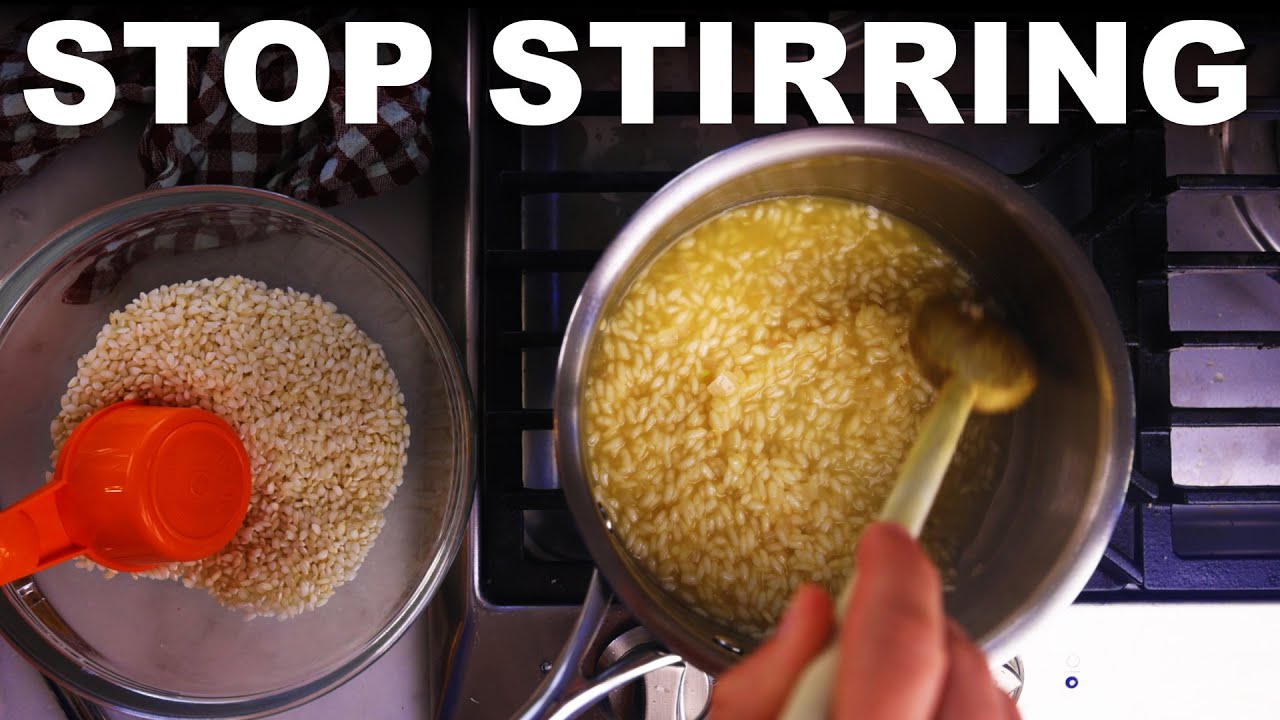
You don't need to stir risotto (much)
video description
Here s my full technique:
-prepare a stock in a pot
-place your rice into the cold risotto sauce pan
-strain the stock into the sauce pan to cover the rice with broth (the straining is to remove the solids from broth making, if your broth is already solid free, no need to do this) empty the strainer after
-stir the rice vigorously for a minute
-strain the rice and broth back into the broth pot. You should now have your rinsed rice in the strainer
-add the rice to the sauce pan, cook off all the moisture and toast the rice until really fragrant
-proceed to make risotto as shown in the video. Make sure to underestimate the time and amount of liquid you need when using the technique for the first time. Also make sure to stir the stock before adding it to the risotto to distribute the starch in the liquid.
Date: 2023-02-10
Related videos


Comments and reviews: 14
Agnes
Hello there! I have been making risotto for years and I think I found a balance between stirring constantly and leaving it alone. I am starting with the onion on butter. Once the onion goes translucent I add sloppily chopped asparagus (from a jar, as the season is short, and fresh white asparagus is tough) and once it is frying for a bit and loose most moisture I add some wine and wild mushrooms (that I soak thinly slices, dried porcini into hot water 15 min before. I save the mushroom-soaking water, as it is fool of flavor. I am adding rice and frying for a minute. After that, there is a splash of white wine. Once it's evaporated I am adding chicken (or vegetable) stock mixed with mushroom-soaking water. About 200mil. I am mixing and coming back when the liquid has evaporated (an=bot 4-6 min. I add another splash (about 200ml bullion with mushroom-soaking water) and mix it. Then I am coming after 5min adding the rest. Once it is grainy and evaporated I am adding a splash of cream and pecorino and/or Parmigiano. And I taste. When it is soft and I like it I serve. Most likely with fresh chopped parsley.
reply
Hello there! I have been making risotto for years and I think I found a balance between stirring constantly and leaving it alone. I am starting with the onion on butter. Once the onion goes translucent I add sloppily chopped asparagus (from a jar, as the season is short, and fresh white asparagus is tough) and once it is frying for a bit and loose most moisture I add some wine and wild mushrooms (that I soak thinly slices, dried porcini into hot water 15 min before. I save the mushroom-soaking water, as it is fool of flavor. I am adding rice and frying for a minute. After that, there is a splash of white wine. Once it's evaporated I am adding chicken (or vegetable) stock mixed with mushroom-soaking water. About 200mil. I am mixing and coming back when the liquid has evaporated (an=bot 4-6 min. I add another splash (about 200ml bullion with mushroom-soaking water) and mix it. Then I am coming after 5min adding the rest. Once it is grainy and evaporated I am adding a splash of cream and pecorino and/or Parmigiano. And I taste. When it is soft and I like it I serve. Most likely with fresh chopped parsley.
reply
L nzji
The only italian risotto recipe I've ever looked at said to stir each time when I put stock in it. Not more than that. And as far as I could tell, the idea behind the putting the stock in more than one time is for better control. I think this comes from open fire cooking, where standardised precise recipe cooking is impossible as heat control is so much more difficult.
Anway: for risotto, pressure cooker is the way to go. I always use the same rice, always the same proportions, always exactly the same cooking time, stir vigorously at the end. Viscosity correction at that moment, put the cheese in at the same time. Works every time.
Edit as I was writing during the video: yes, your final point might be the most important: risotto does not wait for people, people wait for risotto
reply
The only italian risotto recipe I've ever looked at said to stir each time when I put stock in it. Not more than that. And as far as I could tell, the idea behind the putting the stock in more than one time is for better control. I think this comes from open fire cooking, where standardised precise recipe cooking is impossible as heat control is so much more difficult.
Anway: for risotto, pressure cooker is the way to go. I always use the same rice, always the same proportions, always exactly the same cooking time, stir vigorously at the end. Viscosity correction at that moment, put the cheese in at the same time. Works every time.
Edit as I was writing during the video: yes, your final point might be the most important: risotto does not wait for people, people wait for risotto
reply
James
I occasionally make risotto using a recipe and program on my pressure cooker. The process is similar: using the sear function to cook the onions, toast the rice, and add the wine. But after adding the stock, you close it up and run in pressure cooker mode. When the program finishes, you add cheese and butter and stir. I generally thought of it as cheating, but the end result tasted good enough, and it was a lot less work.
I guess one difference to the stove top method is that it doesn't need as much stock. Since the thing is sealed for most of the cooking time, there's nowhere for the stock to evaporate to.
reply
I occasionally make risotto using a recipe and program on my pressure cooker. The process is similar: using the sear function to cook the onions, toast the rice, and add the wine. But after adding the stock, you close it up and run in pressure cooker mode. When the program finishes, you add cheese and butter and stir. I generally thought of it as cheating, but the end result tasted good enough, and it was a lot less work.
I guess one difference to the stove top method is that it doesn't need as much stock. Since the thing is sealed for most of the cooking time, there's nowhere for the stock to evaporate to.
reply
Nathan
I'm a chef and my risotto at workplaces have nearly always been better than the ones I make at home.
I think it's because we make them in big batches with consistency. Also, because it will be 3/4 cooked as prep, that means for service you're just reheating with extra stock, flavor lumps, and then cheesing it- so little chance of over or undercooking. If a restaurant serves bad rissoto then you're going to the wrong restaurants. Or maybe it's just because I'm passionate about risotto so make sure it's done right.
At home I'm less focused and it's always a new recipe so the results are inconsistent.
reply
I'm a chef and my risotto at workplaces have nearly always been better than the ones I make at home.
I think it's because we make them in big batches with consistency. Also, because it will be 3/4 cooked as prep, that means for service you're just reheating with extra stock, flavor lumps, and then cheesing it- so little chance of over or undercooking. If a restaurant serves bad rissoto then you're going to the wrong restaurants. Or maybe it's just because I'm passionate about risotto so make sure it's done right.
At home I'm less focused and it's always a new recipe so the results are inconsistent.
reply
Aidan
My family friend in her eighties has been making risotto this way my whole life! She was dogmatic about some things, not allowing parm on a seafood risotto but not about that way of cooking. I use the same method now in my restaurant job and it works great!
We do parcook our risotto as a sort of base so we can finish it in the pan with more stock and seasonings. I feel it isn t hard to maintain a good texture in the end if you only take the rice between halfway and 2/3 cooked. I wonder about the effects on the starch retrogradation on achieving that al dente bite
reply
My family friend in her eighties has been making risotto this way my whole life! She was dogmatic about some things, not allowing parm on a seafood risotto but not about that way of cooking. I use the same method now in my restaurant job and it works great!
We do parcook our risotto as a sort of base so we can finish it in the pan with more stock and seasonings. I feel it isn t hard to maintain a good texture in the end if you only take the rice between halfway and 2/3 cooked. I wonder about the effects on the starch retrogradation on achieving that al dente bite
reply
Birdie
Maybe it's the result of the kind of gas stove I have but I can NEVER get rice, pasta, or anything else at a gentle enough simmer to not stick and burn on the bottom so I'm constantly stirring everything. I've even tried a flame tamer and that's nearly as frustrating since I need to blast it to even get the tamer warm and then drop it down to nothing. The only way I can think to fix this is put the pot and flame tamer on like medium on a separate burner and let it get hot for 10-15 minutes, then put the pan on it after and turn it down. What am I doing wrong?
reply
Maybe it's the result of the kind of gas stove I have but I can NEVER get rice, pasta, or anything else at a gentle enough simmer to not stick and burn on the bottom so I'm constantly stirring everything. I've even tried a flame tamer and that's nearly as frustrating since I need to blast it to even get the tamer warm and then drop it down to nothing. The only way I can think to fix this is put the pot and flame tamer on like medium on a separate burner and let it get hot for 10-15 minutes, then put the pan on it after and turn it down. What am I doing wrong?
reply
izzy4bitney
It's funny you mentioned the restaurant comparison. My sister and her husband went to Vegas for their honeymoon and got reservations at Hell's Kitchen. They both got the seafood risotto and were absolutely disappointed in it. They said it was bland and slightly mushy. Fast forward a few months, and I hadn't heard that story yet. I had them over for dinner, and I made a very simple mushroom risotto and was surprised when they said mine was better than Hell's Kitchen risotto. Sometimes I feel like super fancy restaurants are severely overrated.
reply
It's funny you mentioned the restaurant comparison. My sister and her husband went to Vegas for their honeymoon and got reservations at Hell's Kitchen. They both got the seafood risotto and were absolutely disappointed in it. They said it was bland and slightly mushy. Fast forward a few months, and I hadn't heard that story yet. I had them over for dinner, and I made a very simple mushroom risotto and was surprised when they said mine was better than Hell's Kitchen risotto. Sometimes I feel like super fancy restaurants are severely overrated.
reply
Skele-Ton
This is like when people say not to stir rice because it makes it sticky by activating the starch. This makes absolutely no sense. There are so many little cooking superstitions like this that respectable chefs actually repeat. Constantly stirring the risotto seems to work on the same fake principle that somehow you're activating the starch on purpose to create the risotto texture.
What seems much more likely is that as you cook the rice, the piping hot liquid is what is extracting starch from the rice at the same time that it softens.
reply
This is like when people say not to stir rice because it makes it sticky by activating the starch. This makes absolutely no sense. There are so many little cooking superstitions like this that respectable chefs actually repeat. Constantly stirring the risotto seems to work on the same fake principle that somehow you're activating the starch on purpose to create the risotto texture.
What seems much more likely is that as you cook the rice, the piping hot liquid is what is extracting starch from the rice at the same time that it softens.
reply
Federico
You put the broth little by little because the amount needed is never the exact same, especially when rice qualities were more variable from town to town so you couldn't know exactly how much would be too much. So you add it little by little until it's right, adding too much and reducing it by evaporation would make the dish saltier and the rice overcooked. And you constantly stir it because if you don't, when you add the broth little by little, it would stick and burn.
I'm Italian, I know right. xD
BTW I'm from Bari
reply
You put the broth little by little because the amount needed is never the exact same, especially when rice qualities were more variable from town to town so you couldn't know exactly how much would be too much. So you add it little by little until it's right, adding too much and reducing it by evaporation would make the dish saltier and the rice overcooked. And you constantly stir it because if you don't, when you add the broth little by little, it would stick and burn.
I'm Italian, I know right. xD
BTW I'm from Bari
reply
chefmdecamp
In my experience, stirring constantly only matters when you're making BIG batches, like 12 quarts-ish. There you do get a mildly thicker risotto as the very large amount of rice grinds against itself, which doesn't really happen as much with a cup or two of rice. However, the bigger reason is that you have to keep stirring that much rice in a huge rondeau pan.
Maybe the constant stirring thing was taken from restaurants or kitchens of big noble houses and accepted as the way for even small home cooks, who knows.
reply
In my experience, stirring constantly only matters when you're making BIG batches, like 12 quarts-ish. There you do get a mildly thicker risotto as the very large amount of rice grinds against itself, which doesn't really happen as much with a cup or two of rice. However, the bigger reason is that you have to keep stirring that much rice in a huge rondeau pan.
Maybe the constant stirring thing was taken from restaurants or kitchens of big noble houses and accepted as the way for even small home cooks, who knows.
reply
Miodrag
. You people do know that you don't have to eat your rice and noodles Al dente, right? Just because a bunch of chefs on TV and all over Italy say it's the most ideal or best way to eat rice and noodles doesn't mean that it is. There is nothing wrong with soft rice and noodles. Taste is subjective. But this is another perfect example as to, repeating a lie (things in general) over and over again will eventually make all the masses believe it. Kind of like everyone believes you need a credit score to live or succeed.
reply
. You people do know that you don't have to eat your rice and noodles Al dente, right? Just because a bunch of chefs on TV and all over Italy say it's the most ideal or best way to eat rice and noodles doesn't mean that it is. There is nothing wrong with soft rice and noodles. Taste is subjective. But this is another perfect example as to, repeating a lie (things in general) over and over again will eventually make all the masses believe it. Kind of like everyone believes you need a credit score to live or succeed.
reply
food
Here's the thing Adam. In restaurants, specifically mine, we pre cook the rice. Normally this is in the entremetier station. It would be impossible to time a starch with another station if we had to cook risotto from scratch. We need o be synched for a 5 to 7 minute timing with the other stations. Risotto, along with other dishes are still perfect when finished at the last minute. Thanks for your great videos. Do people really think we are magicians in professional kitchens? We are just great cooks.
reply
Here's the thing Adam. In restaurants, specifically mine, we pre cook the rice. Normally this is in the entremetier station. It would be impossible to time a starch with another station if we had to cook risotto from scratch. We need o be synched for a 5 to 7 minute timing with the other stations. Risotto, along with other dishes are still perfect when finished at the last minute. Thanks for your great videos. Do people really think we are magicians in professional kitchens? We are just great cooks.
reply
Tinil0
Wow Adam, I am shocked you would stick your neck out like that and declare al dente to be the perfect texture. You know, no one else has ever expressed that opinion before, it's pretty brave. Usually all these professional chefs and foodies like to hate on anything al dente and are really big on mushy or crunchy, but it's nice to see someone standing up for al dente.
(I'm obviously kidding, I just found it amusing how you talked up al dente like it was something that needed to be talked up)
reply
Wow Adam, I am shocked you would stick your neck out like that and declare al dente to be the perfect texture. You know, no one else has ever expressed that opinion before, it's pretty brave. Usually all these professional chefs and foodies like to hate on anything al dente and are really big on mushy or crunchy, but it's nice to see someone standing up for al dente.
(I'm obviously kidding, I just found it amusing how you talked up al dente like it was something that needed to be talked up)
reply
Yankee
Pro chef here, you can in fact cook perfect risotto well in advance and still get that perfect al-dente texture. The trick is to not cook it fully and not add cheese. You want it 85% done, it will carry to 90% in the time it takes you to place on a sheet pan and chill in the fridge. Place it in an airtight container and you can pick it up with a little stock in a pan, add your cheese, and have perfect fresh risotto in minutes whenever you want it. Perfect for weekend meal prep.
reply
Pro chef here, you can in fact cook perfect risotto well in advance and still get that perfect al-dente texture. The trick is to not cook it fully and not add cheese. You want it 85% done, it will carry to 90% in the time it takes you to place on a sheet pan and chill in the fridge. Place it in an airtight container and you can pick it up with a little stock in a pan, add your cheese, and have perfect fresh risotto in minutes whenever you want it. Perfect for weekend meal prep.
reply
Add a review, comment
Other channel videos