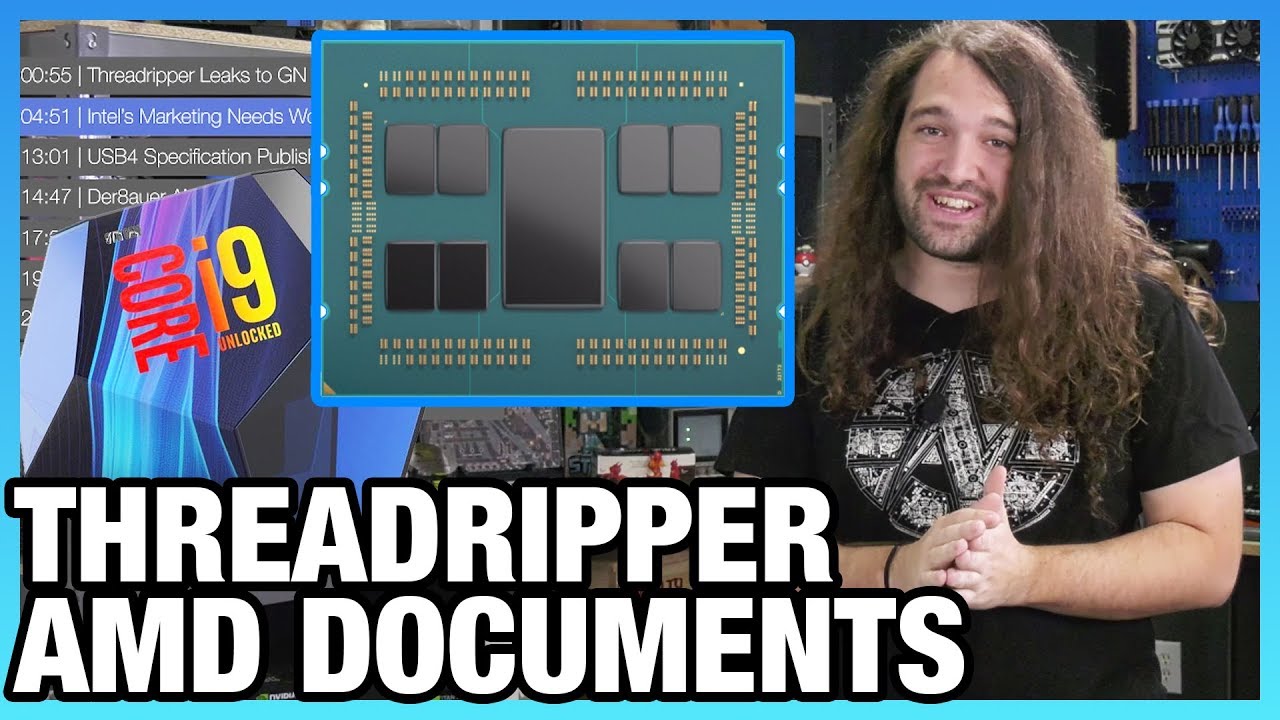
HW News - Threadripper 8-Channel & 4ch Spec Leaks, Intel & AMD Bickering
video description
Date: 2020-05-06
Related videos


Comments and reviews: 10
Rob
hmmm. got to disagree on the Steam Survey numbers. Yes RX 580 gained another. 07 but it was introduced in April of 2017 and didnt break 1% until AMD slashed prices to the bone and bundled games with it. Right below the 580 with the same 1. 45% share is the 2070, released a year and a half after the 580 and already replaced by the 2070Super. It cost more than twice as much and has worse cost per frame. Look down the chart just a bit and you will find the 1660ti - A February 2019 release that is more expensive in both actual dollars and dollars per frame. Based on its steady adoption rate, it will likely pass the RX 580 when the October survey is published, achieving the same adoption rate that took AMDs best performing GPU 2 1/2 years to achieve in 8 months. Look down a little more and you will see the 1660 (non-ti) on track to pass the RX 570 around the same time. Go down past that and you will find the widely derided 1650 that will likely pass the RX 570 around the same October time frame. The 1650 was released almost exactly 2 years after the 570, cost more than the 570 and delivers slightly less performance than the 570. Of the. 4% AMD gained over the month, .19 came from RX 590 series - another GPU that AMD is likely making zero money on given the bargain pricing. Is this the we will make it up in the volume strategy? I dont hate AMD - Im typing this on a RX 570 Win/Hacintosh sitting right next to my 580X iMac - but they remain a near non-factor in gaming and until they have actual 5700 AIB boards shipping I dont see that changing and even that is questionable. I know most gamers think the 1050/1650 series GPUs are crap but there is a reason they are popular - they turn cheap crap boxes in to viable gaming machines in minutes. You can put a 570 in SOME crap boxes but not the 580 and certainly not the 590. Until AMD makes a viable 120-150W GPU and a it works 75W GPU they are going to continue to get hammered by Nvidia. The 5700XT and 2070Super are roughly the same in performance but the XT draws way more power. You guys know better than anyone that that means heat and heat means throttling eventually. Until AMD can make a GPU that doesnt act as a secondary space heater, they are not going to break into the System Integrator market like they so desperately want to and because of that they will continue to suffer in the mind share market. SIs are operating on razor thin margins and the difference between a 500W PSU and a 600W PSU combined with a needs two fans box and a needs three fans box might be half their profit. JMHO
reply
hmmm. got to disagree on the Steam Survey numbers. Yes RX 580 gained another. 07 but it was introduced in April of 2017 and didnt break 1% until AMD slashed prices to the bone and bundled games with it. Right below the 580 with the same 1. 45% share is the 2070, released a year and a half after the 580 and already replaced by the 2070Super. It cost more than twice as much and has worse cost per frame. Look down the chart just a bit and you will find the 1660ti - A February 2019 release that is more expensive in both actual dollars and dollars per frame. Based on its steady adoption rate, it will likely pass the RX 580 when the October survey is published, achieving the same adoption rate that took AMDs best performing GPU 2 1/2 years to achieve in 8 months. Look down a little more and you will see the 1660 (non-ti) on track to pass the RX 570 around the same time. Go down past that and you will find the widely derided 1650 that will likely pass the RX 570 around the same October time frame. The 1650 was released almost exactly 2 years after the 570, cost more than the 570 and delivers slightly less performance than the 570. Of the. 4% AMD gained over the month, .19 came from RX 590 series - another GPU that AMD is likely making zero money on given the bargain pricing. Is this the we will make it up in the volume strategy? I dont hate AMD - Im typing this on a RX 570 Win/Hacintosh sitting right next to my 580X iMac - but they remain a near non-factor in gaming and until they have actual 5700 AIB boards shipping I dont see that changing and even that is questionable. I know most gamers think the 1050/1650 series GPUs are crap but there is a reason they are popular - they turn cheap crap boxes in to viable gaming machines in minutes. You can put a 570 in SOME crap boxes but not the 580 and certainly not the 590. Until AMD makes a viable 120-150W GPU and a it works 75W GPU they are going to continue to get hammered by Nvidia. The 5700XT and 2070Super are roughly the same in performance but the XT draws way more power. You guys know better than anyone that that means heat and heat means throttling eventually. Until AMD can make a GPU that doesnt act as a secondary space heater, they are not going to break into the System Integrator market like they so desperately want to and because of that they will continue to suffer in the mind share market. SIs are operating on razor thin margins and the difference between a 500W PSU and a 600W PSU combined with a needs two fans box and a needs three fans box might be half their profit. JMHO
reply
Ranger
Ryzen 3000 boost issue: Hooray! We're getting BIOS updates that are not without risk so every once in a while we can measure a 1-2% higher boost than we're getting now, but at what voltage? In reality, even if 95% of 3900X users are never reaching 4. 6 GHz on one core but are fully stable at the spec'd base clock of 3. 8 on all cores, they are getting what the spec sheet advertises. UP TO 4. 6 means less than or equal to 4. 6, so anything over base falls into the advertised range. Nothing in AMD's material says that you will get 4. 6 GHz boost. The PC enthusiast community has unrealistic expectations fueled by social media and the pervasive use of mostly free benchmarking software whose accuracy is arguably all over the place. I don't care if my 3900X reaches 4. 6 on one core once in a while or if it just gets to 4. 58. I can't perceive this difference in any workload, and neither can you, without laboratory measuring devices. In actual use, for 95% of us, it honestly makes no difference. It's a tempest in a teapot.
reply
Ryzen 3000 boost issue: Hooray! We're getting BIOS updates that are not without risk so every once in a while we can measure a 1-2% higher boost than we're getting now, but at what voltage? In reality, even if 95% of 3900X users are never reaching 4. 6 GHz on one core but are fully stable at the spec'd base clock of 3. 8 on all cores, they are getting what the spec sheet advertises. UP TO 4. 6 means less than or equal to 4. 6, so anything over base falls into the advertised range. Nothing in AMD's material says that you will get 4. 6 GHz boost. The PC enthusiast community has unrealistic expectations fueled by social media and the pervasive use of mostly free benchmarking software whose accuracy is arguably all over the place. I don't care if my 3900X reaches 4. 6 on one core once in a while or if it just gets to 4. 58. I can't perceive this difference in any workload, and neither can you, without laboratory measuring devices. In actual use, for 95% of us, it honestly makes no difference. It's a tempest in a teapot.
reply
Jouni
Steam hardware survey. Something that needs to be interpreted correctly. If GTX 550 TI gets reasonable percentage increase relative to its installed base, is it because a) current steam users bought those cards new or from non-steam users. Or is it more likely that there was influx of new steam users with reasonable numbers in countries with lower average income like India or China that just happen to have that card in their system. Okay the effect isn't as clear in this month as couple of months ago, but percentage changes can come from three things. 1) New users, 2) Existing users replacing hardware and 3) Monthly variation of survey participation. I wouldn't put third one there at first but then I saw the Linux processor vendor statistic history. 1% of Linux users changed to Intel in June, then in July half percentage of got AMD and August 2. 6% got AMD. That one could be explained on natural variation of people coming to platform.
reply
Steam hardware survey. Something that needs to be interpreted correctly. If GTX 550 TI gets reasonable percentage increase relative to its installed base, is it because a) current steam users bought those cards new or from non-steam users. Or is it more likely that there was influx of new steam users with reasonable numbers in countries with lower average income like India or China that just happen to have that card in their system. Okay the effect isn't as clear in this month as couple of months ago, but percentage changes can come from three things. 1) New users, 2) Existing users replacing hardware and 3) Monthly variation of survey participation. I wouldn't put third one there at first but then I saw the Linux processor vendor statistic history. 1% of Linux users changed to Intel in June, then in July half percentage of got AMD and August 2. 6% got AMD. That one could be explained on natural variation of people coming to platform.
reply
enlightendbel
The issue for Intel this time around is that AMD has a far better product on the server side. More cores, far better TDPs and quite a bit better power consumption. The first and the last being the main definers of datacenter server costs these days. AMD's power consumption is somewhere around 50% of that of Intel on a per core basis, while bringing twice the cores per package. So a 1 CPU server can now have double the cores (that now perform the same and with the high cache, quite a bit better in certain applications) for the same power cost. If AMD just had caught up on desktop, Intel would still not give them the light of day. Btu because AMD is selling double the cores for half the power and the same performance per core, Intel is seeing some gigantic projects jump to AMD, which will drive the rest of the server market to do the same.
reply
The issue for Intel this time around is that AMD has a far better product on the server side. More cores, far better TDPs and quite a bit better power consumption. The first and the last being the main definers of datacenter server costs these days. AMD's power consumption is somewhere around 50% of that of Intel on a per core basis, while bringing twice the cores per package. So a 1 CPU server can now have double the cores (that now perform the same and with the high cache, quite a bit better in certain applications) for the same power cost. If AMD just had caught up on desktop, Intel would still not give them the light of day. Btu because AMD is selling double the cores for half the power and the same performance per core, Intel is seeing some gigantic projects jump to AMD, which will drive the rest of the server market to do the same.
reply
Jonas
One general question about the AMD boost stuff: how accurate are the readings in software like hwinfo? I have heard (but not looked deeply into) that there was some sort of system clock issue in Win 7 which persists in Win 10, where the OS misinterprets the base clock or something. That would lead to small changes in clock frequency as read by the OS. In the survey, many users were within 50 MHz or so of the advertised boost, and my question is then if the OS and a software readout like that can actually be relied on with that level of precision? 50 MHz 4. 4 GHz is 1. 14 %. Someone with a good oscilloscope will have better precision than that, but where and how is the clock frequency read out on the motherboard? Just to be clear: this is just out of curiosity, not to discredit any of the work by you or Roman. Love your content!
reply
One general question about the AMD boost stuff: how accurate are the readings in software like hwinfo? I have heard (but not looked deeply into) that there was some sort of system clock issue in Win 7 which persists in Win 10, where the OS misinterprets the base clock or something. That would lead to small changes in clock frequency as read by the OS. In the survey, many users were within 50 MHz or so of the advertised boost, and my question is then if the OS and a software readout like that can actually be relied on with that level of precision? 50 MHz 4. 4 GHz is 1. 14 %. Someone with a good oscilloscope will have better precision than that, but where and how is the clock frequency read out on the motherboard? Just to be clear: this is just out of curiosity, not to discredit any of the work by you or Roman. Love your content!
reply
Eloi
The point of Intel downplaying cinebench and saying is not that relevant, has his point, and is not because cinema 4d is or not more relevant than blender or others. Its because its just a renderer. People working in 3d do much more than just rendering. animators, modellers, riggers, simulations. (I work in 3d and I render really occasionally. For all this people that are also creators, will benefit more from a higher ghz core than multiple cores for example, and I think is the point of intel. During last years has been the trend to move to gpu renderers, so then, even if you use cinema 4d for rendering or cycles for rendering, if you use a gpu, knowing that X cpu is faster at rendering. well, on this cases has no point.
reply
The point of Intel downplaying cinebench and saying is not that relevant, has his point, and is not because cinema 4d is or not more relevant than blender or others. Its because its just a renderer. People working in 3d do much more than just rendering. animators, modellers, riggers, simulations. (I work in 3d and I render really occasionally. For all this people that are also creators, will benefit more from a higher ghz core than multiple cores for example, and I think is the point of intel. During last years has been the trend to move to gpu renderers, so then, even if you use cinema 4d for rendering or cycles for rendering, if you use a gpu, knowing that X cpu is faster at rendering. well, on this cases has no point.
reply
Aquila
Did i hear Steve being facetious about AMD and the DeBauer vid? (damn I can't say that word and can't spell it either. Had to look it up. p. s. I am on the verge of replacing my 2700X with a 3700X. Seems like a 10% upgrade and a luxury kind of. But I liked the power savings from replacing my 2500K so much that I want more. My 2500K was running at 4. 3ghz. Power bills last winter were over 200 per month and about 100 in summer. Now they are close to half of that and the only thing that changed was my CPU (highest bill this winter has been 133 NZD. if I can get good performance and lower bills, I will. That kind of savings almost pays off a new GPU or something.
reply
Did i hear Steve being facetious about AMD and the DeBauer vid? (damn I can't say that word and can't spell it either. Had to look it up. p. s. I am on the verge of replacing my 2700X with a 3700X. Seems like a 10% upgrade and a luxury kind of. But I liked the power savings from replacing my 2500K so much that I want more. My 2500K was running at 4. 3ghz. Power bills last winter were over 200 per month and about 100 in summer. Now they are close to half of that and the only thing that changed was my CPU (highest bill this winter has been 133 NZD. if I can get good performance and lower bills, I will. That kind of savings almost pays off a new GPU or something.
reply
Science!
As someone who primarily uses their high end PC for gaming and internet I'd personally look at the i7 9700K as the best gaming CPU. It's close enough to, and even beats in certain gaming applications, the 9900K, were it becomes rather pointless to spend nearly 50% more simply to gain a few percentage point on average. The i7 9700K also has a power draw advantage which directly correlates into lower noise/thermals. For value, the R5 3600 obviously takes the crown. I currently have a 7700K though, so upgrading at this moment in time is sort of pointless playing ay 1440p 16: 9 with a 2080 Ti pushing the pixels.
reply
As someone who primarily uses their high end PC for gaming and internet I'd personally look at the i7 9700K as the best gaming CPU. It's close enough to, and even beats in certain gaming applications, the 9900K, were it becomes rather pointless to spend nearly 50% more simply to gain a few percentage point on average. The i7 9700K also has a power draw advantage which directly correlates into lower noise/thermals. For value, the R5 3600 obviously takes the crown. I currently have a 7700K though, so upgrading at this moment in time is sort of pointless playing ay 1440p 16: 9 with a 2080 Ti pushing the pixels.
reply
Dane
I got my old laptop based around performance in programs I expected to use while in school, I was offered a similar laptop with better gaming performance however that wasn't the use case I needed a laptop for so I went Intel over AMD. If I were about to upgrade a server and Intel says we are only the best for gaming guess who isn't supplying the new parts, this is the dumbest attempt to save them selves, how is we used to makes billions of the server market, let us alienate them by saying the competition is better for everything except the one thing that is useless in the server space in any way rational?
reply
I got my old laptop based around performance in programs I expected to use while in school, I was offered a similar laptop with better gaming performance however that wasn't the use case I needed a laptop for so I went Intel over AMD. If I were about to upgrade a server and Intel says we are only the best for gaming guess who isn't supplying the new parts, this is the dumbest attempt to save them selves, how is we used to makes billions of the server market, let us alienate them by saying the competition is better for everything except the one thing that is useless in the server space in any way rational?
reply
TK
Blender is literally used, of course, but by whom? You are talking about a very small user base (relative to the gaming community) that is NOT representative of the general computer user or gamer. Yes, there is a point to be made about synthetic benchmarks which skew results, e. g, by allowing unrealistic cache utilization, but the real argument against Cinebench is not that it is a synthetic benchmark, but that only a comparatively small number of users run rendering and other types of applications that scale well with core count. So Intel's point stands (though they are obviously using flawed data.
reply
Blender is literally used, of course, but by whom? You are talking about a very small user base (relative to the gaming community) that is NOT representative of the general computer user or gamer. Yes, there is a point to be made about synthetic benchmarks which skew results, e. g, by allowing unrealistic cache utilization, but the real argument against Cinebench is not that it is a synthetic benchmark, but that only a comparatively small number of users run rendering and other types of applications that scale well with core count. So Intel's point stands (though they are obviously using flawed data.
reply
Add a review, comment
Other channel videos