Power Supply Testing & Failure Analysis: Engineering the Best PSUs (2020)
video description
Date: 2020-05-06
Related videos



Comments and reviews: 10
Today
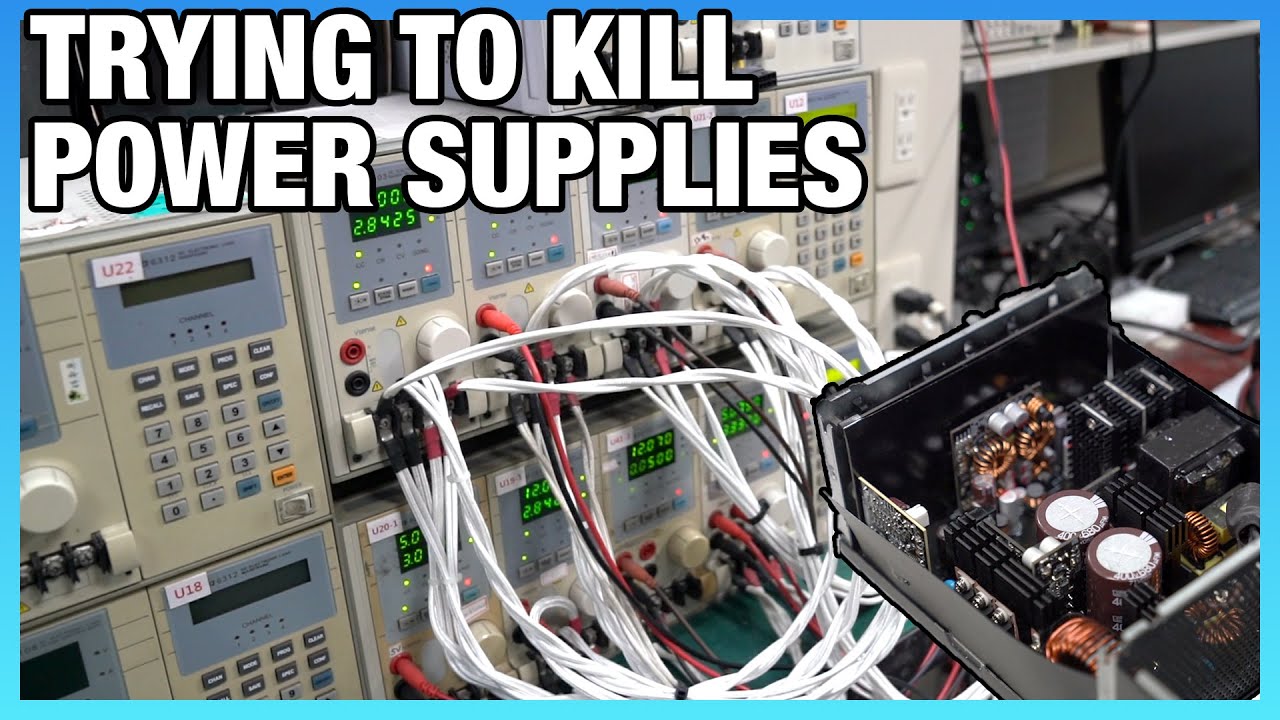
I feel really nit picky, since this video is overall very good and informative, but, I noticed a couple of details that could be worth taking into consideration. These racks also include oscilloscopes, thermocouples and waverunner or wavesurfer brand devices for loging and analyzing component performance. 8: 17 Is a statement that risks being misleading. It's technically not wrong to phrase things in this fashion. But why highlight the two product series? Both Waverunner and Wavesurfer are Lecroy oscilloscopes, and in essence are the same as the Tektronics oscilloscope that the quote started at. (Ie, the statement can be summed up as these racks include oscilloscopes, thermocouples, and Lecroy oscilloscopes or other Lecroy oscilloscopes for logging and analyzing component performance. a somewhat redundant statement) Also, pointing out the scope product name for the inrush testing is a bit overkill, since almost any scope on the market could do this test fairly sufficiently. So it is an unneeded detail and only wastes time in the video. (Though, the way they use the scope in that scene would require them to use an isolation transformer for driving the powersupply, otherwise the scope would suffer severe damage. (this is a trap for many beginners in the electronics world) This is frankly a more important detail than the brand/product name of the scope being used) In the world of test equipment, the main thing that actually matters is product specifications. The brand/series/model starts becoming important when expanding an existing setup. Since there is few communication standards for test equipment, and rarely even standards for the interfaces to start with. (in short, test equipment can have frankly arcane interfaces, even if one has used multiple other arcane interfaces on other equipment. So reading user manuals is not unheard off) So an R&D lab, manufacturing line or test lab can tend to use specific equipment for a long slew of reasons. But primarily it is down to specifications, price, interfacing and unit size, sometimes also other details. But practically speaking, almost any piece of test gear from one manufacturer can be replaced by something similar from another. There is few test gear manufacturers that have their own corner of the market. Ie, it is much more informative to state the specifications required for doing a certain task, instead of sating what specific tool were used for the task. Since a test/R&D lab can at times use totally overkill tools for a task, since each piece of test gear costs money to buy, store, and learn how to use. Not to mention recurring calibration costs for ensuring that it is in spec. So most labs tends to just use what they already have on hand instead. 99% of the time a scope is a scope, a load is a load, and a multimeter is a multimeter. As long as the test gear has sufficient specs for the task, then it can be used. (obviously, a 300 watt load isn't sufficient for performing a 400 watt load test. But it is on the other hand sufficient for everything under 300 watts. (or at least down to its minimum resolution/range. (ie, it might struggle to load something with only 1mW) These last to paragraphs kinda applies to all your factory tours to be fair. (at least you aren't stating the manufacturer/series/model names of the robotic arms used in the production lines, or the conveyor belts, screw drivers, etc. But for electronics test equipment you are frankly on that level) Then we have the acrylic test chamber where you say, these use light bulbs in the bottom to heat up the chamber to about 1500 watts. is frankly an odd statement. Would be far more logical to say, these use light bulbs in the bottom providing about 1500 watts to heat up the chamber. this is really a nit pick, but Steve, this is your field. (or are you just testing your audience here)
reply
I feel really nit picky, since this video is overall very good and informative, but, I noticed a couple of details that could be worth taking into consideration. These racks also include oscilloscopes, thermocouples and waverunner or wavesurfer brand devices for loging and analyzing component performance. 8: 17 Is a statement that risks being misleading. It's technically not wrong to phrase things in this fashion. But why highlight the two product series? Both Waverunner and Wavesurfer are Lecroy oscilloscopes, and in essence are the same as the Tektronics oscilloscope that the quote started at. (Ie, the statement can be summed up as these racks include oscilloscopes, thermocouples, and Lecroy oscilloscopes or other Lecroy oscilloscopes for logging and analyzing component performance. a somewhat redundant statement) Also, pointing out the scope product name for the inrush testing is a bit overkill, since almost any scope on the market could do this test fairly sufficiently. So it is an unneeded detail and only wastes time in the video. (Though, the way they use the scope in that scene would require them to use an isolation transformer for driving the powersupply, otherwise the scope would suffer severe damage. (this is a trap for many beginners in the electronics world) This is frankly a more important detail than the brand/product name of the scope being used) In the world of test equipment, the main thing that actually matters is product specifications. The brand/series/model starts becoming important when expanding an existing setup. Since there is few communication standards for test equipment, and rarely even standards for the interfaces to start with. (in short, test equipment can have frankly arcane interfaces, even if one has used multiple other arcane interfaces on other equipment. So reading user manuals is not unheard off) So an R&D lab, manufacturing line or test lab can tend to use specific equipment for a long slew of reasons. But primarily it is down to specifications, price, interfacing and unit size, sometimes also other details. But practically speaking, almost any piece of test gear from one manufacturer can be replaced by something similar from another. There is few test gear manufacturers that have their own corner of the market. Ie, it is much more informative to state the specifications required for doing a certain task, instead of sating what specific tool were used for the task. Since a test/R&D lab can at times use totally overkill tools for a task, since each piece of test gear costs money to buy, store, and learn how to use. Not to mention recurring calibration costs for ensuring that it is in spec. So most labs tends to just use what they already have on hand instead. 99% of the time a scope is a scope, a load is a load, and a multimeter is a multimeter. As long as the test gear has sufficient specs for the task, then it can be used. (obviously, a 300 watt load isn't sufficient for performing a 400 watt load test. But it is on the other hand sufficient for everything under 300 watts. (or at least down to its minimum resolution/range. (ie, it might struggle to load something with only 1mW) These last to paragraphs kinda applies to all your factory tours to be fair. (at least you aren't stating the manufacturer/series/model names of the robotic arms used in the production lines, or the conveyor belts, screw drivers, etc. But for electronics test equipment you are frankly on that level) Then we have the acrylic test chamber where you say, these use light bulbs in the bottom to heat up the chamber to about 1500 watts. is frankly an odd statement. Would be far more logical to say, these use light bulbs in the bottom providing about 1500 watts to heat up the chamber. this is really a nit pick, but Steve, this is your field. (or are you just testing your audience here)
reply
Sam
I'm very excited about this video! Product/Test engineering is great! Only a few notes this time. Excellent work as always. 0: 35 waverunners and oscilloscopes Waverunner is the name for LeCroy's oscilloscopes like the LT354 shown an 0: 35 8: 88 waverunner and wavesurfer brand devices Wavesurfer is also LeCroy (now teledyne. They are slightly newer than waverunner. Both are just Oscilloscopes like the tektronix DPO3014 you have at 8: 17 9: 40 That LeCroy WaveSurfer 24MXs-b is 11, 000 It's from 2003 15: 23 buck capacitors Do you mean bulk capacitors? The capacitors in a buck regulator are usually referred to which side they are on: the input or output capacitors (since they serve different purposes and are both critical parts of the design, whereas many PCB designers use the term bulk capacitors to refer to the biggest ones you see there. It can't refer to both the input and output capacitors of the buck stage since they will definitely be different. Maybe it's multiple line items in the list of 27?
reply
I'm very excited about this video! Product/Test engineering is great! Only a few notes this time. Excellent work as always. 0: 35 waverunners and oscilloscopes Waverunner is the name for LeCroy's oscilloscopes like the LT354 shown an 0: 35 8: 88 waverunner and wavesurfer brand devices Wavesurfer is also LeCroy (now teledyne. They are slightly newer than waverunner. Both are just Oscilloscopes like the tektronix DPO3014 you have at 8: 17 9: 40 That LeCroy WaveSurfer 24MXs-b is 11, 000 It's from 2003 15: 23 buck capacitors Do you mean bulk capacitors? The capacitors in a buck regulator are usually referred to which side they are on: the input or output capacitors (since they serve different purposes and are both critical parts of the design, whereas many PCB designers use the term bulk capacitors to refer to the biggest ones you see there. It can't refer to both the input and output capacitors of the buck stage since they will definitely be different. Maybe it's multiple line items in the list of 27?
reply
Brian
Tape is actually very important for safety in switch mode power supplies, which is why it is tested so closely. The primary side of a SMPS typically operates at line voltages (up to hundreds of volts. The secondary side is hooked up to your device. It is very important that the primary side is isolated from the secondary side properly. Without proper isolation, you could damage your device, cause a fire, or get a nasty shock. The primary and secondary windings are separated by the insulation on the wires, plus specific tape. The number of layers of tape and the specifications of the tape are standardized by UL and other testing laboratories. Tape is used so that an insulation fault in the windings (such as a manufacturing defect, or damage caused by a surge) doesn't result in an unsafe situation. This is why you should always use power supplies that have been tested by a recognized independent laboratory, such as UL. Proper design really matters here.
reply
Tape is actually very important for safety in switch mode power supplies, which is why it is tested so closely. The primary side of a SMPS typically operates at line voltages (up to hundreds of volts. The secondary side is hooked up to your device. It is very important that the primary side is isolated from the secondary side properly. Without proper isolation, you could damage your device, cause a fire, or get a nasty shock. The primary and secondary windings are separated by the insulation on the wires, plus specific tape. The number of layers of tape and the specifications of the tape are standardized by UL and other testing laboratories. Tape is used so that an insulation fault in the windings (such as a manufacturing defect, or damage caused by a surge) doesn't result in an unsafe situation. This is why you should always use power supplies that have been tested by a recognized independent laboratory, such as UL. Proper design really matters here.
reply
Peter
Coil whine is very normal for any circuit which has inductors and capacitors, the essential part is whether or not the sound from it is within the range of the human hearing. We had coil whine long before PC-users complained about it but back then the frequency was too high for us to hear it. The higher efficiency which the engineers aim for these days make it more difficult to prevent audible coil whine. Inductors store energy in a magnetic field, capacitors store energy in an electric field. In an electric circuit energy gets exchanged between capacitors and inductors with a certain frequency. It is the exchange of energy which makes the wires in inducts contract and expand all the time That frequency, that is the problem, with a higher efficiency that frequency gets within the audible range. Gluing has been attempted as a do it yourself solution. It makes sense that these PSU-companies now also try that.
reply
Coil whine is very normal for any circuit which has inductors and capacitors, the essential part is whether or not the sound from it is within the range of the human hearing. We had coil whine long before PC-users complained about it but back then the frequency was too high for us to hear it. The higher efficiency which the engineers aim for these days make it more difficult to prevent audible coil whine. Inductors store energy in a magnetic field, capacitors store energy in an electric field. In an electric circuit energy gets exchanged between capacitors and inductors with a certain frequency. It is the exchange of energy which makes the wires in inducts contract and expand all the time That frequency, that is the problem, with a higher efficiency that frequency gets within the audible range. Gluing has been attempted as a do it yourself solution. It makes sense that these PSU-companies now also try that.
reply
justjoeblow420
As some one that is an electronics hobbyist these factory tours are nice to watch as it shows how much work goes into even the most basic of components most people don't think about like PSU's. I'm glad to see people that are not aware of the kind of work involved in even a PSU realizing how much engineering a design time goes into the things that they use every day and don't have to think about. And yeah component selection is one of the most crucial parts of PSU design stages as the difference between going with one smoothing cap on the DC output to another can effect everything from the ripple current seen to the maximum wattage the design can handle with minor tweaks.
reply
As some one that is an electronics hobbyist these factory tours are nice to watch as it shows how much work goes into even the most basic of components most people don't think about like PSU's. I'm glad to see people that are not aware of the kind of work involved in even a PSU realizing how much engineering a design time goes into the things that they use every day and don't have to think about. And yeah component selection is one of the most crucial parts of PSU design stages as the difference between going with one smoothing cap on the DC output to another can effect everything from the ripple current seen to the maximum wattage the design can handle with minor tweaks.
reply
George
Don't buy Cooler Master products! They are bad quality. I have a power supply that fails to resume from sleep, although the voltage and noise levels look very good. My Cooler Master case came with a screw cutting through the wire for the power button. Also don't buy Fortron (FSP) power supplies! I've seen motherboards and CPU's fried due to swelling capacitors, and no over-voltage protection. This is a common issue among their power supplies. When a capacitor goes bad, pulsations around the reference voltage becomes higher, until the board can no longer tolerate the peak and gets fried. Most commonly caused by the 3V3 and 5VSB rails.
reply
Don't buy Cooler Master products! They are bad quality. I have a power supply that fails to resume from sleep, although the voltage and noise levels look very good. My Cooler Master case came with a screw cutting through the wire for the power button. Also don't buy Fortron (FSP) power supplies! I've seen motherboards and CPU's fried due to swelling capacitors, and no over-voltage protection. This is a common issue among their power supplies. When a capacitor goes bad, pulsations around the reference voltage becomes higher, until the board can no longer tolerate the peak and gets fried. Most commonly caused by the 3V3 and 5VSB rails.
reply
zwz
This being China, I suspect that they rigged a lab by borrowing equipment from several colleges to show us how advanced R&D they have. This is overkill on every level and unlike the budget Chinese nature. These are just PSUs, not processors. And yes, you can guess the size of most cooling components from experience. And then test which part fails the most in the oven and beef it up. The K-cells really made me SMH. How good thermal contact do you think they have? A thermal camera may be less accurate, but it won't gather huge errors from slipping cells and it will still reveal hotspots you neglected to measure with the thermocouples.
reply
This being China, I suspect that they rigged a lab by borrowing equipment from several colleges to show us how advanced R&D they have. This is overkill on every level and unlike the budget Chinese nature. These are just PSUs, not processors. And yes, you can guess the size of most cooling components from experience. And then test which part fails the most in the oven and beef it up. The K-cells really made me SMH. How good thermal contact do you think they have? A thermal camera may be less accurate, but it won't gather huge errors from slipping cells and it will still reveal hotspots you neglected to measure with the thermocouples.
reply
dronshi
This is why I sometimes don't trust some PSU reviews at times saying a PSU is bad (yes, I'm talking about LTT PSU Tier List and those who interpret it incorrectly. These stuff go through a lot of quality testing, especially those PSUs that seem high quality or came from reputable companies. Just because one or few reviews say it had problems or defects in their testing doesn't mean all units are bad. Of course, when it comes to non-rated PSUs, I wouldn't be surprised that it's bad and a fire waiting to happen.
reply
This is why I sometimes don't trust some PSU reviews at times saying a PSU is bad (yes, I'm talking about LTT PSU Tier List and those who interpret it incorrectly. These stuff go through a lot of quality testing, especially those PSUs that seem high quality or came from reputable companies. Just because one or few reviews say it had problems or defects in their testing doesn't mean all units are bad. Of course, when it comes to non-rated PSUs, I wouldn't be surprised that it's bad and a fire waiting to happen.
reply
Varsh
Using Windows XP is not something that I have an issue with. I have worked in places that use XP as it just works, and they don't need to change it. And I agree. But using a laptop is something that I am not comfortable for prolonged use. You can do very little to repair an old notebook, and finding replacement parts for them is far more complicated. But that's a company's decision. I am glad to learn this kind of scenario exists. Great work, Steve and team.
reply
Using Windows XP is not something that I have an issue with. I have worked in places that use XP as it just works, and they don't need to change it. And I agree. But using a laptop is something that I am not comfortable for prolonged use. You can do very little to repair an old notebook, and finding replacement parts for them is far more complicated. But that's a company's decision. I am glad to learn this kind of scenario exists. Great work, Steve and team.
reply
Steven
This video is so sadly waffling. Its like panning for gold on useful information to apply to my own PSU. What I want to know is how PSU failures today effect hardware, and are the crazy risks people talk about like taking out Gfx and mobo and RAM still applicable today. Has hardware changed in design to eliminate risks from a PSU failing? Do ratings like platinum to bronze eliviate risks? Useful information. This is waaaaay off base.
reply
This video is so sadly waffling. Its like panning for gold on useful information to apply to my own PSU. What I want to know is how PSU failures today effect hardware, and are the crazy risks people talk about like taking out Gfx and mobo and RAM still applicable today. Has hardware changed in design to eliminate risks from a PSU failing? Do ratings like platinum to bronze eliviate risks? Useful information. This is waaaaay off base.
reply
Add a review, comment
Other channel videos