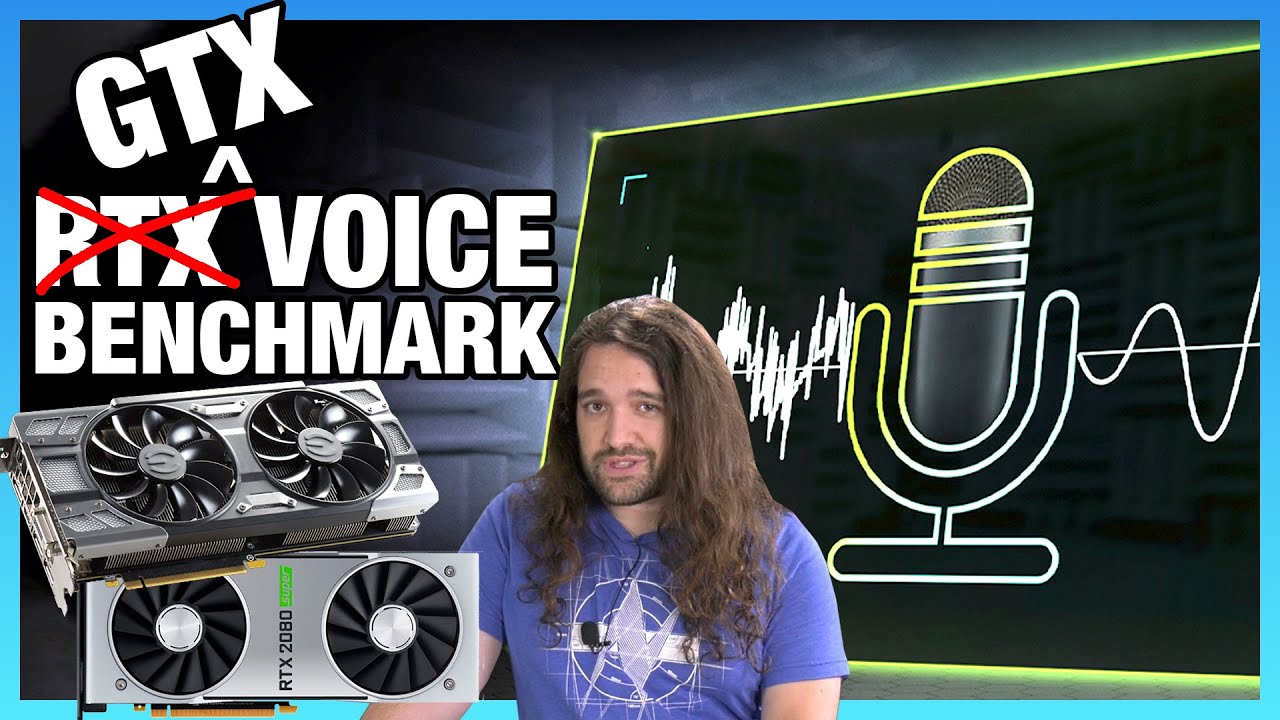
NVIDIA RTX Voice Benchmark on GTX vs. RTX GPUs, Gaming Performance, & Voice Quality
video description
Date: 2020-05-06
Related videos



Comments and reviews: 10
Luteloots
Interesting findings. I wonder how different the results are with various forms of sound and if the various forms of speech input that you DO want to go through. Myself and a friend both have this installed running on 1080TIs and seem to be having MUCH better results with the actual audio filtering and lack of distortion for our speech itself. A big thing I've personally found that it seems useful with is how well it seems to filter out noises aside speech from even registering in a voice chat (Discord) despite using voice detection rather than a push to talk key. For example using the same headset as used in this test case RTX voice near perfectly filters out any keyboard sound from my mechanical keyboard which is otherwise extremely noticeable and I've also found that it can filter out eating and chewing even chips or such with the microphone active right in your face outside of very intentionally trying to do so with your mouth open and as loud as possible. It also (unfortunately) is quite good at filtering out my cat meowing for what that's worth. One note however is that when gaming I rarely push my GPU anywhere close to as hard as possible which means I'm not noticing the performance hit AND this might mean RTX voice is being allowed to use more GPU power than it would otherwise under max loud from gaming applications. That might be attributing to the lack of robotic artifacting that was clearly noticeable in the 1080 test in the video. Seems like currently RTX voice might be a much more compelling option for those that aren't already pushing their GPU to the limit, a potential use case where using benchmarks for the tests might not show. I'd honestly be curious if there's a noticeable difference in the performance hit between the 1080 and 1080 ti, possibly due to faster memory or such allowing the voice processing to work more efficiently. Beyond that I'd be quite curious how a 1080ti would compare to a RTX 2060 super in terms of performance hit from RTX voice considering their standard gaming performance in comparison.
reply
Interesting findings. I wonder how different the results are with various forms of sound and if the various forms of speech input that you DO want to go through. Myself and a friend both have this installed running on 1080TIs and seem to be having MUCH better results with the actual audio filtering and lack of distortion for our speech itself. A big thing I've personally found that it seems useful with is how well it seems to filter out noises aside speech from even registering in a voice chat (Discord) despite using voice detection rather than a push to talk key. For example using the same headset as used in this test case RTX voice near perfectly filters out any keyboard sound from my mechanical keyboard which is otherwise extremely noticeable and I've also found that it can filter out eating and chewing even chips or such with the microphone active right in your face outside of very intentionally trying to do so with your mouth open and as loud as possible. It also (unfortunately) is quite good at filtering out my cat meowing for what that's worth. One note however is that when gaming I rarely push my GPU anywhere close to as hard as possible which means I'm not noticing the performance hit AND this might mean RTX voice is being allowed to use more GPU power than it would otherwise under max loud from gaming applications. That might be attributing to the lack of robotic artifacting that was clearly noticeable in the 1080 test in the video. Seems like currently RTX voice might be a much more compelling option for those that aren't already pushing their GPU to the limit, a potential use case where using benchmarks for the tests might not show. I'd honestly be curious if there's a noticeable difference in the performance hit between the 1080 and 1080 ti, possibly due to faster memory or such allowing the voice processing to work more efficiently. Beyond that I'd be quite curious how a 1080ti would compare to a RTX 2060 super in terms of performance hit from RTX voice considering their standard gaming performance in comparison.
reply
Daniel
I don't find the issue to be that RTX performs better than GTX or think that Nvidia held back GTX performance. But, they did name this software RTX and they said it used the RTX cores to do the work indicating they were necessary. On top of that they locked out GTX cards with a simple software check. That smells like old Nvidia for sure who used to lock SW features that could be supported by all cards to specific cards, locked PhysX from running on AMD cards and then even locked PhysX from running on Nvidia cards if an AMD card was used in the system. Nvidia has created something cool. But intend of doing that, getting great PR and looking awesome they once again screw it up. Exactly why only they know, but the optics of it given their history gives the impression of trying to make people believe it could only be achieved by their new shiny RTX cards. People were less than impressed by RTX given its high price and very limited use and Nvidia do everything to make it look like they, even artificially, try to do everything they can to make it look like something needed even when its not. They could have handled this so much better and been seen as cool guys releasing something awesome instead of clouding it in this.
reply
I don't find the issue to be that RTX performs better than GTX or think that Nvidia held back GTX performance. But, they did name this software RTX and they said it used the RTX cores to do the work indicating they were necessary. On top of that they locked out GTX cards with a simple software check. That smells like old Nvidia for sure who used to lock SW features that could be supported by all cards to specific cards, locked PhysX from running on AMD cards and then even locked PhysX from running on Nvidia cards if an AMD card was used in the system. Nvidia has created something cool. But intend of doing that, getting great PR and looking awesome they once again screw it up. Exactly why only they know, but the optics of it given their history gives the impression of trying to make people believe it could only be achieved by their new shiny RTX cards. People were less than impressed by RTX given its high price and very limited use and Nvidia do everything to make it look like they, even artificially, try to do everything they can to make it look like something needed even when its not. They could have handled this so much better and been seen as cool guys releasing something awesome instead of clouding it in this.
reply
Dylan
There is actually scope for the gtx cards to perform worse, just by math. The numbers being multiplied here are 16 bits as they fit Into tensor cores, so they are probably being treated as 16 bits on gtx too (if they were 32 the performance delta would be much higher) But 16bit tensor calculations are substantially more accurate than the equivalent 16 bit calculations done individually- there's much less rounding, sometimes none at all Tensor cores do something akin to 1. 1 1. 1=1. 21=1. 10 1. 10=/=1. 2 (It never rounds intermediate results and not the output if you want) Tensor cores give the same results as pretending that those 16 bit numbers are really 32 bit numbers and doing the calculations entirely in 32 bits, which is going to produce vastly different results than performing the calculation entirely In 16 bit. The difference could be several bits of error, and when you only have 10 bits of precision, that could really be noticeable. It might not be noticeable under a lot of conditions, but appear once you really push it like you did. If I'm right, then it's not just an optimisation issue and can't really be fixed. Running the entire calculation as 32 bit might solve the issue, but tank the performance: /
reply
There is actually scope for the gtx cards to perform worse, just by math. The numbers being multiplied here are 16 bits as they fit Into tensor cores, so they are probably being treated as 16 bits on gtx too (if they were 32 the performance delta would be much higher) But 16bit tensor calculations are substantially more accurate than the equivalent 16 bit calculations done individually- there's much less rounding, sometimes none at all Tensor cores do something akin to 1. 1 1. 1=1. 21=1. 10 1. 10=/=1. 2 (It never rounds intermediate results and not the output if you want) Tensor cores give the same results as pretending that those 16 bit numbers are really 32 bit numbers and doing the calculations entirely in 32 bits, which is going to produce vastly different results than performing the calculation entirely In 16 bit. The difference could be several bits of error, and when you only have 10 bits of precision, that could really be noticeable. It might not be noticeable under a lot of conditions, but appear once you really push it like you did. If I'm right, then it's not just an optimisation issue and can't really be fixed. Running the entire calculation as 32 bit might solve the issue, but tank the performance: /
reply
TheBackyardChemist
If I had to guess, the 10 series cards will be dropped, because proper support on pre-Turing (perhalps pre-Volta, something u could test on a Titan V) cards may possibly require further software workaround that could probably tank graphics performance. The issue is that Pascal GPUs cannot properly handle async compute, especially this kind of latency sensitive multi-program usage. Essentially when you run 3Dmark and CUDNN at the same time, Pascal cards are forced to alternate between running 3D and CUDA, flushing a lot of buffers, etc. This results in unpredictable execution latency of the CUDA kernel that processes the audio, but the sound card is of course operating at real-time by necessity, filling input buffers and emptying output buffers. If the rest of the software stack cannot keep up, and fails to fill the output buffer of the sound card in time (due to a CUDA latency spike, audio pops and glitches are guaranteed. Turing is much improved in this regard and finally has proper async compute, thus can handle running CUDA and 3D workloads at the same time much better. Please note that this is just a conjecture off the top of my head, some parts might be completely wrong.
reply
If I had to guess, the 10 series cards will be dropped, because proper support on pre-Turing (perhalps pre-Volta, something u could test on a Titan V) cards may possibly require further software workaround that could probably tank graphics performance. The issue is that Pascal GPUs cannot properly handle async compute, especially this kind of latency sensitive multi-program usage. Essentially when you run 3Dmark and CUDNN at the same time, Pascal cards are forced to alternate between running 3D and CUDA, flushing a lot of buffers, etc. This results in unpredictable execution latency of the CUDA kernel that processes the audio, but the sound card is of course operating at real-time by necessity, filling input buffers and emptying output buffers. If the rest of the software stack cannot keep up, and fails to fill the output buffer of the sound card in time (due to a CUDA latency spike, audio pops and glitches are guaranteed. Turing is much improved in this regard and finally has proper async compute, thus can handle running CUDA and 3D workloads at the same time much better. Please note that this is just a conjecture off the top of my head, some parts might be completely wrong.
reply
EerieEgg
I couldn't get RTX Voice to work with my Logitech Pro X headset Mic. I manually set the default output and input soun devices in Windows 10 (latest version with updates) to Nvidia RTX Voice then in the RTX Voice UI I set my headset Mic to the input and enabled suppression then set the output device in the RTX Voice UI to my headset. I made several recording with suppression ON vs OFF and made lots of background noise and it just didn't work -- it wasn't changing the input at all. I did get the Output suppression to work though, but really what you want is the input to get worked I think in general. Now, normally the pro x uses Blue Voice through logitech ghub but I disabled it and enabled it for these tests. I made a bug report and watched a couple tutorials to be extra sure I'd set everything up correctly, but it just would not work at all with my headset mic.
reply
I couldn't get RTX Voice to work with my Logitech Pro X headset Mic. I manually set the default output and input soun devices in Windows 10 (latest version with updates) to Nvidia RTX Voice then in the RTX Voice UI I set my headset Mic to the input and enabled suppression then set the output device in the RTX Voice UI to my headset. I made several recording with suppression ON vs OFF and made lots of background noise and it just didn't work -- it wasn't changing the input at all. I did get the Output suppression to work though, but really what you want is the input to get worked I think in general. Now, normally the pro x uses Blue Voice through logitech ghub but I disabled it and enabled it for these tests. I made a bug report and watched a couple tutorials to be extra sure I'd set everything up correctly, but it just would not work at all with my headset mic.
reply
TVwazhere
I noticed my 1080ti FTW3 initially was a bit buggy getting it enabled, sometimes enabling it made it constantly peaking at the tiniest amount of noise (just straight unusable noise looking at Audacity's wave graph) but going back to default and re-enabling it fixed it. I havent had any problems since (including the static noise surrounding voice in audio files heard in this video) I now have it working for discord, and after about an hour of game-play, it's learned my mechanical keyboard sounds and diminished those to not trigger Discord to transmit audio. Now I'll never be that guy in Discord again! Sadly many of my friends in my discord server have AMD cards so they cannot utilize this.
reply
I noticed my 1080ti FTW3 initially was a bit buggy getting it enabled, sometimes enabling it made it constantly peaking at the tiniest amount of noise (just straight unusable noise looking at Audacity's wave graph) but going back to default and re-enabling it fixed it. I havent had any problems since (including the static noise surrounding voice in audio files heard in this video) I now have it working for discord, and after about an hour of game-play, it's learned my mechanical keyboard sounds and diminished those to not trigger Discord to transmit audio. Now I'll never be that guy in Discord again! Sadly many of my friends in my discord server have AMD cards so they cannot utilize this.
reply
SkyeWolf
I'm curious, I'm using a GTX 1080 Strix A8G-gaming and I started using RTX Voice for about a week now and It's been perfect for me. Using a Wired Headset with Mic. Playing games like Star Citizen and Ark I don't really notice any performance hits, Even when using OBS while Dolby Atmos is also running. I haven't experienced any bugs either. It launches fine and exits fine. My room is rather noisy and my wife's tv is right next to me and it's rather loud but is blocked with no issues. Only one real noise get through and that's annoyingly loud parakeet. Who's chirps are super high pitch and don't get blocked at all.
reply
I'm curious, I'm using a GTX 1080 Strix A8G-gaming and I started using RTX Voice for about a week now and It's been perfect for me. Using a Wired Headset with Mic. Playing games like Star Citizen and Ark I don't really notice any performance hits, Even when using OBS while Dolby Atmos is also running. I haven't experienced any bugs either. It launches fine and exits fine. My room is rather noisy and my wife's tv is right next to me and it's rather loud but is blocked with no issues. Only one real noise get through and that's annoyingly loud parakeet. Who's chirps are super high pitch and don't get blocked at all.
reply
John
I've been running it since the internet went bananas over it. I've actually left it running non-stop for the last few days, and the only issue I've had with it cropped up today. I launched teamspeak (all voice processing settings in the client have been disabled) and discovered that my mic was transmitting nothing but static at a seemingly boosted volume anytime my mic picked up sound. The only reason I knew about it, is because I launched Audacity to check my audio quality to confirm if it was an issue with my end or theirs. A simple restart of RTX Voice fixed the issue. This is running on an RTX2070 Super btw.
reply
I've been running it since the internet went bananas over it. I've actually left it running non-stop for the last few days, and the only issue I've had with it cropped up today. I launched teamspeak (all voice processing settings in the client have been disabled) and discovered that my mic was transmitting nothing but static at a seemingly boosted volume anytime my mic picked up sound. The only reason I knew about it, is because I launched Audacity to check my audio quality to confirm if it was an issue with my end or theirs. A simple restart of RTX Voice fixed the issue. This is running on an RTX2070 Super btw.
reply
Sarmax
I got a dumb question: in theory you can run any IA simulations on any hardware. GPU core are just more suited for that task. So, if i just buy a spare gtx 1660 and put it as a second gpu with my 1080ti, could i run that RTX related technologies on it and hot it will run? Is a single 1660 less powerful in computing than those tensor cores in RTX cards? How it s possible if the 2080 super if just 10-20% more powerful that GTX 1080ti? I don t get it. it sounds like a scam to make us buy those expensive RTX cards.
reply
I got a dumb question: in theory you can run any IA simulations on any hardware. GPU core are just more suited for that task. So, if i just buy a spare gtx 1660 and put it as a second gpu with my 1080ti, could i run that RTX related technologies on it and hot it will run? Is a single 1660 less powerful in computing than those tensor cores in RTX cards? How it s possible if the 2080 super if just 10-20% more powerful that GTX 1080ti? I don t get it. it sounds like a scam to make us buy those expensive RTX cards.
reply
Jeffrey
Hey STEVE. to tell you the TRUTH. You should ask NVidia to consider using your digitized face as the ground truth for maximum handsomeness then test various RTX cards for how well they upscale Linus' face to match. Ideally there should be enough horsepower to get to the Wendel level of handsomeness in an RTX2080Ti but we need you to verify that if/when NVidia considers this suggestion. And if an RTX3080Ti can upscale all the way to Steve handsomeness then maybe I will Just Buy It!
reply
Hey STEVE. to tell you the TRUTH. You should ask NVidia to consider using your digitized face as the ground truth for maximum handsomeness then test various RTX cards for how well they upscale Linus' face to match. Ideally there should be enough horsepower to get to the Wendel level of handsomeness in an RTX2080Ti but we need you to verify that if/when NVidia considers this suggestion. And if an RTX3080Ti can upscale all the way to Steve handsomeness then maybe I will Just Buy It!
reply
Add a review, comment
Other channel videos