PPI is Imaginary! PPI vs DPI vs Resolution
video description
Date: 2022-07-19
Related videos


Comments and reviews: 20
ibjacked
Nah, PPI isn't imaginary, and digital pixels do have a size. They are the size of the LEDs. Some displays have big pixels, like maybe your car radio. Others have teeny tiny pixels, such as modern, high-end phones like the iPhone and Galaxy.
PPI and resolution are both measurements, but they measure different things. Resolution is the size of the grid (eg. 10x10, while PPI is the density of the grid. The higher the density, the more realistic the image can be, with fewer jaggies, smoother curves.
That's why when you view an original iPhone image on a desktop monitor, the image is huge (if viewing at 100%. It's the same resolution, but it went from the high-density (high-PPI) display of the iPhone to the low-density display.
reply
Nah, PPI isn't imaginary, and digital pixels do have a size. They are the size of the LEDs. Some displays have big pixels, like maybe your car radio. Others have teeny tiny pixels, such as modern, high-end phones like the iPhone and Galaxy.
PPI and resolution are both measurements, but they measure different things. Resolution is the size of the grid (eg. 10x10, while PPI is the density of the grid. The higher the density, the more realistic the image can be, with fewer jaggies, smoother curves.
That's why when you view an original iPhone image on a desktop monitor, the image is huge (if viewing at 100%. It's the same resolution, but it went from the high-density (high-PPI) display of the iPhone to the low-density display.
reply
Paul
I disagree a bit. PPI is not Imaginary, it is a relationship that we define. This relationship does not need a constant mathematic relationship to make it non-Imaginary. PPI is not something as a measurement (such as inches. It is a definition of how many pixels we want per inch in a physical world. That's it.
Also, pixels are a specific area within a monitor. Photoshop mimics what pixels are and allows you to zoom in and out in order to adjust digital art, but your monitor has a limited amount of PPI. It is something you can measure and is the smallest controllable element on your monitor.
reply
I disagree a bit. PPI is not Imaginary, it is a relationship that we define. This relationship does not need a constant mathematic relationship to make it non-Imaginary. PPI is not something as a measurement (such as inches. It is a definition of how many pixels we want per inch in a physical world. That's it.
Also, pixels are a specific area within a monitor. Photoshop mimics what pixels are and allows you to zoom in and out in order to adjust digital art, but your monitor has a limited amount of PPI. It is something you can measure and is the smallest controllable element on your monitor.
reply
Cainz
umm actually. ppi does make sense in the case where the monitors dimentions are used in the equasion. so for instance you want to trace from your phone a picture. but you want/need it to be the same size as the one your friend traced from hes phone(on to paper for example. Thats where ppi along with monitor dimentions can give the exact same scale regardless if the device is 5 inces or 32 inches
this has come up in web dev but i imagine it comes up in CAD projects aswell. sadly cant speak for that since i have not collaborated many CAD projects
reply
umm actually. ppi does make sense in the case where the monitors dimentions are used in the equasion. so for instance you want to trace from your phone a picture. but you want/need it to be the same size as the one your friend traced from hes phone(on to paper for example. Thats where ppi along with monitor dimentions can give the exact same scale regardless if the device is 5 inces or 32 inches
this has come up in web dev but i imagine it comes up in CAD projects aswell. sadly cant speak for that since i have not collaborated many CAD projects
reply
John
PPI is extremely useful when digitizing items for archival purposes. Its analogous to the sampling rate when digitizing analog audio. For example, audio is typically sampled at 44. 1 kHz or 44, 100 samples per second, something youd want to know. When digitizing 35mm film, I want to know whether I am getting at least 3, 500 pixels per inch. When digitizing original artwork, I want to know whether I am getting at least 300 pixels per inch. It is important from the perspective of creating future proof digital archives, with no print size in mind.
reply
PPI is extremely useful when digitizing items for archival purposes. Its analogous to the sampling rate when digitizing analog audio. For example, audio is typically sampled at 44. 1 kHz or 44, 100 samples per second, something youd want to know. When digitizing 35mm film, I want to know whether I am getting at least 3, 500 pixels per inch. When digitizing original artwork, I want to know whether I am getting at least 300 pixels per inch. It is important from the perspective of creating future proof digital archives, with no print size in mind.
reply
DragonManZ710
From my own tests I'd say although visually to our eyes there might not be much of a difference when changing a 300 ppi image to 72 ppi it is good to avoid doing this unless you are 100% sure the photo will not be printed, this is as when increasing the ppi of an image it actually just means that where there was 1 ppi, it will now have approximately 4. 2 ppi of the exact same colour.
Reducing the ppi of an image should only be done if u are wanting a purely digital copy of that image.
reply
From my own tests I'd say although visually to our eyes there might not be much of a difference when changing a 300 ppi image to 72 ppi it is good to avoid doing this unless you are 100% sure the photo will not be printed, this is as when increasing the ppi of an image it actually just means that where there was 1 ppi, it will now have approximately 4. 2 ppi of the exact same colour.
Reducing the ppi of an image should only be done if u are wanting a purely digital copy of that image.
reply
KOSM0S
Thank you for explaining this. I feel like I've been explaining this to people for 20 years when they talk about PPI incoherently. I feel like at some point this was explained to people incorrectly, and it was never 'corrected' for them. Asking for a 300 dpi image when i send them a 72 dpi image. because they wanted a higher resolution - but the funny part is, they weren't printing it. they were asking for the wrong thing! they just wanted more pixels in the end.
reply
Thank you for explaining this. I feel like I've been explaining this to people for 20 years when they talk about PPI incoherently. I feel like at some point this was explained to people incorrectly, and it was never 'corrected' for them. Asking for a 300 dpi image when i send them a 72 dpi image. because they wanted a higher resolution - but the funny part is, they weren't printing it. they were asking for the wrong thing! they just wanted more pixels in the end.
reply
Katharina
DPI is for printing, as far as I know, and pixels is digital. I have asked a printer, and they told me that it's no use sending something in pixels this and that if they don't get a size to, and then they can tell you if the image is of a quality that is suitable or not. 150 dpi images (in the size you set for the paper) for newspapers, 300 for regular print and 600 and above for finer quality.
reply
DPI is for printing, as far as I know, and pixels is digital. I have asked a printer, and they told me that it's no use sending something in pixels this and that if they don't get a size to, and then they can tell you if the image is of a quality that is suitable or not. 150 dpi images (in the size you set for the paper) for newspapers, 300 for regular print and 600 and above for finer quality.
reply
Chropoles
Awesome vid bruh!
As I remember it, usually 72ppi are good for web stuff/digital and 300ppi are for prints. I usually keep to 300ppi even though I'm just posting stuff digitally as you never know if you need it for print. Changes from 72 to 300 ppi may have a bad quality on the work so by keeping it 300 you don't have to redo the work for a higher ppi.
reply
Awesome vid bruh!
As I remember it, usually 72ppi are good for web stuff/digital and 300ppi are for prints. I usually keep to 300ppi even though I'm just posting stuff digitally as you never know if you need it for print. Changes from 72 to 300 ppi may have a bad quality on the work so by keeping it 300 you don't have to redo the work for a higher ppi.
reply
Kai
yeah ppi is meant for physical measurements, like the first pixels, real ones, LEDS on screens, because you could have a screen that is 20inch by 20inch and has a resolution of 1000 by 1000, if you take that same resolution and put it on a smaller screen say 1 inch by 1 inch then the physical pixels on the screen are smaller, yet the resolution stays the same.
reply
yeah ppi is meant for physical measurements, like the first pixels, real ones, LEDS on screens, because you could have a screen that is 20inch by 20inch and has a resolution of 1000 by 1000, if you take that same resolution and put it on a smaller screen say 1 inch by 1 inch then the physical pixels on the screen are smaller, yet the resolution stays the same.
reply
MekPriest
So the entire 2 sentence long premise of this video is 'ppi is completely imaginary, all pixels are the same ignore this setting, you only have to focus on DPI. Unless you are printing, which is the entire purpose of ppi so the last 8 minutes ive been lying to you'. why is the video so long, overly hyperbolic and mansplaned?
reply
So the entire 2 sentence long premise of this video is 'ppi is completely imaginary, all pixels are the same ignore this setting, you only have to focus on DPI. Unless you are printing, which is the entire purpose of ppi so the last 8 minutes ive been lying to you'. why is the video so long, overly hyperbolic and mansplaned?
reply
Kalle
Coming from a hardware perspective PPI makes a lot of sense, if you stare close at your phone you cant see the pixels, but on a monitor you can because the phone has a higher PPI, flagship phones are in the range 400-600 ppi and thats what makes you not see the pixels, but as you say, in software it doesnt matter at all
reply
Coming from a hardware perspective PPI makes a lot of sense, if you stare close at your phone you cant see the pixels, but on a monitor you can because the phone has a higher PPI, flagship phones are in the range 400-600 ppi and thats what makes you not see the pixels, but as you say, in software it doesnt matter at all
reply
Adrian
I love this video, I'm going to use it every time I have to explain this concept (DPI is not digital so it does not matter what DPI you use for a 1080 x 1920 image - what does matter is the image is 1080 x 1920 pixels) I can't believe I have to explain this over and over to people who can't comprehend this.
reply
I love this video, I'm going to use it every time I have to explain this concept (DPI is not digital so it does not matter what DPI you use for a 1080 x 1920 image - what does matter is the image is 1080 x 1920 pixels) I can't believe I have to explain this over and over to people who can't comprehend this.
reply
kakman1958
This is a great video and the first description of a 1000px x 1000px square illustrates it perfectly. It's somewhat counter-intuitive, but it would be nice if people could just start using pixels as the dimensions for their images then they don't have to worry about resolution unless going to print.
reply
This is a great video and the first description of a 1000px x 1000px square illustrates it perfectly. It's somewhat counter-intuitive, but it would be nice if people could just start using pixels as the dimensions for their images then they don't have to worry about resolution unless going to print.
reply
Ofer
Sorry mate. You missed the point of pixels vs. dots. The computer screen shows pixels, the printer prints dots of ink. Also, the term PPI (for example a computer screen might be 96 PPI, it means pixels per square inch. Horizontal and vertical density are usually the same.
reply
Sorry mate. You missed the point of pixels vs. dots. The computer screen shows pixels, the printer prints dots of ink. Also, the term PPI (for example a computer screen might be 96 PPI, it means pixels per square inch. Horizontal and vertical density are usually the same.
reply
Elnazorobi
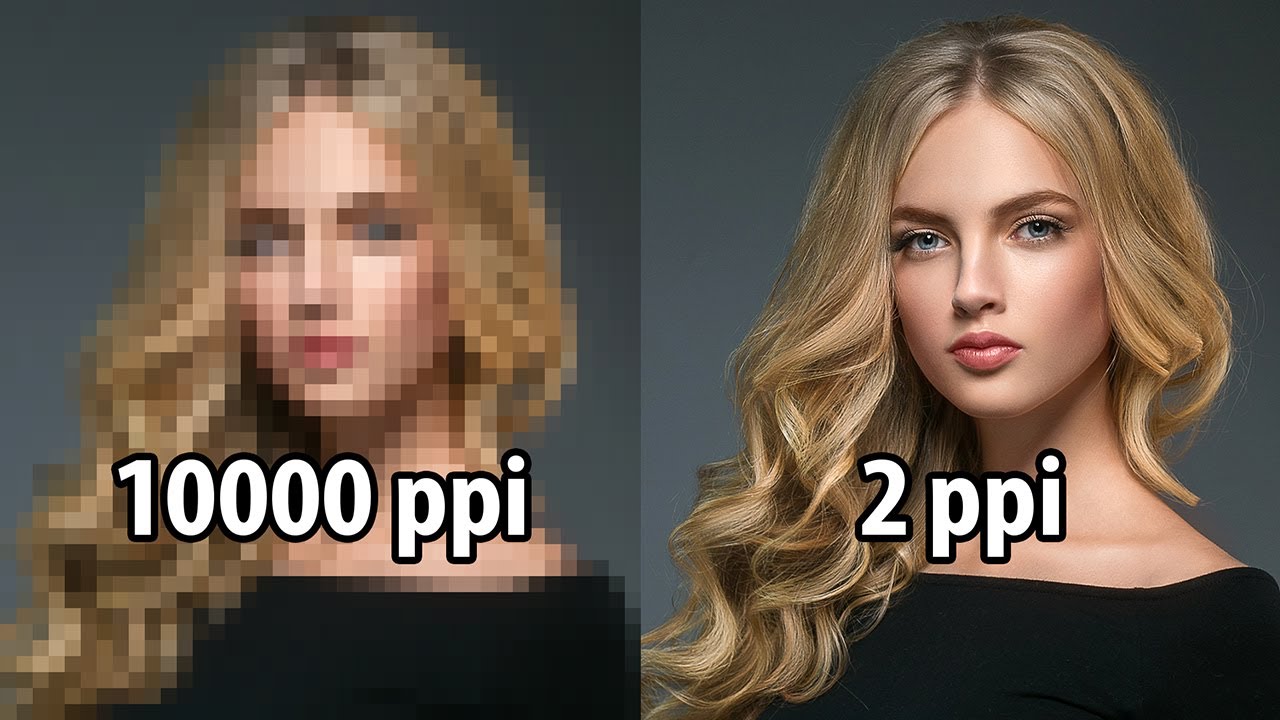
I still don't fully understand this concept, based on the image calculation you did about 10000ppi not being clear and 2ppi being clear and sharp, my question now is what resolution is best to export with after editing a picture for screen purpose? Thanks
reply
I still don't fully understand this concept, based on the image calculation you did about 10000ppi not being clear and 2ppi being clear and sharp, my question now is what resolution is best to export with after editing a picture for screen purpose? Thanks
reply
Kernow
Good explanation. I had a 3m wide landscape banner printed a few years. The printer kept on whittering about DPI not being high enough. The pci was taken with a 36mp Nikon full frame SLR. I still go him to print it, and it was very good and detailed.
reply
Good explanation. I had a 3m wide landscape banner printed a few years. The printer kept on whittering about DPI not being high enough. The pci was taken with a 36mp Nikon full frame SLR. I still go him to print it, and it was very good and detailed.
reply
yauck1
A bit misleading: should've said the disclaimer about PPI would make sense under this condition. Saying it doesn't make sense and then reveal the condition much later could give wrong ideas to viewers who didn't watch the whole video.
reply
A bit misleading: should've said the disclaimer about PPI would make sense under this condition. Saying it doesn't make sense and then reveal the condition much later could give wrong ideas to viewers who didn't watch the whole video.
reply
James
While I understand your premise, every unit of measurement, in fact every human construct, is imaginary, and is simply a standard humanity has collectively chosen as a unit of reference. Interesting and informative video. Thank you.
reply
While I understand your premise, every unit of measurement, in fact every human construct, is imaginary, and is simply a standard humanity has collectively chosen as a unit of reference. Interesting and informative video. Thank you.
reply
RedRisotto
70% of the people commenting are more confused than ever. Just explain it as dots printed in physical media/screen resolution/image resolution. Everything starts with the image resolution (n) pixels x (n) pixels.
reply
70% of the people commenting are more confused than ever. Just explain it as dots printed in physical media/screen resolution/image resolution. Everything starts with the image resolution (n) pixels x (n) pixels.
reply
oldproji
The difference between ppi and dpi can best be understood like this. Ppi is a digital input resolution and dpi is an output resolution, or dots printed per square inch. from a physical printer. That's it really.
reply
The difference between ppi and dpi can best be understood like this. Ppi is a digital input resolution and dpi is an output resolution, or dots printed per square inch. from a physical printer. That's it really.
reply
Add a review, comment
Other channel videos