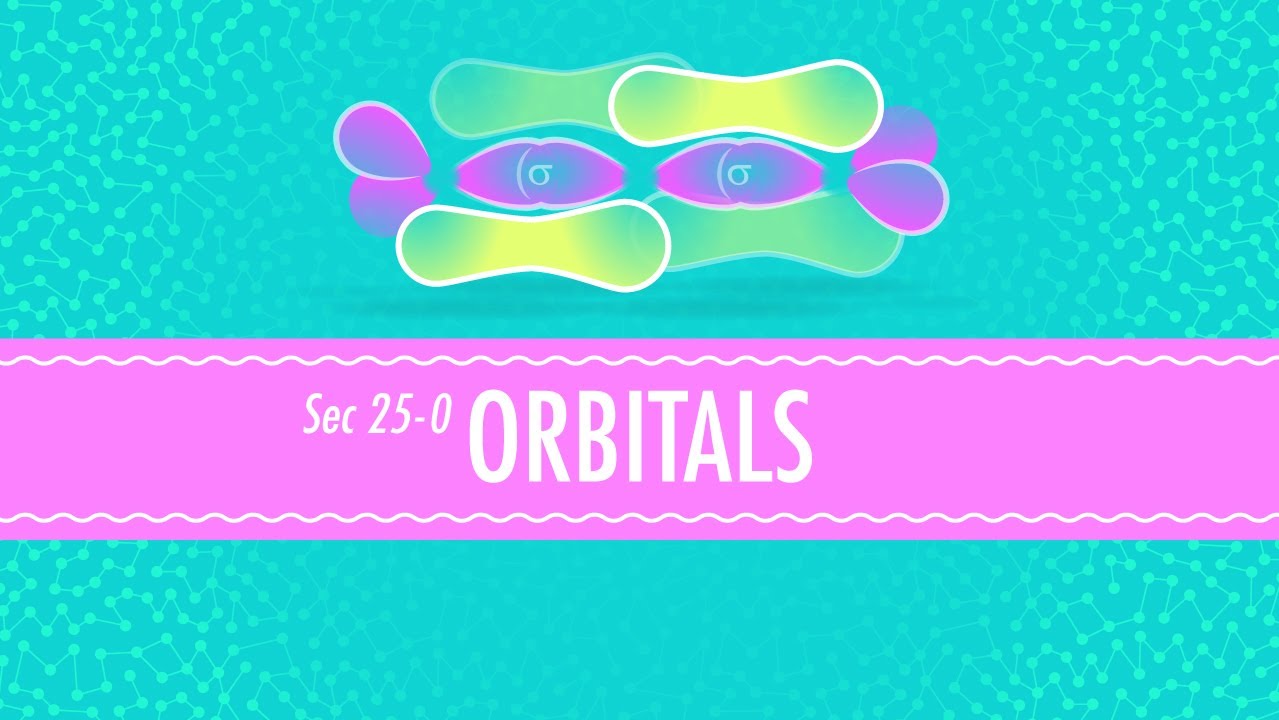
Orbitals: Crash Course Chemistry #25
video description
Date: 2022-04-04
Related videos





Comments and reviews: 10
Excaliburhead
There's good information here, but I don't like the style of this and other instructional series in which the speakers speak unnaturally fast with few if any pauses. Do you know anyone who talks like this in real life? If so, do they come with a Pause button? After a couple of minutes of this type of video, I start tuning out due to all the unnaturally fast yackety-yack. -
Why don't the lecturers use a normal human pace with normal, well-placed pauses to allow for better absorption of material? I realize there are many people who think faster than I do, but I don't think I'm particularly slow, either. With complex concepts like quantum wave functions, etc, a little time is usually required for the student to absorb the ideas. -
Instead, the videos end up looking more like tours-de-force intended to highlight the brilliance of the lecturer. They don't seem as interested in actually teaching the subject effectively.
reply
There's good information here, but I don't like the style of this and other instructional series in which the speakers speak unnaturally fast with few if any pauses. Do you know anyone who talks like this in real life? If so, do they come with a Pause button? After a couple of minutes of this type of video, I start tuning out due to all the unnaturally fast yackety-yack. -
Why don't the lecturers use a normal human pace with normal, well-placed pauses to allow for better absorption of material? I realize there are many people who think faster than I do, but I don't think I'm particularly slow, either. With complex concepts like quantum wave functions, etc, a little time is usually required for the student to absorb the ideas. -
Instead, the videos end up looking more like tours-de-force intended to highlight the brilliance of the lecturer. They don't seem as interested in actually teaching the subject effectively.
reply
Omar
it is nice I think. I dont know if it is a great video or not to be honest. I remember the first time I learnt about orbitals my mind had so many questions. I guess it cant be truly understood without extensive studying and thinking. Most of my non-chemist friends hate chemistry and just wanna pass the damn tests. Hence, most people dont understand orbitals very well I would say.
I particularly hate hybridization theory, like my first professor taught me; I find it particularly useful in organic chemistry but quite misleading in inorganic chemistry.
reply
it is nice I think. I dont know if it is a great video or not to be honest. I remember the first time I learnt about orbitals my mind had so many questions. I guess it cant be truly understood without extensive studying and thinking. Most of my non-chemist friends hate chemistry and just wanna pass the damn tests. Hence, most people dont understand orbitals very well I would say.
I particularly hate hybridization theory, like my first professor taught me; I find it particularly useful in organic chemistry but quite misleading in inorganic chemistry.
reply
Solutions
-Electron Orbitals behavior is based on Quantum Mechanic Three Dimensional Wave Functions probablistic distribution of Electrons in Space, -
I'm so saying that next time I get asked.
Now I'm going do a Level III diagnostic on the Argus Array.
reply
-Electron Orbitals behavior is based on Quantum Mechanic Three Dimensional Wave Functions probablistic distribution of Electrons in Space, -
I'm so saying that next time I get asked.
Now I'm going do a Level III diagnostic on the Argus Array.
reply
hang
0: 54 so, assuming one measures the location of said electrons, what would it look like without the haze? (this question makes no sense upon proof reading, so you may have to reread to get what I'm asking exactly)
reply
0: 54 so, assuming one measures the location of said electrons, what would it look like without the haze? (this question makes no sense upon proof reading, so you may have to reread to get what I'm asking exactly)
reply
Ryan
My lecturer showed us his working using mathematica and showed how orbitals change when we change quantum numbers. So knowing that, I doubt you could understand any behaviour of these orbitals without the math.
reply
My lecturer showed us his working using mathematica and showed how orbitals change when we change quantum numbers. So knowing that, I doubt you could understand any behaviour of these orbitals without the math.
reply
-----
Yes, I'm just trying to pass a test. (Thanks for the video, I mean it, really-)
Someone tell my A-levels chemistry teacher the drawing everything on whiteboard does not work at all please- XD
reply
Yes, I'm just trying to pass a test. (Thanks for the video, I mean it, really-)
Someone tell my A-levels chemistry teacher the drawing everything on whiteboard does not work at all please- XD
reply
Luke
Why wouldn't all the bonds all be different diameter spheres? Wouldn't that use less energy? Is there an equation that generates each orbital? What are the factors in that equation?
reply
Why wouldn't all the bonds all be different diameter spheres? Wouldn't that use less energy? Is there an equation that generates each orbital? What are the factors in that equation?
reply
Suze
25k likes yet few of those people understand wavefunctions from this video, understand standing waves, but how the hell they make these patterns is hard to imagine.
reply
25k likes yet few of those people understand wavefunctions from this video, understand standing waves, but how the hell they make these patterns is hard to imagine.
reply
gaurav
Catchy graphics and overdone monologues don't make great learning videos. To all teachers at PBS - you are not supposed to do a stand-up.
reply
Catchy graphics and overdone monologues don't make great learning videos. To all teachers at PBS - you are not supposed to do a stand-up.
reply
Miguel
Water isnt completely asymetric, but it dont holds an equal distribution of charge due to the distinct electronegativity.
reply
Water isnt completely asymetric, but it dont holds an equal distribution of charge due to the distinct electronegativity.
reply
Add a review, comment
Other channel videos