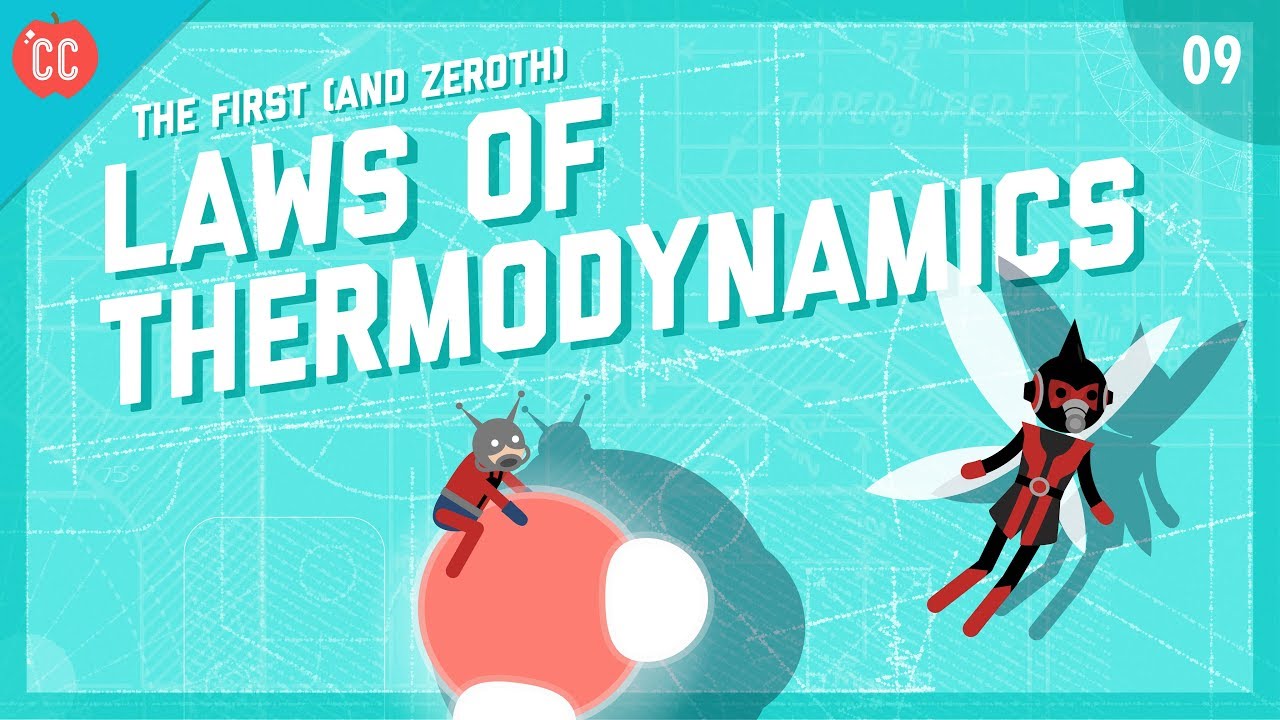
The First & Zeroth Laws of Thermodynamics: Crash Course Engineering #9
video description
Date: 2022-04-04
Related videos





Comments and reviews: 9
Luis
First, we need to focus in the zeroth law, that represents the thermal equilibrium between objects those are sharing their heat one each other, and when other object with different temperature comes to the system, the other objects give o receive the heat to the other object, until the system stay in thermal equilibrium.
The first Thermodynamic's law talks about the way that the heat and the work (both, types of transition's energy) mixed to be named intern energy, another variable in Thermodynamics. This law is based in the conservation energy's principle.
Alejandro Ventura UP170146
reply
First, we need to focus in the zeroth law, that represents the thermal equilibrium between objects those are sharing their heat one each other, and when other object with different temperature comes to the system, the other objects give o receive the heat to the other object, until the system stay in thermal equilibrium.
The first Thermodynamic's law talks about the way that the heat and the work (both, types of transition's energy) mixed to be named intern energy, another variable in Thermodynamics. This law is based in the conservation energy's principle.
Alejandro Ventura UP170146
reply
CrashCourse
Note from our Content Consultant: Different branches of engineering sometimes define the first law of thermodynamics differently, depending on how work is defined. Essentially, work released from a system might be defined as a positive value or a negative value, and thus the first law can be defined as either Q-W or Q+W. Both are acceptable forms, depending on how the system is defined! We chose to focus on only one definition here to limit the confusion.
reply
Note from our Content Consultant: Different branches of engineering sometimes define the first law of thermodynamics differently, depending on how work is defined. Essentially, work released from a system might be defined as a positive value or a negative value, and thus the first law can be defined as either Q-W or Q+W. Both are acceptable forms, depending on how the system is defined! We chose to focus on only one definition here to limit the confusion.
reply
Luz
Excellent video to remember the basic concepts of thermodynamics, the relationship between open and closed systems, as well as the considerations that must be made with each of them. For a person who doesn't live with calculations that involve this branch of science, it seems a good tool to start learning. The graphics seemed right to me, especially when he explained the kinetic energy with the Star Wars character.
reply
Excellent video to remember the basic concepts of thermodynamics, the relationship between open and closed systems, as well as the considerations that must be made with each of them. For a person who doesn't live with calculations that involve this branch of science, it seems a good tool to start learning. The graphics seemed right to me, especially when he explained the kinetic energy with the Star Wars character.
reply
Tadeo
adolfo tadeo huerta garcia, up170690, ene04a, ing. energia. universidad politecnica de aguascalientes. termodyanmics describes how thermal energy is converted to and from other forms of energy. it is one of the main focuses of engineering. because engineer need to know how much heat or work they will get out of an engine if they put energy into it.
reply
adolfo tadeo huerta garcia, up170690, ene04a, ing. energia. universidad politecnica de aguascalientes. termodyanmics describes how thermal energy is converted to and from other forms of energy. it is one of the main focuses of engineering. because engineer need to know how much heat or work they will get out of an engine if they put energy into it.
reply
Pedro
Well, the video is about to characteristics, explain about to the equilibrium the fluid try to be in the same temperature, explain the first law, explain the tipes of kinetic energy for example the translational, rotational, vibrational. Explain the heat formula and variants of that
Pedro Antonio Reyes Cruz.
ENE04A
UP170498
reply
Well, the video is about to characteristics, explain about to the equilibrium the fluid try to be in the same temperature, explain the first law, explain the tipes of kinetic energy for example the translational, rotational, vibrational. Explain the heat formula and variants of that
Pedro Antonio Reyes Cruz.
ENE04A
UP170498
reply
Nadia
I know about thermodynamics is that it obviously has to do with energy, heat and work.
The study of thermodynamic is very important to understand the process of when energy is transformed un to another and with it we can improve the efficiency to lose less energy in the from of heat
Alejandra Mascorro UP170565
ENE04A
reply
I know about thermodynamics is that it obviously has to do with energy, heat and work.
The study of thermodynamic is very important to understand the process of when energy is transformed un to another and with it we can improve the efficiency to lose less energy in the from of heat
Alejandra Mascorro UP170565
ENE04A
reply
Aldo
This is an excellent introductory video to thermodynamics because it very simply explains things that, theoretically reading them, are a bit complex, but the girl no comment that the thermodynamics only work in a especifica moment of the time ( It worked with straight lines.
reply
This is an excellent introductory video to thermodynamics because it very simply explains things that, theoretically reading them, are a bit complex, but the girl no comment that the thermodynamics only work in a especifica moment of the time ( It worked with straight lines.
reply
ChillsAhoy
I've seen a few cases of the Zeroth Law of, in areas where a more fundamental law was discovered some time after the first law. What happens if, further down the line, you find an even more fundamental law?
reply
I've seen a few cases of the Zeroth Law of, in areas where a more fundamental law was discovered some time after the first law. What happens if, further down the line, you find an even more fundamental law?
reply
X4rrr
aren't all forms of energy ultimately kinetic in some way: light has to move, chemicals have to move, electrons have to move, quarks have to move. -things- need to move and interact basically?
reply
aren't all forms of energy ultimately kinetic in some way: light has to move, chemicals have to move, electrons have to move, quarks have to move. -things- need to move and interact basically?
reply
Add a review, comment
Other channel videos