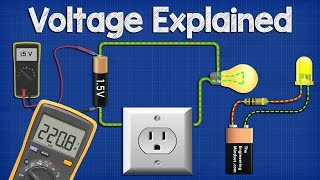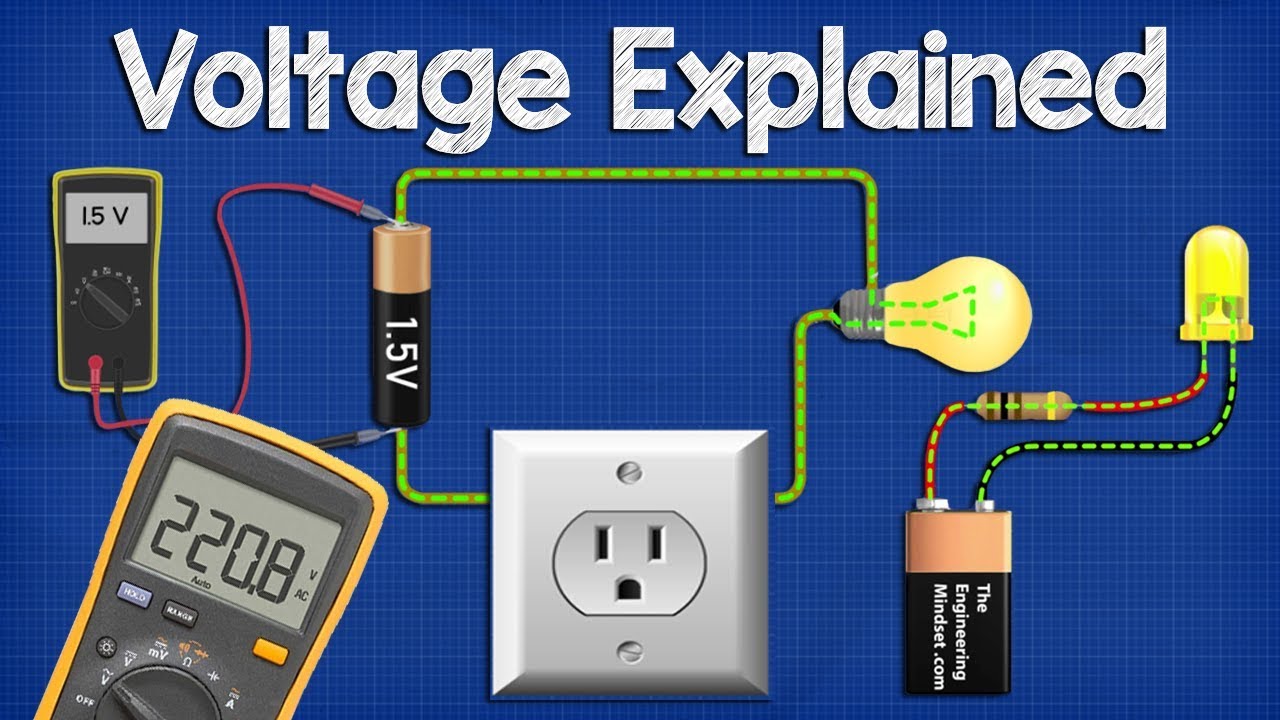
Voltage Explained - What is Voltage? Basic electricity potential difference
video description
Date: 2023-11-17
Related videos




Comments and reviews: 19
Josh
I would say that voltage and volts aren't all that different- I know it's addressing the classical issue of young physics students mixing up what they're measuring with what units it's in, e. g. we could measure pressure in Bar- but we'd never say something is at 32 pressures. And we wouldn't really ask what's the Bar? to find out the pressure of something. or would we? I find it not so uncommon for people to use the units as a sort of synecdoche for what's being measured, like asking what's the PSI at? of a particular pressure chamber. And I think that's kind of what's been done to invent the term voltage. Because _technically, _ what's being measured is potential difference; that's not just another term for it, that's its real meaning. But I could be 100% wrong, for I am claiming no historical knowledge of how the terms developed, only of my experience with nomenclature.
reply
I would say that voltage and volts aren't all that different- I know it's addressing the classical issue of young physics students mixing up what they're measuring with what units it's in, e. g. we could measure pressure in Bar- but we'd never say something is at 32 pressures. And we wouldn't really ask what's the Bar? to find out the pressure of something. or would we? I find it not so uncommon for people to use the units as a sort of synecdoche for what's being measured, like asking what's the PSI at? of a particular pressure chamber. And I think that's kind of what's been done to invent the term voltage. Because _technically, _ what's being measured is potential difference; that's not just another term for it, that's its real meaning. But I could be 100% wrong, for I am claiming no historical knowledge of how the terms developed, only of my experience with nomenclature.
reply
Ian
At 6: 48 when explaining how certain components are rated for certain voltages, the resistor is placed in the path of the current flowing OUT of the component into the battery terminal. My intuition would have been to place the resistor in the path of the current flowing IN to the component in order to limit the current and prevent the component from being damaged. Can anyone explain the placement in the animation? Is the resistor acting on the entire circuit, in this case does placement of the resistor matter, once its in the circuit somewhere? Is the animation using conventional current representation but placing the resistor assuming the electron flow representation?
reply
At 6: 48 when explaining how certain components are rated for certain voltages, the resistor is placed in the path of the current flowing OUT of the component into the battery terminal. My intuition would have been to place the resistor in the path of the current flowing IN to the component in order to limit the current and prevent the component from being damaged. Can anyone explain the placement in the animation? Is the resistor acting on the entire circuit, in this case does placement of the resistor matter, once its in the circuit somewhere? Is the animation using conventional current representation but placing the resistor assuming the electron flow representation?
reply
Aimortality
I don't think parallel circuits lower voltage because of splitting. It lowers voltage because look at the end of the battery. Now the positive charge doesn't have a clean path to the negative charge. There are other positive charges from the other battery connected to it. fighting it. The craziness of parallel circuitry has bothered me my entire life until I looked at it that way. You are connecting a bunch of similarly charged things together. so it causes a traffic jam. like a resistor. which slows the discharge. This is so obvious.
reply
I don't think parallel circuits lower voltage because of splitting. It lowers voltage because look at the end of the battery. Now the positive charge doesn't have a clean path to the negative charge. There are other positive charges from the other battery connected to it. fighting it. The craziness of parallel circuitry has bothered me my entire life until I looked at it that way. You are connecting a bunch of similarly charged things together. so it causes a traffic jam. like a resistor. which slows the discharge. This is so obvious.
reply
Mike
HA! I get it! I now understand why the term potential difference is used. Whilst understanding how to apply and measure it, I never knew what it meant. Your videos are absolutely wonderful at explaining to someone who is just learning. Thank you so much, I appreciate all the hard work you have put into these.
reply
HA! I get it! I now understand why the term potential difference is used. Whilst understanding how to apply and measure it, I never knew what it meant. Your videos are absolutely wonderful at explaining to someone who is just learning. Thank you so much, I appreciate all the hard work you have put into these.
reply
ubada
good expain and understanble
but I have a question:
why we measure the difference potential to about 400v or 390V or so on in three lines circuit?
as long as every line have a potential and none of them is neutral
is it must be 0 instead of 400V?
reply
good expain and understanble
but I have a question:
why we measure the difference potential to about 400v or 390V or so on in three lines circuit?
as long as every line have a potential and none of them is neutral
is it must be 0 instead of 400V?
reply
Voltechs
Huzzah! Ive always struggled with keeping the concept of voltage (and current etc) in my brain regardless of analogies, but Im no dummy. Highly educated and a successful engineer, but always keep coming back to this stuff. Its slowly starting to stick!
reply
Huzzah! Ive always struggled with keeping the concept of voltage (and current etc) in my brain regardless of analogies, but Im no dummy. Highly educated and a successful engineer, but always keep coming back to this stuff. Its slowly starting to stick!
reply
Brandin8r
Man I suck at this.
I'm trying my hardest to understand electricity.
if you have a lamp that requires 1. 5 volts without resistance from a 1. 5 volt battery, would it only power the lamp for 1 second until the battery is depleted?
reply
Man I suck at this.
I'm trying my hardest to understand electricity.
if you have a lamp that requires 1. 5 volts without resistance from a 1. 5 volt battery, would it only power the lamp for 1 second until the battery is depleted?
reply
Mahima
using the pipe and water analogy how does the current flow from negative terminal to positive terminal in between the cells in a torch? If we assume the positive terminal to be at a certain greater height compared to the negative terminal.
reply
using the pipe and water analogy how does the current flow from negative terminal to positive terminal in between the cells in a torch? If we assume the positive terminal to be at a certain greater height compared to the negative terminal.
reply
Hodei
At 6: 30, if the coulombs are 0. 2, how come the electrons are 1. 8726 1018? It looks like it is dividing 6. 242 1018 (1 coulomb) by 3, but it should be dividing it by 5 (0. 2 coulomb) to get 1. 2484 1018 electrons, right?
reply
At 6: 30, if the coulombs are 0. 2, how come the electrons are 1. 8726 1018? It looks like it is dividing 6. 242 1018 (1 coulomb) by 3, but it should be dividing it by 5 (0. 2 coulomb) to get 1. 2484 1018 electrons, right?
reply
education
Been to technical school for 3 years, what I learned was only how to stole electricity from private own corp. Now did I only knew voltage was a force. Gonna be fnishing this playlist so much to remember
reply
Been to technical school for 3 years, what I learned was only how to stole electricity from private own corp. Now did I only knew voltage was a force. Gonna be fnishing this playlist so much to remember
reply
HEREST
Hi, Paul. I just wanna say many thanks.
Your videos help me to learn useful words for my engineering career (I'm not a native english speaker.
Obviously, I'll buy a coffee in paypal hehe.
reply
Hi, Paul. I just wanna say many thanks.
Your videos help me to learn useful words for my engineering career (I'm not a native english speaker.
Obviously, I'll buy a coffee in paypal hehe.
reply
Mahima
Another question I have is about the power dissipation. Electrical energy is being converted to light and heat energy, how can still the same electrical energy flows in the closed circuit?
reply
Another question I have is about the power dissipation. Electrical energy is being converted to light and heat energy, how can still the same electrical energy flows in the closed circuit?
reply
Ed
what made me finally understand them was thinking of it as gas in a tank. psi is the voltage and current can be thought as how much you open the valve.
reply
what made me finally understand them was thinking of it as gas in a tank. psi is the voltage and current can be thought as how much you open the valve.
reply
Jason
Hold on I just got it explained to me like the current flows from the positive side and ends at the negative but the picture has it going opposite?
reply
Hold on I just got it explained to me like the current flows from the positive side and ends at the negative but the picture has it going opposite?
reply
Jon
EngineeringMindset Pressure is misspelled in the definition of Volts 4: 35. Just thought you'd want to know. Great video. Thanks a ton of volts!
reply
EngineeringMindset Pressure is misspelled in the definition of Volts 4: 35. Just thought you'd want to know. Great video. Thanks a ton of volts!
reply
Luutas
9: 28 This map is wrong. We also use 220v here in Brazil. Only a very small percentage of brasil (4 states out of 26) use 110v
reply
9: 28 This map is wrong. We also use 220v here in Brazil. Only a very small percentage of brasil (4 states out of 26) use 110v
reply
Christopher
I'm having a hard time wrapping my head around how Volts are both _potential difference_ and _pressure_
reply
I'm having a hard time wrapping my head around how Volts are both _potential difference_ and _pressure_
reply
Sultan
I was trying to understand for a long time, today I understand volts and voltage after watching your video
reply
I was trying to understand for a long time, today I understand volts and voltage after watching your video
reply
Joe
I don't like the quintillion bazallion talk. I think they could have left that out without losing anything
reply
I don't like the quintillion bazallion talk. I think they could have left that out without losing anything
reply
Add a review, comment
Other channel videos