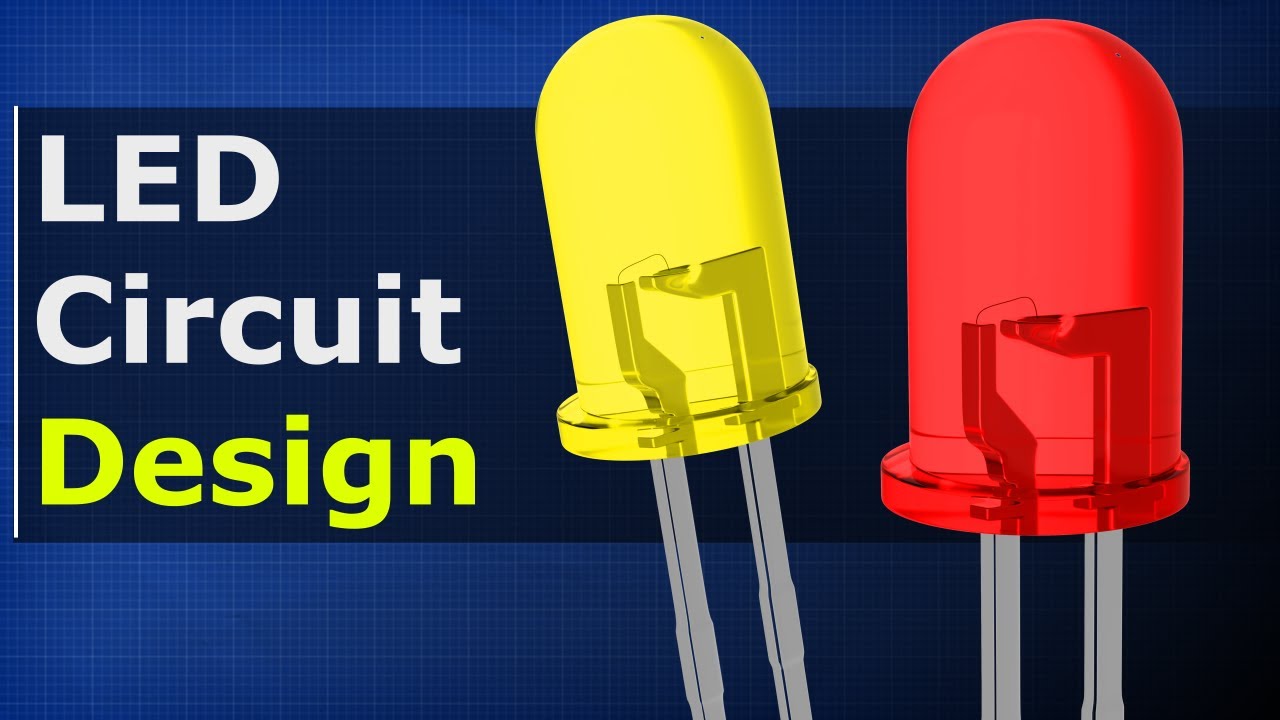
LED Circuit Design - How to design LED circuits
video description
Date: 2023-11-17
Related videos


Comments and reviews: 28
Douglas
Late to the party as usual. but.
There are many cases where you do not want the maximum brightness from an LED, especially with the super bright ones they're making today. For example a super bright Blue led used as a power indicator with 20 ma of current will be more akin to a flashlight than a power indicator. So the trick is to use less. often far less. than the usual maximum of 20ma.
It is important to understand that since an LED's on voltage is a fixed value, you're going to get some light out of it no matter what resistor you use. The on threshold will always be reached, it's just a question of how much current will flow.
In this case you would use the calculations above to determine the lowest value of resistor you can safely use. and then test higher values to set the brightness experimentally.
For example:
When used as power or data indicators, we typically just want a soft glow, not something that will light up a room, so I will typically use between 0. 5ma and 2ma of current. That is about 1/10th of the maximum, so I just multiply the resistor value by 10. If I calculate 350 ohms for 20ma, I will typically start with a 3. 5k resistor and may increase that as high as 10k to mute the brightness to an acceptable level.
It should also be noted that different colour leds can appear brighter or darker according to colour at the same currents. In this case you can use the resistor tuning trick above to brightness match them. Simply experiment with different value resistors to even them out. put a higher value on the brightest ones to match them to the darkest one.
Hope this helps.
reply
Late to the party as usual. but.
There are many cases where you do not want the maximum brightness from an LED, especially with the super bright ones they're making today. For example a super bright Blue led used as a power indicator with 20 ma of current will be more akin to a flashlight than a power indicator. So the trick is to use less. often far less. than the usual maximum of 20ma.
It is important to understand that since an LED's on voltage is a fixed value, you're going to get some light out of it no matter what resistor you use. The on threshold will always be reached, it's just a question of how much current will flow.
In this case you would use the calculations above to determine the lowest value of resistor you can safely use. and then test higher values to set the brightness experimentally.
For example:
When used as power or data indicators, we typically just want a soft glow, not something that will light up a room, so I will typically use between 0. 5ma and 2ma of current. That is about 1/10th of the maximum, so I just multiply the resistor value by 10. If I calculate 350 ohms for 20ma, I will typically start with a 3. 5k resistor and may increase that as high as 10k to mute the brightness to an acceptable level.
It should also be noted that different colour leds can appear brighter or darker according to colour at the same currents. In this case you can use the resistor tuning trick above to brightness match them. Simply experiment with different value resistors to even them out. put a higher value on the brightest ones to match them to the darkest one.
Hope this helps.
reply
Arno
Hi, thanks these are really understandable videos for newbies like me. I'm having a specific issue with LEDs. I'll work with 12V 1A power supply (Actually I'm planning to change it to 2A adapter. I'll have two parallel connections. I want to be able to power with batteries one of these two in order to be cable-free, they will not supply the circuit at the same time. So, I want to step down the voltage with regulator 12 to 5V. I'm planning to use Adjustable LM2596S Constant Current regulator to do so. But I'm having issues to understand how current moves in a circuit, what happens if I try to regulate it, when the first parallel wing doesn't work how my regulator take the current provided by main power supply, when voltage decrease current should increase? Regulator works with max 3A current, however, if I drop 12 to 5V, current will increase more? etc etc. Do you have any content or advise which let me understand what I'm trying to do and achieve so, even slightly? Thanks! :)
reply
Hi, thanks these are really understandable videos for newbies like me. I'm having a specific issue with LEDs. I'll work with 12V 1A power supply (Actually I'm planning to change it to 2A adapter. I'll have two parallel connections. I want to be able to power with batteries one of these two in order to be cable-free, they will not supply the circuit at the same time. So, I want to step down the voltage with regulator 12 to 5V. I'm planning to use Adjustable LM2596S Constant Current regulator to do so. But I'm having issues to understand how current moves in a circuit, what happens if I try to regulate it, when the first parallel wing doesn't work how my regulator take the current provided by main power supply, when voltage decrease current should increase? Regulator works with max 3A current, however, if I drop 12 to 5V, current will increase more? etc etc. Do you have any content or advise which let me understand what I'm trying to do and achieve so, even slightly? Thanks! :)
reply
James
I have an led that uses 12V. It already has a resistor from the seller. What is strange is if I put a 20K resistor in series it is a little dimmer but still works. And it works all the way down to 2V. So it runs at a really low current and voltage. And also runs at 14 volts with no added resistor. Of course it is brighter.
So maybe my point is there is no right resistor. It can be as bright as you like it, or as dim. As long as you don't burn it out.
reply
I have an led that uses 12V. It already has a resistor from the seller. What is strange is if I put a 20K resistor in series it is a little dimmer but still works. And it works all the way down to 2V. So it runs at a really low current and voltage. And also runs at 14 volts with no added resistor. Of course it is brighter.
So maybe my point is there is no right resistor. It can be as bright as you like it, or as dim. As long as you don't burn it out.
reply
john
Hi thanks very much for the videos you explain everything so well can you just give me an answer to this I have 90 2v leds in parallel and I need to switch then individual so that 1 2 or the 90 etc could they be on or off separately at any one time if so would I need to resist them individually or could I run the in sets of 5 or more on 1 resistor on each set I wont hold you responsible if I blow the house up thanks in anticipation regards john
reply
Hi thanks very much for the videos you explain everything so well can you just give me an answer to this I have 90 2v leds in parallel and I need to switch then individual so that 1 2 or the 90 etc could they be on or off separately at any one time if so would I need to resist them individually or could I run the in sets of 5 or more on 1 resistor on each set I wont hold you responsible if I blow the house up thanks in anticipation regards john
reply
Dave
Would anyone here know, I'm looking for a way to control the brightness of a single 1w LED in a microscope because I accidentally blew the control board it came with and the company doesn't sell the part. Would anyone have any ideas where I could get a control board that can control the brightness with a dial? Thanks!
reply
Would anyone here know, I'm looking for a way to control the brightness of a single 1w LED in a microscope because I accidentally blew the control board it came with and the company doesn't sell the part. Would anyone have any ideas where I could get a control board that can control the brightness with a dial? Thanks!
reply
Antonio
This is an excellent video! I had to buy a sweatshirt it was so good! NOTE: you do NOT have to look up a chart to remember the resistor numbers. All you have to do is remember the black (o) and the brown (1. After that, they follow the colors of the rainbow. Well, close enough. At least, that's how I do it. :!
reply
This is an excellent video! I had to buy a sweatshirt it was so good! NOTE: you do NOT have to look up a chart to remember the resistor numbers. All you have to do is remember the black (o) and the brown (1. After that, they follow the colors of the rainbow. Well, close enough. At least, that's how I do it. :!
reply
John
I don't get it. If an LED only allows current to flow in one direction, the positive wire, why would someone put the resistance on the negative wire? Wouldn't that negate the whole point of a resistance? The LED would take full current and die wouldn't it, since the resistance is after?
reply
I don't get it. If an LED only allows current to flow in one direction, the positive wire, why would someone put the resistance on the negative wire? Wouldn't that negate the whole point of a resistance? The LED would take full current and die wouldn't it, since the resistance is after?
reply
LassetUnsSpielen
great video but i remain with two dummy questions
1. if I use a 3 V power source, does that mean i need no resistors and can put as many 3V LED in parallel as I want?
2. can i power multiple light chains from the same source?
reply
great video but i remain with two dummy questions
1. if I use a 3 V power source, does that mean i need no resistors and can put as many 3V LED in parallel as I want?
2. can i power multiple light chains from the same source?
reply
Hseyin
Congratulations. you have worked very hard. this seems obvious. and it was a very detailed and flowing narration. It has been a resource that will be used for years. Not just coffee, I'll make you Turkish coffee after dinner.
reply
Congratulations. you have worked very hard. this seems obvious. and it was a very detailed and flowing narration. It has been a resource that will be used for years. Not just coffee, I'll make you Turkish coffee after dinner.
reply
Munawar
Thanks for another awesome video. Quick question. How do you know which is first stripe on the resistor? And what would be typical reasons for putting resistors in parallel other than using what you have in hand? Thanks
reply
Thanks for another awesome video. Quick question. How do you know which is first stripe on the resistor? And what would be typical reasons for putting resistors in parallel other than using what you have in hand? Thanks
reply
Kartono
Balik asal dulu radio tape ampli semua di lengkapi deretan lampu led berkedip sesuai irama! Sejak kerusuhan 98 hilang semua teknologi elektronik rumah tangga mundur 30thn! Menyedihkan!
reply
Balik asal dulu radio tape ampli semua di lengkapi deretan lampu led berkedip sesuai irama! Sejak kerusuhan 98 hilang semua teknologi elektronik rumah tangga mundur 30thn! Menyedihkan!
reply
Blue
Thank you so much, high schooler here, needed the video for a project ( a wind mill that produces electricity) instead of the battery will use a dc motor as a generator. Hoping it works
reply
Thank you so much, high schooler here, needed the video for a project ( a wind mill that produces electricity) instead of the battery will use a dc motor as a generator. Hoping it works
reply
Joh750
The video uses batteries providing input voltage. How can I use 120v outlets for input source? I have many adapters that provide 5v to 18v output but all are using 120v input.
reply
The video uses batteries providing input voltage. How can I use 120v outlets for input source? I have many adapters that provide 5v to 18v output but all are using 120v input.
reply
Nick
If I have a 5v power supply and LEDs with a forward voltage of 2. 5v, can I wire two in series and omit a resistor since the cumulative voltage is the same as my power supply?
reply
If I have a 5v power supply and LEDs with a forward voltage of 2. 5v, can I wire two in series and omit a resistor since the cumulative voltage is the same as my power supply?
reply
Jeff
So if I understand correctly. my circuit is powered by 12V and my LEDs wired in series have a total voltage drop of 12V. so I don't need any resistor, right?
reply
So if I understand correctly. my circuit is powered by 12V and my LEDs wired in series have a total voltage drop of 12V. so I don't need any resistor, right?
reply
dipi
Use single button cell, the type used in watches. No resistor needed. In correct direction LED will glow, in wrong nothing will happen. Easy way to test LED
reply
Use single button cell, the type used in watches. No resistor needed. In correct direction LED will glow, in wrong nothing will happen. Easy way to test LED
reply
joen7xxx
Is there a reason that circuits seem to favor switching the negative side of the led? I seem to see this much more than on the positive side.
reply
Is there a reason that circuits seem to favor switching the negative side of the led? I seem to see this much more than on the positive side.
reply
Arthur
1: 03 - Why would 72 milliwatts of power cause the resistor in your example to be over 150 degrees C? Something in your presentation is wrong.
reply
1: 03 - Why would 72 milliwatts of power cause the resistor in your example to be over 150 degrees C? Something in your presentation is wrong.
reply
PBS
You seriously have the electron flowing from positive to negative. why? The electrons are stored inside the negative terminal of the battery.
reply
You seriously have the electron flowing from positive to negative. why? The electrons are stored inside the negative terminal of the battery.
reply
Max
Thank you for your excellent explanation of using resistors for LED. However, can you also explain the other option of using LED drivers?
reply
Thank you for your excellent explanation of using resistors for LED. However, can you also explain the other option of using LED drivers?
reply
George
Very interesting and educational video. Well worth watching again and I will be doing so and other of your videos.
Thank you Sir.
reply
Very interesting and educational video. Well worth watching again and I will be doing so and other of your videos.
Thank you Sir.
reply
Leon
Hey, I have a 3. 7 volt 12000 mAh battery, and want to run a bulb 12v led 500 lumen 4. 5 watt, can that happen, if so how to calculate
reply
Hey, I have a 3. 7 volt 12000 mAh battery, and want to run a bulb 12v led 500 lumen 4. 5 watt, can that happen, if so how to calculate
reply
sunny
Really useful information for LED design. We produce LED components. If need, we can offer free samples for your design.
reply
Really useful information for LED design. We produce LED components. If need, we can offer free samples for your design.
reply
RobSmathome
What have i missed? at 11. 05 calculated power value is 0. 126W 'so we use a 1/4W rated resistor' why? Thanks.
reply
What have i missed? at 11. 05 calculated power value is 0. 126W 'so we use a 1/4W rated resistor' why? Thanks.
reply
Stephen
Thanks brother. Keep making these great videos. It helps old electrical engineers like me brush the cobwebs off.
reply
Thanks brother. Keep making these great videos. It helps old electrical engineers like me brush the cobwebs off.
reply
Willy
So you can basically use a red and green led in series on a 5 volt supply, since 2v and 3. 2v add up to 5. 2v?
reply
So you can basically use a red and green led in series on a 5 volt supply, since 2v and 3. 2v add up to 5. 2v?
reply
Fred
Thank you for comprehensive tutorial as Im fitting multiple leds in my modelling projects regards Fred
reply
Thank you for comprehensive tutorial as Im fitting multiple leds in my modelling projects regards Fred
reply
Shawn
I'm not done yet, but this is the best training video I've come across! You make it all make since!
reply
I'm not done yet, but this is the best training video I've come across! You make it all make since!
reply
Add a review, comment
Other channel videos