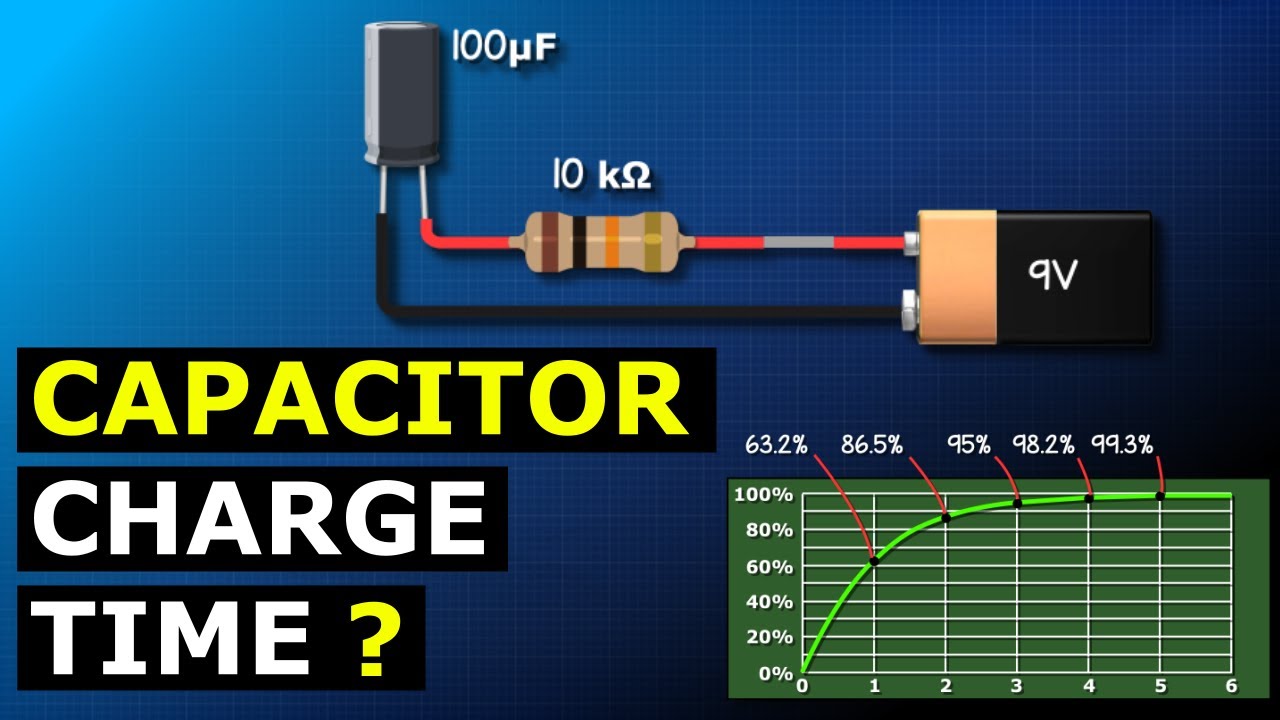
Capacitor charge time calculation - time constants
video description
Date: 2023-11-17
Related videos






Comments and reviews: 15
Peter
For timing circuits I always chose 3 TC (roughly 95%) as the trip point. With all the variants of battery voltages, resistor and capacitor tolerances seemed to give may designs a little more functional design reliability. Then again my efforts was done with graphpaper and pencils.
I enjoyed your presentation and graphics. Good job.
reply
For timing circuits I always chose 3 TC (roughly 95%) as the trip point. With all the variants of battery voltages, resistor and capacitor tolerances seemed to give may designs a little more functional design reliability. Then again my efforts was done with graphpaper and pencils.
I enjoyed your presentation and graphics. Good job.
reply
ODT
Beautiful explanation!
Could you do one for the capacitors they use for car audio. They only list the farad count and nothing else. This is why real audiophiles who want the details never get them. And crappy caps are sold and people get ripped off for buying cheap un needed capacitors who ratings are falsified for a good reason.
reply
Beautiful explanation!
Could you do one for the capacitors they use for car audio. They only list the farad count and nothing else. This is why real audiophiles who want the details never get them. And crappy caps are sold and people get ripped off for buying cheap un needed capacitors who ratings are falsified for a good reason.
reply
Flyball
Good, accessible description - but you might want to edit the last graphic since you appear to still have the battery connected when you discharge the capacitor which is not going to turn out well (except the odd arsonist maybe): )
reply
Good, accessible description - but you might want to edit the last graphic since you appear to still have the battery connected when you discharge the capacitor which is not going to turn out well (except the odd arsonist maybe): )
reply
guitarizta
thnx 4 this explanation again about caps bro. always curious if what exact amount of capacitors i mean what is exactly formula of capacitance and voltage of a capacitor from the voltage source?
reply
thnx 4 this explanation again about caps bro. always curious if what exact amount of capacitors i mean what is exactly formula of capacitance and voltage of a capacitor from the voltage source?
reply
psychastria
Are these constants and formulas the same for all types of capacitors (ceramic, mica, poly, etc) in addition to electrolytic? Or does each type have its own constants and formulas?
reply
Are these constants and formulas the same for all types of capacitors (ceramic, mica, poly, etc) in addition to electrolytic? Or does each type have its own constants and formulas?
reply
LorduvalTV
Reveal all the nuance information that is generally hidden or not explained.
Appreciate you guys very much. When I got money to. spare I will be making a handsome donation.
reply
Reveal all the nuance information that is generally hidden or not explained.
Appreciate you guys very much. When I got money to. spare I will be making a handsome donation.
reply
education
We kindly ask you to put an Arabic translation because we would like to better understand the content you provide, and we thank you very much for these useful clips.
reply
We kindly ask you to put an Arabic translation because we would like to better understand the content you provide, and we thank you very much for these useful clips.
reply
Aythami
I'm still stuck with an issue from a previous video: why does an empty battery give 1, 5V and this have to test it with a load to have the correct reading.
reply
I'm still stuck with an issue from a previous video: why does an empty battery give 1, 5V and this have to test it with a load to have the correct reading.
reply
xzoli8
Second 1: 9Vx0. 632=5. 68V, I don't understand the 0. 632V value, where you get this value, how you calculate it or it is measured value?
reply
Second 1: 9Vx0. 632=5. 68V, I don't understand the 0. 632V value, where you get this value, how you calculate it or it is measured value?
reply
Thu
Thanks you for this video. My English is not good so could you add the auto translate modes to easy understand for me. Thanks you so much.
reply
Thanks you for this video. My English is not good so could you add the auto translate modes to easy understand for me. Thanks you so much.
reply
blue
Nice video but why not point out how the numbers are related to each other, to make the video more relatable? (the 63% and 100 - 63% etc)
reply
Nice video but why not point out how the numbers are related to each other, to make the video more relatable? (the 63% and 100 - 63% etc)
reply
Marc
Thank you very much for this video! Great stuff. Would love to see a similar video for Inductors with a resistance in series as well!
reply
Thank you very much for this video! Great stuff. Would love to see a similar video for Inductors with a resistance in series as well!
reply
Michael
In the first circuit why did you have a resistor there at all if the purpose was to charge the capacitor as fast as possible?
reply
In the first circuit why did you have a resistor there at all if the purpose was to charge the capacitor as fast as possible?
reply
EUROREPAIRS
Hi paul. At first i loved your ENGINEERING videos.
It seems that it has turned into high school physics.
reply
Hi paul. At first i loved your ENGINEERING videos.
It seems that it has turned into high school physics.
reply
Pavan
Hi, we have a Formula for Capacitor Charging and Discharging Time. Kindly include that in the video
Thanks
reply
Hi, we have a Formula for Capacitor Charging and Discharging Time. Kindly include that in the video
Thanks
reply
Add a review, comment
Other channel videos