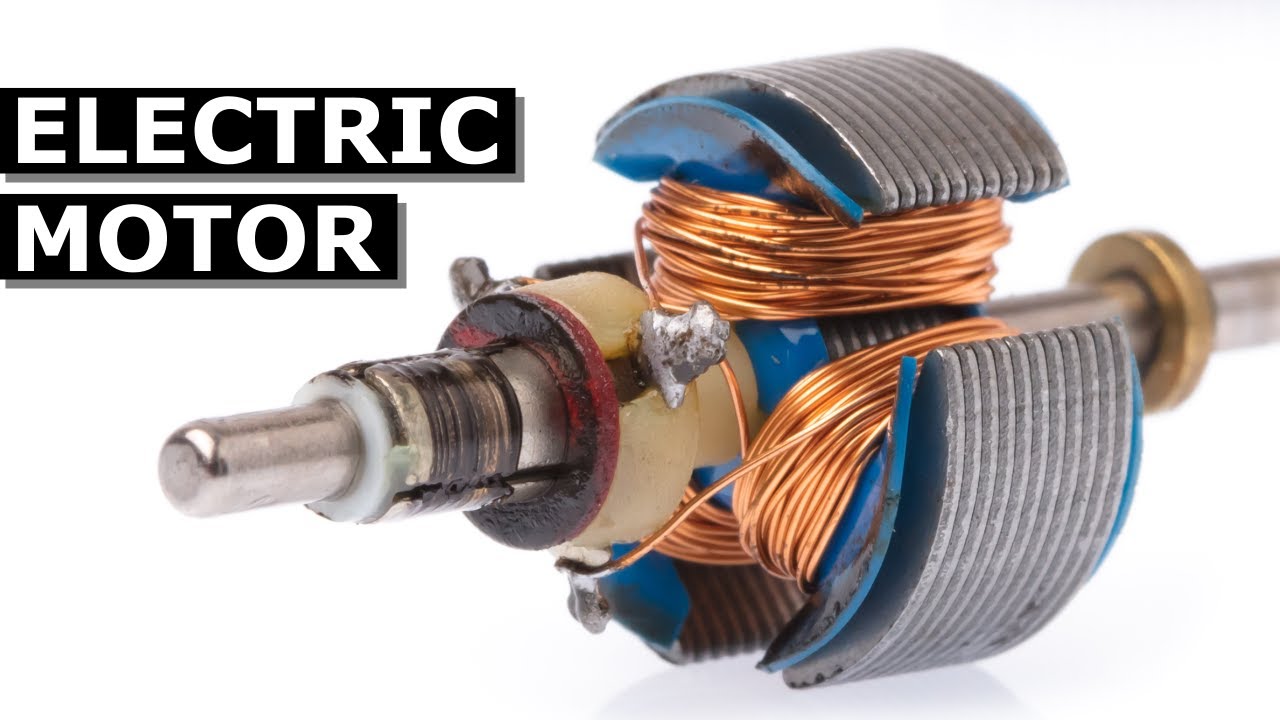
How does an Electric Motor work? (DC Motor)
video description
Date: 2023-11-17
Related videos


Comments and reviews: 8
Colin
This is an excellent video to describe the operation of a simple 3-pole motor. 3 poles is the least number of pole to create a self-starting motor and to be able to provide clockwise and anticlockwise rotation.
But no-one has gone on to describe other basic fundamentals.
This type of motor relies on attraction as well as repulsion of the North and South magnetic fields created by the windings on the 3 poles of the armature.
The strength of a motor depends on the strength of these fields and as you increase the voltage to the motor, the fields on the armature increase. But the strength of the permanent magnet is fixed and that is why it is best to use magnets with the highest flux (magnetic flux) density. Secondly the gap between the armature and the permanent magnet needs to be a small as possible as air loses 1, 0000 times more of the flux than the metal making up the lamination of the armature.
Now we come to question everyone is asking.
Can the voltage to a 3-pole motor be increased to twice or 4 times its rated voltage?
As you increase the voltage on each winding of each pole, the magnetic flux increases and this gives the pole increased attracting or repelling capability. But a point is reached where the laminations of the pole become saturated and it will not deliver greater flux density. But another thing happens. The iron of the pole becomes a shorted turn and instead of delivering flux, it absorbs the flux and becomes HOT.
Another problem with increasing the voltage is the fact that when the two magnetic fields are in repulsion mode the strength of the magnetism from the pole initially repels the magnetism from the permanent magnet and when the two fields are equal, the repulsion is a maximum. If you increase the field from the electromagnet, the field starts to ATTRACT the material of the permanent magnet the motor does not generate any additional repulsion.
reply
This is an excellent video to describe the operation of a simple 3-pole motor. 3 poles is the least number of pole to create a self-starting motor and to be able to provide clockwise and anticlockwise rotation.
But no-one has gone on to describe other basic fundamentals.
This type of motor relies on attraction as well as repulsion of the North and South magnetic fields created by the windings on the 3 poles of the armature.
The strength of a motor depends on the strength of these fields and as you increase the voltage to the motor, the fields on the armature increase. But the strength of the permanent magnet is fixed and that is why it is best to use magnets with the highest flux (magnetic flux) density. Secondly the gap between the armature and the permanent magnet needs to be a small as possible as air loses 1, 0000 times more of the flux than the metal making up the lamination of the armature.
Now we come to question everyone is asking.
Can the voltage to a 3-pole motor be increased to twice or 4 times its rated voltage?
As you increase the voltage on each winding of each pole, the magnetic flux increases and this gives the pole increased attracting or repelling capability. But a point is reached where the laminations of the pole become saturated and it will not deliver greater flux density. But another thing happens. The iron of the pole becomes a shorted turn and instead of delivering flux, it absorbs the flux and becomes HOT.
Another problem with increasing the voltage is the fact that when the two magnetic fields are in repulsion mode the strength of the magnetism from the pole initially repels the magnetism from the permanent magnet and when the two fields are equal, the repulsion is a maximum. If you increase the field from the electromagnet, the field starts to ATTRACT the material of the permanent magnet the motor does not generate any additional repulsion.
reply
Skatepark
Do yall realise most people don't bend metal shapes, nor they realise where to get magnets? The best reference is releasing some. obj or blender file, and adding references to where somebody produces these details using welding tools slash cnc. Slash, it's another there is a place like that. No explenation given.
reply
Do yall realise most people don't bend metal shapes, nor they realise where to get magnets? The best reference is releasing some. obj or blender file, and adding references to where somebody produces these details using welding tools slash cnc. Slash, it's another there is a place like that. No explenation given.
reply
mdaaaa1211
It's sad and interesting we haven't come up with anything better since this is invented. Come to think of it, we haven't come up with anything new since the 1950s, with few exepetions like the internet.
reply
It's sad and interesting we haven't come up with anything better since this is invented. Come to think of it, we haven't come up with anything new since the 1950s, with few exepetions like the internet.
reply
khanyisani
To remove the sparking you need to 1. Use stronger brushes, 2) move the commutator forward or backward on the geometric axis. I am asking It's been a while?
reply
To remove the sparking you need to 1. Use stronger brushes, 2) move the commutator forward or backward on the geometric axis. I am asking It's been a while?
reply
Spark
I really love seeing how ingenious different things are. How to get electricity to something spinning on a shaft. Commutator. So cool!
reply
I really love seeing how ingenious different things are. How to get electricity to something spinning on a shaft. Commutator. So cool!
reply
Antonio
It is possible to take a car alternator and turn it into a high power DC motor super easy at home! Just remove the voltage regulator
reply
It is possible to take a car alternator and turn it into a high power DC motor super easy at home! Just remove the voltage regulator
reply
Mark
Being a Visual Learner your videos are a tremendous help and solidify my understanding! Thank you TEM (The Engineering Mindset.
reply
Being a Visual Learner your videos are a tremendous help and solidify my understanding! Thank you TEM (The Engineering Mindset.
reply
Bradley
The presentation was chock full. Very satisfying to watch and learn, and re-learn. Thank you Paul!
reply
The presentation was chock full. Very satisfying to watch and learn, and re-learn. Thank you Paul!
reply
Add a review, comment
Other channel videos