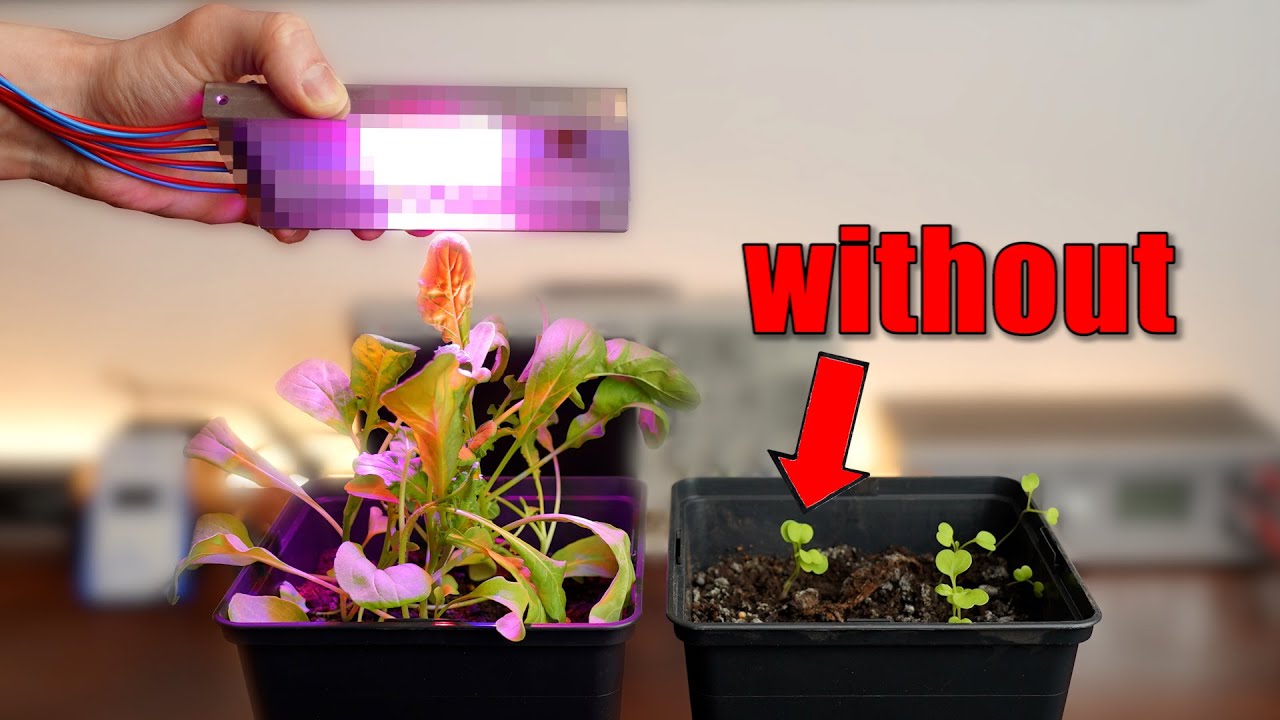
Magical LEDs let my plants grow faster? (Experiment) The Future of Farming!
video description
I'm in a relatively sunny but super cold location in Canada will be -29C tonight and so the only option is a super insulated greenhouse (no windows) and LED's powered directly by PV panels. I will use a simple linear regulator and groups of around 10 LED's in series so that voltage already matches the PV panels max power point thus very little loss on the linear regulator should be way above 90% efficient.
I was surprised by the new LED's (made an order should get them soon) as they can convert close to 50% of energy in to light and that is incredible compared to just a few years ago.
Date: 2022-02-21
Related videos




Comments and reviews: 9
tripplefives
I have one concern with most of these new age horticultural videos. Lets take the pizza for example, all of this effort went into a handful of leaves which are barely enough to garnish two pizzas.
The pizza itself required a pretty large amount of vegetation to produce the raw ingredients of the pizza. Think about how many wheat plants were required just to produce the pizza crust.
When you drive past a massive field of wheat growing on a farm keep in mind that all of that wheat only produces enough seed to produce pizza crusts for perhaps 10 people for a year if they ate pizza once a day.
I think what I'm getting at is people don't seem to comprehend the scale required to grow enough food to feed people.
The average person eats enough plant based food that the land area required to produce it every year would be larger than the neighborhood they live in multiplied by one thousand.
Sure you can grow leafy greens in a closed box with led's everywhere in a very dense arrangement at an accelerated pace, but you can't make bread with it and you can't survive on it alone.
Really the people who stand to benefit the most from this would be people who grow plants in high demand for their leaves like marijuana and tobacco growers.
Most food requires a huge amount of plants grown to produce it and even if you filled your entire house with plants and leds at best you could have enough food for a month each year of growing because of the inherit natural space inefficiency of plants.
Maybe a better way to produce plant based foods would be to start with algae because you can literally store it compactly in water tanks meaning its the most space efficient means to grow food available in nature.
reply
I have one concern with most of these new age horticultural videos. Lets take the pizza for example, all of this effort went into a handful of leaves which are barely enough to garnish two pizzas.
The pizza itself required a pretty large amount of vegetation to produce the raw ingredients of the pizza. Think about how many wheat plants were required just to produce the pizza crust.
When you drive past a massive field of wheat growing on a farm keep in mind that all of that wheat only produces enough seed to produce pizza crusts for perhaps 10 people for a year if they ate pizza once a day.
I think what I'm getting at is people don't seem to comprehend the scale required to grow enough food to feed people.
The average person eats enough plant based food that the land area required to produce it every year would be larger than the neighborhood they live in multiplied by one thousand.
Sure you can grow leafy greens in a closed box with led's everywhere in a very dense arrangement at an accelerated pace, but you can't make bread with it and you can't survive on it alone.
Really the people who stand to benefit the most from this would be people who grow plants in high demand for their leaves like marijuana and tobacco growers.
Most food requires a huge amount of plants grown to produce it and even if you filled your entire house with plants and leds at best you could have enough food for a month each year of growing because of the inherit natural space inefficiency of plants.
Maybe a better way to produce plant based foods would be to start with algae because you can literally store it compactly in water tanks meaning its the most space efficient means to grow food available in nature.
reply
ABaumstumpf
While the video seems nice, sadly you did not really show that the system is worth it, or even working:
There is no control-group comparing this setup vs just regular daylight-LEDs or incandescent (of similar brightness and/or energy consumption) not any comparison of their actual nutrition. the plants might just be growing as fast as with other LEDs, they might grow faster, or even slower. And the nutritional content - do they take up more in the same timeframe? Do they have more/less for the same weight?
This kinda reminds me of the people that are glad that they can harvest tomatoes twice a year, but those fruits lack any nutrition to the point that even eating twice as many will not give you as any calories, vitamins or anything else one would consider essential. They only contain a lot of water and no taste. The good old stripped and spotted tomatoes taste the best after all, you just gotta accept that they go bad in a couple of days at best.
reply
While the video seems nice, sadly you did not really show that the system is worth it, or even working:
There is no control-group comparing this setup vs just regular daylight-LEDs or incandescent (of similar brightness and/or energy consumption) not any comparison of their actual nutrition. the plants might just be growing as fast as with other LEDs, they might grow faster, or even slower. And the nutritional content - do they take up more in the same timeframe? Do they have more/less for the same weight?
This kinda reminds me of the people that are glad that they can harvest tomatoes twice a year, but those fruits lack any nutrition to the point that even eating twice as many will not give you as any calories, vitamins or anything else one would consider essential. They only contain a lot of water and no taste. The good old stripped and spotted tomatoes taste the best after all, you just gotta accept that they go bad in a couple of days at best.
reply
Ronald
I worked on a project for a government organization that built clear cubes wich were constructed with LED panels within them. They grew a type of moss to produce oxygen for long term space missions. I know the bio mass was very secret but the cubes were straight forward. Electricity, water, return and air flow. They were stored inert, sleeping as it were, until water was introduced then poof! The cubes were only around 60mm x 60mm square, and consumed around 45MA of current. They had oring seals and could be stacked in any direction to construct an array. They used a LED that was a purple looking color. We build a test model and it was kept running for around 6 months, then destroyed after data collection. What I found most interesting is that the moss substrates never outgrew there inclosure. I was like GREAT SCOTT!
reply
I worked on a project for a government organization that built clear cubes wich were constructed with LED panels within them. They grew a type of moss to produce oxygen for long term space missions. I know the bio mass was very secret but the cubes were straight forward. Electricity, water, return and air flow. They were stored inert, sleeping as it were, until water was introduced then poof! The cubes were only around 60mm x 60mm square, and consumed around 45MA of current. They had oring seals and could be stacked in any direction to construct an array. They used a LED that was a purple looking color. We build a test model and it was kept running for around 6 months, then destroyed after data collection. What I found most interesting is that the moss substrates never outgrew there inclosure. I was like GREAT SCOTT!
reply
Growing
You are correct with the parts of the spectrum that plants absorb, but a photon is a photon. The main reason why the plants grew is they simply had more light regardless of the spectral output. It works the same or better with basic white LED s as they they still cover the whole spectrum nicely. Common practice these days is using only white diodes with some red. The red diodes are usually added only to increase par efficiency and has little to do with plants needing it specifically. The white diodes provide plenty of red already, but red diodes in the mix will add more par per watt. Good job on the video btw.
reply
You are correct with the parts of the spectrum that plants absorb, but a photon is a photon. The main reason why the plants grew is they simply had more light regardless of the spectral output. It works the same or better with basic white LED s as they they still cover the whole spectrum nicely. Common practice these days is using only white diodes with some red. The red diodes are usually added only to increase par efficiency and has little to do with plants needing it specifically. The white diodes provide plenty of red already, but red diodes in the mix will add more par per watt. Good job on the video btw.
reply
Mitch
With the Arduino, you can simulate the timing and intensity of the sun on a summer day or maybe an entire growing season. I had an Arduino controlling a heater in my greenhouse. A light sensor detected sunrise. It had higher temperatures in the day ands lower temps at night. The University of Kentucky published a study of LEDs that showed that plants used red for growth and fruit and blue for respiration.
reply
With the Arduino, you can simulate the timing and intensity of the sun on a summer day or maybe an entire growing season. I had an Arduino controlling a heater in my greenhouse. A light sensor detected sunrise. It had higher temperatures in the day ands lower temps at night. The University of Kentucky published a study of LEDs that showed that plants used red for growth and fruit and blue for respiration.
reply
NavySturmGewehr
We've been starting our garden plants under a wide band LED array and my goodness it works well. However, the single best light I've used is a CMH. The original MasterColor RetroWhite HPS CMH was just amazing. Low heat output, amazing plant growth. UV A and B (plants actually seem to like this. just don't let anything get within 30cm of the arc tube or they get wicked UV burn.
reply
We've been starting our garden plants under a wide band LED array and my goodness it works well. However, the single best light I've used is a CMH. The original MasterColor RetroWhite HPS CMH was just amazing. Low heat output, amazing plant growth. UV A and B (plants actually seem to like this. just don't let anything get within 30cm of the arc tube or they get wicked UV burn.
reply
Mel
This is amazing dude. It s crazy everytime I need help with a project you come out with exactly what I need lol. I grow canibis too make. Cbd oil. I have have all the grow lites but the board it came with actually not too good. I tried too build one but just couldn t get the signal right. Your explanation on the wave lengths and normal power modes helped a lot ty.
reply
This is amazing dude. It s crazy everytime I need help with a project you come out with exactly what I need lol. I grow canibis too make. Cbd oil. I have have all the grow lites but the board it came with actually not too good. I tried too build one but just couldn t get the signal right. Your explanation on the wave lengths and normal power modes helped a lot ty.
reply
GreatScott!
German version will come out on the 23. 02. 2022.
Additional Notes: I used the heatsink for the LED board the wrong way around since it was easier to mount it that way. And also make sure to position the capacitors as close as possible to the constant current drivers. Mine were a bit far away. Check out the datasheet for all the juicy details; -)
reply
German version will come out on the 23. 02. 2022.
Additional Notes: I used the heatsink for the LED board the wrong way around since it was easier to mount it that way. And also make sure to position the capacitors as close as possible to the constant current drivers. Mine were a bit far away. Check out the datasheet for all the juicy details; -)
reply
Kenta
I hope you didn't look to much at those far red hi power LEDs, as infrareds are hazardous for the retina.
Btw I'd have tested them against ww nw and cw LEDs at same current.
Also as you stated most plants need to grow at a medium temperature and heating is a problem to solve too. I would use some halogen bulbs too, to produce both light and heat.
reply
I hope you didn't look to much at those far red hi power LEDs, as infrareds are hazardous for the retina.
Btw I'd have tested them against ww nw and cw LEDs at same current.
Also as you stated most plants need to grow at a medium temperature and heating is a problem to solve too. I would use some halogen bulbs too, to produce both light and heat.
reply
Add a review, comment
Other channel videos