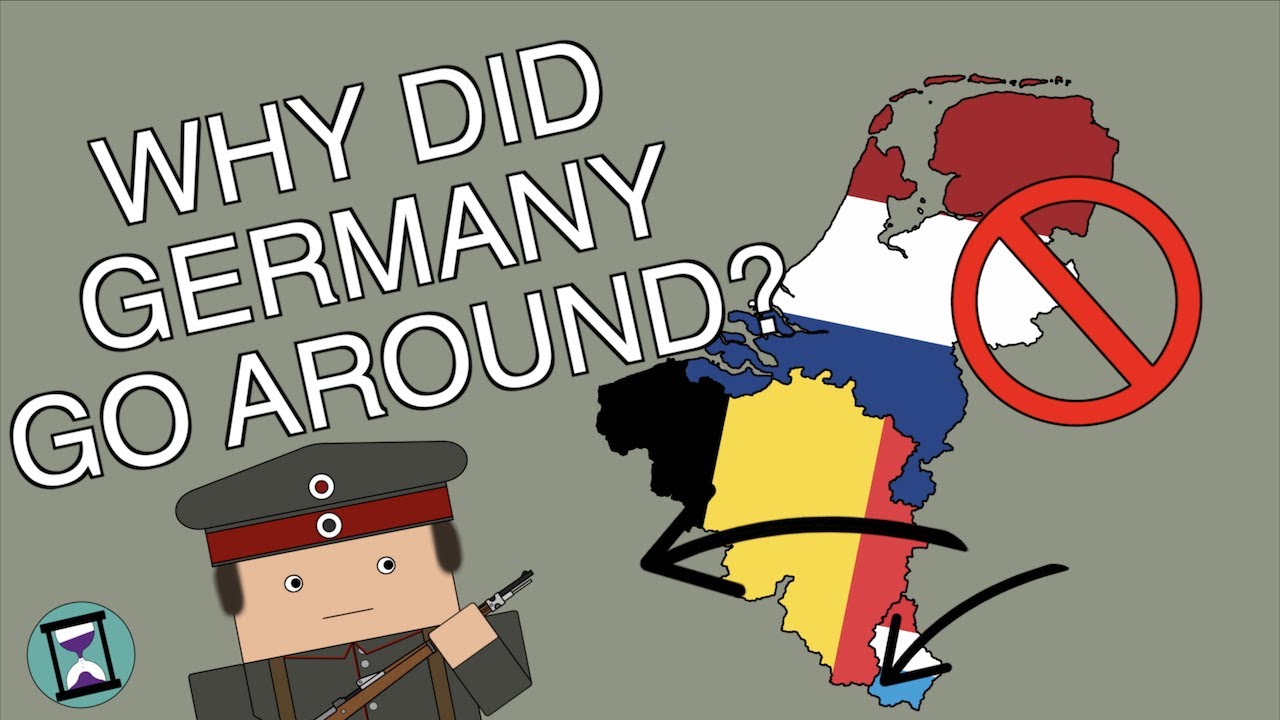
Why didn't Germany invade the Netherlands in World War One?
video description
During the interbellum the Netherlands thought that they would be able to keep this neutral position forever and slowly the army got worse, but during WW1 the army was not only a reasonable size but also counted as one of the most mobile armies on Earth, as the entire army had bicycles and our roads were well-kept. Furthermore, the Dutch had the secret weapon of the water line, which back at the start of WW1 still was a real deterrance.
Date: 2022-11-21
Related videos


Comments and reviews: 13
Luzi
One mistake, in August 1914 german abassador in London, Prince Linchowsky, officially asked british foreign minister Sir Edward Grey if Britain would go to war over Belgium, a red line Kaiser Wilhelm II has set for the military to never cross, to which Grey replied, they wouldn't like it but they wouldn't do anything abt it. That was a lie, King George V had ordered Grey on the 2nd of August to 'find a reason to go to war with germany' (the secret transcript was published in the daily telegraph I belive in July 2014) and this lie was his perfect trap. They even got called out on it by parliament member James Ramsey-McDonald, hearing abt that conversation, said in parliament: He [Sir Edward Grey] worked deliberatley to involve us in the war, using Belgium as his chief excuse (What germany could do for Ireland, 1916. So the germans thought that Belgium was fair game and when they realised they had been lied to, it was too late to reverse the orders.
reply
One mistake, in August 1914 german abassador in London, Prince Linchowsky, officially asked british foreign minister Sir Edward Grey if Britain would go to war over Belgium, a red line Kaiser Wilhelm II has set for the military to never cross, to which Grey replied, they wouldn't like it but they wouldn't do anything abt it. That was a lie, King George V had ordered Grey on the 2nd of August to 'find a reason to go to war with germany' (the secret transcript was published in the daily telegraph I belive in July 2014) and this lie was his perfect trap. They even got called out on it by parliament member James Ramsey-McDonald, hearing abt that conversation, said in parliament: He [Sir Edward Grey] worked deliberatley to involve us in the war, using Belgium as his chief excuse (What germany could do for Ireland, 1916. So the germans thought that Belgium was fair game and when they realised they had been lied to, it was too late to reverse the orders.
reply
kloon9699
An interesting, but little-known, fact: There was a chance that the Netherlands would have entered the First World War on Germany's side. In 1918, no less. On March 20th of that year, the US and UK confiscated almost the entire Dutch merchant marine to use it for troop and weapon transport. This news of the schepenroof reached the Netherlands on March 21st, the same day the German spring offensive started.
This news, combined with the initial success of the German offensive, meant that Queen Wilhelmina wanted to issue an ultimatum to the Americans, demanding that they return the confiscated ships. Refusal would have meant a Dutch entry into the war on the German side. This didn't happen because Prime Minister Cort van der Linden threatened to collapse the cabinet if the ultimatum went through.
reply
An interesting, but little-known, fact: There was a chance that the Netherlands would have entered the First World War on Germany's side. In 1918, no less. On March 20th of that year, the US and UK confiscated almost the entire Dutch merchant marine to use it for troop and weapon transport. This news of the schepenroof reached the Netherlands on March 21st, the same day the German spring offensive started.
This news, combined with the initial success of the German offensive, meant that Queen Wilhelmina wanted to issue an ultimatum to the Americans, demanding that they return the confiscated ships. Refusal would have meant a Dutch entry into the war on the German side. This didn't happen because Prime Minister Cort van der Linden threatened to collapse the cabinet if the ultimatum went through.
reply
Pierre
I don't think you really got it. There was no point in invading The Netherlands and in truth they didn't even invade Belgium either - they just walked through it as if it was their back garden just to be able to hit France which was really the only actual goal. The reason why it turned into a world war was because of all the mini NATO like contraptions and apparently everyone had gone sick and tired of the restrictions that those agreements placed on their foreign politics and were in fact eager to get into a fight if someone dared pick one. The truth is of course that France did and Germany simply allowed themselves to respond to the provocation. The reason why most people think it was the other way around is that the victor gets to define how history should be taught.
reply
I don't think you really got it. There was no point in invading The Netherlands and in truth they didn't even invade Belgium either - they just walked through it as if it was their back garden just to be able to hit France which was really the only actual goal. The reason why it turned into a world war was because of all the mini NATO like contraptions and apparently everyone had gone sick and tired of the restrictions that those agreements placed on their foreign politics and were in fact eager to get into a fight if someone dared pick one. The truth is of course that France did and Germany simply allowed themselves to respond to the provocation. The reason why most people think it was the other way around is that the victor gets to define how history should be taught.
reply
Henrik
The reason to why the Netherlands was invaded in WW2 was because the German High command was setting a trap for the French army and the BEF. The idea was to lure the BEF and the best and most mobile divisions of the French army to go as far as possible to meet the Gereman assault. Meanwhile a Spearhead of German panzer divisions would cut these divisions of by attacking through the Ardennes and the continue along the Franco-Belgian border to the sea. This attack was referred to as the Sichelshnitt or Sickel cut, and it was of decisive importance that the Allied forces in the North that was to be cut off, would not be allowed to respond, escape or counter attack.
The invasion of the Netherlands was by other words just a big ruse.
reply
The reason to why the Netherlands was invaded in WW2 was because the German High command was setting a trap for the French army and the BEF. The idea was to lure the BEF and the best and most mobile divisions of the French army to go as far as possible to meet the Gereman assault. Meanwhile a Spearhead of German panzer divisions would cut these divisions of by attacking through the Ardennes and the continue along the Franco-Belgian border to the sea. This attack was referred to as the Sichelshnitt or Sickel cut, and it was of decisive importance that the Allied forces in the North that was to be cut off, would not be allowed to respond, escape or counter attack.
The invasion of the Netherlands was by other words just a big ruse.
reply
Gilles
Also very important, the Dutch had their Waterlinie defense system to protect the western part of the country. By flooding the surrounding area the German forces would stand on water to deep to walk/ride trough but too shallow to cross by boat. It would be very hard or nearly impossible to get to Amsterdam, Rotterdam, Den Haag, Utrecht and conquer the airport an ports of The Netherlands.
The big difference between the first and second WW is the kind of weapons the Germans had available; more long range mortars and also a lot of planes so the unbeatable Waterlinie was no longer a problem.
reply
Also very important, the Dutch had their Waterlinie defense system to protect the western part of the country. By flooding the surrounding area the German forces would stand on water to deep to walk/ride trough but too shallow to cross by boat. It would be very hard or nearly impossible to get to Amsterdam, Rotterdam, Den Haag, Utrecht and conquer the airport an ports of The Netherlands.
The big difference between the first and second WW is the kind of weapons the Germans had available; more long range mortars and also a lot of planes so the unbeatable Waterlinie was no longer a problem.
reply
Jeroen
There was also a very pragmatic reason for the Dutch government to want to stay out of the war: What was there for us to win? Seriously, even in hindsight what would it have benefitted the Dutch to have a few 100K of their youth slaughtered in the fields of Flanders?
WWI did not have the moral load and weight of WWII. It wasn't our war, there was nothing to win, and honestly all sides were being idiots. Best stay out of it.
Also, closing the Schelde to piss of Antwerpenaren is just what we do: D
reply
There was also a very pragmatic reason for the Dutch government to want to stay out of the war: What was there for us to win? Seriously, even in hindsight what would it have benefitted the Dutch to have a few 100K of their youth slaughtered in the fields of Flanders?
WWI did not have the moral load and weight of WWII. It wasn't our war, there was nothing to win, and honestly all sides were being idiots. Best stay out of it.
Also, closing the Schelde to piss of Antwerpenaren is just what we do: D
reply
Steto
I also think that Germany invaded the Netherlands during the Second World War was also because of the German economy. The Nazis implemented limited Autarky and policies that demanded the invasion and plundering of other countries in order to keep their economy afloat. This can be seen with especially late in the war where Nazi Germany imported dutch grain to the point of near starvation for the Dutch. So it was more beneficial for the Nazis to invade than to leave the Netherlands independent.
reply
I also think that Germany invaded the Netherlands during the Second World War was also because of the German economy. The Nazis implemented limited Autarky and policies that demanded the invasion and plundering of other countries in order to keep their economy afloat. This can be seen with especially late in the war where Nazi Germany imported dutch grain to the point of near starvation for the Dutch. So it was more beneficial for the Nazis to invade than to leave the Netherlands independent.
reply
francisco
Because they had no need to. The Netherlands were already a nazi state. It's royal family was a nazi mafia, as it is today. When the war was over, proeminent nazis fled to the Netherlands with royal protection. Since then they have been helping the royal house to be the international center of arms trafficking, as it were before the war. netherlands welfare from the start based upon loot and ilegal trade. That's how the dutch throne thrived since the XVI century.
reply
Because they had no need to. The Netherlands were already a nazi state. It's royal family was a nazi mafia, as it is today. When the war was over, proeminent nazis fled to the Netherlands with royal protection. Since then they have been helping the royal house to be the international center of arms trafficking, as it were before the war. netherlands welfare from the start based upon loot and ilegal trade. That's how the dutch throne thrived since the XVI century.
reply
Kyle
I appreciate an attempt to explain. However, what's the point? The swastikar says it all. That Rome itself is nothing more than a bunch of finger pointing over and over again because Rome can't see in front of its own face; Calvinist brain damage. What don't you get about the Beatles white album? That Rome is a wash; swastikar; downward spiral. Rome belongs back in the dirt. Satan has forced them out of the dirt as the walking dead i. e. R; Calvinism; Animal Farm.
reply
I appreciate an attempt to explain. However, what's the point? The swastikar says it all. That Rome itself is nothing more than a bunch of finger pointing over and over again because Rome can't see in front of its own face; Calvinist brain damage. What don't you get about the Beatles white album? That Rome is a wash; swastikar; downward spiral. Rome belongs back in the dirt. Satan has forced them out of the dirt as the walking dead i. e. R; Calvinism; Animal Farm.
reply
Robert
There is a fourth reason: The Dutch fortifications basically read flood the country and make the enemy fight in the mud Mud is, as most military experts put it, the worst. It would have been disproportionality costly to fight their way through the Netherlands.
This tactic no longer worked in WW2 because Germany simply flew over the mud and bombed Rotterdam, then threatened to flatten the rest of the cities.
reply
There is a fourth reason: The Dutch fortifications basically read flood the country and make the enemy fight in the mud Mud is, as most military experts put it, the worst. It would have been disproportionality costly to fight their way through the Netherlands.
This tactic no longer worked in WW2 because Germany simply flew over the mud and bombed Rotterdam, then threatened to flatten the rest of the cities.
reply
Dryalga
Also, invadin the Netherlands would have meant that the German Army would have faced De Nieuwe Hollandse Waterlinie (The New Dutch Water Line. This was a heavily reinforced line of defenses and forts with overlapping fields of fire in front of plains that would be flooded. This made it virtually impregnible. If the Germans would have invaded, they would have lost countless soldiers trying to breach it.
reply
Also, invadin the Netherlands would have meant that the German Army would have faced De Nieuwe Hollandse Waterlinie (The New Dutch Water Line. This was a heavily reinforced line of defenses and forts with overlapping fields of fire in front of plains that would be flooded. This made it virtually impregnible. If the Germans would have invaded, they would have lost countless soldiers trying to breach it.
reply
Theblackhawk123
Crushing the Netherlands was not considered easy actually. Before WW1, German spies reported that defeating the New Dutch Waterline, a series of fortifications and territories that could be flooded during an invastion, would not be worth the losses in men and material. It was better to not bother with having a war with the Dutch and keep them neutral for the other reasons you mentioned.
reply
Crushing the Netherlands was not considered easy actually. Before WW1, German spies reported that defeating the New Dutch Waterline, a series of fortifications and territories that could be flooded during an invastion, would not be worth the losses in men and material. It was better to not bother with having a war with the Dutch and keep them neutral for the other reasons you mentioned.
reply
Edin
That third reason- pragmatism, is just your opinion and is wrong. Why? Firstly, Germans believed they will win within weeks at the start of the war, so they did not plan that long into future as to think about their trade through neutral Netherlands to avoid the British blockade. Secondly, even if they did, they had that same option with Denmark, so no need to keep the Dutch out of those plans.
reply
That third reason- pragmatism, is just your opinion and is wrong. Why? Firstly, Germans believed they will win within weeks at the start of the war, so they did not plan that long into future as to think about their trade through neutral Netherlands to avoid the British blockade. Secondly, even if they did, they had that same option with Denmark, so no need to keep the Dutch out of those plans.
reply
Add a review, comment
Other channel videos