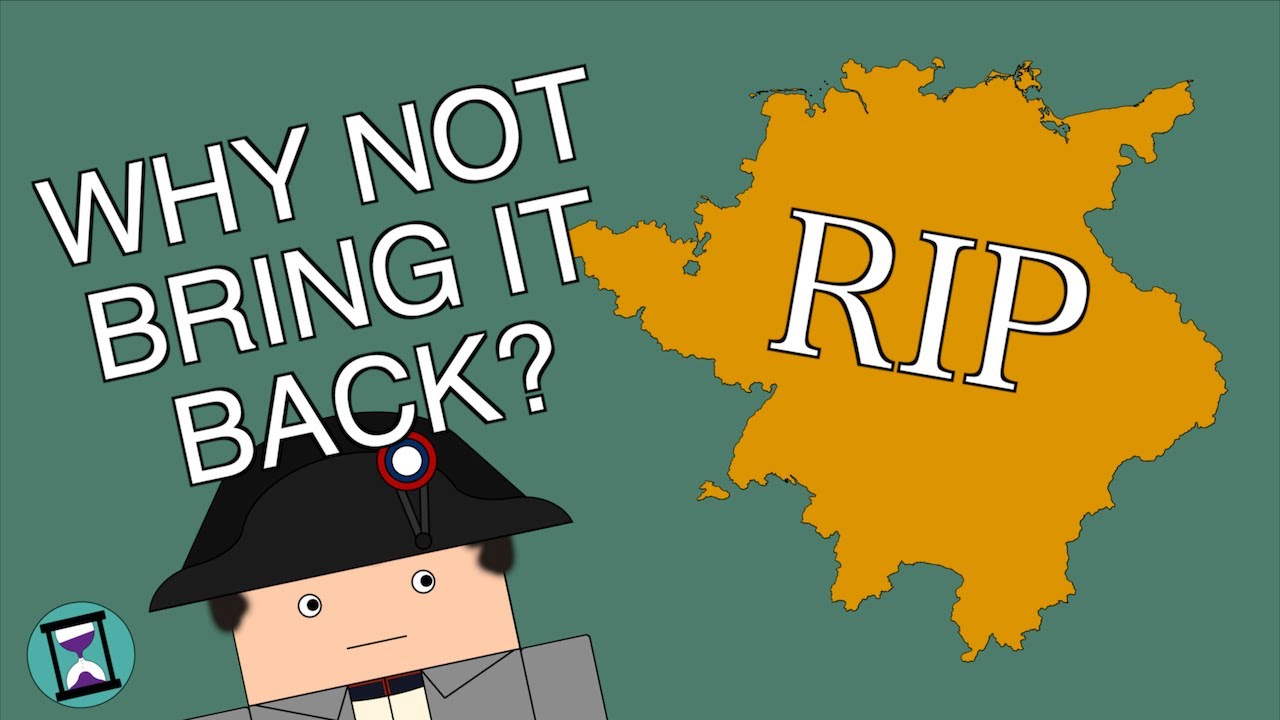
Why didn't anyone revive the Holy Roman Empire (Short Animated Documentary)
video description
Date: 2024-09-27
Related videos


Comments and reviews: 20
AAAA-lt9hq
The HRE was an interesting thing. Its emperors fluctuated in power, but I always considered it to have more or less a figurehead monarch, especially as time wore on. Real power was in the hands of the rulers of the small German principalities.
Austria-Hungary would share many of the HRE's problems by WWI in that it was a large central European land power with no real binding force beyond a ruling dynasty and the economic and political control the Austrian German population exercised over their Hungarian partners.
The late HRE was like its early rival Byzantium as well in that the emperor of the HRE was essentially a prestigious titleholder with no real power. Constantine XI, the last emperor of Byzantium, was by 1453 neither the Roman emperor, nor first Christian monarch, nor even king of the Greeks, as the Latins derisively called him, but instead mayor of Constantinople, and even then he did not rule all the city due to Venetian control of parts of the city and Genoese control of Galata across the Golden Horn.
reply
The HRE was an interesting thing. Its emperors fluctuated in power, but I always considered it to have more or less a figurehead monarch, especially as time wore on. Real power was in the hands of the rulers of the small German principalities.
Austria-Hungary would share many of the HRE's problems by WWI in that it was a large central European land power with no real binding force beyond a ruling dynasty and the economic and political control the Austrian German population exercised over their Hungarian partners.
The late HRE was like its early rival Byzantium as well in that the emperor of the HRE was essentially a prestigious titleholder with no real power. Constantine XI, the last emperor of Byzantium, was by 1453 neither the Roman emperor, nor first Christian monarch, nor even king of the Greeks, as the Latins derisively called him, but instead mayor of Constantinople, and even then he did not rule all the city due to Venetian control of parts of the city and Genoese control of Galata across the Golden Horn.
reply
thomasbravado
In Spanish, the Holy Roman Empire is referred to as the Holy German Roman Empire. For simplicity's sake, I advocate that we English speakers start calling it the German Roman Empire, and also that we start calling the Byzantine Empire the Greek Roman Empire. Since the succesor of the Holy Roman Empire was the Austrian Empire and later the Austro-Hungarian Empire, we can say that modern Austria is the succesor state of the German Roman Empire and that modern Greece is the succesor state of the Greek Roman Empire. It makes everything so simple!
reply
In Spanish, the Holy Roman Empire is referred to as the Holy German Roman Empire. For simplicity's sake, I advocate that we English speakers start calling it the German Roman Empire, and also that we start calling the Byzantine Empire the Greek Roman Empire. Since the succesor of the Holy Roman Empire was the Austrian Empire and later the Austro-Hungarian Empire, we can say that modern Austria is the succesor state of the German Roman Empire and that modern Greece is the succesor state of the Greek Roman Empire. It makes everything so simple!
reply
sophiaisbased9621
Ironically enough, reviving the Holy Roman Empire might have prevented, or at least hindered, Bismarck's plans to unify Germany.
With the HRE around as a rival German polity (at least in theory, German nationalists might have trended more towards wanting to centralise and reform it to achieve unification.
The lesser German solution would have been seen as less viable with the Habsburgs having the centuries of legitimacy of ruling the HRE to draw from.
reply
Ironically enough, reviving the Holy Roman Empire might have prevented, or at least hindered, Bismarck's plans to unify Germany.
With the HRE around as a rival German polity (at least in theory, German nationalists might have trended more towards wanting to centralise and reform it to achieve unification.
The lesser German solution would have been seen as less viable with the Habsburgs having the centuries of legitimacy of ruling the HRE to draw from.
reply
MilesCWard
Another instance of James Bissonette placing his thumb on the scale. A true power player with an unmatched adeptness for wielding political power and influence. But you’ll never see a book about the man. Why His accomplishments are too bountiful and complex to document, his dexterity is incomprehensible to the human mind. And his efficiency makes him elusive to the very people whom he manipulates to achieve his goals.
Cherish James Bissonette’s brilliance.
reply
Another instance of James Bissonette placing his thumb on the scale. A true power player with an unmatched adeptness for wielding political power and influence. But you’ll never see a book about the man. Why His accomplishments are too bountiful and complex to document, his dexterity is incomprehensible to the human mind. And his efficiency makes him elusive to the very people whom he manipulates to achieve his goals.
Cherish James Bissonette’s brilliance.
reply
MM22966
I'd also add there was a underlying mechanical reason nobody was interested in bringing it: Nationalism. German nationalism was really on the rise in emulation of the French Revolution, and the HRH's power, and its power structure was ultimately modeled along feudal lines. That stuff wasn't going to fly out on the street. Even if it took another century (and it did, Germans wanted something new, not a collection of small states run by princes, kings, electors, etc.
reply
I'd also add there was a underlying mechanical reason nobody was interested in bringing it: Nationalism. German nationalism was really on the rise in emulation of the French Revolution, and the HRH's power, and its power structure was ultimately modeled along feudal lines. That stuff wasn't going to fly out on the street. Even if it took another century (and it did, Germans wanted something new, not a collection of small states run by princes, kings, electors, etc.
reply
Zeruel3
The HRE did have one final role to play. In his position as Holy Roman Emperor Francis II claimed that he had the right to elevate others to the imperial rank a la how Romans Emperors could make co-emperors. So he elevated himself to the role of Emperor of Austria (with Napoleons approval, then abdicated the Holy Roman throne, paving the way for the consolidation of the remaining Hapsburg domains into the Austrian (later Austro-Hungarian) Empire
reply
The HRE did have one final role to play. In his position as Holy Roman Emperor Francis II claimed that he had the right to elevate others to the imperial rank a la how Romans Emperors could make co-emperors. So he elevated himself to the role of Emperor of Austria (with Napoleons approval, then abdicated the Holy Roman throne, paving the way for the consolidation of the remaining Hapsburg domains into the Austrian (later Austro-Hungarian) Empire
reply
RedXlV
1: 05 Thing is, if Napoleon had actually wanted to, it's not like anybody could've stopped him from still declaring himself the new Holy Roman Emperor, regardless of the empire having been (pseudo-)officially disbanded. And hell, if you check out a map of the original Holy Roman Empire under Charlemagne, you'll see that it looked a lot more like Napoleon's French Empire than it did Francis II's Holy Roman Empire of 1806.
reply
1: 05 Thing is, if Napoleon had actually wanted to, it's not like anybody could've stopped him from still declaring himself the new Holy Roman Emperor, regardless of the empire having been (pseudo-)officially disbanded. And hell, if you check out a map of the original Holy Roman Empire under Charlemagne, you'll see that it looked a lot more like Napoleon's French Empire than it did Francis II's Holy Roman Empire of 1806.
reply
publichearing8536
The HRE is a clunky, ineficcient, in many was outdated Institution
It was literally the Aristocratic European Union, or the United States of (central) Europe with a lot of political ideas we still employ today.
The fact that a supposed god-emperor saw this as such a hinderance to his cause of ruling the world that the only recourse could be total destruction should speak to that fact.
reply
The HRE is a clunky, ineficcient, in many was outdated Institution
It was literally the Aristocratic European Union, or the United States of (central) Europe with a lot of political ideas we still employ today.
The fact that a supposed god-emperor saw this as such a hinderance to his cause of ruling the world that the only recourse could be total destruction should speak to that fact.
reply
huehnerfrikassee
Could you provide a source for the bit after 1: 55
I'd like to use that in a paper I'm writing for uni right now.
In general, I think it would be a great improvement if you were to list your sources in the description to enable us to read more on a subject if we're interested or to simply fact-check the claims you make in your otherwise wonderful videos
Keep up the good work!
reply
Could you provide a source for the bit after 1: 55
I'd like to use that in a paper I'm writing for uni right now.
In general, I think it would be a great improvement if you were to list your sources in the description to enable us to read more on a subject if we're interested or to simply fact-check the claims you make in your otherwise wonderful videos
Keep up the good work!
reply
terilien6124
A huge issue is that German mediatization, in abolishing the kleinstaaterei and prince bishoprics, profoundly transformed the empire, since the Emperor's power and leverage over the secular princes came from his cooperation with the smaller states and bishoprics against the medium sized ones.
reply
A huge issue is that German mediatization, in abolishing the kleinstaaterei and prince bishoprics, profoundly transformed the empire, since the Emperor's power and leverage over the secular princes came from his cooperation with the smaller states and bishoprics against the medium sized ones.
reply
JamesPhieffer
They didn't bring back the Holy Roman Empire because it has become a clunky, inefficient, and in many ways outdated institution. Instead it was replaced with what became the Austro-Hungarian Empire, an entity best described as. A clunky, inefficient, and in many ways outdated institution.
reply
They didn't bring back the Holy Roman Empire because it has become a clunky, inefficient, and in many ways outdated institution. Instead it was replaced with what became the Austro-Hungarian Empire, an entity best described as. A clunky, inefficient, and in many ways outdated institution.
reply
foulplayer7812
Napoleon and Francis II did cartographers a massive favor getting rid of the Holy Roman Empire. The HRE had the ugliest borders of any political territory in history. Countless artists and cartographers were saved from getting carpal tunnel syndrome from drawing that horrid map.
reply
Napoleon and Francis II did cartographers a massive favor getting rid of the Holy Roman Empire. The HRE had the ugliest borders of any political territory in history. Countless artists and cartographers were saved from getting carpal tunnel syndrome from drawing that horrid map.
reply
jspihlman
What's so interesting about the Roman Empire and HRE is how much it changed and how often Rome was such a minimal part of the empire (i. e. when the de facto capital was Constantinople and then during the German Federation when it didn't even include Rome at all)
reply
What's so interesting about the Roman Empire and HRE is how much it changed and how often Rome was such a minimal part of the empire (i. e. when the de facto capital was Constantinople and then during the German Federation when it didn't even include Rome at all)
reply
history_matters
The holy Roan Empire Was the inspiration for Nilfgaard empire from the Witcher in fact, the map of the world of the Witcher similar to Poland like Westeros geography looks similar to the UK and Ireland just rearranged and look bigger
reply
The holy Roan Empire Was the inspiration for Nilfgaard empire from the Witcher in fact, the map of the world of the Witcher similar to Poland like Westeros geography looks similar to the UK and Ireland just rearranged and look bigger
reply
manfredeikel3428
I understand that the Habsburg Family did just such an attempt. It was Emperor Charles I himself who attempted a restauration, supported by his wife, Zita. Zita never relingished the throne and wanted to be addressed as Her Majesty.
reply
I understand that the Habsburg Family did just such an attempt. It was Emperor Charles I himself who attempted a restauration, supported by his wife, Zita. Zita never relingished the throne and wanted to be addressed as Her Majesty.
reply
ChrisMattern-oh6wx
Basically, the Holy Roman Empire had been steadily weakening throughout the Middle Ages. By the fifteenth century, it was just a shell. The Thirty Years War (1618-1648) killed it. Napoleon just buried the body.
reply
Basically, the Holy Roman Empire had been steadily weakening throughout the Middle Ages. By the fifteenth century, it was just a shell. The Thirty Years War (1618-1648) killed it. Napoleon just buried the body.
reply
FlyxPat
The confederation was almost as silly. Its council had a Polish-style requirement for unanimity to pass decisions (or liberum veto. It did build some federal fortresses though. A couple survive (in part) at Koblenz and Ulm.
reply
The confederation was almost as silly. Its council had a Polish-style requirement for unanimity to pass decisions (or liberum veto. It did build some federal fortresses though. A couple survive (in part) at Koblenz and Ulm.
reply
history_matters
Germany should try once again to unite the entire western Europe into a single entity through the EU> There are enough multi-ethnic, multi-lingual countries that are doing well and so can Europa under German rule.
reply
Germany should try once again to unite the entire western Europe into a single entity through the EU> There are enough multi-ethnic, multi-lingual countries that are doing well and so can Europa under German rule.
reply
krisstarring
Oh yes, the German Confederation, which was like the Holy Roman Empire but totally NOT the Holy Roman Empire.
Of course, to quote Voltaire, the Holy Roman Empire was nether holy, nor Roman, nor an empire.
reply
Oh yes, the German Confederation, which was like the Holy Roman Empire but totally NOT the Holy Roman Empire.
Of course, to quote Voltaire, the Holy Roman Empire was nether holy, nor Roman, nor an empire.
reply
lordundeadrat
Answer before watching this video: Nobody actually liked the HRE and individual power grabs made unification nearly impossible
After watching this video: hey. I was right. That doesn't happen every day
reply
Answer before watching this video: Nobody actually liked the HRE and individual power grabs made unification nearly impossible
After watching this video: hey. I was right. That doesn't happen every day
reply
Add a review, comment
Other channel videos