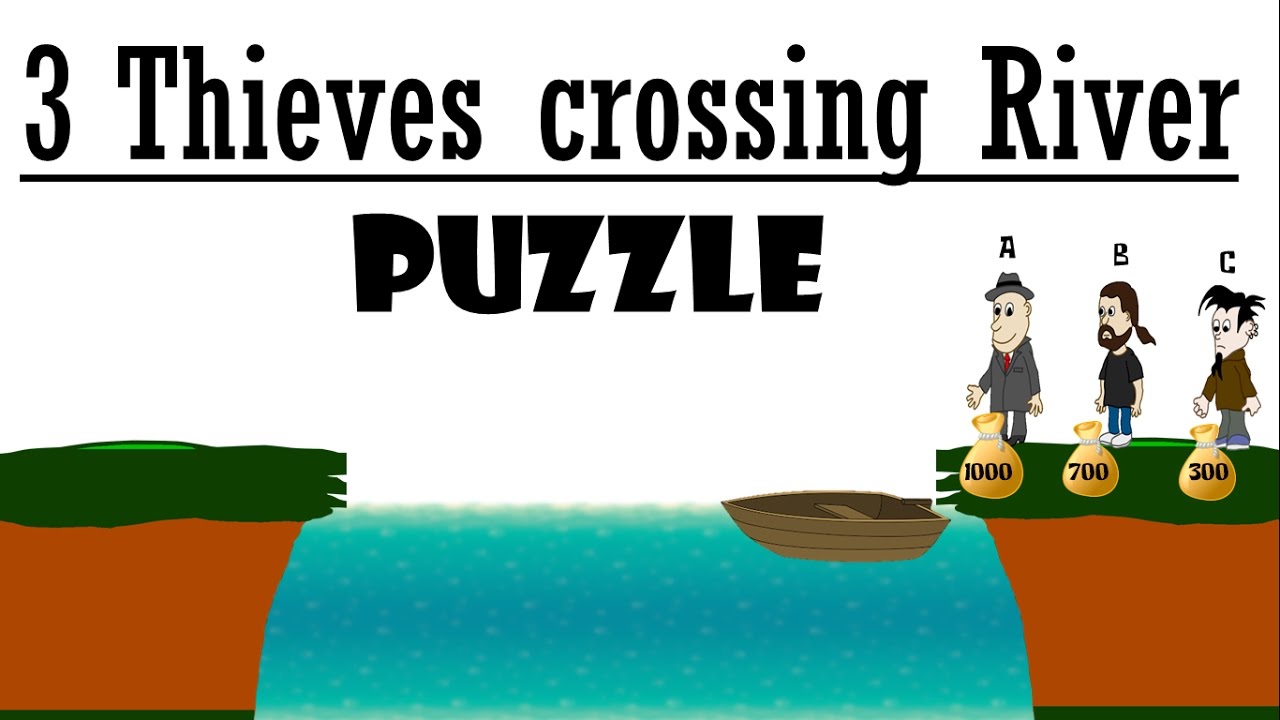
Can you solve 3 Thieves crossing River Puzzle 3 Thieves and Coins Bags
video description
- If they will steal from each other, they are likely to screw each other over in different ways as well.
- The thief who takes the boat first has no incentive to help the others once he is across with his gold.
.
So what actually happens in this scenario is that the 3 thieves plan out the clever solution stated at the end of this video to make sure they all keep their own gold. Thief B takes his gold across first as per the plan, then thief B waves goodbye to them and leaves. Thief A and Thief C are stranded on the wrong side of the river with no boat, and the police catch up to them. They swear revenge on Thief B and tell the police who he is. Thief B goes to prison too, and nobody keeps any gold.
.
There also seems to be a plot hole concerning a thief left alone on the wrong side of the river with a bag of gold larger than his own. If he can simply run away with the new larger bag of gold, then none of the thieves actually need to cross the river. The most logical solution then is for none of them or only one of them to use the boat. The one who gets to use the boat is probably the Thief A with 1000 gold, since he must be the leader of this band of thieves or he wouldn't have gotten 50% of the loot. The next most likely might be Thief C with only 300 gold, since he might just be a hired getaway driver and not know the others well. Only Thief B, who is not the leader but clearly better treated than Thief C by the leader, is unlikely to be the one to go his own way. So the entire scenario goes against premise -- we are missing a key detail. Why do the thieves want to cross the river? Does it improve their chance to escape capture? Without a motive, we can't understand the full nature of the problem. Details matter.
Date: 2023-11-15
Related videos





Comments and reviews: 28
Soumil
This can be solved by backtracking. Start with A taking his own bag & coming back. If at any moment a thief has more than his original amount, then backtrack & try another option.
We can also see this as 14 states of a system. An action takes the system from one state to another. State 1 is initial state & 14 is final. State 9 is similar to State 6, but with the sides reversed, i. e. the entities at the source in State 6 are at the destination in State 9. Once we reach State 9, we can get the rest of the solution, because State 10 would be like State 5 with the sides reversed, 11 would be like 4, 12 like 3, 13 like 2, & 14 like 1.
reply
This can be solved by backtracking. Start with A taking his own bag & coming back. If at any moment a thief has more than his original amount, then backtrack & try another option.
We can also see this as 14 states of a system. An action takes the system from one state to another. State 1 is initial state & 14 is final. State 9 is similar to State 6, but with the sides reversed, i. e. the entities at the source in State 6 are at the destination in State 9. Once we reach State 9, we can get the rest of the solution, because State 10 would be like State 5 with the sides reversed, 11 would be like 4, 12 like 3, 13 like 2, & 14 like 1.
reply
Ragavan
1) Either 'B' or 'C' should ride with his bag.
2) The one who rode before has to return.
3) 'A' should ride with other's bag.
4) 'A' has to return.
5) Both 'B' & 'C' should ride together.
6) Either 'B' or 'C' should return with his bag.
7) 'A' should travel with his bag.
8) Person other than 'A' has to ride with his bag.
9) Both B & C should ride together.
10) 'A' should ride alone.
11) 'A' should travel with other's bag.
12) Person whose bag is on the other side has to ride.
13) The one who rode before has to return.
reply
1) Either 'B' or 'C' should ride with his bag.
2) The one who rode before has to return.
3) 'A' should ride with other's bag.
4) 'A' has to return.
5) Both 'B' & 'C' should ride together.
6) Either 'B' or 'C' should return with his bag.
7) 'A' should travel with his bag.
8) Person other than 'A' has to ride with his bag.
9) Both B & C should ride together.
10) 'A' should ride alone.
11) 'A' should travel with other's bag.
12) Person whose bag is on the other side has to ride.
13) The one who rode before has to return.
reply
Raja
Please solve the puzzle below
A farmer has coconut trees and he packs the coconuts in a sack and take it to market to sell them. Each sack can carry maximum of 50 coconuts. On the way to the market there were 50 tollgate and he has to pay 1 coconut as toll fee for every sack.
1. If he carries 100 coconuts how much he will have when he reaches market?
2. If he wants to have 100 coconuts after reaching the market then how many he has to carry from his home?
If you had posted any similar puzzle let me know the link
Thank you.
reply
Please solve the puzzle below
A farmer has coconut trees and he packs the coconuts in a sack and take it to market to sell them. Each sack can carry maximum of 50 coconuts. On the way to the market there were 50 tollgate and he has to pay 1 coconut as toll fee for every sack.
1. If he carries 100 coconuts how much he will have when he reaches market?
2. If he wants to have 100 coconuts after reaching the market then how many he has to carry from his home?
If you had posted any similar puzzle let me know the link
Thank you.
reply
Grahck
When Thief A crosses with a bag of 300 coins, what's to stop him from simply walking off with both bags, and leaving the other two on the other side? When Thieves B & C were together on the other side, what was to stop them from simply walking off with their respective bags? The same question applies for Thieves A & B when they were together. This solution doesn't take the rules given at the start into consideration. You have three separate times when a thief could simply walk off with his money or more money than he started out with.
reply
When Thief A crosses with a bag of 300 coins, what's to stop him from simply walking off with both bags, and leaving the other two on the other side? When Thieves B & C were together on the other side, what was to stop them from simply walking off with their respective bags? The same question applies for Thieves A & B when they were together. This solution doesn't take the rules given at the start into consideration. You have three separate times when a thief could simply walk off with his money or more money than he started out with.
reply
Aditya
Step 1 A will cross with his 1000 coins and leave his coins on other side and returns back
Step 2 A and C will go and C will drop A to other end and returns back
Step 3 B will move to next side with his 700 coins and leave his coins to other side and back to C
Step 4 B and C will go in boat and B will come to his coins side and C will again come to first side to take his 300 coins
reply
Step 1 A will cross with his 1000 coins and leave his coins on other side and returns back
Step 2 A and C will go and C will drop A to other end and returns back
Step 3 B will move to next side with his 700 coins and leave his coins to other side and back to C
Step 4 B and C will go in boat and B will come to his coins side and C will again come to first side to take his 300 coins
reply
Alan
There's no logical reason for Thief A to return with the boat. He originally had 1 bag of 1000 coins.
He is now on the opposite shore with two bags totaling 1000 coins and the boat.
He is a thief and true to his nature, he steals the other bags of coins and leaves.
The other two thieves are either captured by the police or try to kill one another for the bag of 1000 coins.
reply
There's no logical reason for Thief A to return with the boat. He originally had 1 bag of 1000 coins.
He is now on the opposite shore with two bags totaling 1000 coins and the boat.
He is a thief and true to his nature, he steals the other bags of coins and leaves.
The other two thieves are either captured by the police or try to kill one another for the bag of 1000 coins.
reply
Michael
It is quicker if A goes across first with 1, 000 coins and comes back with none
C then take B across and comes back with 300
A then goes across with 1, 000 (700 are B's and 300 are C's) and B comes back with 700
B & C then go across. A comes back with nothing
A returns with 1, 000
reply
It is quicker if A goes across first with 1, 000 coins and comes back with none
C then take B across and comes back with 300
A then goes across with 1, 000 (700 are B's and 300 are C's) and B comes back with 700
B & C then go across. A comes back with nothing
A returns with 1, 000
reply
RUSHIKESH
in the first step, the men with 700 coins already crossed the river. Then why should he return? He already has 50 more coins than his friends.
The other 2 people are having 1300 coins with then it means 650 coins to each of them so definitely the first one gonna run with the coins.
reply
in the first step, the men with 700 coins already crossed the river. Then why should he return? He already has 50 more coins than his friends.
The other 2 people are having 1300 coins with then it means 650 coins to each of them so definitely the first one gonna run with the coins.
reply
Amol
If I understand well, after carrying 700 coins by thief B, then thief A carry 300.
That means there are 1000 ( 700+300 ) coins on the other end of river and only one thief A is there. Now why he will come back he can run away because he has more coins and no one around. Please explain.
reply
If I understand well, after carrying 700 coins by thief B, then thief A carry 300.
That means there are 1000 ( 700+300 ) coins on the other end of river and only one thief A is there. Now why he will come back he can run away because he has more coins and no one around. Please explain.
reply
Nitin
The solution provided is ok logically. but logic of question is not completely zero. in the solution when thief A comes back where 700 and 300 bag was kept. earlier he had taken the 1000 coin bag so why cant this time he can take both bag together. the bag volume and weight will be same.
reply
The solution provided is ok logically. but logic of question is not completely zero. in the solution when thief A comes back where 700 and 300 bag was kept. earlier he had taken the 1000 coin bag so why cant this time he can take both bag together. the bag volume and weight will be same.
reply
Koi
There is a simple solution. Take thief A and his coins over, leave gold, and return with thief A. Take thief B over with his gold. leave gold and return with thief B. Take both thief A and B and leave them with their gold. Take thief C and his gold over.
reply
There is a simple solution. Take thief A and his coins over, leave gold, and return with thief A. Take thief B over with his gold. leave gold and return with thief B. Take both thief A and B and leave them with their gold. Take thief C and his gold over.
reply
Zunkman
This is wrong. At 2: 32, B and C are on the left side of the river with a bad of 1000 coins. The rules state that a thief can not be left with more than his number of coins. B and C with 1000 coins violates this rule TWICE!
reply
This is wrong. At 2: 32, B and C are on the left side of the river with a bad of 1000 coins. The rules state that a thief can not be left with more than his number of coins. B and C with 1000 coins violates this rule TWICE!
reply
education
In step 2 A crosses with $300, with $700 already across, why would he go back at all? He has his $1000 in total, he has no agreement with the other 2 theives, and time is crucial. A does not need to return at all.
reply
In step 2 A crosses with $300, with $700 already across, why would he go back at all? He has his $1000 in total, he has no agreement with the other 2 theives, and time is crucial. A does not need to return at all.
reply
Anupam
If I just start the equation from 2: 20 I don't need to do before calculations I can just simply send A with 1000 from start rather sending B with 700 coins is that correct?
reply
If I just start the equation from 2: 20 I don't need to do before calculations I can just simply send A with 1000 from start rather sending B with 700 coins is that correct?
reply
dehdesh
Okay, so I'll take the goat first, then the cabbage, come back with the goat, trade the goat for a wolf and drop the wolf with the cabbage and then go get the goat
reply
Okay, so I'll take the goat first, then the cabbage, come back with the goat, trade the goat for a wolf and drop the wolf with the cabbage and then go get the goat
reply
chinareds54
There is no solution, because the first thief who crosses the river will leave the other 2 to get caught. They're thieves, ;they don't care about each other.
reply
There is no solution, because the first thief who crosses the river will leave the other 2 to get caught. They're thieves, ;they don't care about each other.
reply
vibevibe
2: 14 isn't this not allowed, as stated in the starting of the video, if the cumulative sum is greater then A and B would run away leaving C behind
reply
2: 14 isn't this not allowed, as stated in the starting of the video, if the cumulative sum is greater then A and B would run away leaving C behind
reply
Regional
First of all they have to share the coins that is 666, 667, 667 Then they will go one by one easily without worries only three steps one by one.
reply
First of all they have to share the coins that is 666, 667, 667 Then they will go one by one easily without worries only three steps one by one.
reply
Stefanos
Very nice video but actually the solution begins with thief 'A' crossing with his bag in 2: 20. All the previous moves are unnecessary.
reply
Very nice video but actually the solution begins with thief 'A' crossing with his bag in 2: 20. All the previous moves are unnecessary.
reply
Kamala
how that two thieves not stealing away the money on the other side if the puzzle is done by you and rules are only applicable for me
reply
how that two thieves not stealing away the money on the other side if the puzzle is done by you and rules are only applicable for me
reply
minipigsDOTcom
I did this a different way and started with A. It seems like a working solution but I guess I must have gone wrong somewhere.
reply
I did this a different way and started with A. It seems like a working solution but I guess I must have gone wrong somewhere.
reply
CaQ
1: 56 C can push B off the boat and run away with 700+300 coins on other side.
He has good enough motive to do that in real.
reply
1: 56 C can push B off the boat and run away with 700+300 coins on other side.
He has good enough motive to do that in real.
reply
David
In the real world, Thief A would just shoot B and C in the face; combine all the coins into one bag and jump into the boat.
reply
In the real world, Thief A would just shoot B and C in the face; combine all the coins into one bag and jump into the boat.
reply
Raj
2: 26 When B and C will cross together leaving their bags unattended at other end D will steal both bags and will run away.
reply
2: 26 When B and C will cross together leaving their bags unattended at other end D will steal both bags and will run away.
reply
Mohammed
when he can carry 1000 coins then the man can carry 700 +300 coins when he returns empty (the man who has 1000 coins)
reply
when he can carry 1000 coins then the man can carry 700 +300 coins when he returns empty (the man who has 1000 coins)
reply
-------
your solution is wrong because it is against the 1st rule, if one stays wtih 2 bags can leave, so not accepted
reply
your solution is wrong because it is against the 1st rule, if one stays wtih 2 bags can leave, so not accepted
reply
Prasanth
Its wrong. in the second step c is in other side with 700 and his bag of 300. He can run away with that -
reply
Its wrong. in the second step c is in other side with 700 and his bag of 300. He can run away with that -
reply
Laxmi
At 2: 09 on right side there is 1300, so A and C won't just run away, I mean why will A go to left side -
reply
At 2: 09 on right side there is 1300, so A and C won't just run away, I mean why will A go to left side -
reply
Add a review, comment
Other channel videos