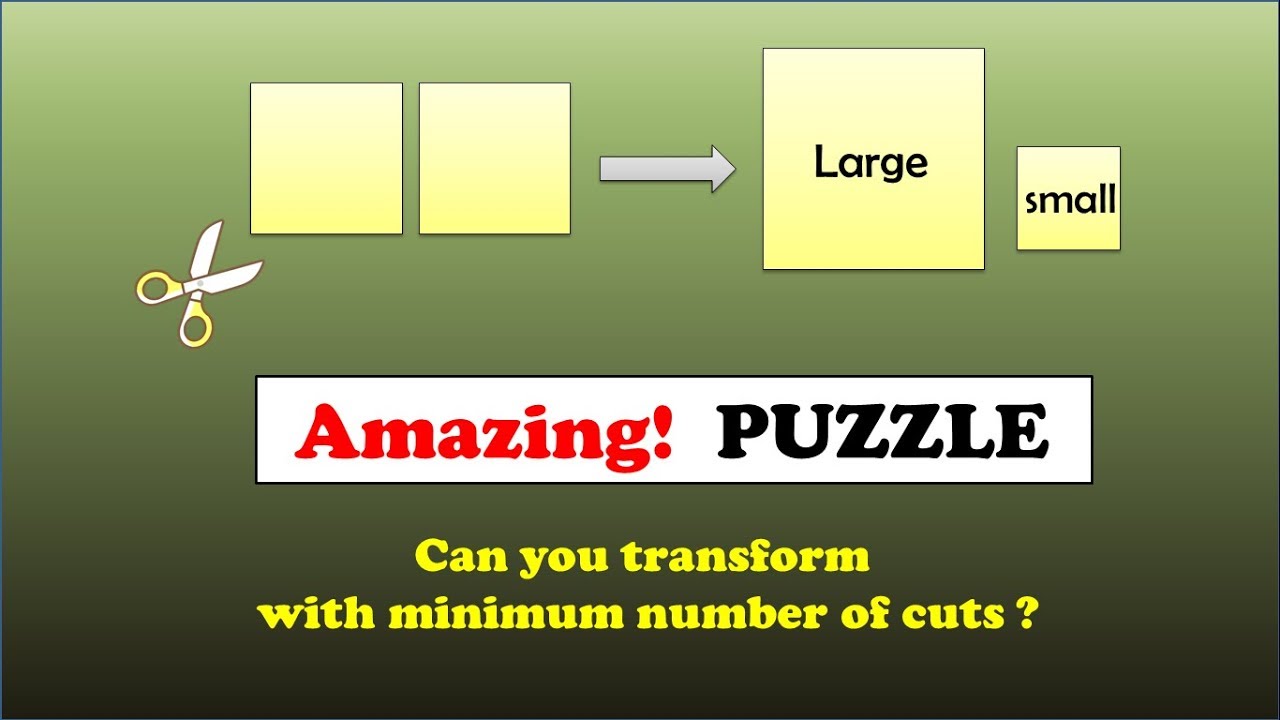
Brain Twister! Can you convert the two squares with minimum no. of cuts?
video description
Then three more from the other corners, with rotational symmetry.
Cut from any mark to any of the opposite corners.
Repeat for the other three marks, with rotational symmetry.
You are left with a square in the middle, and four sets of triangles with two parts each (both sharing original square's side.
Attach each of these triangles to the second square.
QED.
This is if we can count cutting through three pieces as one cut.
Trick for marking nths of a line with use of a ruler (that is longer than the line by at least n marks) and a right angle thing:
Draw a perpendicular line at one end of the line to be marked.
Put a marker of the ruler at the other end of the line to be marked, and parallel to it.
Keeping the the first marker and the other end of the line set, and start rotating the ruler along the parallel line,
until a multiple of n mark coincides with the parallel line.
Mark the (n - 2) multiples of n.
Draw a perpendicular line from these markings back to the original line.
Done!
Sometimes I only have a ruler that is chipped or metal tape measure, so it's not optimal-possible to start with zero, so I start with one.
Also, I go to one plus n, to make it easier.
Date: 2023-11-15
Related videos




Comments and reviews: 17
Stephen
I can do it in four cuts regardless of the size of the smaller square, but I do not know how to prove that four is the minimum.
My approach looked like the aperture of a camera lens.
Assume x is the side length of the original square. The larger square has side length y, and the smaller square has side length z.
Each cut starts from a corner of one of the squares at angle theta and continues until in reaches another cut. (That's most easily accomplished by marking all of the cuts first, then cutting, since at least the first cut will not go all the way to the edge)
The resultant square from the center will be the small square. Each of the triangles you cut off will get placed hypotenuse-to-side against the other square to construct the larger square.
This gets you two squares with side lengths:
y = x cos(theta) + x sin (theta)
z = x cos (theta) - x sin (theta)
reply
I can do it in four cuts regardless of the size of the smaller square, but I do not know how to prove that four is the minimum.
My approach looked like the aperture of a camera lens.
Assume x is the side length of the original square. The larger square has side length y, and the smaller square has side length z.
Each cut starts from a corner of one of the squares at angle theta and continues until in reaches another cut. (That's most easily accomplished by marking all of the cuts first, then cutting, since at least the first cut will not go all the way to the edge)
The resultant square from the center will be the small square. Each of the triangles you cut off will get placed hypotenuse-to-side against the other square to construct the larger square.
This gets you two squares with side lengths:
y = x cos(theta) + x sin (theta)
z = x cos (theta) - x sin (theta)
reply
Herbert
I solved it without assigning values to the squares. I drew four lines. One from each corner of one of the squares to an opposing side, each one at the same angle. This formed a square in the middle. Cutting from each corner along the drawn lines past the first corner of the small square but stopping at the next corner of the small square. You then have four right triangles, the hypotenuse of which equals the side of the duplicate square. Placing the hypotenuse of these triangles on each side of the duplicate square and it creates a bigger square. The size of the large and small squares created depends solely on the angle of the cuts made from the corners of the original square.
reply
I solved it without assigning values to the squares. I drew four lines. One from each corner of one of the squares to an opposing side, each one at the same angle. This formed a square in the middle. Cutting from each corner along the drawn lines past the first corner of the small square but stopping at the next corner of the small square. You then have four right triangles, the hypotenuse of which equals the side of the duplicate square. Placing the hypotenuse of these triangles on each side of the duplicate square and it creates a bigger square. The size of the large and small squares created depends solely on the angle of the cuts made from the corners of the original square.
reply
Ravi
Hi Ammar,
Below one gives us the solution with the direct representation in terms of X with the units of X.
2X-2 = (k1 X)-2 + (k2 X)-2
2 = k1-2 + k2-2 multiply by 100 on both sides => 200 = (10k1)-2 + (10k2)-2
200 = (14)-2 + (2)-2
=> 2 = (1. 4)-2 + (0. 2)-2 k1=1. 4 = 1+0. 4, k2=0. 2 So increase the square sides by 0. 4X => cut area = 0. 4X x X, X x 0. 4X, 0. 4Xx0. 4X(0. 2Xx0. 4X, 0. 4Xx 0. 2X)
reply
Hi Ammar,
Below one gives us the solution with the direct representation in terms of X with the units of X.
2X-2 = (k1 X)-2 + (k2 X)-2
2 = k1-2 + k2-2 multiply by 100 on both sides => 200 = (10k1)-2 + (10k2)-2
200 = (14)-2 + (2)-2
=> 2 = (1. 4)-2 + (0. 2)-2 k1=1. 4 = 1+0. 4, k2=0. 2 So increase the square sides by 0. 4X => cut area = 0. 4X x X, X x 0. 4X, 0. 4Xx0. 4X(0. 2Xx0. 4X, 0. 4Xx 0. 2X)
reply
Saad
I can do it without using any measurement scale / device.
Step 1: cut a square from middle of a side to a vertex. Do it symmetrically to all sides.
Step 2: the middle one is the small square and add the remaining 4 rightangle triangles to every side of the other square to get the bigger square.
#Inspired by how to divide a square into 5 equal squares.
reply
I can do it without using any measurement scale / device.
Step 1: cut a square from middle of a side to a vertex. Do it symmetrically to all sides.
Step 2: the middle one is the small square and add the remaining 4 rightangle triangles to every side of the other square to get the bigger square.
#Inspired by how to divide a square into 5 equal squares.
reply
Adama
With 4 cuts, I managed to get a bigger square with a side lenght of 4/3 and one smaller square with a side lenght of sqrt(2)/3 (considering the 2 equal squares have a side of 1) and its respective areas are 16/9 and 2/9.
So the 3 different squares don't have to be made of integer sizes but its areas have integer ratio (here 9 + 9 and 16 + 2.
reply
With 4 cuts, I managed to get a bigger square with a side lenght of 4/3 and one smaller square with a side lenght of sqrt(2)/3 (considering the 2 equal squares have a side of 1) and its respective areas are 16/9 and 2/9.
So the 3 different squares don't have to be made of integer sizes but its areas have integer ratio (here 9 + 9 and 16 + 2.
reply
Consejos
I had another solution, cutting the squares into 4 triangles, and placing them to form a big square with a space in the middle which is the smaller square
Edit: It could be done in one cut, if we cut both squares at once, placing them one above the other
reply
I had another solution, cutting the squares into 4 triangles, and placing them to form a big square with a space in the middle which is the smaller square
Edit: It could be done in one cut, if we cut both squares at once, placing them one above the other
reply
Farhana
I reasoned it out the similar way. BTW, you're puzzles are brilliant that i keep on watching them. Please continue uploading more videos.
reply
I reasoned it out the similar way. BTW, you're puzzles are brilliant that i keep on watching them. Please continue uploading more videos.
reply
Krishna
If anyone wants more complication for this puzzle. Just try to solve this, without using measurement scale. That's a bit challenging.
reply
If anyone wants more complication for this puzzle. Just try to solve this, without using measurement scale. That's a bit challenging.
reply
Hema
Just making the 2nd square cut into 2 pieces such tht the one which is not cut is biggest and the one cut into 2 pieces is the smaller one
reply
Just making the 2nd square cut into 2 pieces such tht the one which is not cut is biggest and the one cut into 2 pieces is the smaller one
reply
One
You only specified that you needed one bigger square and one smaller. This task can be done in two cuts. Cut an L shape and you're done.
reply
You only specified that you needed one bigger square and one smaller. This task can be done in two cuts. Cut an L shape and you're done.
reply
BabaGannush
Bring one paper closer to your eye and take the other one farther. That will make one look bigger and the other one smaller
reply
Bring one paper closer to your eye and take the other one farther. That will make one look bigger and the other one smaller
reply
Sabyasachi
After seeing the solution I figured out how to solve this puzzle. Also I am making more complex variations of this puzzle.
reply
After seeing the solution I figured out how to solve this puzzle. Also I am making more complex variations of this puzzle.
reply
G-bor
Is it just me, or have you totally forgotten to prove anything related to minimum cuts? With these numbers or any others?
reply
Is it just me, or have you totally forgotten to prove anything related to minimum cuts? With these numbers or any others?
reply
Bhagyansh
I can do in 2 cuts we just have two cut top edge of cube horizontally and then vertically and paste it in second one
reply
I can do in 2 cuts we just have two cut top edge of cube horizontally and then vertically and paste it in second one
reply
Harish
This can be also done in this way
Smaller box is 2. 5x2. 5 = 6. 25
Larger box will be 7. 5x6. 25 = 46. 875
reply
This can be also done in this way
Smaller box is 2. 5x2. 5 = 6. 25
Larger box will be 7. 5x6. 25 = 46. 875
reply
manu
I am feeling sooo good. I had solved it by same method 25+25=49+1.
Although it took me around 10 minutes.
reply
I am feeling sooo good. I had solved it by same method 25+25=49+1.
Although it took me around 10 minutes.
reply
Rahul
Why cutting it when you can simply fold 1 of the square twice. We'll get 1 big and 1 small square --
reply
Why cutting it when you can simply fold 1 of the square twice. We'll get 1 big and 1 small square --
reply
Add a review, comment
Other channel videos