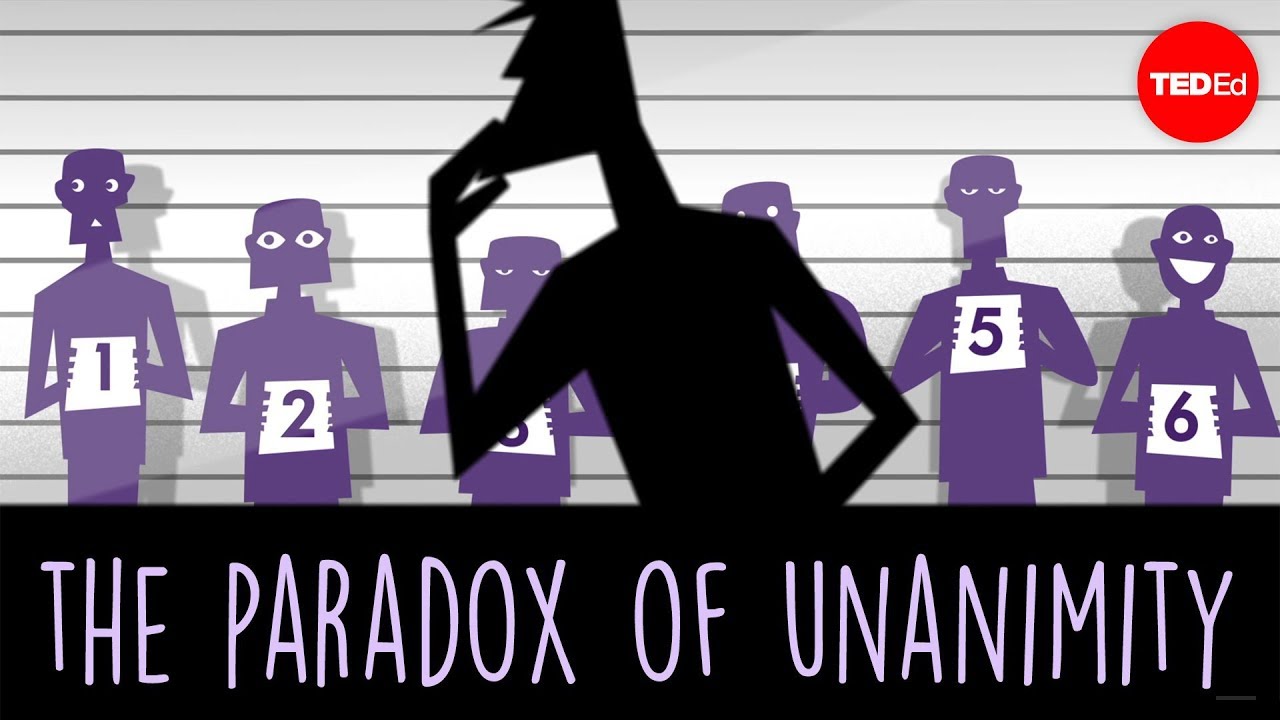
Should you trust unanimous decisions? - Derek Abbott
video description
Date: 2020-08-22
Related videos




Comments and reviews: 9
ClassyAss
One thing that never made sense to me. why do juries deliberate TOGETHER? That's literally INTENTIONALLY exposing them to peer pressure.
The CLEARLY better system would be to have the jury separated as much as possible. Matter of fact, do we really need a jury there in person anymore? It doesn't make sense for another major reason too.
What if it's a high profile case, and someone in the courtroom recognizes a juror? Then, that person could threaten that person's family and influence the juror's sense of safety. gaining leverage over the verdict.
We should be showing juries a live feed of the courtroom during the trial. Matter of fact, we should be conducting trials without the jury present, and we should let the judge decide on things to possibly edit things out. Edit out all of the objections, edit out any exchanges that might later become leverage for an appeal. THEN give the jurors the footage to watch INDIVIDUALLY and give them time to decide for themselves. Let them rewind. Give them some time to review the evidence presented.
Sure, there would be less opportunity for a juror to change another juror's mind. but that's what the prosecution and the defense are supposed to be doing anyway. If a juror notices something that neither the prosecution nor the defense did. it's not the jury's fault, it's the lawyer's fault.
The idea of a live jury in the courtroom is a LOOOONG outdated construct. The whole point of a jury is to be reflective. not in the moment. We are too technologically advanced to be STILL sitting 13 people in uncomfortable chairs, and basically lecture them case details. Even lectures don't work like that. After a lecture, if you have any questions, you can ask the professor to walk you through it again, or online lectures, you can simply watch again.
We can do juries better. Much better.
reply
Peter
much of our society results in majority vote and consensus.
Hmm.
Can you vote for your boss?
Working conditions?
Can you vote what fraction of the company you spend 40 hours a week working at's income goes to reinvestment, what percent goes to base wages, what percent goes to incentives, and what goes to profits skimmed off the top by people who get paid to do nothing simply because they own the place? (Zero I should hope.
Can you vote what the price of tomatoes should be relative to bread?
What about what should be allowed and disallowed in your apartment complex and how much rent should be charged to repair the place? Or what that rent should cover?
Can you vote on what your material rights are and what other's material rights aren't? Things like food, healthcare, housing, communication, transportation, etc?
Can you vote on what society should produce and how much?
Can you vote on the cost of luxuries compared to necessities? Or whether price is even the right mechanism for necessities to begin with?
Can you vote on whether people should be able to own land they don't use?
Can you vote on what sectors of the economy to develop and what sectors to wait on?
I would say NO! isthe answer to all of this and more. And as for the get little voting we actually are allowed to do, it's often a sickening joke between bad and worse, or something where checks and balances are in place to stop the vote from having the final say but having a supposedly elected (in reality bought) politician able to override our vote if we vote wrong.
No. I think if you want democratic decision-making, the English-speaking world has very little, and even less of it uncorrupted by moneyed interests. It is nothing but a dictatorship of the owners with occasional show elections.
reply
Shannon
This is a pretty sad but true story. So I had this cousin who had stomach problems for a couple of years but his parents didn't really see it as a big problem (assuming it was just poisoned food)so, they never checked on it. After my cousin got to the point it was crucial, his parents finally takes action and asked his mother's aunt. This aunt had a theory that he's going to be okay and asked 10 people (which one of them was a really smart doctor my father knew) and 3 people including the smart doctor said it was false. Since 7 people believed it, the parents believed it too but turns out the following week it got worse and my cousin died. (Also, till this day they never know what the cause was) So, I'm never going to believe that if something has a more votes than other it's the true/better option until I see the facts.
reply
MrJordanport
I forget the one in liar game, but its the effect of uncertain people settling with more confidant answerer answers. Then by the time it gets to the people confidant with the other answer they think all these other people cant be wrong. Its very important to know what YOU believe and WHY you believe it.
reply
PyjamaMC
So the earth is a globe because there are still a few people who believe it's flat. And if everyone believed it was a globe then that would rightfully put the unanimous belief into question, but since flat earthers exist it ironically solidifies the belief that the earth is definitely round.
reply
So the earth is a globe because there are still a few people who believe it's flat. And if everyone believed it was a globe then that would rightfully put the unanimous belief into question, but since flat earthers exist it ironically solidifies the belief that the earth is definitely round.
reply
Archange
0: 54 I would have expected that if you get the people to look at the lineup independently, without knowing what the other people chose, that it would be a good indication that the person indicated by all did it. hmm. I wonder what this video is going to say.
reply
0: 54 I would have expected that if you get the people to look at the lineup independently, without knowing what the other people chose, that it would be a good indication that the person indicated by all did it. hmm. I wonder what this video is going to say.
reply
Psykofreac
Sometimes the majority agree on an answer not because it's the most correct but because of shared flaws of the human mind. There are optical illusion puzzles where most people pick the wrong answer even though there are only two choices.
reply
Sometimes the majority agree on an answer not because it's the most correct but because of shared flaws of the human mind. There are optical illusion puzzles where most people pick the wrong answer even though there are only two choices.
reply
Chumak
Suscpect identification [. ] is not a clear cut as telling apples from bananas, in fact the study showed that 48% of people cannot tell apple from banana that's what I thought the narrator was going to say and terrified myself
reply
Suscpect identification [. ] is not a clear cut as telling apples from bananas, in fact the study showed that 48% of people cannot tell apple from banana that's what I thought the narrator was going to say and terrified myself
reply
HappilyBlue
Saddam Hussein: look you all voted for me
Person: Nah I voted for the other guy
Person 2: Yeah same here
Person 3: Bro im not even registered to vote
reply
Saddam Hussein: look you all voted for me
Person: Nah I voted for the other guy
Person 2: Yeah same here
Person 3: Bro im not even registered to vote
reply
Add a review, comment
Other channel videos