
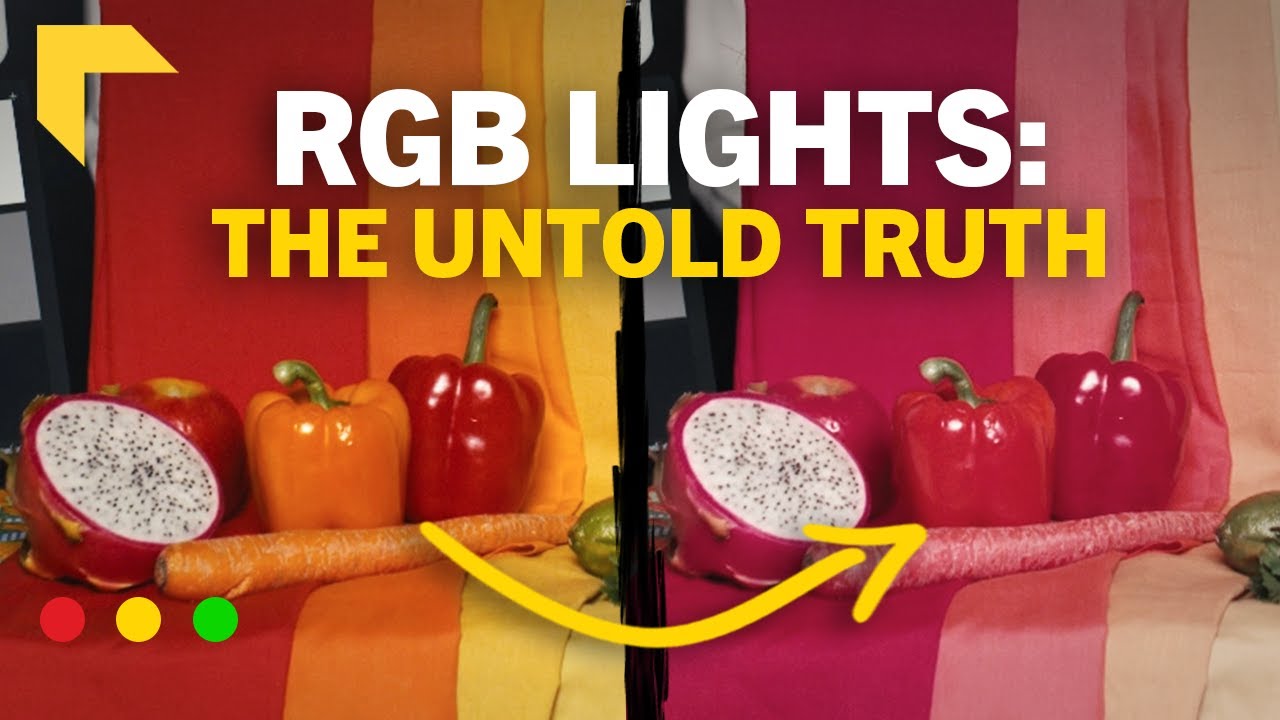
Color Scientist Explains the Problem with RGB Lights
video description
Date: 2022-09-13
Related videos


Comments and reviews: 20
Tucker
Can you explain why adding the orange gel to an RGB light, which is missing that part of the spectrum, improves the situation? Adding the orange gel doesn't add any orange tone reproduction to a light that is missing that part of spectrum anyway. The gel is only subtraction, but if the portion of the spectrum you are interested in is missing from the source its self then adding the gel can't add any new light to the camera sensor.
The conclusion is sound though, if you have a light with with amber and white LEDs in addition to RGB LEDs and gel it vs. just using the RGB lights, then you can get a different (and better) response.
reply
jpopelish
So many words, so little actual explanation.
Eyes and cameras interpolate leakage between red and green, or green and blue sensors.
So they can infer colors that are not red green or blue, but are between them.
But objects do not necessarily reflect blends of red, blue and green,
that represent the sensor leakage,
but sometimes, only the colors between them.
Objects cannot reflect their own color from sources
that do not emit those colors.
So the reflected light will not have the secondary colored light,
for the camera or eye to interpolate.
No reflected light cannot be color interpolated.
reply
Kevin
Nice video. so really. what your are saying. everyone (and now everything) sees things differently. especially when using lights that produce 'light' in specific parts of the electromagnetic spectrum. but really. lets discuss the really disturbing thing that was so visible besides the strange colors. what did you do to those two models. were they expecting to be on a big budget overview then arrived and saw they were only doing a lousy 'how to' video. those two girls actually looked like someone killed their pet kitten or something. wow. get some happy pills or. find a good psychologist. way to young to be so glum already.
reply
Tzisorey
This kinda goes to something I was wondering a while ago - our RGB screens/etc are designed to work with our eyes - the cones being sensitive to those wavelengths. but if we ever encounter alien species, with a different evolutionary history than our own, we don't know that their eyes would be sensitive to the same wavelengths. Would we be able to see things accurately on their screens, and they on ours? Would we be able to see anything on their screens at all?
reply
ClokworkGremlin
The orange pepper, the orange carrot, it turns out most orange things, and even a lot of the yellow things in this sample set, do not reflect green light.
Our eyes, and the cameras, detect yellow and orange light the same way that we detect mixes of green and red light, but because the pepper reflects orange and red wavelengths but not green, trying to fake it without any yellow or orange light causes it to just look red instead.
reply
Mr.
Hi Ted! Thanks for this amazing Test. The RGB LED Colors are sometimes a big Problem in Theater or Tv Shows for the camera, especially by monochrom light. The effects sometimes terrible, especially the Hotspot of monochrom LED light have so much intensity that it overexposed for the camera to white, but the human eye in reality can't really see it.
Thanks a lot for this VideoBlog and please more of this fundamental Physics about light!
reply
flameshana9
10: 12 Wait what? They're not Exactly identical. At 13: 50 they're much closer to both being the same red.
Can I replicate this with cheap lights myself somehow? I've never seen this happen before so I'd like to try it out with my own eyes. What would I need? I have some cheap daylight LEDs I could use, but I can't imagine it will change a yellow pepper into an orange or red one no matter what I do. So I don't get it.
reply
MrVipitis
I think there is a difference overlooked: incandescent isn't burning. It is emitting black body radiation along a curve. Very high energy will fill the full visible spectrum and it will be white hot.
Burning does also have black body radiation but usually includes very strong peaks (emission lines) and therefore we can end up with color flames.
reply
pepe6666
fantastic to finally see this explained properly with the spectrums shown. a key takeaway is that yellow can appear to be shown by using RGB lights, but thats just our brain compositing it. yellow is an actual wavelength which you need to push out of lights to illuminate a scene
reply
subtexts
Question is why no mention on (grading) monitor used to judge those colors [although of couse waveform/histogram is very crucial], because that's another part in the color pipeline
not the only missing one & there's a lot more depths on other parts too, obviously
reply
Joo
Thank you guys. I learned more with your video than in my 10 years of LED experience.
I'm light technician and I was surprised when saw the Orange amplis (we have a lot of Rock & Metal concerts) aren't so orange as we saw in my light shows and, now I know what to do.
reply
Agustin
Great Video! Would be nice to see the RGB color rendition difference between different cameras and Color spaces. And do this same test comparing the latest sensors of each manufacturer and see how they render Color RGB and gelled lights.
reply
Blaine
Great video! Really needed to see it twice. Can you recommend any particular yellow or amber gels as a starting point? I'm using high cri daylight leds in place of my modeling lamps (in my flash fixtures for video interviews. Thanks!
reply
Douglas
I work in TV news and this video explains perfectly why wardrobe colors don't appear correctly on camera in the studio! Time to convince someone to redo the lights. What's that? Not important enough for the expense? Drat.
reply
Jam
I thought about this when seeing high quality IF light photography. Its different from black and white but also has no color. LED opens the door to the science being far more specific and involved for artists and engineers.
reply
Alexander
The fact that this goes on for 18 minutes when all you had to say was It looks like garbage, and it has made all computer parts look like a cheap EDM festival is what really butters my biscuit.
reply
Csar
Thanks for proving my point that rgb lights are for idiots. Green/Orange/Yellow/Blue light emiting diodes were made to show if an electronic circuit is turned on, not for retarded lightning.
reply
Kevin
Hi,
This is a lot to take in. May I test my understanding with an analogy? So using RGB lights is like using coloured highlighters, whereas LED lights are like using coloured pens?
reply
kd1s
Hell I found out by accident. Sit in green light for 15-20 minutes. Then turn the green light off and turn on soft-white light. Everything looks pinkish/red for a few minutes.
reply
BroodMango
That was like watching a ZeroPunctuation review of something I had absolutely no clue about, and in which every comparison was summed up by It looks pretty good. =I
reply
Add a review, comment
Other channel videos


