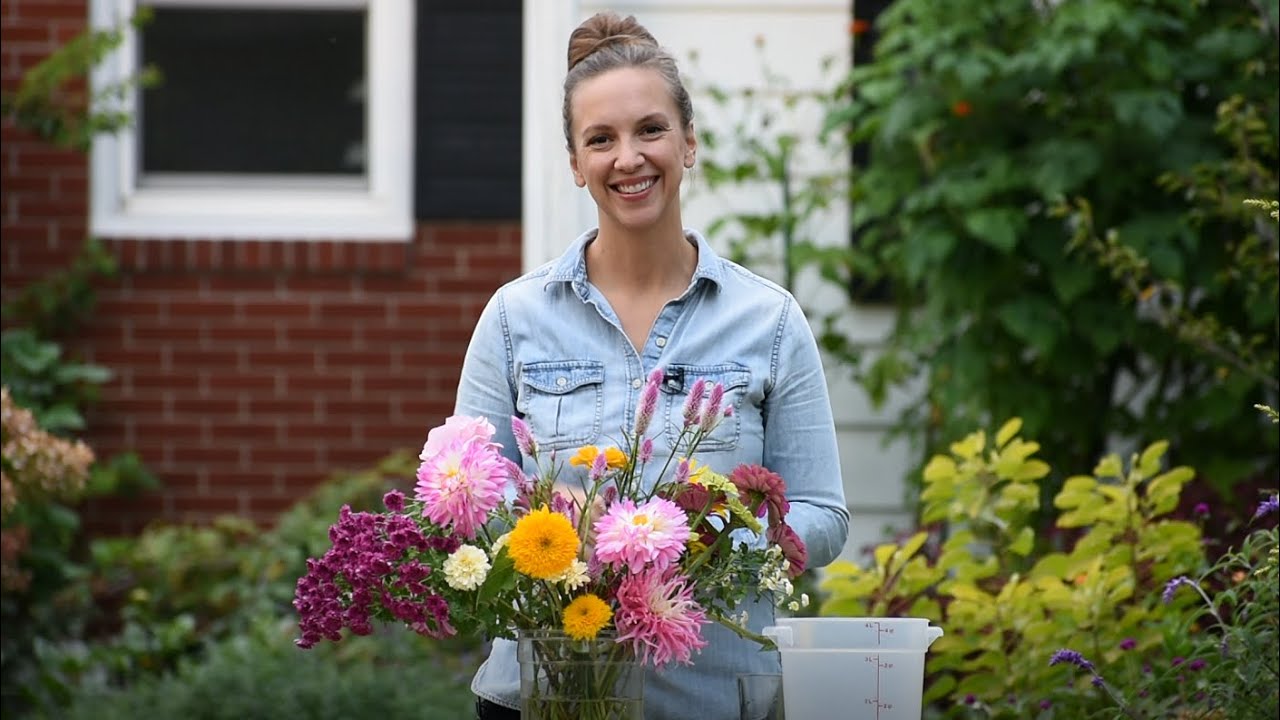
How to make cut flowers last longer
1. Cut in the early morning or the evening when the flowers are most hydrated. Flowers cut in the early morning or evening do not have to contend with the harsh heat stress of the day and will always last longer in the vase.
2. Always use clean tools and clean buckets. Bacteria is the enemy of cut flowers, and we don't want them to be cut with snips that have cleaned up diseased plants, or buckets that have never been scrubbed. So take care to always bring clean buckets and snips to the garden to cut. I like to say that you should be able to take a drink from your harvesting bucket of water, and cut a steak with your snips. That's how clean we want our buckets and tools.
3. Know the proper harvest stage for the flower and foliage you are picking. Different flowers have different requirements as to the best stage for harvest, and while it would take days to go over each flower a general rule of thumb we want to pick spike flowers at a third open, and disk flowers as they are just cracking open. There are certainly exceptions to this rule - for instance a zinnia shouldn't be picked until it's fully open and has a stiff neck, and a dahlia won't open much further in the vase. In general we want to pick the blooms before the bees can pollinate them - thus decreasing their vase life. However, it really is important to know what each particular flowers proper stage is - so I'm going to include some handy links below for reference. For foliage cuts - age is key. The more mature the foliage the less chance of it flopping in the vase. So look for darker colored older stems and always slice up vertically any woody stem.
4. Strip all the leaves that fall below the water line. As leaves break down they introduce bacteria into the water, which is always what we are trying to avoid. I prefer to strip all the leaves that would fall below the water line out in the garden, so that I never have to worry about this problem.
5. Cut the stem at an angle. A stem that is cut flat and sits flat at the bottom of the vase has two problems. It does not have a lot of exposed surface area to take up water, and it can often get clogged if it's sitting flat on the bottom of your vessel. So cut at an angle to increase water uptake surface area and to avoid the stem getting clogged.
6. Condition the flowers. Conditioning is the process where we let the flowers rest in their original water for many hours in order to rehydrate and recuperate from being cut. Giving them that long soak in a deep bucket of clean water will work wonders for the vase life of your blooms. I prefer to condition all my flowers overnight, but at least 4 hours in recommended.
7. When your ready to arrange - recut the stem. Once again this encourages the flower to take another drink.
8. Add flower food. Cut flowers need both sugar to eat, acicity to help them absord water, and a biocide to fend off bacteria. So adding flower food to the water gives them both these elements and will extend their vase life.
9. Keep your flowers in a cool spot away from bright light. An arrangement placed on a radiator with the sun shining on it through a window will fade much faster than one kept in a cool place away from the sun rays.
10. Change the water when needed. Depending on the type of flowers you pick will determine how quickly the water becomes mirky. The key here is to always have fresh and clean water in the vase. Depending on the arrangement you may want to pour out all the water, recut the stems, and place back into fresh water. However, sometimes with an arrangement made in a frog this is not possible. For more elaborate arrangements created with mechanics like frogs or chicken wire I like to do what I call flushing the vase. This is where we take the arrangement to the sink and run running water into the vessel. As the water runs the old water is pushed out and new clean water is added in.
Harvesting Guides Date: 2022-08-07
Kaitlin I-ve been wondering how people deal with changing water in arrangements with mechanics! These simple little things are so often skipped over by others in videos so this was really helpful. Thank you!
reply
Lyla How do you clean your snips between cuts? How many flowers do you cut before cleaning? Between each different plant? Between each different variety? Different type of plant?
reply
WhoElse What type are those purple flowers in the vase on the left? The clustered ones. They look beautiful. Also, the creamy white ones in the vase? Thank you!
reply
Mirla Probably the best tips ever. Thank you for your organization and not babbling. Us cut flower farmers appreciate it. Thank you!
reply
elvia Thank you so much for this video. I am just starting to learn about flowers and these types of videos are very useful.
reply
Joanna Thank your Danielle, such a great tips! Your vice make it easy to listen and remember, you are a lovely person!
reply
Jessica You're such a great teacher! I also appreciate how you speak in your videos. the pace and enunciation - reply