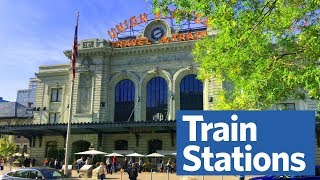
Train stations are making a comeback. But why?
video description
Date: 2019-09-12
Related videos





Comments and reviews: 10
Steven Barrett
When I was an 11 year old, my father was stationed in Wiesbaden, Germany. Just a few days after we landed, I took a stroll by myself (this is back in '62) and found myself going over the the city's Hauptbahnhof, a large redstone headhouse with several glass overhead sheds covering 12 terminal tracks. I was amazed. Utterly amazed. Because outside of passing through NYC's Grand Central Terminal during the late 50s, I'd never seen such a large and (most importantly) vibrant station. Granted, Wiesbaden wasn't heavily bombed like nearby Frankfurt. Nevertheless, Frankfurt managed to rebuild it's twice as big terminal glass-shed during Germany's comeback. I travelled to Berlin on the overnight Duty Train operated for the American, British and French Allies to be able to serve Berlin, help keep it free, etc. Sadly, there was at the time nothing but a small suburban station that was little more than a former freight unloading structure. Far cry from Frankfurt. I'd also been in Munich's bombed out terminal on a previous trip to Germany the decade before when we were living in Morocco. Hell, even the old beat-up and shed-less Hauptbahnhof was more lively than what many American stations serving large cities were to become shortly. Jump to the mid-Seventies. I was working for the Federal Courts in Boston and had to use the nearby South Station to catch a commuter (really old New Haven stock) to a suburb I was living in. If you were in the Service at any time (or your parents were) during the Sixties, there was an old joke about Germany's rapid recovery compared to our falling on our faces back home: Who won the war? Sie nicht vergessen das, richtig? Please. We didn't lose the war. We flushed the prosperity so many of our biggest blowhard politicians, the same ones who boast about the wonders of the private sector, who gouge every tax break for themselves while leaving the public sector a shambles and they have the nerve to say, See, where your taxes have gone? (Oh ho, don't ask them to tell you what's lining their bank accounts. Just look at Trump and his gang of thieves. What a lot, and what a load of a mentality they bring with them as they're denuding our public infrastructure. I'll never forget what South Station looked like and worse, smelled like throughout the much reduced head-house. A trashed out hall reeking with urine. And South Station, before Grand Central Terminal's completion in 1912, was THE nation's leading portal on land for the waves of immigrants. Not New York, but smaller (albeit closer) Boston for all the Europeans who later provided many of the sons who bravely liberated their parents and ancestors from the Nazis. Yes, the Germans had the Marshall Plan, but if people even try to mention that again here, they get the same reception that Joe Stalin gave it when it was conceived. He was afraid it would undermine Communism. Our ever-so brave capitalist leaders have since the inception of the Marshall Plan for Europe, all seem to be in tune when it comes to singing their praises of the free market system that allowed them to drain public transportation, write off urban areas and let our cities go to hell like Boston's sad example of South Station during the Sixties through Seventies. Oh yeah, they couldn't sing enough about the evils of Western European Democratic Socialism. Funny how, during the Eighties, Boston, the Comm. of Massachusetts and the region's private sector all worked together to recreate a vibrant and clean well-used South Station again. It's not as big as she once was, boasting a wide huge single structure shed, but she's back. Now that's making America great again
reply
When I was an 11 year old, my father was stationed in Wiesbaden, Germany. Just a few days after we landed, I took a stroll by myself (this is back in '62) and found myself going over the the city's Hauptbahnhof, a large redstone headhouse with several glass overhead sheds covering 12 terminal tracks. I was amazed. Utterly amazed. Because outside of passing through NYC's Grand Central Terminal during the late 50s, I'd never seen such a large and (most importantly) vibrant station. Granted, Wiesbaden wasn't heavily bombed like nearby Frankfurt. Nevertheless, Frankfurt managed to rebuild it's twice as big terminal glass-shed during Germany's comeback. I travelled to Berlin on the overnight Duty Train operated for the American, British and French Allies to be able to serve Berlin, help keep it free, etc. Sadly, there was at the time nothing but a small suburban station that was little more than a former freight unloading structure. Far cry from Frankfurt. I'd also been in Munich's bombed out terminal on a previous trip to Germany the decade before when we were living in Morocco. Hell, even the old beat-up and shed-less Hauptbahnhof was more lively than what many American stations serving large cities were to become shortly. Jump to the mid-Seventies. I was working for the Federal Courts in Boston and had to use the nearby South Station to catch a commuter (really old New Haven stock) to a suburb I was living in. If you were in the Service at any time (or your parents were) during the Sixties, there was an old joke about Germany's rapid recovery compared to our falling on our faces back home: Who won the war? Sie nicht vergessen das, richtig? Please. We didn't lose the war. We flushed the prosperity so many of our biggest blowhard politicians, the same ones who boast about the wonders of the private sector, who gouge every tax break for themselves while leaving the public sector a shambles and they have the nerve to say, See, where your taxes have gone? (Oh ho, don't ask them to tell you what's lining their bank accounts. Just look at Trump and his gang of thieves. What a lot, and what a load of a mentality they bring with them as they're denuding our public infrastructure. I'll never forget what South Station looked like and worse, smelled like throughout the much reduced head-house. A trashed out hall reeking with urine. And South Station, before Grand Central Terminal's completion in 1912, was THE nation's leading portal on land for the waves of immigrants. Not New York, but smaller (albeit closer) Boston for all the Europeans who later provided many of the sons who bravely liberated their parents and ancestors from the Nazis. Yes, the Germans had the Marshall Plan, but if people even try to mention that again here, they get the same reception that Joe Stalin gave it when it was conceived. He was afraid it would undermine Communism. Our ever-so brave capitalist leaders have since the inception of the Marshall Plan for Europe, all seem to be in tune when it comes to singing their praises of the free market system that allowed them to drain public transportation, write off urban areas and let our cities go to hell like Boston's sad example of South Station during the Sixties through Seventies. Oh yeah, they couldn't sing enough about the evils of Western European Democratic Socialism. Funny how, during the Eighties, Boston, the Comm. of Massachusetts and the region's private sector all worked together to recreate a vibrant and clean well-used South Station again. It's not as big as she once was, boasting a wide huge single structure shed, but she's back. Now that's making America great again
reply
Daniel Hillegus
Meanwhile my city is continuing to let the station rot to the ground. Beautiful building built by renow architect Louis Curtiss in 1911. The station is in Downtown Joplin, Mo. The name of the building is called the Joplin Union Depot. The city used to have an extensive trolley rail car network back in the early 1900s which for some reason was ripped out. I can't find any information on when the rail system was paved over or why. Its just rather unfortunate. I presume the rail systen was removed for urban renewal which is also around the timd a good chunk of historic buildings were destroyed for more parking lots. To this day Joplins Downtown suffers from an abundance of parking lots. At least the city has realized that and have donated one of the largest parking lots (memorial hall parking lot) in the city to be demollished and replaced with a brand new arts complex which is set to be completed in the first few years of the 2020s. I think a bug thing people overlook about urban renewel is the fact parking lots took over American main streets and choked them in much the same way freeways choked up the rest of a city. Thankfully the city didn't build a freeway cutting through downtown so there is that. I guaruntee you if the city was bigger in the 50s and 60s the city would have definitely built a massive freeway through Downtown. Thankfully the highway loop for Joplin is farther north so as to not disrupt anything. I'd love to hear your thoughts on all this. I know this vid is old and im late to commenting I just wanted to get this out here.
reply
Meanwhile my city is continuing to let the station rot to the ground. Beautiful building built by renow architect Louis Curtiss in 1911. The station is in Downtown Joplin, Mo. The name of the building is called the Joplin Union Depot. The city used to have an extensive trolley rail car network back in the early 1900s which for some reason was ripped out. I can't find any information on when the rail system was paved over or why. Its just rather unfortunate. I presume the rail systen was removed for urban renewal which is also around the timd a good chunk of historic buildings were destroyed for more parking lots. To this day Joplins Downtown suffers from an abundance of parking lots. At least the city has realized that and have donated one of the largest parking lots (memorial hall parking lot) in the city to be demollished and replaced with a brand new arts complex which is set to be completed in the first few years of the 2020s. I think a bug thing people overlook about urban renewel is the fact parking lots took over American main streets and choked them in much the same way freeways choked up the rest of a city. Thankfully the city didn't build a freeway cutting through downtown so there is that. I guaruntee you if the city was bigger in the 50s and 60s the city would have definitely built a massive freeway through Downtown. Thankfully the highway loop for Joplin is farther north so as to not disrupt anything. I'd love to hear your thoughts on all this. I know this vid is old and im late to commenting I just wanted to get this out here.
reply
Jason Tempest
Looking at Google Earth neither Buffalo's or Detroit's disused railway stations are near the downtown unlike Denver's Union Station. This severally limits their use without injecting massive funds and attractions into surrounding areas. Buffalo: For some reason I see Buffalo's disused station as either a university campus or the centerpiece of a specialized scientific or technology hub thus re-inventing Buffalo's future. I see proximity to many large US and Canadian cities as a bonus here. Detroit: Again the former railway station sits well outside the downtown core and cannot really be used as a transport hub. Given the availability of land in the area I would suggest a massive injection of capital (I know Detroit's bankrupt) into an entertainment and shopping precinct. The building itself just screams Casino/Hotel however if a large enough area surrounding the former station east of I75 to the river bounded by all those freeways was turned into some kind of special economic zone or tax free haven similar to City of London that included commercial investment aimed providing a foothold in North America without actually being on American or Canadian soil you may have an economic driver that can lift the rest of Detroit out of it's slump. The former station could be the poster child for the new Detroit. Just a thought.
reply
Looking at Google Earth neither Buffalo's or Detroit's disused railway stations are near the downtown unlike Denver's Union Station. This severally limits their use without injecting massive funds and attractions into surrounding areas. Buffalo: For some reason I see Buffalo's disused station as either a university campus or the centerpiece of a specialized scientific or technology hub thus re-inventing Buffalo's future. I see proximity to many large US and Canadian cities as a bonus here. Detroit: Again the former railway station sits well outside the downtown core and cannot really be used as a transport hub. Given the availability of land in the area I would suggest a massive injection of capital (I know Detroit's bankrupt) into an entertainment and shopping precinct. The building itself just screams Casino/Hotel however if a large enough area surrounding the former station east of I75 to the river bounded by all those freeways was turned into some kind of special economic zone or tax free haven similar to City of London that included commercial investment aimed providing a foothold in North America without actually being on American or Canadian soil you may have an economic driver that can lift the rest of Detroit out of it's slump. The former station could be the poster child for the new Detroit. Just a thought.
reply
Andrew Chiu-kit Tsang
There is something very similar has been happening in Auckland, New Zealand, where the original downtown train terminal was not located at the heart of the city centre. The train line extended eastward reaching the underground of the old General Post Office at the north end of Queen Street and five minutes walk away from the ferry terminal. The old post office refurbished becomes the Britomart Transport Centre. There were a lot of empty factory warehouses and office blocks in Downtown Auckland. They have been transformed into apartments or tertiary education establishment. Auckland's real estate boom has been gone much further fuel by the influx of wealthy immigrants, overseas students and tourists from Asia. The original downtown train terminal has been transformed into a hostel. A shopping centre opposite the east end of Britomart is now demolished and it will accommodate the future expansion of the transport hub. Auckland used to have low usage of public transport but Britomart is now proven to be a real game changer. Patronage on Auckland's rail network reached 19 million in April 2017.
reply
There is something very similar has been happening in Auckland, New Zealand, where the original downtown train terminal was not located at the heart of the city centre. The train line extended eastward reaching the underground of the old General Post Office at the north end of Queen Street and five minutes walk away from the ferry terminal. The old post office refurbished becomes the Britomart Transport Centre. There were a lot of empty factory warehouses and office blocks in Downtown Auckland. They have been transformed into apartments or tertiary education establishment. Auckland's real estate boom has been gone much further fuel by the influx of wealthy immigrants, overseas students and tourists from Asia. The original downtown train terminal has been transformed into a hostel. A shopping centre opposite the east end of Britomart is now demolished and it will accommodate the future expansion of the transport hub. Auckland used to have low usage of public transport but Britomart is now proven to be a real game changer. Patronage on Auckland's rail network reached 19 million in April 2017.
reply
John Labus
As part of a renaissance of Raleigh's warehouse district, an entirely new Union Station nears completion from the shell of a mid-century warehouse. As a city that didn't really have any size or national significance when most of the country's grand stations were being built, Raleigh doesn't have a grand old station to restore. Instead, it's getting a very modern architecture station. The warehouse being renovated was a simple building without redeeming architectural features, and there wasn't really anything to save. Following in the footsteps of recent warehouse renovations that house a new contemporary art museum and Raleigh's site for Citrix Systems, the new Union Station is being built simultaneously and across the street from a significant 1-1/2 block mixed use project that rose from another brick warehouse. This one includes a tower whose skin at its lowest levels is the old warehouse facade. A block north, another warehouse is being converted to a food hall; it's across the street from the expanding Citrix operations.
reply
As part of a renaissance of Raleigh's warehouse district, an entirely new Union Station nears completion from the shell of a mid-century warehouse. As a city that didn't really have any size or national significance when most of the country's grand stations were being built, Raleigh doesn't have a grand old station to restore. Instead, it's getting a very modern architecture station. The warehouse being renovated was a simple building without redeeming architectural features, and there wasn't really anything to save. Following in the footsteps of recent warehouse renovations that house a new contemporary art museum and Raleigh's site for Citrix Systems, the new Union Station is being built simultaneously and across the street from a significant 1-1/2 block mixed use project that rose from another brick warehouse. This one includes a tower whose skin at its lowest levels is the old warehouse facade. A block north, another warehouse is being converted to a food hall; it's across the street from the expanding Citrix operations.
reply
mattieb gaming
The Buffalo central train station has been saved but battles financial problems frequently along with low land value surrounding the station. The station is used though, but not in any of the ways you have mentioned. Along with Jamestown's rail station (Jamestown NY, also known as Lucy town, for Lucial Ball growing up in Jamestown) both are used in model train shows along with special events. The Jamestown train station is about an hour and a half south of Buffalo but has been almost completely repaired to its original glory with one of the old street trolleys being repaired to its original glory. Sadly the Buffalo station has not been so lucky with the emense size of it needing critical repair and in 2009 the pedestrian path from the main building to the platforms has been removed to allow for taller freight trains to pass underneith. So hopefully Buffalo will bring back the Grand central station but it will take tons of money and time.
reply
The Buffalo central train station has been saved but battles financial problems frequently along with low land value surrounding the station. The station is used though, but not in any of the ways you have mentioned. Along with Jamestown's rail station (Jamestown NY, also known as Lucy town, for Lucial Ball growing up in Jamestown) both are used in model train shows along with special events. The Jamestown train station is about an hour and a half south of Buffalo but has been almost completely repaired to its original glory with one of the old street trolleys being repaired to its original glory. Sadly the Buffalo station has not been so lucky with the emense size of it needing critical repair and in 2009 the pedestrian path from the main building to the platforms has been removed to allow for taller freight trains to pass underneith. So hopefully Buffalo will bring back the Grand central station but it will take tons of money and time.
reply
Native Texan
I love trains. They're so cool. But the reason that they aren't gaining as much momentum is because of how inefficient they are. I live in San Antonio. If I were to take Amtrak from SA to Austin, it would take 2 hours and 23 minutes. If I drive from one station to the other, it would take me 1 hour and 17 minutes. It takes an hour longer to go by train. Amusingly, if I took Greyhound, from Greyhound station to Greyhound station, it would be from 1: 30 to 1: 50. The longer route includes stops in two or three towns along the way. Sadly, trains are just inefficient here in the US. Oh, and if I wanted to go to Vegas from SA, it would take me 70 hours going to San Antonio to St Louis MO, hop another train to Kansas City MO, then another train to Kingman AZ, then finally one more train to Las Vegas NV. Greyhound can get me there in as little as 1 transfer resulting in a 33. 5 hour trip. Frontier Airlines can get me there in 3 hours.
reply
I love trains. They're so cool. But the reason that they aren't gaining as much momentum is because of how inefficient they are. I live in San Antonio. If I were to take Amtrak from SA to Austin, it would take 2 hours and 23 minutes. If I drive from one station to the other, it would take me 1 hour and 17 minutes. It takes an hour longer to go by train. Amusingly, if I took Greyhound, from Greyhound station to Greyhound station, it would be from 1: 30 to 1: 50. The longer route includes stops in two or three towns along the way. Sadly, trains are just inefficient here in the US. Oh, and if I wanted to go to Vegas from SA, it would take me 70 hours going to San Antonio to St Louis MO, hop another train to Kansas City MO, then another train to Kingman AZ, then finally one more train to Las Vegas NV. Greyhound can get me there in as little as 1 transfer resulting in a 33. 5 hour trip. Frontier Airlines can get me there in 3 hours.
reply
Call Me Swivel Hips
If American cities are going to stay relevant going into the 21st and 22nd centuries, it is absolutely crucial we fix our car and poor transport network problems. Cars and dense city centers just do not mix. Cars take up too much space leading to grid lock, as well as noise and smog pollution. These mass transit revitalization efforts are key to our cities staying relevant on the global stage, especially when developed in conjunction with other crucial city structural parts. Such as is mentioned, mixed high density zones. Good city design is about connection, right? SO LET'S CONNECT PEOPLE WHILE REMOVING THOSE DAMN CARS The more time people can spend downtown without needing to drive home means they'll be able to spend more money, feeding back into the system
reply
If American cities are going to stay relevant going into the 21st and 22nd centuries, it is absolutely crucial we fix our car and poor transport network problems. Cars and dense city centers just do not mix. Cars take up too much space leading to grid lock, as well as noise and smog pollution. These mass transit revitalization efforts are key to our cities staying relevant on the global stage, especially when developed in conjunction with other crucial city structural parts. Such as is mentioned, mixed high density zones. Good city design is about connection, right? SO LET'S CONNECT PEOPLE WHILE REMOVING THOSE DAMN CARS The more time people can spend downtown without needing to drive home means they'll be able to spend more money, feeding back into the system
reply
Don Parkison
The places with the most successful rail service are much higher density with much shorter distances. UK / Europe, Japan & the North East corridor of the US as examples. What is spurring the usefulness of these terminals is Light Rail, not inter city travel. Denver was able to kick start its light rail system shortly after Portland built theirs, but believe me, it was barely passed and a lot of conservatives fought it tooth and nail. So, Light Rail is key and convincing people to pay for it is the difficulty. But Denver is reaping the rewards now as one of the hottest real estate markets in the country.
reply
The places with the most successful rail service are much higher density with much shorter distances. UK / Europe, Japan & the North East corridor of the US as examples. What is spurring the usefulness of these terminals is Light Rail, not inter city travel. Denver was able to kick start its light rail system shortly after Portland built theirs, but believe me, it was barely passed and a lot of conservatives fought it tooth and nail. So, Light Rail is key and convincing people to pay for it is the difficulty. But Denver is reaping the rewards now as one of the hottest real estate markets in the country.
reply
jokka83
Hi. I am a guy that often chooses my vacation destinations for the cities sizes and quality of transportation. Since I live in Oslo, my travel to paris is perfect due to a girlfriend and its city intresting architcture and transportation system. When I watch your videos, I feel a lot of US cities miss this quality which I set high. So my question to you, is that I would like you do some videos on Chinese or Japanese cities which really gets public transportation and city planning right. Yes, cities in Europe get it right too, but the scale and tech in Japan and China is on a much more up to date level.
reply
Hi. I am a guy that often chooses my vacation destinations for the cities sizes and quality of transportation. Since I live in Oslo, my travel to paris is perfect due to a girlfriend and its city intresting architcture and transportation system. When I watch your videos, I feel a lot of US cities miss this quality which I set high. So my question to you, is that I would like you do some videos on Chinese or Japanese cities which really gets public transportation and city planning right. Yes, cities in Europe get it right too, but the scale and tech in Japan and China is on a much more up to date level.
reply
Add a review, comment
Other channel videos