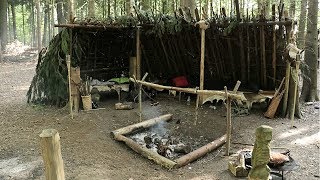
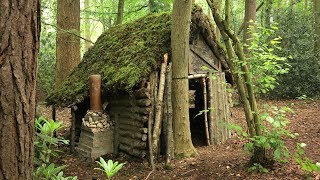
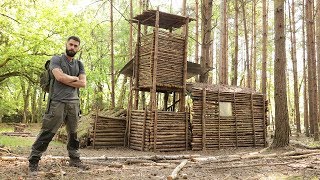
Building a Turf Roof Viking House with Hand Tools: Bushcraft Project (PART 1)
video description
Date: 2019-10-29
Related videos






Comments and reviews: 10
Objective Observer
Clarifying your permissions is always a good thing. Encouraging others to be respectful of the land and it's owners; again, always a good thing. Absolutely, you should include this in your description of every building video: those are your 'disclaimers. 'For those whining and whinging that you do this only for the view counts- this is your job. This is your business. Of Course you are doing this for the view counts; and that's a good thing. I've told several you tubers: Diversification is the key to survival when you are self employed and an entrepreneur. There are many many Bushcrafters and Campers on YT. We can vicariously go camping across the globe, YOUR BUILDING PROJECTS ARE UNIQUE. There aren't but a handful of folks building primitive structures, and even fewer building them in historic styles. Your Teaching background is serving you well. You can see the value of these projects beyond our entertainment: you are teaching us all kinds of skills and lessons that the Bushcrafters are not. They don't include the History and archetecture of a place. As long as you are successful with your videos, keep doing what you are doing. The complainers are envious of what you can do, and they can take a long walk off a short pier. I thoroughly enjoy you quiet videos, where I get to see a part of the world, I will never get to visit. I get to hear the sounds of this place, I will never get to visit. You take me places, that are beyond what my body is capable of doing. I am grateful. Stay the course, kind sir, it is true and worthy.
reply
Clarifying your permissions is always a good thing. Encouraging others to be respectful of the land and it's owners; again, always a good thing. Absolutely, you should include this in your description of every building video: those are your 'disclaimers. 'For those whining and whinging that you do this only for the view counts- this is your job. This is your business. Of Course you are doing this for the view counts; and that's a good thing. I've told several you tubers: Diversification is the key to survival when you are self employed and an entrepreneur. There are many many Bushcrafters and Campers on YT. We can vicariously go camping across the globe, YOUR BUILDING PROJECTS ARE UNIQUE. There aren't but a handful of folks building primitive structures, and even fewer building them in historic styles. Your Teaching background is serving you well. You can see the value of these projects beyond our entertainment: you are teaching us all kinds of skills and lessons that the Bushcrafters are not. They don't include the History and archetecture of a place. As long as you are successful with your videos, keep doing what you are doing. The complainers are envious of what you can do, and they can take a long walk off a short pier. I thoroughly enjoy you quiet videos, where I get to see a part of the world, I will never get to visit. I get to hear the sounds of this place, I will never get to visit. You take me places, that are beyond what my body is capable of doing. I am grateful. Stay the course, kind sir, it is true and worthy.
reply
bdctrans70
For turf, you need a good green web to hold the slabs of earth together. Find an area that has a thick moss cover, or a grass meadow that will have an established green web built in. You need at least a four inch depth of earth on your slabs to hold them together when it rains or snows, and an allowance for it to shrink in hot weather. You are going to source your product outside of the woodland. The cover is way too light to withhold the demands for your roof and sidewalls. Or, if there is a sod farm that have scraps that are not perfect for commercial use, you can get them close to nothing at this time of year. They will be reseeding the turfs in the fall for a good spring crop. Or if a neighbor is wanting a new lawn and you could remove the turf off of their lawns for them. But you do need to source it outside of your woodland. Best of luck
reply
For turf, you need a good green web to hold the slabs of earth together. Find an area that has a thick moss cover, or a grass meadow that will have an established green web built in. You need at least a four inch depth of earth on your slabs to hold them together when it rains or snows, and an allowance for it to shrink in hot weather. You are going to source your product outside of the woodland. The cover is way too light to withhold the demands for your roof and sidewalls. Or, if there is a sod farm that have scraps that are not perfect for commercial use, you can get them close to nothing at this time of year. They will be reseeding the turfs in the fall for a good spring crop. Or if a neighbor is wanting a new lawn and you could remove the turf off of their lawns for them. But you do need to source it outside of your woodland. Best of luck
reply
chris osh
All the questions you have just answered, you have answered in previous videos, about private land, the fact that the structures are used in education etc. Sometimes I think people are more interested in criticising than watching or, more importantly in this case, listening. I find these builds fascinating, partly because I would do a lot of things differently and it's interesting to see why you do what you do but also because it's enjoyable to watch people create, to label it all as click bait is asinine.
reply
All the questions you have just answered, you have answered in previous videos, about private land, the fact that the structures are used in education etc. Sometimes I think people are more interested in criticising than watching or, more importantly in this case, listening. I find these builds fascinating, partly because I would do a lot of things differently and it's interesting to see why you do what you do but also because it's enjoyable to watch people create, to label it all as click bait is asinine.
reply
Richard Frazee
The biggest thing I see you doing, (A good thing, is you are using DEAD WOOD to build everything. The sawing, using a draw-knife and drilling all create wood chips which break down quicker than the whole trees that are left standing. Also, by removing those dead trees you are opening up the forest to more sun light for things to grow. Keep up the good work and may God continue to bless you and keep you safe from harm.
reply
The biggest thing I see you doing, (A good thing, is you are using DEAD WOOD to build everything. The sawing, using a draw-knife and drilling all create wood chips which break down quicker than the whole trees that are left standing. Also, by removing those dead trees you are opening up the forest to more sun light for things to grow. Keep up the good work and may God continue to bless you and keep you safe from harm.
reply
Grim Adventures of Bushcraft and Hiking
Bushcraft isn't just leave no trace, it's skills, understanding and the ability to survive and thrive in the wilderness. What you're doing here is to me more advanced bushcraft. You're absolutely right unless it's your land or land you have permission to be on leave no trace. Always great to hear some of the next generation is still wanting to get outside.
reply
Bushcraft isn't just leave no trace, it's skills, understanding and the ability to survive and thrive in the wilderness. What you're doing here is to me more advanced bushcraft. You're absolutely right unless it's your land or land you have permission to be on leave no trace. Always great to hear some of the next generation is still wanting to get outside.
reply
KlazyY
This sort of reminds me of the soddies (sod houses) built by our early westward moving pioneers on the prairies of America where there were few trees to speak of. Many of them just disassembled their wagons for the wood to keep the walls from washing away in the seasonal storms. Leastwise, that's what the history books of my childhood said. ..
reply
This sort of reminds me of the soddies (sod houses) built by our early westward moving pioneers on the prairies of America where there were few trees to speak of. Many of them just disassembled their wagons for the wood to keep the walls from washing away in the seasonal storms. Leastwise, that's what the history books of my childhood said. ..
reply
richard Turk
I wonder why you use the word yeah or so yeah in the middle of a sentence? I notice you and Survival Lilly on YT both do that. Must be a European thing. Really annoying because the sentence is explaining what you are doing/conveying a thought and using yeah in the wrong place really screws up your sentence structure.
reply
I wonder why you use the word yeah or so yeah in the middle of a sentence? I notice you and Survival Lilly on YT both do that. Must be a European thing. Really annoying because the sentence is explaining what you are doing/conveying a thought and using yeah in the wrong place really screws up your sentence structure.
reply
movinon04
OMG-- TY TY- for doing this series-- i was so hoping you would build a turf house-- i cant wait to come along and see the ups and downs of this-Turf houses make the most sense of any building type in history-- far superior to even modern building practices--- good luck and many blessings on this build. Glo
reply
OMG-- TY TY- for doing this series-- i was so hoping you would build a turf house-- i cant wait to come along and see the ups and downs of this-Turf houses make the most sense of any building type in history-- far superior to even modern building practices--- good luck and many blessings on this build. Glo
reply
Alex Sell
Love your videos. Love the banter between you, your old man & Dustin in the previous Viking house build. These videos have inspired me to go out and attempt to build my own camp shelter. I'm hoping to build something like your bushcraft super shelter for me and my mates to camp out in.
reply
Love your videos. Love the banter between you, your old man & Dustin in the previous Viking house build. These videos have inspired me to go out and attempt to build my own camp shelter. I'm hoping to build something like your bushcraft super shelter for me and my mates to camp out in.
reply
OldSaltyOne OSO
Ponders if that's the axe head that Alec Steele made you. Also a project idea for you Mike. A semi Dug out house half dug into the earth with a roof tall enough and hole in the ground deep enough where just the tops of the roof is at ground level. That would be interesting.
reply
Ponders if that's the axe head that Alec Steele made you. Also a project idea for you Mike. A semi Dug out house half dug into the earth with a roof tall enough and hole in the ground deep enough where just the tops of the roof is at ground level. That would be interesting.
reply
Add a review, comment
Other channel videos