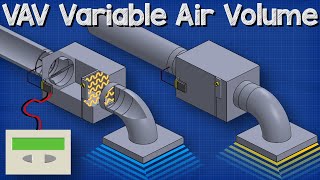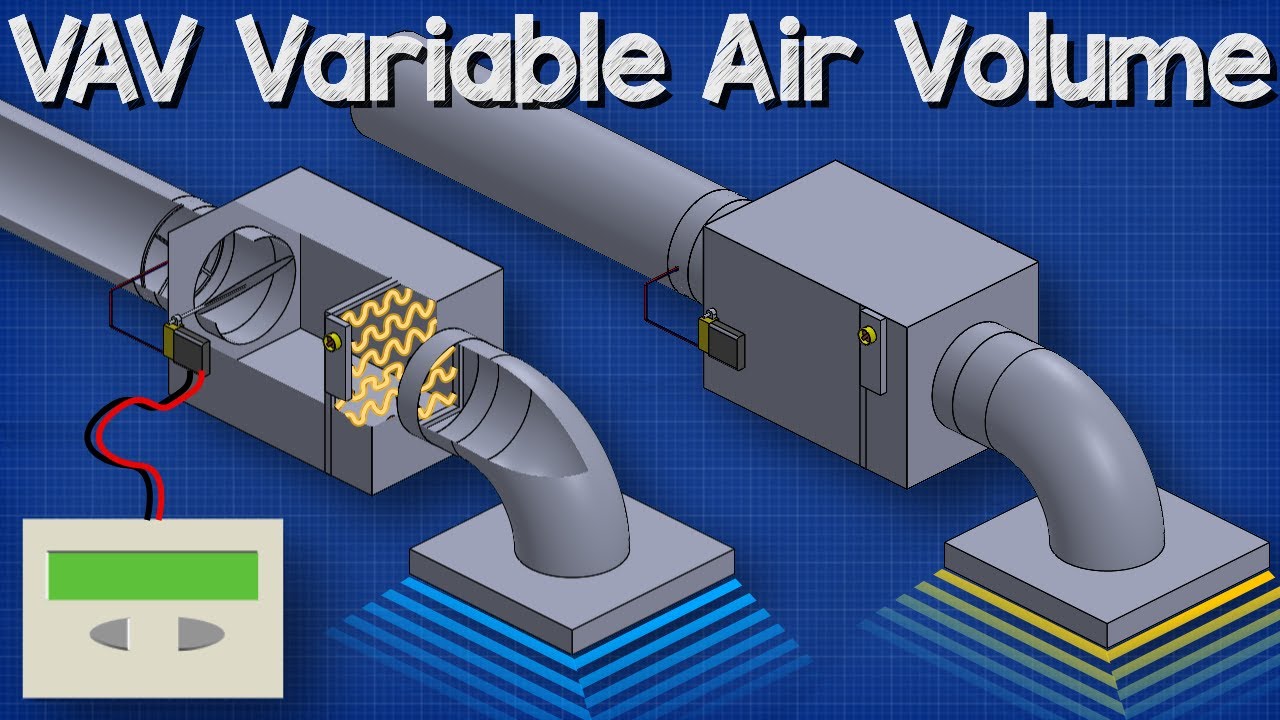
VAV Variable Air Volume - HVAC system basics hvacr
video description
Date: 2023-11-17
Related videos





Comments and reviews: 30
Stomachbuzz
It's now interesting to watch this video, as this is literally my job despite not having even heard of a VAV system 6 months ago.
My job is the controller aspect of the system. Tweaking internal coding, values, confirming everything is operational, and networking all of them together and to the central BMS mainframe.
I want to make a few notes:
First of all, this is a perfect example of a concept I am quite fond of: increasing resolution of a system by adding more discrete units to it.
For example, the old way would have been to have a Constant Volume AHU blasting air to every space of every floor no matter the actual temperature in those specific areas.
Possibly oversimplified as just heat or cool for the ENTIRE building.
Then maybe you segregate each floor to have independent control. Probably better as heat rises, so the top floor needs less heat than the basement.
Then, within each floor, you add these VAV units to greatly increase local temperature control.
LOCAL is the key word.
But it is always a compromise of ultimate local control vs cost and complexity.
Rarely does every single office room have its own thermostat and VAV. Usually one stat will control air for 3-5 rooms.
On the other hand, some large open spaces may have several thermostats in each corner for example, each one controlling an independent VAV.
Long ago, these units were actually pneumatic controlled. Now they are all digital control.
Even a small office building may have 30-40 of these VAVs per floor.
They usually can operate independently, in case of network failure, but can be monitored and controlled from an executive front end.
The key concept here is modulation in the controls.
The damper can be anywhere from 0-100%, constantly modulating to maintain setpoint. It may only modulate by 1 or 2%.
The controllers use PID control algorithms to maintain setpoint.
Monitoring input data such as room temp, discharge temp from the VAV, occupancy mode, and others.
It is a bottom-up system.
Each VAV modulates independently to its assigned room temperature.
The AHU then modulates its speed (via VFD) to maintain setpoint (static duct pressure) in reaction to VAVs opening or closing.
Another note is that the duct pressure sensor I've always heard to be 2/3 down the duct, not at the very end, which is interesting.
The AHU uses chilled water to cool tbe supply air. The outside air compressor, or chiller, then modulates itself based on the return temperature of that chilled water.
Many systems now take into account air quality, mostly CO2 data, but also room humidity.
When possible, the AHUs will open their outside dampers to use cooler outside air, known as economy mode or 'free cooling'.
Regardless of outside air temp, that outside air damper must remain open to a certain degree for CO2 regulation.
So the damper opens with low outside air temps, and closes with warm outside air Temps, and also regulates itself on CO2 content.
Electric reheaters in the VAV boxes are becoming increasingly common. Value engineering
Electric boxes are cheaper and easier to make and install.
Just run power (usually 277v) and done! The alternative is hot water reheat, which requires water pipes running to (and from) each box and a valve actuator.
The flip-side is that Electric heat is very expensive.
Additionally, buildings usually only have reheat boxes (of any kind) along the perimeter of the building. The central VAVs are typically cooling only.
Fan-powered boxes do exist, but are rather uncommon in my experience.
reply
It's now interesting to watch this video, as this is literally my job despite not having even heard of a VAV system 6 months ago.
My job is the controller aspect of the system. Tweaking internal coding, values, confirming everything is operational, and networking all of them together and to the central BMS mainframe.
I want to make a few notes:
First of all, this is a perfect example of a concept I am quite fond of: increasing resolution of a system by adding more discrete units to it.
For example, the old way would have been to have a Constant Volume AHU blasting air to every space of every floor no matter the actual temperature in those specific areas.
Possibly oversimplified as just heat or cool for the ENTIRE building.
Then maybe you segregate each floor to have independent control. Probably better as heat rises, so the top floor needs less heat than the basement.
Then, within each floor, you add these VAV units to greatly increase local temperature control.
LOCAL is the key word.
But it is always a compromise of ultimate local control vs cost and complexity.
Rarely does every single office room have its own thermostat and VAV. Usually one stat will control air for 3-5 rooms.
On the other hand, some large open spaces may have several thermostats in each corner for example, each one controlling an independent VAV.
Long ago, these units were actually pneumatic controlled. Now they are all digital control.
Even a small office building may have 30-40 of these VAVs per floor.
They usually can operate independently, in case of network failure, but can be monitored and controlled from an executive front end.
The key concept here is modulation in the controls.
The damper can be anywhere from 0-100%, constantly modulating to maintain setpoint. It may only modulate by 1 or 2%.
The controllers use PID control algorithms to maintain setpoint.
Monitoring input data such as room temp, discharge temp from the VAV, occupancy mode, and others.
It is a bottom-up system.
Each VAV modulates independently to its assigned room temperature.
The AHU then modulates its speed (via VFD) to maintain setpoint (static duct pressure) in reaction to VAVs opening or closing.
Another note is that the duct pressure sensor I've always heard to be 2/3 down the duct, not at the very end, which is interesting.
The AHU uses chilled water to cool tbe supply air. The outside air compressor, or chiller, then modulates itself based on the return temperature of that chilled water.
Many systems now take into account air quality, mostly CO2 data, but also room humidity.
When possible, the AHUs will open their outside dampers to use cooler outside air, known as economy mode or 'free cooling'.
Regardless of outside air temp, that outside air damper must remain open to a certain degree for CO2 regulation.
So the damper opens with low outside air temps, and closes with warm outside air Temps, and also regulates itself on CO2 content.
Electric reheaters in the VAV boxes are becoming increasingly common. Value engineering
Electric boxes are cheaper and easier to make and install.
Just run power (usually 277v) and done! The alternative is hot water reheat, which requires water pipes running to (and from) each box and a valve actuator.
The flip-side is that Electric heat is very expensive.
Additionally, buildings usually only have reheat boxes (of any kind) along the perimeter of the building. The central VAVs are typically cooling only.
Fan-powered boxes do exist, but are rather uncommon in my experience.
reply
Ron
With a lot of real life VAV experience I have to say that you do not want to exhaust all or most of your return air. In cold conditions (30's and 40's in Southern California) it is better to exhaust a portion of the air (typically 20% for indoor air quality) and recycle most of the warm air because it is very hard and expensive to bring this cold OSA air up to a high enough temperature to heat the room. Conversely, in the summer, you do not want to exhaust you building air that you have cooled to the low 70's and bring in 105 degrees outside air and try to cool it. Normally there is what is called a mixed air control, and you can modulate your return air and outside air to get proper mixed air temp. In this senario. during cold conditions you can maintain a 60 mixed air temp that is easy to heat and the cold air can cool the room ( called an economizer function) without any expensive mechanical cooling. As the outside air reaches mild temperature, then you can go into full outside air supply for air quality purposes. As temperatures increase. then usually the system will do an enthalpy calculation on the return air and OSA, and exhaust whichever one has a higher heat content. As OSA temperatures increase then it will go back to the 20% OSA mix for efficient cooling. Also reheat is unnecessary and expensive. A better system has is what is called a hot deck and a cold deck in the unit and each zone has its own duct with 2 damper actuators, one hot and one cold, that way the system can vary the amount of hot or cold constant temperature air to the room but never mixes them which is very energy wastefull, especially with highly costly and inefficient strip heaters.
reply
With a lot of real life VAV experience I have to say that you do not want to exhaust all or most of your return air. In cold conditions (30's and 40's in Southern California) it is better to exhaust a portion of the air (typically 20% for indoor air quality) and recycle most of the warm air because it is very hard and expensive to bring this cold OSA air up to a high enough temperature to heat the room. Conversely, in the summer, you do not want to exhaust you building air that you have cooled to the low 70's and bring in 105 degrees outside air and try to cool it. Normally there is what is called a mixed air control, and you can modulate your return air and outside air to get proper mixed air temp. In this senario. during cold conditions you can maintain a 60 mixed air temp that is easy to heat and the cold air can cool the room ( called an economizer function) without any expensive mechanical cooling. As the outside air reaches mild temperature, then you can go into full outside air supply for air quality purposes. As temperatures increase. then usually the system will do an enthalpy calculation on the return air and OSA, and exhaust whichever one has a higher heat content. As OSA temperatures increase then it will go back to the 20% OSA mix for efficient cooling. Also reheat is unnecessary and expensive. A better system has is what is called a hot deck and a cold deck in the unit and each zone has its own duct with 2 damper actuators, one hot and one cold, that way the system can vary the amount of hot or cold constant temperature air to the room but never mixes them which is very energy wastefull, especially with highly costly and inefficient strip heaters.
reply
Brian
Hey Paul, Im a huge fan of your videos. I have a question I wanted to ask, feel free to respond or disregard this inquiry at your discretion.
I manage the facilities for a commercial space that has a single zone totaling 786, 000 cubic feet. The design intent for this areas HVAC is a single zone VAV system, served by a total of 7 package RTUs dedicated to this one space, each unit can move up to 21, 500 cfm of airflow and is equipped with power exhaust fans.
My question is, can a large single zone such as this be served by 7 RTUs all operating in single zone VAV operation, or should they all be utilizing duct static pressure for fan speed controls? I will also point out that these units do not communicate with each other as the BAS can only support setpoint adjustment, so each units fan speed adjusts to its individual zone temperature reading via a zone thermostat.
Apologies for writing this long form, but I didnt want to miss any pertinent details. Again please disregard answering this if so inclined, just wanted to see if I could get someone elses input. Keep making videos my friend, you do an excellent job!
reply
Hey Paul, Im a huge fan of your videos. I have a question I wanted to ask, feel free to respond or disregard this inquiry at your discretion.
I manage the facilities for a commercial space that has a single zone totaling 786, 000 cubic feet. The design intent for this areas HVAC is a single zone VAV system, served by a total of 7 package RTUs dedicated to this one space, each unit can move up to 21, 500 cfm of airflow and is equipped with power exhaust fans.
My question is, can a large single zone such as this be served by 7 RTUs all operating in single zone VAV operation, or should they all be utilizing duct static pressure for fan speed controls? I will also point out that these units do not communicate with each other as the BAS can only support setpoint adjustment, so each units fan speed adjusts to its individual zone temperature reading via a zone thermostat.
Apologies for writing this long form, but I didnt want to miss any pertinent details. Again please disregard answering this if so inclined, just wanted to see if I could get someone elses input. Keep making videos my friend, you do an excellent job!
reply
Ryan
For what its worth, network and server rooms should not be on a buildings VAV system. These rooms typically require constant cooling which is super inefficient as the AHU has to run all night/weekend. Also, return air is a common feature. Local codes only dictate the amount of fresh air per occupant or square foot, they dont prohibit the return air.
reply
For what its worth, network and server rooms should not be on a buildings VAV system. These rooms typically require constant cooling which is super inefficient as the AHU has to run all night/weekend. Also, return air is a common feature. Local codes only dictate the amount of fresh air per occupant or square foot, they dont prohibit the return air.
reply
Young
An important thing to bear in mind is that many HVAC systems will contain a butterfly valve near the VAV system to back-feed the air back to the source. This valve is often wired to the thermostat via a mechatronic system. This is one of the many ways in which an HVAC system will modulate the air supply to produce comfortable conditions.
reply
An important thing to bear in mind is that many HVAC systems will contain a butterfly valve near the VAV system to back-feed the air back to the source. This valve is often wired to the thermostat via a mechatronic system. This is one of the many ways in which an HVAC system will modulate the air supply to produce comfortable conditions.
reply
Young
Depending on the building layout, a large HVAC system can contain one VAV or dozens (or hundreds)which is to be decided jointly by the customers and the mechanical engineers. The reasons for an increased number of VAVs are many, with the predominant reason being a need for more varied temperatures across the building.
reply
Depending on the building layout, a large HVAC system can contain one VAV or dozens (or hundreds)which is to be decided jointly by the customers and the mechanical engineers. The reasons for an increased number of VAVs are many, with the predominant reason being a need for more varied temperatures across the building.
reply
dietydevil
You didn't explain when the heater is going to trigger and what should be the airflow setpoint to cause the heater to trigger, there is heat and reheat and reheater has a certain value, if the airflow doesn't meet that value, the heater won't work
reply
You didn't explain when the heater is going to trigger and what should be the airflow setpoint to cause the heater to trigger, there is heat and reheat and reheater has a certain value, if the airflow doesn't meet that value, the heater won't work
reply
Ramz718
Most of what you explained in this video is correct except when there is a high demand for a VAV terminal to provide more cooling it will output maximum design air flow programmed in the controller instead of positioning the damper full open.
reply
Most of what you explained in this video is correct except when there is a high demand for a VAV terminal to provide more cooling it will output maximum design air flow programmed in the controller instead of positioning the damper full open.
reply
Rajat
Can you please explain how a clean room is designed?
Actually we are having a clean room but our a. h. u. outdoor units compressors gets faulty many times in summers so I want to just know the parameters of designing a clean room.
reply
Can you please explain how a clean room is designed?
Actually we are having a clean room but our a. h. u. outdoor units compressors gets faulty many times in summers so I want to just know the parameters of designing a clean room.
reply
Renn
HVAC design engineer and NEBB certified TAB contractor here. Your vids are excellentwell done. As a TAB contractor, two of my favorite things are (1) Siemens Controls and (2) Autoflow valves for flow control on the VAV boxes.
reply
HVAC design engineer and NEBB certified TAB contractor here. Your vids are excellentwell done. As a TAB contractor, two of my favorite things are (1) Siemens Controls and (2) Autoflow valves for flow control on the VAV boxes.
reply
Sagittarius
how come a hospital project has a vav on the return ductwork? (ducted return. this is not connected to the fan assists, it goes to a main return ductwork. does this vav serve like a return air fan? please explain. thx
reply
how come a hospital project has a vav on the return ductwork? (ducted return. this is not connected to the fan assists, it goes to a main return ductwork. does this vav serve like a return air fan? please explain. thx
reply
Adam
So, assuming that the system is running, and VAVs are open partially, how would the main air blower be adjusted? To avoid high pressure within duct resulted from the VAVs being partially opened? Are blowers VFDs driven?
reply
So, assuming that the system is running, and VAVs are open partially, how would the main air blower be adjusted? To avoid high pressure within duct resulted from the VAVs being partially opened? Are blowers VFDs driven?
reply
Lea
The fan assist explanation uses a parallel box but adds the explanation from a series box (constant flow) where the fan in in a different location within the box. This can be confusing to a student.
reply
The fan assist explanation uses a parallel box but adds the explanation from a series box (constant flow) where the fan in in a different location within the box. This can be confusing to a student.
reply
Mark
Nicely done. As a control's technician for 34 years, having started up and commissioned several 1, 000's of these things, I agree with all that you have put forth in this Video. Great work.
reply
Nicely done. As a control's technician for 34 years, having started up and commissioned several 1, 000's of these things, I agree with all that you have put forth in this Video. Great work.
reply
Pig
2: 20 you make it sound like its unusual to use return air. Theres a reason its called a return duct and not an exhaust duct. Its a huge waste of energy to exhaust more air than necessary.
reply
2: 20 you make it sound like its unusual to use return air. Theres a reason its called a return duct and not an exhaust duct. Its a huge waste of energy to exhaust more air than necessary.
reply
Kazuto
hi. good video. you mind to allow auto generate english subtitle? I watch things in 4x speed nowadays. only managed to read subtitle though with that speed. good video again! thanks
reply
hi. good video. you mind to allow auto generate english subtitle? I watch things in 4x speed nowadays. only managed to read subtitle though with that speed. good video again! thanks
reply
realvanman1
Curious how the AHU exhaust fan is controlled. I would imagine that it's desirable to maintain a slight positive pressure within the building at all times. Is it so controlled?
reply
Curious how the AHU exhaust fan is controlled. I would imagine that it's desirable to maintain a slight positive pressure within the building at all times. Is it so controlled?
reply
RoboBobo
Great video, thank you! Actually doing a school project and VAVs are a part of it. Does anyone know how you would troubleshoot a vav box, or where I can find that information?
reply
Great video, thank you! Actually doing a school project and VAVs are a part of it. Does anyone know how you would troubleshoot a vav box, or where I can find that information?
reply
Mike
So putting 13 degC air into a building is likely to make people feel cold, no? what about if you have a coil, would it not be better to put out air that is warmer than 13degC?
reply
So putting 13 degC air into a building is likely to make people feel cold, no? what about if you have a coil, would it not be better to put out air that is warmer than 13degC?
reply
Caffeinated
Great explanation on VAV systems/terminals. For those who wonder what is the difference between a VVT and a VAV terminal box. VVT does not have an air flow feedback.
reply
Great explanation on VAV systems/terminals. For those who wonder what is the difference between a VVT and a VAV terminal box. VVT does not have an air flow feedback.
reply
Joseph
I have AHU with VAV's all at the air handler units that are going to different zones. Do you have videos to show how those are controlled from all the thermostats?
reply
I have AHU with VAV's all at the air handler units that are going to different zones. Do you have videos to show how those are controlled from all the thermostats?
reply
fajar
great video. how about VAV in cyclone system for pneumatic lifting and separating.
dusty air could make pitot tube cloged and make calculation wrong.
reply
great video. how about VAV in cyclone system for pneumatic lifting and separating.
dusty air could make pitot tube cloged and make calculation wrong.
reply
Arjun
In case if we have to maintain ACPH in the area like sterile application.
How the functioning will be
Kindly update different versions
reply
In case if we have to maintain ACPH in the area like sterile application.
How the functioning will be
Kindly update different versions
reply
Abcd
Excellent. this video is full of information.
Is vav terminal also known as plenum?
Or plenum is a different thing?
Please reply
reply
Excellent. this video is full of information.
Is vav terminal also known as plenum?
Or plenum is a different thing?
Please reply
reply
mer
Could you make a video about Dedicated Outdoor Air Systems? It seems so similar to a air handling unit but they say that its more efficient?
reply
Could you make a video about Dedicated Outdoor Air Systems? It seems so similar to a air handling unit but they say that its more efficient?
reply
Ben
Great video. Installing my first VAV system in an office building and this helped so much in just understanding the basic function of it.
reply
Great video. Installing my first VAV system in an office building and this helped so much in just understanding the basic function of it.
reply
Wassim
Can you control different temps and pressures with these devices on different rooms and zones if they are connected to the same AhU
reply
Can you control different temps and pressures with these devices on different rooms and zones if they are connected to the same AhU
reply
aslam
In AHU supply we can control temperature for each room by VCD. valium control demper. Since 1967 I am related with HVAC.
reply
In AHU supply we can control temperature for each room by VCD. valium control demper. Since 1967 I am related with HVAC.
reply
Shakir
your video presentation is very good, but even after watching my one doubt didn't cleared- Connection of hose pipes.
reply
your video presentation is very good, but even after watching my one doubt didn't cleared- Connection of hose pipes.
reply
Jakov
This is really excellent, I am using this videos to study for collage exams and they are GREAT help! Thank you
reply
This is really excellent, I am using this videos to study for collage exams and they are GREAT help! Thank you
reply
Add a review, comment
Other channel videos