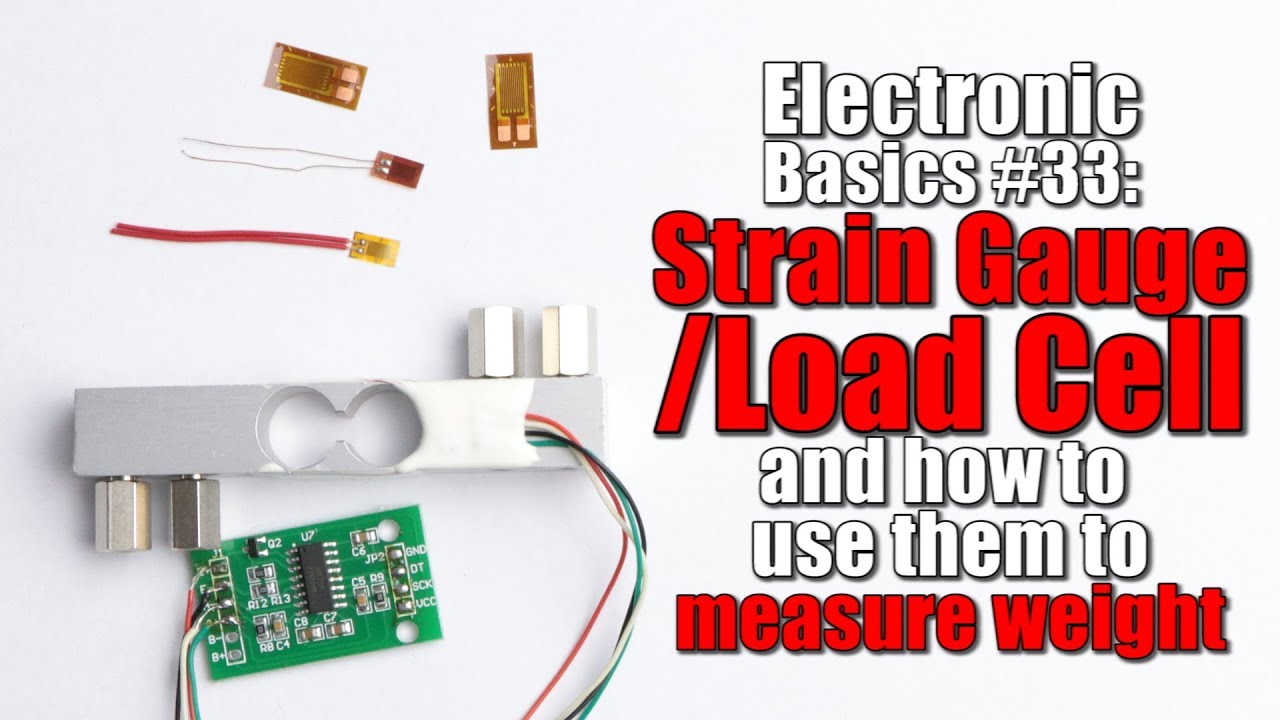
Electronic Basics #33: Strain Gauge/Load Cell and how to use them to measure weight
video description
Date: 2020-09-05
Related videos


• TED-Ed




Comments and reviews: 9
Charles
For the adventurous: You can make an instrumentation amplifier out of normal low noise op-amps, then use oversampling + dither to get > 10-bit depth out of the ATmega SAR ADC. Feeding the whetstone bridge with a well regulated source, as well as making sure to air float (dead bug) your instrumentation amp is critical. (At these levels, merely the ambient moisture in the air condensing and re-evaporating on a PCB can cause variations in output. Professional systems use guard rings for this reason)
reply
For the adventurous: You can make an instrumentation amplifier out of normal low noise op-amps, then use oversampling + dither to get > 10-bit depth out of the ATmega SAR ADC. Feeding the whetstone bridge with a well regulated source, as well as making sure to air float (dead bug) your instrumentation amp is critical. (At these levels, merely the ambient moisture in the air condensing and re-evaporating on a PCB can cause variations in output. Professional systems use guard rings for this reason)
reply
Mehmet
Hi, GreatScott!
Is it for measuring mass(kg) of an object? For vertical position we can determine weight(Newton) which is using formula G=mg. However which path i have to follow to measure horizontal force(for exp, positioning the load cell as verticak and pressing it along a horizontal axis)
Can you help me please?
reply
Hi, GreatScott!
Is it for measuring mass(kg) of an object? For vertical position we can determine weight(Newton) which is using formula G=mg. However which path i have to follow to measure horizontal force(for exp, positioning the load cell as verticak and pressing it along a horizontal axis)
Can you help me please?
reply
education
This is a very good video. Thanks for this. I'm using this cheap load cell that you showed. But in my project I found that to be temperature-dependent. Can you please help me out with a load cell that doesn't vary its values wrt temperatures between 10 deg C to 45 deg Celcius?
reply
This is a very good video. Thanks for this. I'm using this cheap load cell that you showed. But in my project I found that to be temperature-dependent. Can you please help me out with a load cell that doesn't vary its values wrt temperatures between 10 deg C to 45 deg Celcius?
reply
Ajit
If you find the following program in Arduino, if you call Sim900a, the bulb 1 should start only 2 seconds ON and when you call again the bulb 2 ON should start 2s.
Material.
1. Arduino
2. Sim900A
3. LED 1
4. LED2
reply
If you find the following program in Arduino, if you call Sim900a, the bulb 1 should start only 2 seconds ON and when you call again the bulb 2 ON should start 2s.
Material.
1. Arduino
2. Sim900A
3. LED 1
4. LED2
reply
M.
I would like to measure weights of small things using Arduino.
I would use servo with the weight sensor and Arduino.
Could you please help with the code and nameof the sensor.
Mossad. samahagmail. com
Thanks!
reply
I would like to measure weights of small things using Arduino.
I would use servo with the weight sensor and Arduino.
Could you please help with the code and nameof the sensor.
Mossad. samahagmail. com
Thanks!
reply
Weights&Measure
I'm a certified scale calibration technician and you hit every point right on the nose. Your video is awesome and u do a fantastic job explaining everything so simply. Thank you for the info on integration.
reply
I'm a certified scale calibration technician and you hit every point right on the nose. Your video is awesome and u do a fantastic job explaining everything so simply. Thank you for the info on integration.
reply
Dyso
Where would you add the second strain gauge? Would it be under the first one (stuck together) or would you put it somewhere where the temperature changes with the first one but the bending moment is kept constant?
reply
Where would you add the second strain gauge? Would it be under the first one (stuck together) or would you put it somewhere where the temperature changes with the first one but the bending moment is kept constant?
reply
Hybrid
Hi, I was wondering if there was a reason you picked the resistor value of 120 ohms for the wheatstone bridge, even though the strain gauge who used had a nominal resistance of 350 ohms?
reply
Hi, I was wondering if there was a reason you picked the resistor value of 120 ohms for the wheatstone bridge, even though the strain gauge who used had a nominal resistance of 350 ohms?
reply
Irfan
Hello now I'm doing my final project to make hang weighing scale. I want to ask, how to minimize the noise of loadcell to get more stable data reading? Please help me, thank you
reply
Hello now I'm doing my final project to make hang weighing scale. I want to ask, how to minimize the noise of loadcell to get more stable data reading? Please help me, thank you
reply
Add a review, comment
Other channel videos

 12:47
12:47