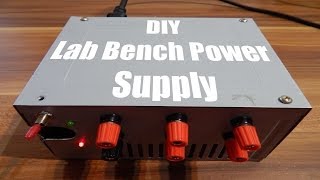
DIY Lab Bench Power Supply
video description
1. While the voltages here are low enough to not be lethal to human beings, the currents that the PSU can provide are dangerous. A typical ATX PSU can commonly provide 50A at the 12V output. That is enough to make any jumper wires, pcb-traces, breadboards, and maybe even proper cables into fuses. I. e. it will melt your circuit possibly causing a fire in the event of a short circuit. You say that the PSU has over-current protection, but that is very misleading when it is unlikely that you will reach the current levels necessary to trigger shutdown. It is likely that you will already have a big mess by then.
The whole idea of a Lab bench power supply is that it will be used with experimental circuits which may fail, and in that case a proper current limiting is very important. I think it is unfortunate no not bring this up. Besides, the issue could have been mostly solved by adding quick fuses of say 5-10A to the outputs. A simple measure to increase the safety by a lot.
2. Most lab bench power supplies have floating outputs, whereas Computer ATX PSUs have mains-earth-referenced outputs. While this is not a danger per se, I think it is something the viewers should be aware of. A earth referenced output means that the GND output of the PSU is connected to the chassis of all earthed devices in your lab. Again, the voltages are not lethal in this case, but the high currents can definitely cause fires or burns. This means that not only is any dodgy experimental circuit a potential fire hazard, but also any mains-earth-references device around you. The classic one is when probing around with an oscilloscope, which typically has its ground probes tied to mains earth.
I don't know if it is possible or safe to disconnect the ATX PSU ground from mains earth and make the PSU floating, and having a mains-earth-referenced PSU is not necessarily a bad thing. But it is significant enough to be mentioned in the video.
Date: 2020-09-05
Related videos





Comments and reviews: 9
funkylosik
5 years later, thanks: ) Couple of points:
- Green PS-On wire can be connected directly to the Ground, if you already have the switch on the side of PSU, as I did. One switch less.
- My 2 large capacitors are discharged automatically couple of seconds after i turn off the PSU. I've read that good design of good PSU has resistors on each capacitor to drain them. But short them with insulated screw-driver just to be sure.
- Soldering such thicc wires with 35W soldering iron is really hard. Almost a cold soldering. Better to split the wires in two and wrap them around your binding post, securing with nuts.
- My binding post inner core was all metal from the outside. Be sure to insulate it, otherwise it will touch the ground (case) and a short could appear.
- Take some really old PSU, preferably with a fan on the side, with more room inside. Chieftec had a huge fan on top, it took space inside, i had to be very careful with wires to fit everything.
reply
5 years later, thanks: ) Couple of points:
- Green PS-On wire can be connected directly to the Ground, if you already have the switch on the side of PSU, as I did. One switch less.
- My 2 large capacitors are discharged automatically couple of seconds after i turn off the PSU. I've read that good design of good PSU has resistors on each capacitor to drain them. But short them with insulated screw-driver just to be sure.
- Soldering such thicc wires with 35W soldering iron is really hard. Almost a cold soldering. Better to split the wires in two and wrap them around your binding post, securing with nuts.
- My binding post inner core was all metal from the outside. Be sure to insulate it, otherwise it will touch the ground (case) and a short could appear.
- Take some really old PSU, preferably with a fan on the side, with more room inside. Chieftec had a huge fan on top, it took space inside, i had to be very careful with wires to fit everything.
reply
education
Would be nice if you could make a simple schematic especially to clarify the point of how many wires and of what color you leave unsoldered from the bundle that goes on the posts and gets soldered elsewhere (led, dummy loads, etc) depending on the type of PSU. Everything else was clear except that. I have an older PSU that works but it does not have the label with all the amps, voltages and watts so I am stuck. Kannst du mir bitte helfen?
reply
Would be nice if you could make a simple schematic especially to clarify the point of how many wires and of what color you leave unsoldered from the bundle that goes on the posts and gets soldered elsewhere (led, dummy loads, etc) depending on the type of PSU. Everything else was clear except that. I have an older PSU that works but it does not have the label with all the amps, voltages and watts so I am stuck. Kannst du mir bitte helfen?
reply
Dillon
Wonderful video! I'm surprised that I hadn't watched this one yet.
One question:
What are the other color wires for? +5V SB? PW-OK? Just curious! Considering converting one of my old power supplies into a lab-bench supply after I'm finished replicating your variable lab-bench power supply: ) I just need to find the time in the coming weeks to convert the case on an old stereo.
reply
Wonderful video! I'm surprised that I hadn't watched this one yet.
One question:
What are the other color wires for? +5V SB? PW-OK? Just curious! Considering converting one of my old power supplies into a lab-bench supply after I'm finished replicating your variable lab-bench power supply: ) I just need to find the time in the coming weeks to convert the case on an old stereo.
reply
cri8tor
Confused about the load resistor. Most videos suggest connecting the load resistor to the rail with the highest amperage, but one video suggest the one with the highest wattage. On my PSU there is a +3. 3V, 22A and a +12V, 15A. Which one should get the load resistor and why? Cheers
reply
Confused about the load resistor. Most videos suggest connecting the load resistor to the rail with the highest amperage, but one video suggest the one with the highest wattage. On my PSU there is a +3. 3V, 22A and a +12V, 15A. Which one should get the load resistor and why? Cheers
reply
masio
I have a question: You were using a resistor for the supply that produces most current, for making it stable on the small load, so im guessing you need a current flow trought the wire to make a stable supply. how much load is needed for specific power supply?
reply
I have a question: You were using a resistor for the supply that produces most current, for making it stable on the small load, so im guessing you need a current flow trought the wire to make a stable supply. how much load is needed for specific power supply?
reply
Djebli
Good work
To protect the ATX again short circuit. It will be better to connect the Green wire (power on) to Relay contact with black wire. And to energize the relay with the 12 v or 5 v accorditly.
reply
Good work
To protect the ATX again short circuit. It will be better to connect the Green wire (power on) to Relay contact with black wire. And to energize the relay with the 12 v or 5 v accorditly.
reply
Donald
I have a atx power supply that will not take 6amps without turning it off then connecting the load then it works. if i dont turn it off before i connect the load it shuts down. any ideas?
reply
I have a atx power supply that will not take 6amps without turning it off then connecting the load then it works. if i dont turn it off before i connect the load it shuts down. any ideas?
reply
Ren
Thanks for this video! Also, what do I do with the tiny left wires? Gray, brown, black and jointed black and white? They are not the fans ones since the fans are already connected.
reply
Thanks for this video! Also, what do I do with the tiny left wires? Gray, brown, black and jointed black and white? They are not the fans ones since the fans are already connected.
reply
Abdul
Hey great Scott! I followed your steps andadey bench power supply but the 5 ohm 5watt resistor is getting really hot! Is it really required?
reply
Hey great Scott! I followed your steps andadey bench power supply but the 5 ohm 5watt resistor is getting really hot! Is it really required?
reply
Add a review, comment
Other channel videos