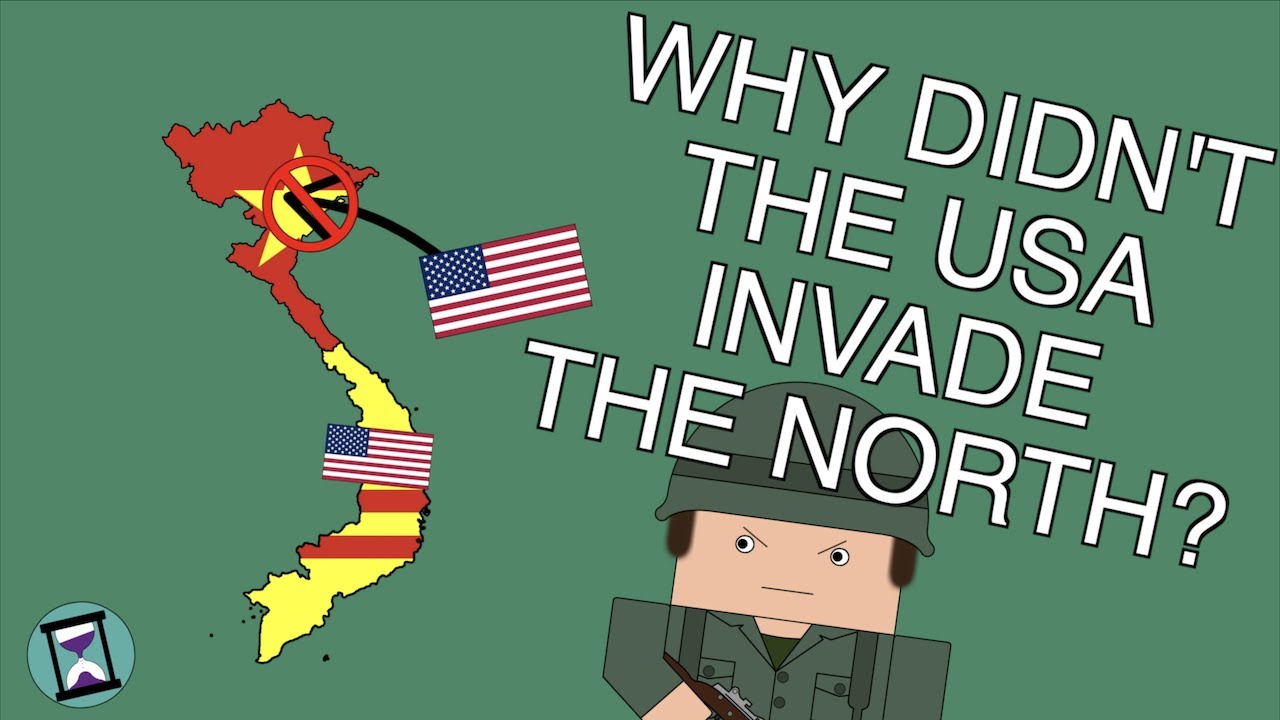
Why didn't the USA invade North Vietnam?
video description
2. It likely would've taken at least a million men to hold North Vietnam (and fight China while doing so)
3. In order to maintain domestic support for the war, the US government never sufficiently raised taxes to pay for it. This attempt to fight a guns and butter war would bite back in the '70s as the US faced an extended period of stagflation.
4. The US was pouring money into Japan and South Korea to procure raw material and maintain shipping lines. All this American money would fuel the Japanese miracle as the country experienced several decades of rapid economic growth. This would also blow back on the US when well-funded Japanese (and South Korean) companies began wiping out American corporations in the '70s and '80s with far superior products.
5. The US tried to use conscripted troops to wage a longterm war of occupation, something which would fan anti-war resistance back home. The reason the US would be able to carry out longterm occupations of Afghanistan and Iraq was because the country used an all volunteer military (i. e. a mercenary army of the poor and indebted) which meant the rest of the population not only didn't have to worry about being drafted, they didn't even have to think about the war.
Date: 2023-04-23
Related videos


Comments and reviews: 14
soviet
whats so weird to consider is that despite literally decades of american involvement directly against the vietnamese communist party, now vietnam is basically america's biggest asian ally short of japan. part of this is of course the enemy of my enemy is my friend and considering china has wanted vietnam to be under its control/influence since like the beginning of eastern society, its not surprising that the vietnamese would be willing to work with the more subtle influence of the americans. the States have been working to build an alliance in asia against chinese influence and considering vietnam is second on china's consume list (only being behind taiwan) any alliance to protect against the chinese expansionism is something vietnam was always going to join no matter who headed it.
also vietnam did what china had done and reformed its communism to be more capitalist and open allowing buisness in. we see many things that are now made in vietnam in the states due to manufacturing there, meaning there are relatively strong buissness ties in vietnam to the west. especially with many american buisnessman being less assured of chinese stability many have moved manufactering elsewhere, including vietnam
frankly its so interesting to consider that should war ever break out in asia we may very well see american and vietnamese soldiers fighting side by side, as veterans of the vietnam war are laughing at the irony.
reply
whats so weird to consider is that despite literally decades of american involvement directly against the vietnamese communist party, now vietnam is basically america's biggest asian ally short of japan. part of this is of course the enemy of my enemy is my friend and considering china has wanted vietnam to be under its control/influence since like the beginning of eastern society, its not surprising that the vietnamese would be willing to work with the more subtle influence of the americans. the States have been working to build an alliance in asia against chinese influence and considering vietnam is second on china's consume list (only being behind taiwan) any alliance to protect against the chinese expansionism is something vietnam was always going to join no matter who headed it.
also vietnam did what china had done and reformed its communism to be more capitalist and open allowing buisness in. we see many things that are now made in vietnam in the states due to manufacturing there, meaning there are relatively strong buissness ties in vietnam to the west. especially with many american buisnessman being less assured of chinese stability many have moved manufactering elsewhere, including vietnam
frankly its so interesting to consider that should war ever break out in asia we may very well see american and vietnamese soldiers fighting side by side, as veterans of the vietnam war are laughing at the irony.
reply
Andrew
You missed a couple of key points here. First, that the US was facing a serious morale problem. By the '70s a US infantry officer had to be wary of fire from both enemy troops and his own. Live grenades were starting to somehow find their way in to officers' tents (if you play video games, this is where the term fragging comes from. There is no way the US brass was not aware of this and the prospect of soldiers mutinying if ordered North would have made it look questionable to even try.
The second is that North Vietnam didn't invade the South until the South declined to hold the agreed-upon referendum for unification due to (as mentioned) the view many Vietnamese had towards communism. The South Vietnamese leadership dragged their feet on this until eventually the US decided that wasn't good enough and did what it so often did in the Cold War and orchestrated a coup to install a murderous, fanatically anticommunist dictatorship. That ended any possibility of peaceful unification.
reply
You missed a couple of key points here. First, that the US was facing a serious morale problem. By the '70s a US infantry officer had to be wary of fire from both enemy troops and his own. Live grenades were starting to somehow find their way in to officers' tents (if you play video games, this is where the term fragging comes from. There is no way the US brass was not aware of this and the prospect of soldiers mutinying if ordered North would have made it look questionable to even try.
The second is that North Vietnam didn't invade the South until the South declined to hold the agreed-upon referendum for unification due to (as mentioned) the view many Vietnamese had towards communism. The South Vietnamese leadership dragged their feet on this until eventually the US decided that wasn't good enough and did what it so often did in the Cold War and orchestrated a coup to install a murderous, fanatically anticommunist dictatorship. That ended any possibility of peaceful unification.
reply
Hieu
You failed to mention that the division between North and south after the Geneva convention was supposed to be temporary, and the two parts of Viet Nam was supposed to be united by an election. The south with US backing realized that there is no way they could win against Ho Chi Minh and so they oppressed anyone open minded towards an election, furthermore, they enacted a brutal killing system where you could be killed just on the suspicion or accusation of being a communist. This repression caused outrage in the south, but since communist leaders were still pursuing a diplomatic solution to get an election, the strategy for southerners was to avoid confrontation with the Sai Gon government. The north after realizing that the country could end up like Korea or Germany, decided to approve armed uprising to overthrow the puppet government in the south, which results in the Uprising movement that gave birth to the Liberation Front (the half red half blue flag.
reply
You failed to mention that the division between North and south after the Geneva convention was supposed to be temporary, and the two parts of Viet Nam was supposed to be united by an election. The south with US backing realized that there is no way they could win against Ho Chi Minh and so they oppressed anyone open minded towards an election, furthermore, they enacted a brutal killing system where you could be killed just on the suspicion or accusation of being a communist. This repression caused outrage in the south, but since communist leaders were still pursuing a diplomatic solution to get an election, the strategy for southerners was to avoid confrontation with the Sai Gon government. The north after realizing that the country could end up like Korea or Germany, decided to approve armed uprising to overthrow the puppet government in the south, which results in the Uprising movement that gave birth to the Liberation Front (the half red half blue flag.
reply
Paul
In my opinion, the reason America never conquered North Vietnam, is because the US government DIDN'T formally declare war on North Vietnam. Without this declaration, any aggressive action in North Vietnam could potentially be perceived, legally as a war crime, because the authority to declare war lies solely in the hands of congress, not the president. That being said, I believe the conflict was prosecuted illegally by sending the US army to intervene militarily in Vietnam, absent a declaration of war from congress. P. S. This is also why American POW camps in North Vietnam were so atrocious (or thats the convenient excuse, because the North didn't see them as enemy combatants, but rather as war criminals.
reply
In my opinion, the reason America never conquered North Vietnam, is because the US government DIDN'T formally declare war on North Vietnam. Without this declaration, any aggressive action in North Vietnam could potentially be perceived, legally as a war crime, because the authority to declare war lies solely in the hands of congress, not the president. That being said, I believe the conflict was prosecuted illegally by sending the US army to intervene militarily in Vietnam, absent a declaration of war from congress. P. S. This is also why American POW camps in North Vietnam were so atrocious (or thats the convenient excuse, because the North didn't see them as enemy combatants, but rather as war criminals.
reply
The
Because the same thing that would have happened during the korean war would have happened: China would have flooded across the border like crazy. Only this time they had nukes and NATO alliances would have been forced to start world war 3.
This is why i take issue with the idea that the US Lost vietnam: The point was never to invade north vietnam or even to protect south vietnam, it was to slow the spread (rapid in the late 50s early 60s) of communism in asia. Thats why indonesia and australia arent communist today. To give the CIA time to prevent democracy and for diplomats to form alliances. The point was never to save vietnam itself, but to prevent it becoming a base for the next big step.
reply
Because the same thing that would have happened during the korean war would have happened: China would have flooded across the border like crazy. Only this time they had nukes and NATO alliances would have been forced to start world war 3.
This is why i take issue with the idea that the US Lost vietnam: The point was never to invade north vietnam or even to protect south vietnam, it was to slow the spread (rapid in the late 50s early 60s) of communism in asia. Thats why indonesia and australia arent communist today. To give the CIA time to prevent democracy and for diplomats to form alliances. The point was never to save vietnam itself, but to prevent it becoming a base for the next big step.
reply
sharpshooter13ify
It also didn t help that as the war dragged on interference from DC meant that there was never any serious push to stop the north from sending forces into the south. A prime example being operation rolling thunder which on paper was supposed to deprive the north of manpower and the ability to supply its forces, but thanks to politicians in DC the operation was not only limited to targets of low importance but was paused on multiple occasions with the hope the north would be intimidated into surrender when in reality as far as the north Vietnamese we re concerned they were fighting a tyrannical imperialist power trying to assert control over them.
reply
It also didn t help that as the war dragged on interference from DC meant that there was never any serious push to stop the north from sending forces into the south. A prime example being operation rolling thunder which on paper was supposed to deprive the north of manpower and the ability to supply its forces, but thanks to politicians in DC the operation was not only limited to targets of low importance but was paused on multiple occasions with the hope the north would be intimidated into surrender when in reality as far as the north Vietnamese we re concerned they were fighting a tyrannical imperialist power trying to assert control over them.
reply
Nguyen
Fun fact: After the war, Vietnam wanted to form an Indochina Federation under Vietnamese' rules so later we installed a puppet government in Laos and did the same to Cambodia so we could easily control them.
But then Pol Pot turned out to be a psychopath so we had to got rid of him and liberated Cambodia by force. Then, China attacked us and the US sanctioned us because we invaded Cambodia. Because of that, we have to stop our dream of having a Greater Vietnam. What a shame
I mean, we treated our minorities very well. Laotians and Cambodians would be considered important minorities in the new country.
reply
Fun fact: After the war, Vietnam wanted to form an Indochina Federation under Vietnamese' rules so later we installed a puppet government in Laos and did the same to Cambodia so we could easily control them.
But then Pol Pot turned out to be a psychopath so we had to got rid of him and liberated Cambodia by force. Then, China attacked us and the US sanctioned us because we invaded Cambodia. Because of that, we have to stop our dream of having a Greater Vietnam. What a shame
I mean, we treated our minorities very well. Laotians and Cambodians would be considered important minorities in the new country.
reply
Jeff
The end of the Vietnam war was a bit more complicated. The US agreed to pull its troops out largely because its Vietnamization strategy had been successful. In 1974 North Vietnam launched an attack against the South that was repulsed with no more American involvement beyond air support and boatloads of supply. But 1974 was an election year and in the wake of Watergate a large number of far-Left Democrats were elected. One of their first priorities was to bar any further aid to South Vietnam, so the North's 1975 invasion was much more successful than the one the year before.
reply
The end of the Vietnam war was a bit more complicated. The US agreed to pull its troops out largely because its Vietnamization strategy had been successful. In 1974 North Vietnam launched an attack against the South that was repulsed with no more American involvement beyond air support and boatloads of supply. But 1974 was an election year and in the wake of Watergate a large number of far-Left Democrats were elected. One of their first priorities was to bar any further aid to South Vietnam, so the North's 1975 invasion was much more successful than the one the year before.
reply
Just
So, the country was united under one flag (North Vietnamese, and everything was over, but fun fact: No.
Although the communist did took control of Vietnam, and USA evacuated the country, China invaded anyway (multiple times) and every time had their bottoms (PLA) handed down by Vietnams army every time. While the US did not wanted to hurt the feelings of the Chinese people (a rhetoric CCP used cca 100k and still uses to this day) there was no way to gloss over the fact that both CCP & PLA were enormously incompetent back then
reply
So, the country was united under one flag (North Vietnamese, and everything was over, but fun fact: No.
Although the communist did took control of Vietnam, and USA evacuated the country, China invaded anyway (multiple times) and every time had their bottoms (PLA) handed down by Vietnams army every time. While the US did not wanted to hurt the feelings of the Chinese people (a rhetoric CCP used cca 100k and still uses to this day) there was no way to gloss over the fact that both CCP & PLA were enormously incompetent back then
reply
coolawesomeepicman
Ironic enough Ho Chi Minh was actually present at the Treaty of Versailles to try and represent Vietnamese independence. He was denied entry via Woodrow Wilson and left by train back to Vietnam, which took him through the Soviet Union where he read the manifesto and met Vladimir Lenin. What s even more crazy is Ho Chi Minh lived in Harlem New York for a short time and attended UNIA meetings, A Pan-African movement. This dude also did all of this in his mid 20s and 30s.
reply
Ironic enough Ho Chi Minh was actually present at the Treaty of Versailles to try and represent Vietnamese independence. He was denied entry via Woodrow Wilson and left by train back to Vietnam, which took him through the Soviet Union where he read the manifesto and met Vladimir Lenin. What s even more crazy is Ho Chi Minh lived in Harlem New York for a short time and attended UNIA meetings, A Pan-African movement. This dude also did all of this in his mid 20s and 30s.
reply
education
Some small errors:
- Ho Chi Minh died in 1969, so he should be somewhat transparent here in 3: 03.
- You missed out the Phu Quoc, a large island off the southwestern coast.
- South Vietnamese-controlled Paracel and parts of Spratly islands should be included. China invaded the whole of Paracel in 1974, but since it was under the South's control and China was helping the North, North Vietnam couldn't even protest until the relationship fell out 5 years later.
reply
Some small errors:
- Ho Chi Minh died in 1969, so he should be somewhat transparent here in 3: 03.
- You missed out the Phu Quoc, a large island off the southwestern coast.
- South Vietnamese-controlled Paracel and parts of Spratly islands should be included. China invaded the whole of Paracel in 1974, but since it was under the South's control and China was helping the North, North Vietnam couldn't even protest until the relationship fell out 5 years later.
reply
David
I'm surprised James Bissonette did not immediately step in and point out the final big reason: the U. S. couldn't afford to do an invasion. The war had already almost collapsed the economy once (first run on the dollar, and American military resources were stretched thinly as it was --still guarding the 38th Parallel in Korea, , still maintaining a nuclear-based defensive posture around Taiwan, and still (as ever) worried about a move against West Berlin.
reply
I'm surprised James Bissonette did not immediately step in and point out the final big reason: the U. S. couldn't afford to do an invasion. The war had already almost collapsed the economy once (first run on the dollar, and American military resources were stretched thinly as it was --still guarding the 38th Parallel in Korea, , still maintaining a nuclear-based defensive posture around Taiwan, and still (as ever) worried about a move against West Berlin.
reply
chaosXpert
The US plan to simply sit in the South and hope that North Vietnam would eventually give up was extremely flawed. The US was never going to win the war with that as their strategy. In addition, the South Vietnamese government was made up of a lot of the old royal ruling class the most Vietnamese wanted to get rid of. You can't promote corrupt governments and hope to win over the local population. It's the same reason the US lost in Afghanistan.
reply
The US plan to simply sit in the South and hope that North Vietnam would eventually give up was extremely flawed. The US was never going to win the war with that as their strategy. In addition, the South Vietnamese government was made up of a lot of the old royal ruling class the most Vietnamese wanted to get rid of. You can't promote corrupt governments and hope to win over the local population. It's the same reason the US lost in Afghanistan.
reply
Slew
We divided the Vietnam, even before WW2 ended. We realize the French was too weak, and didn't really liked the French because we weren't sure of treating them as an ally. So we made a deal with CHina and England. China occupies the North, and England the SOuth. This was before we knew China would end up being communist though. This didn't happen, because as soon as the war ended, ROC couldn't hold their own country, much less Vietnam.
reply
We divided the Vietnam, even before WW2 ended. We realize the French was too weak, and didn't really liked the French because we weren't sure of treating them as an ally. So we made a deal with CHina and England. China occupies the North, and England the SOuth. This was before we knew China would end up being communist though. This didn't happen, because as soon as the war ended, ROC couldn't hold their own country, much less Vietnam.
reply
Add a review, comment
Other channel videos