4 Interview Puzzles That Will Test Your Brain Power
video description
Date: 2024-12-02
Related videos




Comments and reviews: 7
hikari1690
Hmmm, for the final puzzle, does the competition have a limit on number of shots For now I just calculated:
100/16 = 6 remainder 4 which means replacing 4 of 16 with 17 you can get 2x 16 and 4x 17.
But I'm unsure if this is the only solution nor am I sure if this solution is the most efficient.
What if the rules say less than 5 shots
I mean I can do 16i 17j 23k 24l 39m 40n and try all combinations such that i j k l m n 6 but I hope there's a neat trick in the next video or I'll be sad!
reply
Hmmm, for the final puzzle, does the competition have a limit on number of shots For now I just calculated:
100/16 = 6 remainder 4 which means replacing 4 of 16 with 17 you can get 2x 16 and 4x 17.
But I'm unsure if this is the only solution nor am I sure if this solution is the most efficient.
What if the rules say less than 5 shots
I mean I can do 16i 17j 23k 24l 39m 40n and try all combinations such that i j k l m n 6 but I hope there's a neat trick in the next video or I'll be sad!
reply
thatreilyrandomguy
Final question: Answer is 4x17 and 2x16. First I realised that 40 was useless because it can be made up from 16 and 24 so if it's a solution theres also a solution without it so no point including 40. 39 also seemed suspicious. I tried just using 16s at first but came up with 96. I thought about replacing 1 with a 24 but that was too much. Then I realised I could swap 4 16s with 17 to gain 4 on the total.
reply
Final question: Answer is 4x17 and 2x16. First I realised that 40 was useless because it can be made up from 16 and 24 so if it's a solution theres also a solution without it so no point including 40. 39 also seemed suspicious. I tried just using 16s at first but came up with 96. I thought about replacing 1 with a 24 but that was too much. Then I realised I could swap 4 16s with 17 to gain 4 on the total.
reply
DeepeshMaan
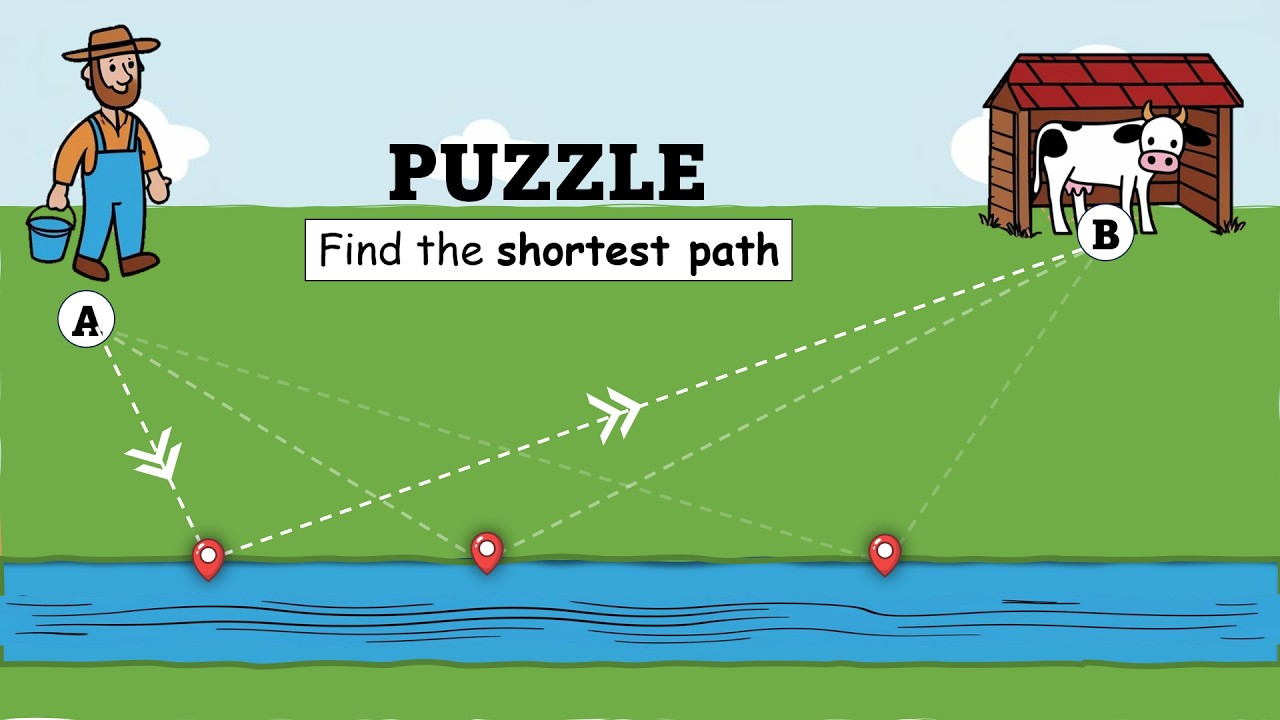
The first problem is analogous to the law of reflection of light, represented as n1 sin(i) = n2 sin(r, where n1 and n2 are proportional to the speed of the entity (in this case, the farmer) in the respective mediums. Since both mediums are identical (n1 = n2, the equation simplifies to i = r, which corresponds to moving in a straight line if the boundary between the two mediums is crossed.
reply
The first problem is analogous to the law of reflection of light, represented as n1 sin(i) = n2 sin(r, where n1 and n2 are proportional to the speed of the entity (in this case, the farmer) in the respective mediums. Since both mediums are identical (n1 = n2, the equation simplifies to i = r, which corresponds to moving in a straight line if the boundary between the two mediums is crossed.
reply
akashramkamal7539
I think there are two solutions for the 2nd question. One is aligning the point A in the path of the straight line and another is aligning B in the path of the straight line in between X and Y
Edit: There is also a third solution where you align the midpoint of AB on the straight line in between X and Y
reply
I think there are two solutions for the 2nd question. One is aligning the point A in the path of the straight line and another is aligning B in the path of the straight line in between X and Y
Edit: There is also a third solution where you align the midpoint of AB on the straight line in between X and Y
reply
ajishjohn2872
Out of the box thinking for 1st question:
Although the shortest distance must be the one mentioned, a logical answer would be the one wherein he has to carry the water for the least amount of time, reducing the total effort.
Coz his speed would reduce once he has the water
reply
Out of the box thinking for 1st question:
Although the shortest distance must be the one mentioned, a logical answer would be the one wherein he has to carry the water for the least amount of time, reducing the total effort.
Coz his speed would reduce once he has the water
reply
vaibhavsharma7630
Last question answer could be 2 x 40 and one arrow between 17 and 23. That would give us a total of 100 with minimum number of arrows.
16x4 and 17x2 participant will lose because she would have won in the first 3 rounds only.
reply
Last question answer could be 2 x 40 and one arrow between 17 and 23. That would give us a total of 100 with minimum number of arrows.
16x4 and 17x2 participant will lose because she would have won in the first 3 rounds only.
reply
yaduvarma9854
For the last question - I divided 100 with the shortest number which was 16 - I got 6 with 4 as remainder.
So I replaced 4 of those 16s with 17 and that was the answer.
reply
For the last question - I divided 100 with the shortest number which was 16 - I got 6 with 4 as remainder.
So I replaced 4 of those 16s with 17 and that was the answer.
reply
Add a review, comment
Other channel videos